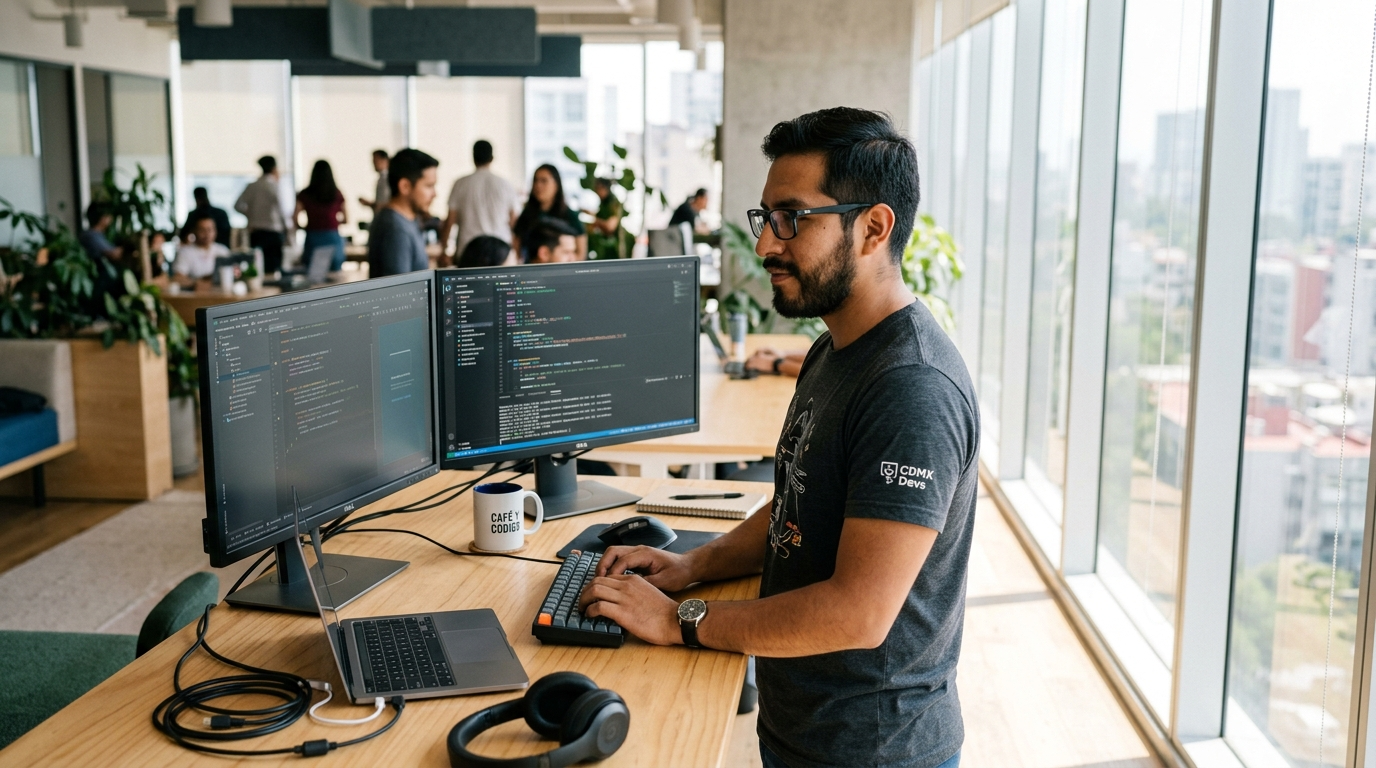
Why Nearshore AI and Android Talent in Mexico Is the 2026 Default
Nearshore hiring from Mexico and Latin America has crossed a tipping point. If you run a US, Canadian, or UK business and you need to hire AI developers or Android app developers without burning six figures on a domestic salary, nearshore Mexico is no longer a "maybe" — it is the default move for founders and operators who've done the math. The combination of overlapping business hours, strong English fluency, and a maturing technical talent pipeline makes nearshore Latin America stand out from every other global hiring option on the table right now.
Mexico alone graduated over 130,000 engineering and technology students in a single academic year, according to INEGI, Mexico's National Institute of Statistics (2023). That pipeline feeds directly into the AI, mobile, and full-stack developer market that US startups and SMBs are tapping today. And unlike hiring from regions 8 to 12 hours away, nearshore developers in Mexico and the broader LatAm region work your hours — no massive time-zone lag, no asynchronous bottlenecks, no 48-hour turnaround on a one-line Slack question.
This post is a practical guide for business owners evaluating nearshore AI and Android app developer hiring in 2026. We cover what "nearshore" actually means, how to compare your options, what a flat-rate staffing model looks like in practice, and how to avoid the mistakes that make technical hiring expensive and slow.
What Is a Nearshore AI Developer? (2026 Definition)
A nearshore AI developer is a software professional based in a geographically proximate country — for US companies, that typically means Mexico, Colombia, Argentina, Brazil, or another Latin American nation — who works within 0 to 3 hours of US Eastern Time. "AI developer" in this context covers professionals who build, fine-tune, or integrate machine learning models, large language model (LLM) pipelines, computer vision systems, and AI-powered application features. They are distinct from data scientists (who primarily analyze) and DevOps engineers (who deploy) — though many nearshore developers span all three disciplines.
An Android app developer, by contrast, specializes in building mobile applications for Android devices using languages like Kotlin or Java, frameworks like Jetpack Compose, and tools like Android Studio. In 2026, the line between AI developer and Android developer is increasingly blurred: most competitive Android apps ship with on-device AI features — think real-time translation, smart search, or personalized recommendations — so many nearshore hires do both.
If you want to understand the broader landscape of where nearshore fits against other staffing models, our detailed breakdown of nearshore vs offshore vs onshore virtual assistant hiring covers the full comparison with real cost data.
How Nearshore vs Offshore vs Onshore Hiring Compares in 2026
The single biggest mistake US companies make when hiring technical talent is treating "offshore" and "nearshore" as synonyms. They are not. Offshore typically means distant regions in South or Southeast Asia with 8-to-13-hour time differences from US Eastern Time. Nearshore means Latin America — same or near-identical business hours, same cultural touchpoints, real-time collaboration by default.
| Hiring Model | Typical Cost (Full-Time) | Timezone Overlap (US ET) | English Fluency | Avg. Ramp Time |
|---|---|---|---|---|
| Onshore (US) | $8,000–$15,000/mo fully loaded | Full overlap | Native | 2–4 weeks |
| Nearshore (Mexico/LatAm) | $2,500–$4,500/mo | 0–3 hrs difference | Strong (8/10+ screened) | 1–2 weeks |
| Offshore (distant regions, 8–13 hr gap) | $1,200–$3,000/mo | 8–13 hrs difference | Variable (4–7/10) | 3–6 weeks |
| Freelance Marketplace | $1,500–$6,000/mo (variable) | Variable / unpredictable | Variable | 2–5 weeks |
The cost gap between onshore and nearshore is not marginal. According to the U.S. Bureau of Labor Statistics Occupational Employment Statistics (2023), the median annual wage for software developers in the US is $132,270 — roughly $11,000 per month before benefits, taxes, and overhead. Nearshore developers through a flat-rate staffing model come in at a fraction of that cost, with recruiting, vetting, payroll, and HR already bundled in.
How Rose Talent Solutions Places AI and Android Developers in 2026
Rose Talent Solutions operates as a nearshore staffing agency focused exclusively on Latin America — not a freelance marketplace, not a job board. When you engage Rose, you get a fully vetted, full-time team member based in Latin America who works your business hours, communicates in fluent English (screened at 8/10 or above on Rose's proficiency scale), and ships with a role-specific AI copilot trained on the tools your team actually uses — whether that's Android Studio, TensorFlow, Firebase, or a project management stack like Jira and Linear.
The pricing is $2,500 per month, flat. That covers recruiting, vetting, payroll, HR compliance, and ongoing management. There is no long-term contract — you stay month-to-month and cancel with 30 days written notice. If the team member isn't a fit, Rose replaces them at no additional cost. That's the only risk reversal on offer — and for most clients, it's all they need.
Intake & Role Scoping
Rose's team spends 30–60 minutes understanding your technical stack, team workflow, and the specific AI or Android competencies you need. This brief drives the entire candidate search.
Candidate Sourcing & Vetting
Rose sources from its Latin America network, screens for English fluency (8/10+ floor), technical skills, and cultural fit with US-based teams. Only pre-vetted candidates reach your inbox.
Your Interview & Selection
You interview the shortlisted candidates and make the final call. You're not assigned someone — you choose your team member.
Onboarding with AI Copilot
Your new developer onboards with a role-specific AI copilot pre-configured for your tools, cutting ramp time significantly compared to a cold hire.
Ongoing HR & Management Support
Rose handles payroll, compliance, and performance monitoring on the back end, so you manage the work — not the HR administration.
What Skills Do Nearshore AI and Android Developers in Mexico Actually Bring?
The technical skill set of Mexican and LatAm developers has matured significantly. In AI development, nearshore professionals commonly work with Python, PyTorch, TensorFlow, LangChain, OpenAI API integrations, Hugging Face model deployment, and RAG (retrieval-augmented generation) pipelines. In Android development, the standard toolkit includes Kotlin, Jetpack Compose, Retrofit, Room database, Firebase, and Google Play Console management. Many senior nearshore developers hold certifications from Google, AWS, or Meta's developer programs.
"Latin America has become one of the fastest-growing regions for technology talent globally. The combination of improving university infrastructure, English adoption, and US-aligned work culture makes the region uniquely positioned for nearshore software development." — Agustín Fabre, CEO at Workana, the largest Latin American freelance marketplace (2023)
According to Coursera's Global Skills Report (2023), Latin America ranks among the top-improving regions globally in technology and data science skill proficiency, with Brazil, Mexico, and Colombia leading the continent. This is not anecdotal — it's a measurable, tracked trend across millions of learners.

The hidden cost of distant offshore AI development isn't the hourly rate — it's the 8-to-13-hour timezone gap that turns every code review, bug escalation, and stakeholder question into a next-day event. Over a 6-month sprint cycle, that delay compounds into weeks of lost velocity that never show up on an invoice but absolutely show up in your product roadmap.
If you're still weighing the full spectrum of options — including whether a more distant staffing model might still work for your use case — our post on the real tradeoffs between onshore and offshore hiring lays out the decision framework clearly. For most US product teams shipping mobile or AI features in 2026, nearshore Latin America wins on net.
How the AI Copilot Advantage Accelerates Nearshore Developer Ramp in 2026
One feature that separates Rose's model from a standard staffing agency is the role-specific AI copilot that ships with every placed team member. For an Android developer, that means a copilot pre-trained on Android Studio workflows, Google Play submission processes, Jetpack Compose patterns, and your specific project's codebase documentation. For an AI developer, it means a copilot configured with your LLM stack, API schemas, and preferred prompt engineering conventions.
The practical result: your new hire isn't starting from a blank slate. They arrive with institutional context baked in, and the copilot surfaces the right answers to common workflow questions without needing to pull a senior engineer away from deep work. According to McKinsey's report on the economic potential of generative AI (2023), AI coding tools can improve software developer productivity by 35–45% on repetitive coding tasks — a number that compounds when the developer is already strong and just needs context, not capability.
You can explore the full scope of what the AI advantage includes on the Rose AI Advantage page, including how copilots are configured per role and what the onboarding process looks like technically. For businesses that also need support on the operational and financial side, Rose also staffs nearshore bookkeeping and accounting roles — useful context if you're building out a broader remote operations team.
Pros and Cons of Hiring Nearshore AI Developers in Latin America in 2026
No hiring model is perfect for every company. Here is an honest assessment of what nearshore AI and Android developer hiring from Latin America delivers — and where it has real constraints.
Pros
- Same-timezone collaboration (0–3 hrs from US ET) — real-time standups, reviews, and escalations
- Significantly lower cost than US or Canadian domestic hires
- English fluency screened and verified before placement
- Strong and growing technical talent pipeline in Mexico and broader LatAm
- No long-term contract — month-to-month terms with 30 days written notice
- AI copilot reduces ramp time and institutional knowledge gaps
- Cultural alignment with US work norms and communication styles
Cons
- Top-tier senior engineers with 10+ years of niche AI specialization may still command closer-to-onshore rates
- Not suitable if your role legally requires US residency or security clearance
- Requires you to manage the work itself — Rose handles HR, not your sprint backlog
- Smaller talent pool for ultra-niche subfields (e.g., robotics ML, defense AI) compared to US market
For most US SMBs, startups, and mid-market companies building consumer-facing mobile apps or integrating AI into existing products, the pros outweigh the cons by a wide margin. The companies that struggle with nearshore hiring are almost always the ones who treat it like a purely asynchronous, ticket-based vendor relationship. Nearshore works because you treat the developer like a member of your team, not a distant resource.
Our comprehensive resource on hiring virtual staff from Latin America covers the cultural and operational nuances that make nearshore engagement successful — including communication cadence, onboarding best practices, and what "fluent English" actually looks like in a technical context. And if you're comparing specific agencies, our post reviewing virtual assistant and staffing companies operating across Latin America gives you a framework for evaluating vendors beyond the marketing copy.
The Latin American developer market is also growing faster than most US hiring managers realize. According to Statista's Latin America IT Services Market data (2023), the regional IT services market is projected to exceed $60 billion by 2026, driven largely by nearshore demand from North American enterprises. That growth is pulling more engineering talent into the workforce and raising the bar on training and certification standards across the board.
When you're ready to move from research to placement, the fastest path is to start your Rose intake process here — the team will scope your role and begin sourcing within 24 hours of your brief.