
Nearshore accounting talent from Latin America has become one of the most practical hiring decisions a US or Canadian business can make in 2026. You get full-time, English-fluent accountants who work your business hours, understand North American accounting standards, and cost a fraction of what a local hire runs — without the double-digit timezone gap that makes distant offshore hiring so operationally painful. This guide walks you through exactly how to hire accountants in Latin America, what it actually costs, and where most businesses get it wrong.
Why Businesses Are Choosing to Hire Accountants in Latin America in 2026
The US is facing a genuine accounting talent shortage. The number of accountants and auditors in the US workforce declined by 17% between 2019 and 2023, according to the U.S. Bureau of Labor Statistics (2024). At the same time, the median annual salary for a staff accountant in the US hit $79,880 in 2023 — and that number climbs fast when you add benefits, payroll taxes, and recruiting overhead. Many small and mid-sized businesses simply cannot compete for that talent locally.
Latin America fills that gap in a way that more distant offshore regions cannot replicate. Countries like Colombia, Mexico, and Argentina share time zones with the continental US — Colombia is ET, Mexico spans CT and MT, Argentina runs ET+1. Universities across the region graduate tens of thousands of accounting and finance professionals every year, many of whom are trained on the same software stacks US companies use: QuickBooks, Xero, NetSuite, and SAP. English fluency in professional graduate programs is high and rising — a pattern documented in British Council research on English proficiency in Latin America (2023).
If you want a deeper look at how nearshore compares to other hiring models, the complete nearshore vs. offshore vs. onshore virtual assistant comparison breaks down the tradeoffs across timezone, cost, and communication quality in detail.
What Does "Nearshore Accountant" Actually Mean?
A nearshore accountant is a finance professional based in a country geographically and culturally close to the client's home market — in this context, Latin America serving the US, Canada, or UK. Unlike distant offshore outsourcing, nearshore talent works in overlapping or identical time zones, communicates in real-time during the client's business day, and operates within a cultural context closer to North American business norms.
Nearshore is not a synonym for "cheap." It describes a staffing model built on proximity and alignment — not just cost arbitrage. The best nearshore accountants in Latin America hold recognized credentials (CPA equivalents, degrees from AACSB-accredited programs), speak English at a professional level, and work inside the same communication rhythms as your domestic team.

How the Real Cost of Hiring an Accountant in Latin America Compares in 2026
Cost is usually the first question. Here is what the numbers actually look like across three hiring models for a full-time accounting role:
| Hiring Model | Typical Monthly Cost | Timezone Overlap (US ET) | English Proficiency | Tool Readiness |
|---|---|---|---|---|
| Onshore (US staff accountant) | $6,500–$9,000+ | Full overlap | Native | High |
| Nearshore Latin America (via Rose) | $2,500 flat, all-in | Full overlap (same TZ) | 8/10+ screened | High (AI copilot included) |
| Offshore (distant time zones) | $1,200–$2,000 | 10–13 hr gap | Moderate (varies widely) | Moderate (tool training required) |
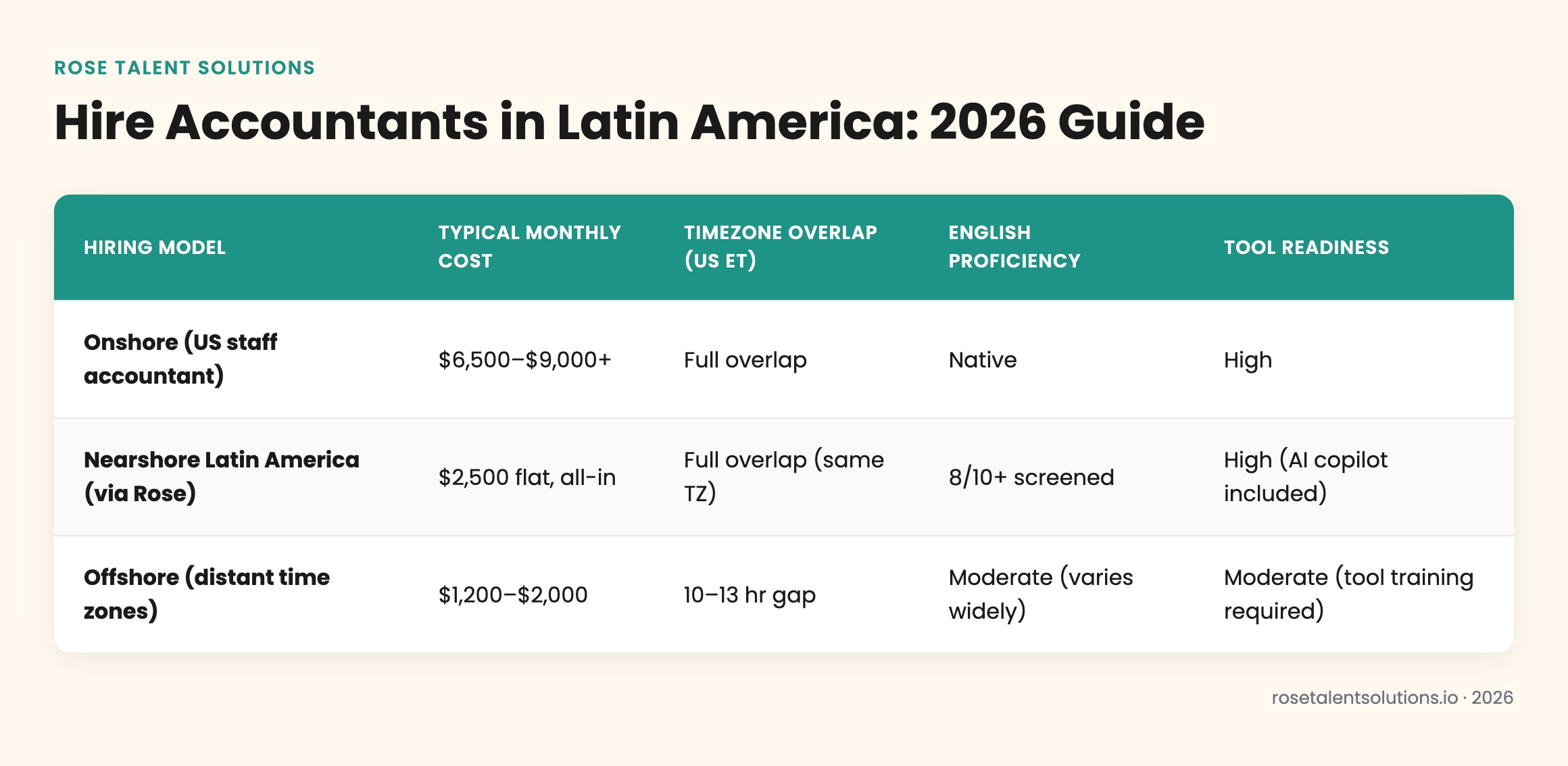
The nearshore model sits at a compelling middle ground: you pay roughly 30–40 cents on the dollar compared to a domestic hire, but you do not sacrifice same-day communication or software competency. Rose's flat $2,500/month rate covers recruiting, vetting, payroll, HR, and ongoing management — there is no hidden per-hour billing or surprise fees at month-end.
For a broader look at how Latin America staffing agencies structure these engagements, the guide to working with a Latin America staffing agency covers what to expect from the recruitment and onboarding process end to end.
How Rose Talent Solutions Vets and Places Accounting Hires in 2026
Not every agency that claims to place Latin American accountants runs the same process. Here is how Rose's placement works, from first conversation to your accountant's first day:
Role scoping call
Rose's team maps your accounting workflows — AR/AP, reconciliations, payroll support, reporting — and identifies the specific software you use so the match is precise, not generic.
Candidate sourcing and vetting
Every candidate is screened for English proficiency (8/10+ floor), accounting credentials, and software fluency. Rose runs live skills assessments — not just resume reviews.
Client interview and selection
You interview your top matches and choose who you want. You are not assigned a candidate; you pick one.
AI copilot activation
Your new team member gets a role-specific AI copilot trained on their software stack — QuickBooks, Xero, NetSuite, or whichever tools your business runs. This cuts ramp time significantly.
Ongoing management and HR
Rose handles payroll, HR issues, and performance oversight. If the hire isn't a fit, Rose replaces them at no additional cost — that is the full risk reversal on offer.
This end-to-end model is what separates a managed staffing agency from a freelance marketplace. You are not project-managing a contractor — you are getting a full-time team member with infrastructure behind them. Learn more about how the AI copilot advantage works for accounting and finance roles.
What Tasks Can a Latin American Accountant Handle for Your Business?
The scope of work depends on the candidate's experience level, but most nearshore accountants placed through Rose cover a substantial portion of a typical small-to-mid business finance function. According to SHRM's talent acquisition research (2023), businesses that outsource back-office finance functions report freeing up an average of 12+ hours of owner or executive time per week.
Common accounting tasks handled by nearshore Latin American hires include:
- Accounts payable and receivable management
- Bank and credit card reconciliations
- Month-end close support
- Payroll processing coordination
- Financial reporting and dashboard maintenance
- QuickBooks, Xero, or NetSuite data entry and cleanup
- Vendor and contractor payment management
- Expense categorization and audit prep support
For businesses in real estate and property management specifically, nearshore accountants often work alongside property management software like AppFolio or Buildium. Rose's bookkeeping and accounting virtual assistant service is specifically designed for these hybrid roles where accounting meets property operations.

"Remote work has permanently shifted where talent can be sourced from. Latin America has emerged as the most compelling nearshore market for US finance and accounting roles — the combination of timezone alignment, credential quality, and cost is genuinely hard to beat." — Guillermo Bravo, VP of Finance Operations at Deel (2024)
How to Avoid the Most Common Mistakes When You Hire an Accountant in Latin America
Most hiring mistakes in this category come down to three problems: hiring on price alone, skipping the vetting process, and misunderstanding what "managed" means.
The cheapest Latin American accountant is rarely the best value. If an agency is not screening for English proficiency, software competency, and accounting credentials independently — you are doing that vetting yourself, after the hire starts, at your own expense.
Mistake 1: Hiring from a freelance marketplace without vetting infrastructure. Platforms like Upwork or Freelancer give you access to Latin American talent, but you are responsible for screening, onboarding, payroll compliance, and replacing bad fits. A managed agency like Rose handles all of that — including replacement at no additional cost if the hire does not work out.
Mistake 2: Assuming all Latin American countries produce equivalent talent pools. Colombia, Mexico, Argentina, and Brazil each have distinct accounting education systems, familiarity with US GAAP, and English proficiency distributions. A well-run agency sources from multiple countries and matches based on your specific requirements, not just whoever is available.
Mistake 3: Not clarifying software expectations upfront. An accountant who is fluent in Xero may need ramp time on QuickBooks. Rose's AI copilot reduces that ramp — but the right setup starts with the role scoping call, not after day one. According to QuickBooks' accountant survey data (2023), over 60% of small business accounting errors are attributed to software misuse rather than accounting knowledge gaps.
If you are comparing this model to a fully domestic hire or evaluating how nearshore fits into a hybrid team, the onshore vs. offshore virtual assistant breakdown covers the operational tradeoffs clearly. And if you are specifically building out a Latin America accounting function — not just one hire — the Latin America accountant staffing guide addresses multi-role buildouts and how to structure a finance team across time zones.
Nearshore vs. Distant Offshore Accounting: Pros and Cons in 2026
If you are weighing nearshore Latin America against staffing options that place workers in time zones 10 or more hours ahead, here is an honest breakdown. This is not about which model is universally better — it is about which one fits your business's communication cadence and accounting complexity.
Nearshore Latin America — Pros
- Works US business hours in real time — no overnight batch turnaround
- English fluency screened to a professional standard (Rose requires 8/10+)
- Strong familiarity with US GAAP, QuickBooks, Xero, and NetSuite
- Cultural alignment with North American business communication norms
- Month-to-month terms — no long-term contract required
Distant Offshore — Cons
- Lower monthly cost on paper, but timezone friction adds hidden overhead
- 10–13 hour gap means every question becomes a next-day response
- Variable English proficiency and accounting credential standards require more client-side vetting
For most US small and mid-sized businesses, the timezone alignment alone justifies the cost delta. A McKinsey analysis of remote work productivity (2021) found that asynchronous collaboration with large timezone gaps consistently increases task completion time by 25–40% for roles requiring regular back-and-forth — which describes nearly every accounting function. When your accountant is 11 time zones away, every question becomes an overnight delay. When they are in Bogotá or Mexico City, they answer your Slack message before lunch.
According to Gallup's State of the Global Workplace report (2023), employees who work in real-time collaboration with their primary team report 23% higher engagement scores — a metric that directly correlates with accuracy and retention in accounting roles.
Ready to explore a specific role? The Rose intake process takes about 15 minutes, and placements typically begin within a week of that call.