
What Is Healthcare Nearshore Staffing — and Why Guadalajara in 2026?
Nearshore healthcare staffing means hiring full-time virtual team members from Latin America — people who work your business hours, speak fluent English, and understand US healthcare workflows — instead of routing administrative work to call centers in India or the Philippines. Guadalajara is the specific city US healthcare operators are zeroing in on right now, and for good reason: it is Mexico's second-largest metro, home to a rapidly maturing bilingual workforce, and sits in the Central time zone, which overlaps cleanly with every major US region from Dallas to Chicago to New York.
A nearshore virtual assistant (VA) is a remote professional based in a geographically close country — typically within one to three time zones of the client — hired to perform specialized administrative, operational, or clinical-support tasks. Unlike offshore hires six to eight hours away, nearshore staff answer questions in real time, join your morning huddle without it being their midnight, and escalate patient issues the same business day they arise.
Healthcare admin burnout is not a minor problem. Administrative tasks consume more than 34% of total US healthcare spending, according to a landmark study published in the New England Journal of Medicine (2019). Offloading prior authorizations, insurance verification, appointment reminders, and billing follow-up to a trained nearshore coordinator is not a workaround — it is the fastest structural fix available to small and mid-size practices right now.
If you want a broader orientation on how nearshore compares to offshore and onshore staffing models before diving into healthcare specifics, Rose's guide on the full nearshore vs. offshore vs. onshore virtual assistant comparison is a useful starting point. This post focuses specifically on healthcare roles and why Guadalajara is the dominant sourcing city for that niche in 2026.
How Guadalajara Became the 2026 Hub for Healthcare Virtual Talent
Guadalajara's tech and business-services sector has grown faster than any other Mexican city over the past decade. The metro now hosts more than 700 multinational companies and produces roughly 100,000 engineering and business graduates per year, according to Mexico's Secretaría de Economía (2024). That talent pipeline has a natural spillover into healthcare administration: graduates who trained on US-facing software stacks, speak English at a professional level, and understand HIPAA-adjacent data handling because they have been working with US clients for years.
The city's time zone is another structural advantage that is easy to undervalue until you have experienced its absence. Central Standard Time means a Guadalajara-based prior-authorization coordinator can open the queue at 8 AM CST, work through the same day's denials, and close tickets before your billing manager even checks in. Compare that to a Manila-based team that is processing yesterday's data while your physicians are already seeing today's patients.

English proficiency is not aspirational here — it is screened. Rose requires a minimum 8/10 on English proficiency assessments before any candidate is presented to a client. The EF English Proficiency Index (2024) ranks Mexico's major metro centers — including Guadalajara — above the global emerging-market average, and the city's proximity to the US border reinforces that through years of cross-border commercial exposure.
For context on what a full-service Latin America staffing agency actually manages end-to-end — payroll, HR compliance, vetting, and ongoing management — Rose's overview of how a Latin America staffing agency operates breaks it down clearly. Healthcare clients often assume they will need to handle payroll or Mexican labor law themselves; they do not.
Nearshore vs. Offshore vs. Onshore: Which Model Wins for Healthcare Admin in 2026?
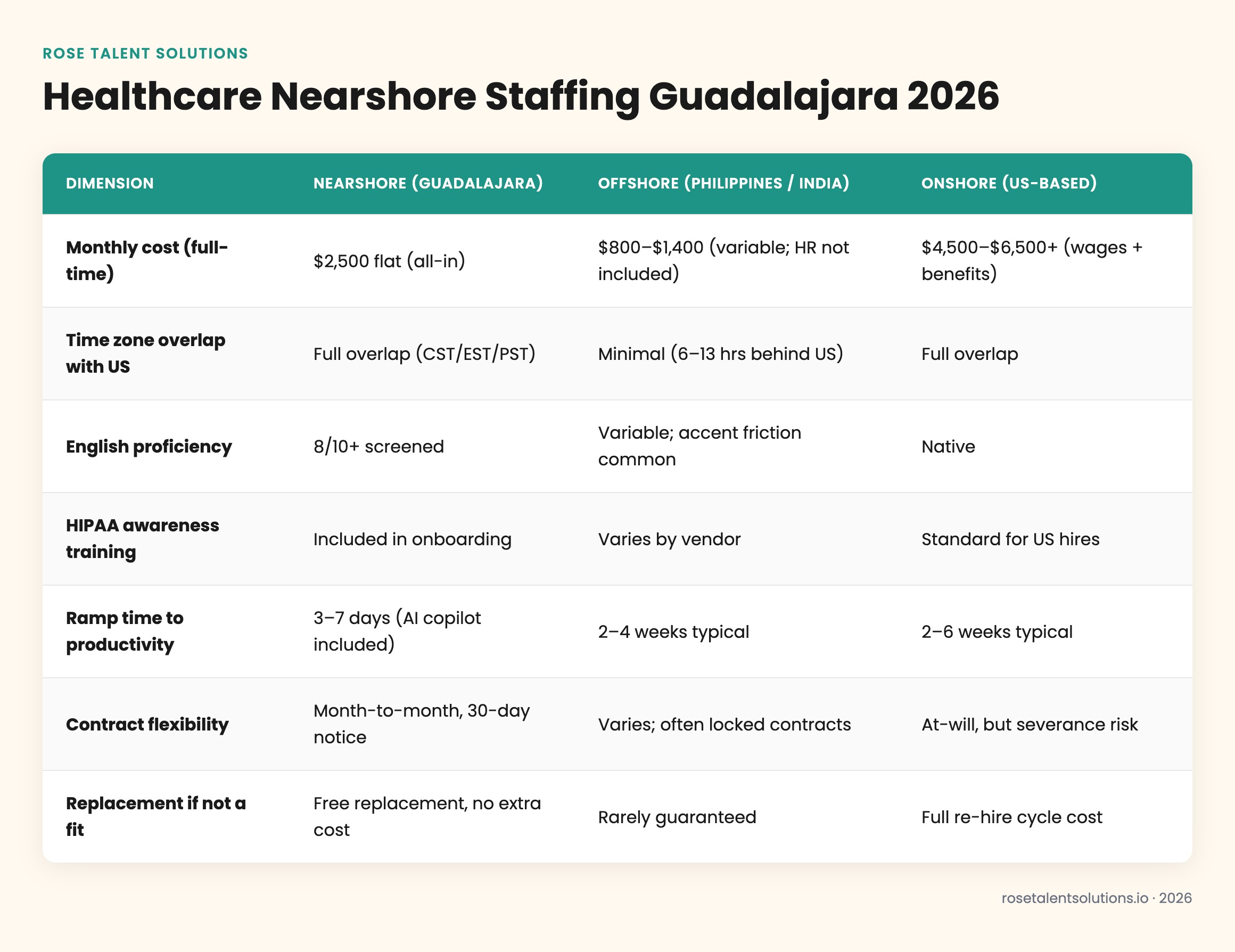
The comparison below reflects real-world conditions for a US medical practice or health-tech company staffing administrative roles in 2026. The numbers on onshore staffing reflect current Bureau of Labor Statistics data: the median annual wage for a US medical records specialist is $47,180, according to the Bureau of Labor Statistics (2024), which works out to roughly $3,930/month before employer taxes, benefits, and recruiting costs.
| Dimension | Nearshore (Guadalajara) | Offshore (Philippines / India) | Onshore (US-based) |
|---|---|---|---|
| Monthly cost (full-time) | $2,500 flat (all-in) | $800–$1,400 (variable; HR not included) | $4,500–$6,500+ (wages + benefits) |
| Time zone overlap with US | Full overlap (CST/EST/PST) | Minimal (6–13 hrs behind US) | Full overlap |
| English proficiency | 8/10+ screened | Variable; accent friction common | Native |
| HIPAA awareness training | Included in onboarding | Varies by vendor | Standard for US hires |
| Ramp time to productivity | 3–7 days (AI copilot included) | 2–4 weeks typical | 2–6 weeks typical |
| Contract flexibility | Month-to-month, 30-day notice | Varies; often locked contracts | At-will, but severance risk |
| Replacement if not a fit | Free replacement, no extra cost | Rarely guaranteed | Full re-hire cycle cost |
"Burnout is driven not by clinical complexity but by documentation and administrative volume. Reducing that burden is the highest-leverage intervention available to practice managers today." — Tait Shanafelt, MD, Chief Wellness Officer at Stanford Medicine (2023), as cited in Mayo Clinic Proceedings
What Healthcare Roles Does Guadalajara Nearshore Staffing Cover in 2026?
The most common healthcare administrative roles filled through nearshore staffing are: medical billing coordinators, prior authorization specialists, insurance verification reps, patient scheduling coordinators, medical records processors, and telehealth support agents. These roles share one defining characteristic — they require real-time responsiveness, fluent English, and familiarity with US insurance logic, all of which Guadalajara-sourced staff deliver.
Rose's AI copilot advantage is especially relevant in healthcare. Every team member ships with a role-specific AI copilot trained on the software they will actually use — whether that is Kareo, DrChrono, AdvancedMD, or a custom EHR. That means your new billing coordinator is not learning your system from a PDF on day one; they have an AI tool that surfaces the right workflow, the right denial code response, and the right payer-specific rule the moment they need it.
The hidden cost of offshore healthcare VAs is not the hourly rate — it is the 6-to-13-hour timezone gap that turns same-day prior authorization follow-ups into 48-hour delays, directly impacting patient care timelines and claim reimbursement cycles.
For practices that also carry a bookkeeping or revenue cycle component — common in multi-provider groups — Rose's bookkeeping and accounting VA service can be paired with a healthcare admin role to cover both billing reconciliation and financial reporting under a single staffing relationship. Many clients run a two-VA configuration: one for clinical admin, one for financial operations, at $5,000/month total — still less than a single US full-time employee with benefits.

According to the Medical Group Management Association (MGMA) (2024), practices that use dedicated prior authorization staff — rather than routing the task to clinical staff — reduce physician administrative time by an average of 6 hours per week per provider. For a 3-physician practice, that is 18 hours of physician time recovered weekly, every week. At a conservative $200/hour physician billing rate, that is $3,600 in weekly recovered productivity — against a $2,500/month staffing cost.
How the Rose Nearshore Staffing Process Works — From Brief to Day One
Understanding the mechanics of how nearshore staffing actually delivers a healthcare VA — not in theory but in practice — removes the main friction point for most practice managers. The process is not complicated, but it is specific. Here is how Rose runs it.
Intake and Role Scoping
You complete a brief intake call covering your EHR, payer mix, volume, and working hours. Rose uses that to build a role-specific screening profile — not a generic VA job description.
Candidate Vetting and Presentation
Rose screens for English proficiency (8/10+ floor), healthcare admin experience, software familiarity, and background checks. You receive 1-3 curated candidates — not a resume dump of 40 applicants.
Interview and Selection
You interview your top pick directly. Most healthcare clients select within 48 hours of their first candidate presentation.
AI Copilot Activation
Before day one, Rose activates a role-specific AI copilot trained on your specific software stack — Kareo, AdvancedMD, or your EHR. Your VA arrives knowing the tool, not just the theory.
Ongoing Management and Payroll
Rose handles payroll, HR compliance, PTO, and performance monitoring. You manage the daily work. If the placement is not a fit, Rose replaces them at no additional cost — no paperwork, no recruiting fee.
If you are ready to scope a role now, the fastest path is Rose's start page, which walks you through the intake in under five minutes.
Nearshore Healthcare Staffing Guadalajara vs. Domestic Locum Admin Staff — 2026 Pros and Cons
Some practice managers consider domestic contract administrative staff — locum admin or agency temp workers — as the alternative to nearshore. The comparison is worth making directly, because the trade-offs are real and the decision depends on your practice's specific constraints. If you want the full structural breakdown of how onshore and offshore models stack up on factors like cultural alignment and legal risk, Rose's post on onshore vs. offshore virtual assistants covers those dynamics in depth. The nearshore-specific pros and cons for healthcare are below.
Nearshore Healthcare VA (Guadalajara) — Pros
- $2,500/month flat — roughly 40–60% less than domestic temp admin with agency markup
- Full US business hours coverage, Central time zone, real-time responsiveness
- 8/10+ English floor; screened for healthcare admin experience specifically
- AI copilot included — faster ramp, fewer training hours required from your clinical staff
- Month-to-month terms; free replacement if not a fit
- Payroll, HR, and compliance handled — zero employer overhead
Nearshore Healthcare VA (Guadalajara) — Cons
- Not physically on-site — unsuitable for roles requiring in-person patient interaction
- Requires a stable, secure internet connection and VPN access to your EHR
- HIPAA Business Associate Agreement must be executed (Rose facilitates this, but it is a step)
- Some payer portals restrict non-US IP access — a solvable but real setup requirement
The IP-restriction issue deserves a direct note: most major payer portals (UnitedHealth, Cigna, Aetna) allow access via VPN with a US-based IP. Rose's onboarding team flags this in the first week and provides the standard technical setup checklist. It is a one-time configuration, not an ongoing friction point. For additional context on how Guadalajara specifically compares to other Latin American sourcing cities on cost and talent density, Rose's dedicated post on nearshore staffing agencies in Guadalajara covers the city-level data in detail.
The bottom line for 2026: if your practice needs a full-time administrative resource who works your hours, speaks clear English, understands US insurance workflows, and costs less than half of a domestic hire — nearshore healthcare staffing from Guadalajara is not an experiment. It is the operationally sound choice, and the practices moving on it now are building a structural cost advantage that compounds every month. Explore how Rose places dedicated virtual staff across service industries to understand the broader staffing framework behind each placement.