
Nearshore SDR services have quietly become one of the sharpest competitive edges available to B2B companies that can't justify a $80,000+ in-house hire yet need consistent pipeline. The debate between fractional SDR models and full-time dedicated reps has intensified in 2026 — and the answer isn't as obvious as vendors on either side want you to believe. This post breaks down both models with real numbers so you can make the right call for your sales motion.
What Is a Fractional SDR Service — and What Is a Full-Time SDR Service?
A fractional SDR service is an arrangement where a sales development representative (or a pod of reps) splits their working hours across multiple client accounts. You're buying a slice of someone's capacity — typically 10 to 20 hours per week — rather than a dedicated rep. Vendors price this as a lower monthly retainer, often $800–$1,500/month, in exchange for shared attention.
A full-time SDR service means one dedicated rep works exclusively on your pipeline, 40 hours per week, during your business hours. In a nearshore model, that rep is based in Latin America, fluent in English at an 8/10+ proficiency level, and trained on your specific CRM and outreach tools. They are functionally your employee — without the overhead of recruiting, payroll administration, or HR compliance that comes with a direct W-2 hire.
The distinction matters because accountability and output scale differently under each model. A fractional rep juggling five clients will naturally triage their effort. A dedicated rep whose only job is filling your calendar has one metric to optimize. According to the Society for Human Resource Management (SHRM, 2024), the average time-to-productivity for a new SDR hire is 3.2 months — a number that shrinks significantly when the rep is already trained on your category's tooling.
How the 2026 Cost Comparison Actually Breaks Down
The sticker price on a fractional SDR looks attractive. But the total cost of pipeline produced — cost per qualified meeting booked — almost always flips the math. Let's look at the three models head-to-head.
| Model | Monthly Cost | Hours/Week Dedicated | Avg. Ramp Time | Meetings Booked/Month (est.) | Cost Per Meeting |
|---|---|---|---|---|---|
| Fractional SDR Service | $800–$1,500 | 10–20 hrs | 4–6 weeks | 4–8 | $150–$375 |
| Full-Time In-House SDR (US) | $5,500–$7,500 (salary + benefits) | 40 hrs | 10–14 weeks | 12–20 | $275–$625 |
| Full-Time Nearshore SDR (Rose) | $2,500 flat | 40 hrs | 5–7 days to start, 2–3 weeks to ramp | 10–18 | $139–$250 |
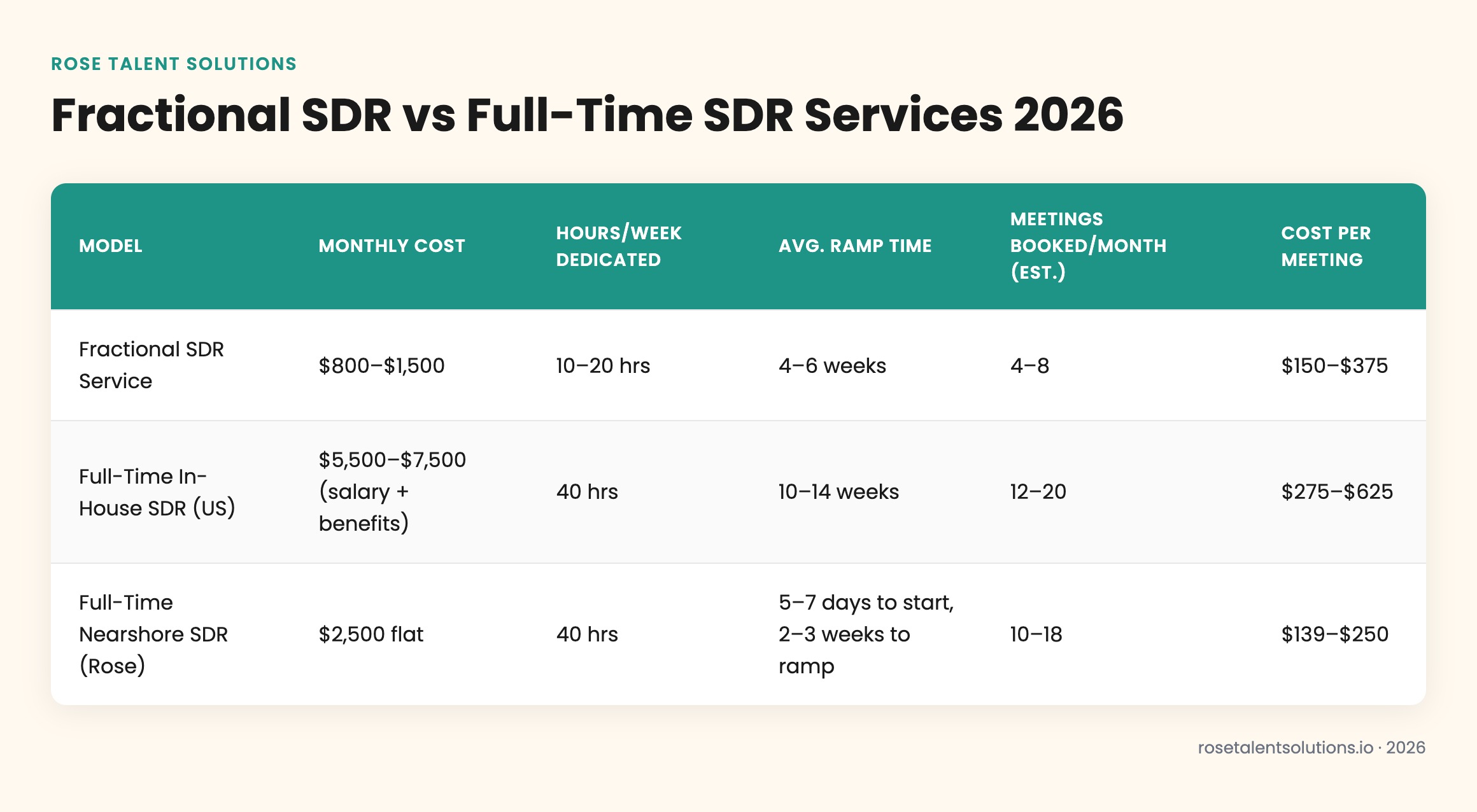
Meeting volume estimates based on typical outbound sequences targeting 200–400 accounts/month using email + LinkedIn + cold call. Results vary by ICP quality, offer strength, and sequence design.
The in-house SDR looks competitive on meetings booked — until you factor in the full employer cost. According to the U.S. Bureau of Labor Statistics (BLS, 2024), benefits add roughly 31% on top of base wages for private-sector employees. A $55,000/year SDR base salary becomes approximately $72,000 fully loaded before you touch recruiting fees, which average $8,000–$15,000 for sales roles per SHRM.

If you're evaluating outsourced sales development more broadly, the detailed outsourced vs. in-house SDR hiring ROI comparison on this blog walks through the full cost model with scenarios for teams at different growth stages.
How Fractional SDR Models Fail at Scale — and Where They Shine
Fractional SDRs are not inherently bad. They are a specific tool for a specific job. If you're running a low-volume, highly targeted ABM motion with fewer than 50 accounts in play and extremely long sales cycles (think enterprise software or commercial real estate), fractional attention may be sufficient. The rep spends 15 hours digging deep into 10 accounts rather than blanketing a list.
Where fractional models break down is anywhere volume and consistency matter. Cold outbound prospecting is a numbers game with a human relationship layer on top. A rep splitting attention across five clients cannot maintain the sequence cadence, personalization depth, or follow-up consistency that books meetings reliably. McKinsey's Growth & Sales research (2024) found that SDR-driven pipeline velocity correlates most strongly with daily dials and touches — a metric that inherently suffers under shared-attention models.
There's also a subtler problem: brand consistency. A fractional rep is simultaneously building rapport as a representative of three to five other companies. Their learned instincts, objection handling, and persona fluency develop across clients — not for yours specifically.
"The reps who hit quota fastest are the ones who spend their first 30 days doing nothing but learning one ICP — not four. Fractional models structurally prevent that depth." — Becc Holland, Founder & CEO at Flip the Script (2023)
For teams with 100–500 target accounts and a clear ICP, the fractional model will hit a ceiling within 60–90 days. That's when the cost-per-meeting math inverts and the full-time model becomes obviously superior.
How Nearshore Full-Time SDRs Outperform Both Models in 2026
The nearshore full-time SDR sits in a unique position: the output profile of an in-house rep at roughly one-third the cost, without the 10–14 week ramp that drains budget before a single pipeline dollar comes in. Rose's nearshore SDRs are based in Latin America, work US Eastern, Central, or Pacific hours without overlap friction, and arrive pre-trained on the tools your team already uses — whether that's HubSpot, Salesforce, Outreach, Apollo, or LinkedIn Sales Navigator.
The hidden cost of fractional SDR services isn't the retainer — it's the pipeline velocity you sacrifice while a shared rep slowly learns your ICP, your tone, and your objection framework across months of diluted attention.
Every Rose team member ships with a role-specific AI copilot trained on their outbound software stack. That means a nearshore SDR using Apollo.io arrives knowing how to build sequences, filter lead lists, manage A/B tests on subject lines, and interpret reply-rate data — not just log calls. You can learn more about how this works on the Rose AI Advantage page.
Timezone alignment is consistently underrated in outsourced SDR conversations. Latin America-based reps work real-time alongside your US or Canadian sales team. When a prospect replies at 11 a.m. EST, your nearshore SDR responds by 11:07 a.m. — not the next morning when an offshore alternative in the Philippines or India would see it. Harvard Business Review research (2011, still benchmarked today) established that lead response within 5 minutes increases contact probability by 100× compared to 30-minute delays. Real-time response matters.
For SaaS companies specifically, the setup process for nearshore SDR hiring has some additional nuances worth understanding — the guide on how to hire outsourced SDR services for SaaS covers onboarding sequences, tool access, and quota-setting frameworks that apply equally well to any tech-forward B2B team.

What Does the 2026 Hiring Process Look Like for a Nearshore SDR?
Discovery Call + ICP Definition
Rose's team spends 30–45 minutes mapping your target accounts, outbound motion, tools, and tone before starting the search — so the rep you meet is already filtered against your actual needs, not a generic SDR profile.
Candidate Shortlist in 5–7 Days
Rose presents 2–3 vetted candidates: English-proficiency scored, tool-tested, and background-checked. You interview and select. No pile of resumes to sift through.
AI Copilot Onboarding
Your chosen SDR's AI copilot is configured to their primary tools before day one. Outreach templates, CRM workflows, and sequence logic are loaded in advance so they're productive within hours of starting.
Month-to-Month Engagement Begins
You pay $2,500 flat. No long-term contract. If the rep isn't a fit, Rose replaces them at no additional cost. Ongoing HR, payroll, and management are handled — you manage the work output, not the employment relationship.
Small B2B teams especially benefit from this model. If you're running a lean operation, the best B2B lead generation services for teams under 20 employees breaks down which outsourced sales roles make sense at each headcount stage and how to sequence your first outbound hires.
Fractional SDR vs Full-Time Nearshore SDR: Pros and Cons in 2026
Full-Time Nearshore SDR — Pros
- 100% dedicated to your pipeline and ICP
- Works your exact business hours in real time
- Faster ramp due to single-client focus and AI copilot
- Lower cost per booked meeting than fractional at scale
- All-in pricing — recruiting, HR, payroll included
- Free replacement if not a fit, no long-term contract
Fractional SDR Service — Pros
- Lower absolute monthly cost ($800–$1,500)
- Flexible if pipeline volume is genuinely low
- Good for ABM-heavy motions with under 50 accounts
- No full-time management overhead if you're hands-off
According to Gallup's research on employee engagement (2023), workers who feel a strong sense of singular purpose and clear accountability to one team outperform split-attention workers on output metrics by a measurable margin. A dedicated nearshore SDR, embedded in your Slack, your CRM, your daily standups, develops that ownership. A fractional rep structurally cannot.
LinkedIn outreach is a growing component of modern SDR work — and it's worth noting that the mechanics of outsourcing LinkedIn prospecting have their own nuances. The comparison of LinkedIn outreach virtual assistant services covers what to look for in a rep who'll be operating your brand's Sales Navigator account daily.
If your business is ready to move from fractional to full-time, or if you've been running outbound manually and need your first dedicated rep, the path forward is straightforward. Visit the Rose start page to begin the matching process — placement typically happens within a week of your discovery call.