What Is an FBA Assistant and Why Does Your Amazon Business Need One in 2026?
Nearshore FBA assistants are reshaping how US-based Amazon sellers scale — and if you're still running your Fulfillment by Amazon operation solo or with a generalist hire, you're leaving both time and margin on the table. An FBA assistant is a dedicated virtual team member whose entire job is to keep your Amazon back end running: listings optimized, inventory balanced, PPC campaigns dialed, and customer feedback managed before it damages your seller score.
The term "FBA" refers to Fulfillment by Amazon, the program where Amazon stores, packs, and ships your products from its own warehouses. Sellers who use FBA often manage dozens or hundreds of SKUs, complex reorder cycles, and constant listing maintenance — all while competing in one of the fastest-moving marketplaces on earth. An FBA assistant takes that operational load off your plate entirely.
According to Statista (2024), third-party sellers now account for 61% of all units sold on Amazon — up from 40% a decade ago. The competition is intensifying, which means the sellers who win are those who invest in specialized support rather than trying to do everything themselves.
If you've been searching for clarity on what an FBA assistant actually does, what they cost, and how to find a great one, this guide covers all of it — with real numbers and no hype.
What Does an FBA Assistant Do? Core Tasks in 2026
A skilled FBA assistant handles the full operational surface area of an Amazon seller account. The specific mix depends on your business, but most FBA assistants cover these core responsibilities on a daily or weekly basis:
- Listing creation and optimization — writing and updating titles, bullets, backend keywords, and A+ content using tools like Helium 10 or Jungle Scout
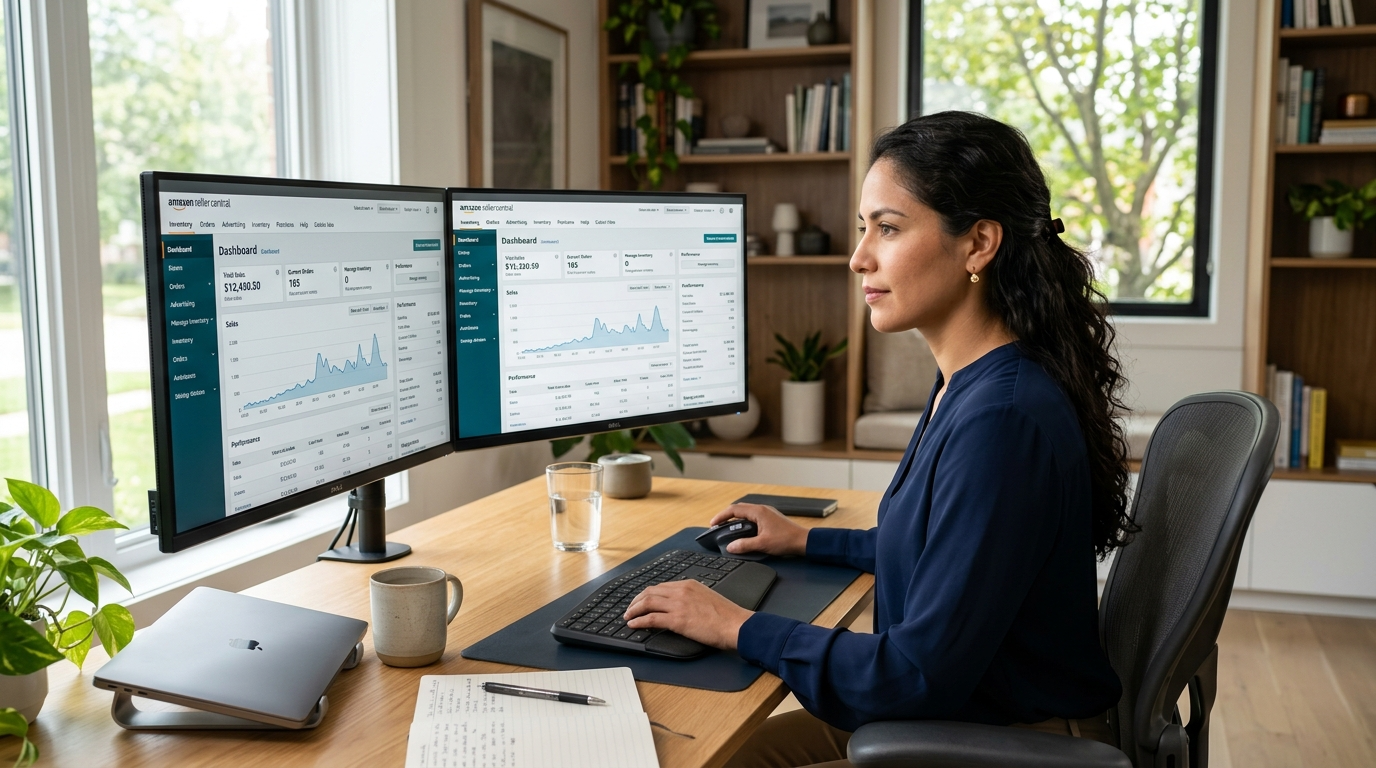
- Inventory management — monitoring stock levels, creating replenishment alerts, and submitting FBA shipments through Seller Central
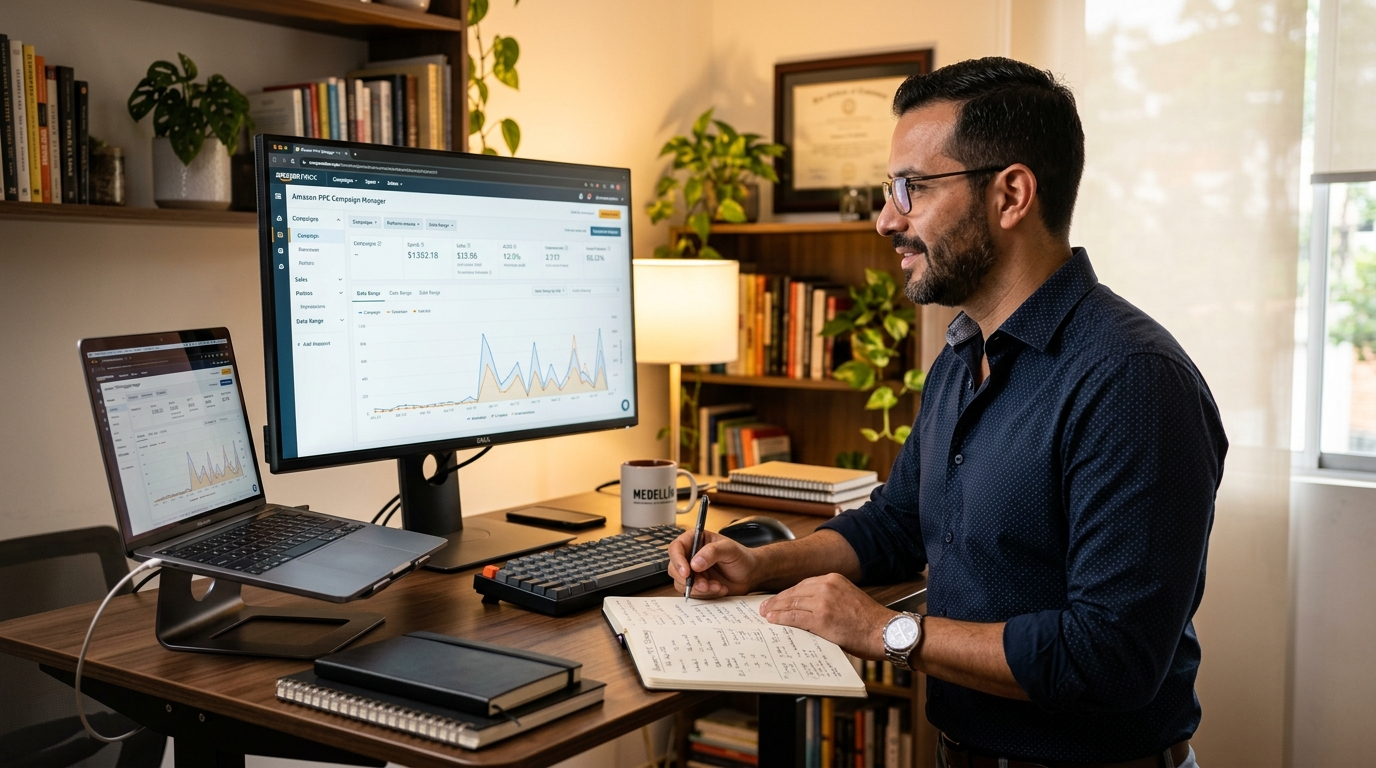
- PPC campaign management — building, reviewing, and optimizing Sponsored Products and Sponsored Brand campaigns to control ACoS
- Customer service and feedback — responding to buyer messages within the 24-hour window, handling returns, and flagging negative reviews for removal where policy allows
- Account health monitoring — watching your Order Defect Rate, Late Shipment Rate, and policy compliance to keep your account in good standing
- Competitor and market research — tracking competing listings, pricing shifts, and keyword trends so you can stay ahead
- Reporting and analytics — pulling Seller Central reports and turning them into actionable summaries for you each week
That list represents 30–40 hours of work per week for a growing seller. Handing it to a dedicated FBA virtual assistant — rather than splitting it across your own schedule — is often the single highest-leverage thing you can do in year two or three of your Amazon business.
How Nearshore FBA Assistants Outperform Offshore in 2026
Most sellers who've tried offshore FBA help — typically from the Philippines or South Asia — hit the same wall: a 10-to-12-hour time zone gap that turns every back-and-forth into a 24-hour delay. When a listing goes down at 2pm Eastern, you don't want to wait until your assistant wakes up on the other side of the world. Real-time responsiveness is a competitive advantage on Amazon, where suppressed listings and unanswered buyer messages cost you sales and seller metrics every hour they sit unresolved.
Nearshore FBA assistants, based in Latin America, work US business hours. They're online when you're online. If you need to hop on a Zoom call to walk through a campaign strategy or a new product launch, you schedule it the same way you'd schedule a call with a US employee — not at 7am before they go to sleep.
For a deeper look at how the three models stack up across every dimension, the nearshore vs. offshore vs. onshore virtual assistant comparison on the Rose blog breaks it down with real criteria. The short version: nearshore consistently wins on time zone, communication quality, and total cost when you factor in management overhead.
| Factor | Onshore VA (US-based) | Nearshore VA (Latin America) | Offshore VA (Philippines/India) |
|---|---|---|---|
| Typical monthly cost | $4,500–$7,000+ | ~$2,500 flat | $800–$1,500 |
| Time zone alignment (US) | Perfect | Full overlap | 6–12 hour gap |
| English fluency | Native | 8/10+ screened | Varies widely |
| Amazon tool proficiency | Varies | Pre-vetted + AI copilot | Varies |
| Ramp-up time | 2–4 weeks | ~1 week | 3–6 weeks |
| Contract terms | Often long-term | Month-to-month | Often long-term |
| Management overhead | Low | Low (managed service) | High |
How the AI Copilot Makes Every FBA Assistant Faster in 2026
One of the biggest differentiators in 2026 is AI augmentation. Every Rose Talent Solutions team member ships with a role-specific AI copilot trained on the exact software your FBA assistant will use — Helium 10, Jungle Scout, Amazon Seller Central reporting tools, and more. This isn't a generic ChatGPT wrapper. It's a purpose-built assistant that knows your workflows and helps your VA move faster without needing hand-holding from you.
The practical result: an AI-augmented FBA assistant can complete listing audits, keyword research cycles, and PPC reporting in a fraction of the time a tool-agnostic hire would need. According to McKinsey's Generative AI report (2023), generative AI tools can increase individual worker productivity by 20–40% on structured, repetitive knowledge tasks — exactly the type of work that dominates FBA account management.
An AI-augmented FBA assistant isn't just faster — they catch things a human alone would miss. Automatic keyword gap alerts, listing suppression flags, and PPC anomaly detection mean your account stays healthy even on the days you're not looking at it.
"AI copilots are not replacing virtual assistants — they're making the best ones dramatically more effective. The sellers who win in 2026 are pairing strong human judgment with AI speed." — Dave Hamrick, Founder at Lurn (e-commerce education platform) (2024)
Beyond raw speed, AI augmentation reduces the onboarding ramp. When your FBA assistant already has an AI tool that understands your product category, your pricing rules, and your PPC structure baked in, the first week of work looks a lot more like week four. That matters when you're paying for results, not for training time.

How Much Does an FBA Assistant Cost in 2026?
Cost is usually the first question, so let's answer it directly. A full-time nearshore FBA assistant through Rose Talent Solutions costs $2,500 per month, flat. That's 40 hours per week, and the rate includes recruiting, vetting, payroll, HR, and ongoing management. You don't pay separately for any of those. There's no long-term contract — terms are month-to-month with 30 days written notice to cancel.
Compare that to the alternatives. A US-based Amazon VA or account manager commands $25–$45 per hour — that's $4,000–$7,200 per month for full-time coverage, before employer taxes and benefits. Offshore options can run $800–$1,500 per month, but the time zone mismatch and variable English fluency often require you to spend 5–10 hours per week managing and re-checking work, which erases the cost savings fast. According to the U.S. Bureau of Labor Statistics (2024), business owners who self-manage remote contractors average 11 hours per week on coordination and oversight tasks — time that costs you far more than the hourly rate differential.
The flat $2,500 model also protects your cash flow forecasting. You know exactly what you're paying. No surprise invoices, no hourly overages, no "we charged extra for the onboarding call" line items. If the team member isn't a fit, Rose replaces them at no additional cost — that's the risk reversal.
For sellers who are comparing staffing options more broadly, it's worth reading the full breakdown of onshore vs. offshore virtual assistant tradeoffs — especially the section on hidden management costs that rarely show up in the headline rate.
How to Hire and Onboard an FBA Assistant in 2026: Step by Step
Getting an FBA assistant placed and productive faster than you'd expect is entirely achievable when the process is structured. Here's how it works with a managed nearshore model:
Define Your Scope
List the specific tasks you want off your plate — listings, PPC, customer service, inventory, or some combination. Being specific here speeds matching and sets your new assistant up to deliver from day one.
Matching and Vetting
Rose screens candidates on English fluency (8/10+ floor), Amazon tool familiarity, and communication style. You review a shortlist — typically within one week — rather than sifting through hundreds of applications yourself.
AI Copilot Activation
Your assistant's role-specific AI copilot is configured for your tools and workflows before their first day. This cuts the standard 3–4 week ramp to roughly one week in most cases.
First Week Handoff
You do one structured handoff call — walk through your account, your brand voice, your PPC targets. After that, daily work runs autonomously with end-of-day updates in your preferred format (Slack, email, Loom).
Ongoing Management
Rose handles HR, payroll, and performance management. You manage the work, not the employment relationship. If something isn't working, you raise it with your account manager and it gets fixed — or replaced at no cost.
The entire process from initial conversation to first day of work typically runs 7–10 business days. That's faster than posting a job on Indeed, let alone interviewing, hiring, and onboarding someone yourself. And if you're curious what the broader landscape of staffing partners looks like in the region, the overview of virtual assistant companies in Latin America gives useful context on how to evaluate providers beyond just the price.
Nearshore vs. Offshore FBA Assistants: Pros and Cons at a Glance
Before you commit to any FBA staffing model, it helps to see the tradeoffs clearly. The headline rate of an offshore assistant is lower, but the total cost of ownership — including your time, your rework, and your opportunity cost — almost always tells a different story. According to Gallup's State of the Global Workplace (2023), teams with high communication alignment are 21% more productive than those with persistent coordination friction — and time zone gaps are one of the most consistent sources of that friction in remote teams.
Nearshore FBA Assistant — Pros
- Full US business hours overlap — real-time problem solving
- English fluency screened and verified (8/10+ floor)
- Flat, predictable monthly pricing at $2,500
- Faster ramp with AI copilot pre-configured
- Month-to-month, no long-term contract
- HR, payroll, and management handled for you
- Free replacement if not a fit
Offshore FBA Assistant — Cons
- 6–12 hour time zone gap creates overnight delays
- English fluency varies — vetting is inconsistent
- Lower headline rate but high hidden management cost
- Longer ramp time without structured onboarding
- You absorb HR, payroll, and compliance risk
- No replacement guarantee in most arrangements
The math favors nearshore almost every time for sellers doing more than $500K in annual Amazon revenue. Below that threshold, you might still prefer nearshore for the communication quality — but the ROI case becomes undeniable once you're managing five or more SKUs with active PPC. Explore the full range of roles Rose places if you need support across more than just your Amazon operation as your business grows.
According to SHRM's workforce research (2024), the average US employer spends $4,700 per hire in direct recruiting and onboarding costs — before the new hire produces a single deliverable. A managed nearshore placement eliminates that cost entirely and shifts it to the staffing partner.