
The Short Answer: Nearshore SDRs Work Inside Your CRM on Day One
Nearshore SDRs are hired specifically to operate inside your existing revenue stack — not to rebuild it. When you bring on a nearshore sales development representative through Rose Talent Solutions, they arrive knowing HubSpot, Salesforce, Pipedrive, Apollo, Outreach, or whichever platform your team already runs. There is no "teach them the tool" phase eating up your first month. The vetting process screens for hands-on CRM experience before a candidate ever reaches your desk.
This is the question nearly every founder and revenue leader asks before pulling the trigger on outsourced SDR help: "Will this person actually work inside my system, or will I spend three weeks on onboarding?" The honest answer — at least with a vetted nearshore hire — is that CRM fluency is a baseline requirement, not a bonus. Rose's English proficiency floor is 8/10 or higher, and CRM platform experience is screened with equal rigor.
That 61% figure isn't a nearshore problem — it's a hiring problem. When CRM proficiency isn't screened at the door, you pay for it in weeks of lost pipeline activity. The entire Rose vetting model is built to eliminate that gap. According to Salesforce's State of Sales report (2024), reps who adopt their CRM in the first two weeks of a role generate 27% more pipeline activity in months two and three than late adopters. That stat alone makes CRM readiness a revenue variable, not just an operational checkbox.
What Is a Nearshore SDR? (And How Does That Differ From Offshore?)
A nearshore SDR is a sales development representative based in Latin America — countries like Colombia, Mexico, Argentina, or Costa Rica — who works exclusively on US, Canadian, or UK business hours. "Nearshore" means geographic and timezone proximity to North America, not just cost arbitrage. This is a meaningful distinction: a nearshore SDR can join your 9am standup, take a live call from a warm lead at 2pm, and update the CRM in real time before end of day. An offshore SDR in the Philippines or India operates on a 10-14 hour lag that makes synchronous collaboration structurally impossible.
The timezone alignment is what makes CRM hygiene actually work in practice. When a nearshore SDR logs a call, sends a sequence, or updates a deal stage, they're doing it inside your working hours — not batching updates at midnight their time that show up as noise in your morning dashboard. If you're weighing the cost difference between outsourced and in-house SDR hiring, this real-time CRM accuracy is one of the most underrated factors in ROI calculations.
How Nearshore SDRs Actually Integrate With Your CRM Stack in 2026
The integration process is less dramatic than most operators expect. Your nearshore SDR gets added to your CRM as a standard user — same as any in-house hire. They receive your sequence templates, your ICP filters, your deal stage definitions, and your activity logging standards. What Rose adds on top of that is a role-specific AI copilot trained on the SDR's exact toolset: if your team runs HubSpot Sales Hub, their AI copilot knows HubSpot's workflow logic, sequence triggers, and reporting views. If you run Salesforce with Outreach layered on top, the copilot is trained on that stack. You can read more about how this works on the AI advantage page.
This AI copilot layer is not a gimmick. It closes the gap between "knows the CRM conceptually" and "operates it at your team's specific standard." According to McKinsey's research on AI in sales (2024), sales reps who use AI-assisted tooling for CRM data entry and next-step recommendations reduce administrative time by up to 40%, freeing more hours for actual prospecting. That's the compounding value: your SDR isn't spending half their day on CRM hygiene tasks — they're spending it on outbound activity that fills your pipeline.
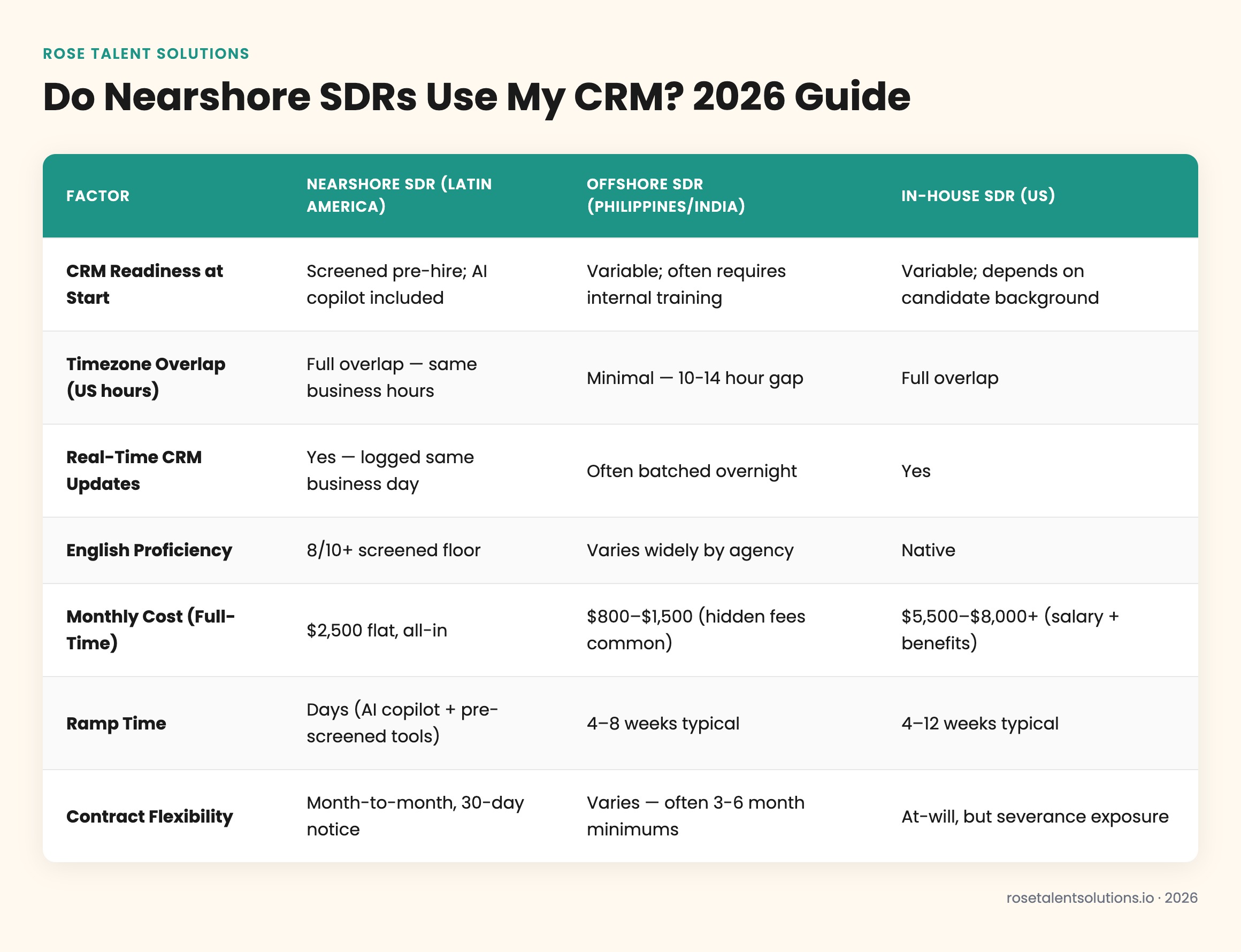
| Factor | Nearshore SDR (Latin America) | Offshore SDR (Philippines/India) | In-House SDR (US) |
|---|---|---|---|
| CRM Readiness at Start | Screened pre-hire; AI copilot included | Variable; often requires internal training | Variable; depends on candidate background |
| Timezone Overlap (US hours) | Full overlap — same business hours | Minimal — 10-14 hour gap | Full overlap |
| Real-Time CRM Updates | Yes — logged same business day | Often batched overnight | Yes |
| English Proficiency | 8/10+ screened floor | Varies widely by agency | Native |
| Monthly Cost (Full-Time) | $2,500 flat, all-in | $800–$1,500 (hidden fees common) | $5,500–$8,000+ (salary + benefits) |
| Ramp Time | Days (AI copilot + pre-screened tools) | 4–8 weeks typical | 4–12 weeks typical |
| Contract Flexibility | Month-to-month, 30-day notice | Varies — often 3-6 month minimums | At-will, but severance exposure |
Which CRMs Do Nearshore SDRs Know in 2026?
Rose Talent's SDR roster covers the platforms that actually run B2B pipelines in 2026. The most common ones we place into are HubSpot Sales Hub, Salesforce Sales Cloud, Pipedrive, Zoho CRM, Close.io, and Apollo.io. Secondary tools — Outreach, Salesloft, Gong, Orum, and LinkedIn Sales Navigator — are screened as add-ons based on your stack. If your workflow involves a less common CRM like Nutshell or Copper, that gets flagged during the matching call and we find a candidate with documented experience in that specific tool before presenting them to you.
"The biggest mistake I see companies make when hiring remote SDRs is treating CRM training as the company's job. The best agencies pre-screen for tool fluency so that onboarding is about your process, not their platform education." — Kyle Coleman, VP of Marketing at Clari (2023)
This matters more than it sounds. According to HubSpot's State of Sales report (2024), 47% of sales managers report that CRM data quality directly affects their pipeline forecasting accuracy. When your SDR doesn't know the platform deeply, you get incomplete records, missed sequence triggers, and contact data that's either duplicated or never logged. That isn't a data hygiene problem — it's a revenue problem dressed up as an admin issue.
For B2B startups specifically, the CRM question intersects directly with capacity. If you're running a lean team, you can't afford a 60-day ramp to get an SDR to full productivity. The best nearshore SDR services for B2B startups are the ones that deliver someone who's operational inside your CRM before the end of week one — not after a full quarter.
How Rose Talent Onboards a Nearshore SDR Into Your CRM — Step by Step
The onboarding sequence is structured to eliminate the two biggest ramp killers: unclear process ownership and tool unfamiliarity. Here's how it works in practice.
Discovery & Stack Audit
During your kickoff call, Rose documents your exact CRM, sequencing tools, and ICP filters. This becomes the matching brief used to select your SDR candidate.
Candidate Screening for Your Specific Tools
Rose only presents candidates with verified hands-on experience in your CRM. If your stack includes Outreach layered over Salesforce, the candidate has used both — not one or the other.
AI Copilot Configuration
Your SDR's role-specific AI copilot is configured for your stack before day one. It knows your CRM's workflow logic, your sequence templates, and your activity logging standards.
CRM Access & Process Walk-Through
Your SDR is added as a standard user in your CRM. A brief process walk-through (usually under two hours) covers your team's specific conventions — deal naming, stage definitions, activity types.
Live Outreach Begins
By end of day three in most placements, your SDR is running sequences, logging calls, and updating pipeline records in real time — during your business hours, on your schedule.
This process works because the heavy lifting happens before day one, not after. The AI copilot is the operational accelerant — it converts platform knowledge into your-company knowledge fast. If you're evaluating whether outsourced SDR services are the right fit for a SaaS model specifically, the onboarding speed question is usually what tips the decision.
The hidden cost of a poorly vetted SDR hire isn't their monthly rate — it's the 6-8 weeks of sales manager time spent on platform training instead of pipeline coaching. Pre-screened CRM fluency eliminates that tax entirely.
What About Data Security When a Remote SDR Accesses My CRM in 2026?
This is a legitimate operational concern, not paranoia. When you add any remote worker — nearshore or otherwise — to your CRM, you're granting access to your contact database, deal history, and potentially your customer communication records. The standard security protocol is the same one you'd apply to any remote in-house hire: role-based access controls inside your CRM (most platforms including HubSpot and Salesforce support this natively), a signed NDA and data handling agreement before day one, and CRM audit logs that track every action by user.
According to SHRM's guidance on remote workforce data security (2024), companies that implement role-based CRM permissions and activity logging for all remote team members report materially fewer data incidents than those relying on trust alone. Rose Talent's standard contractor agreements include explicit data handling clauses covering CRM access, contact list ownership, and post-engagement data deletion requirements. Your CRM data stays yours — the SDR is a user, not an owner.
For smaller teams evaluating cost-effective outbound options, the security question often comes bundled with the budget question. If you're under 20 employees and still building your outbound motion, the best B2B lead generation services for small teams are the ones that treat data security as a standard operating requirement, not an enterprise add-on.
Nearshore SDRs vs. Offshore SDRs: CRM Performance Head-to-Head
The CRM performance gap between nearshore and offshore SDRs comes down to one variable more than any other: synchronous availability. When a prospect replies to a sequence at 10:47am EST, a nearshore SDR in Bogotá or Mexico City sees it immediately and can respond, update the CRM record, and move the deal stage in real time. An offshore SDR in Manila sees it at 11:47pm their time — and responds in their morning, which is your next-day afternoon at the earliest.
That delay doesn't just affect response rates. It affects CRM data integrity. When updates happen in batches rather than in real time, deal stages drift out of sync, activity logs have gaps, and pipeline reporting loses the granularity your VP of Sales needs for accurate forecasting. According to Gartner's sales technology research (2024), pipeline forecast accuracy drops by up to 23% when CRM updates lag real-time activity by more than four hours. That's the quantified cost of timezone misalignment in CRM hygiene terms.
Nearshore SDR CRM Advantages
- Real-time updates during your business hours
- Immediate response to CRM-triggered alerts and lead notifications
- Synchronous communication with your revenue team for deal reviews
- AI copilot trained on your specific CRM stack
- 8/10+ English floor means cleaner call notes and contact records
Offshore SDR CRM Limitations
- Batched updates create data lag in pipeline reporting
- 10-14 hour timezone gap prevents real-time deal stage management
- English proficiency varies widely — affects CRM note quality
- Async-only collaboration slows CRM process refinement
- Hidden onboarding costs when tool training falls to your team
The $2,500/month flat rate Rose charges includes recruiting, vetting, payroll, HR, ongoing management, and the AI copilot. If your SDR isn't a fit, Rose replaces them at no additional cost — that's the complete risk reversal. There's no long-term contract, and you cancel with 30 days written notice. The pricing model is built around the assumption that a properly placed, CRM-ready SDR delivers pipeline value that makes the math straightforward. If you want to model that against an in-house hire, the start page walks through the next steps to get a placement moving.