
Nearshore development outsourcing in Latin America has moved from a budget play to a genuine competitive advantage for US, Canadian, and UK businesses in 2026. A decade ago, "outsourcing" meant wiring money to a vendor eight time zones away and praying the work showed up by morning. Today, LATAM professionals work inside your Slack, attend your standups, and close tickets before your US team breaks for lunch — at a fraction of the cost of a domestic hire. This guide breaks down exactly how it works, what it costs, who it's right for, and what separates great nearshore partners from mediocre ones.
What Is Development Outsourcing in Latin America?
Development outsourcing Latin America refers to the practice of hiring skilled professionals — software developers, operations staff, administrative coordinators, bookkeepers, and similar roles — from countries such as Colombia, Mexico, Brazil, Argentina, Costa Rica, and Peru, rather than from domestic or distant offshore markets. These team members work remotely for a US-based employer, operating on US business hours and communicating primarily in English.
The "nearshore" label matters. Nearshore specifically means geographic and timezone proximity — LATAM professionals typically sit within 0–3 hours of US Eastern time, unlike offshore providers in the Philippines (UTC+8) or India (UTC+5:30), who are 9–13 hours ahead. That gap isn't trivial: it determines whether a question gets answered in five minutes or in tomorrow's inbox. For a full breakdown of how these models compare, see this complete nearshore vs offshore vs onshore comparison that walks through every tradeoff in detail.
That 41% figure from Deloitte's Global Outsourcing Survey (2024) underlines why so many operators are rerouting budget from Asia-Pacific vendors to LATAM nearshore talent. When your outsourced team member is in Medellín or Mexico City, they're live at 9am EST — alongside you, not catching up from a night shift.
How 2026 LATAM Talent Compares to Other Outsourcing Models
Cost is the obvious starting point, but it's not the only variable that matters. The table below compares nearshore Latin America, offshore Asia-Pacific, and onshore US staffing across the dimensions that actually affect your business operations day to day.
| Factor | Nearshore LATAM | Offshore Asia-Pacific | Onshore US |
|---|---|---|---|
| Typical monthly cost (full-time) | $2,000–$3,000 | $800–$1,800 | $5,500–$9,000+ |
| Timezone overlap with US East | 0–3 hours difference | 9–13 hours difference | 0 hours difference |
| Average English proficiency | High (8/10+ screened) | Variable (5–8/10) | Native |
| Cultural alignment with US norms | Strong | Moderate | Native |
| Typical ramp time | 1–2 weeks | 3–6 weeks | 2–4 weeks |
| Long-term contract required | No (month-to-month) | Often 6–12 months | At-will (overhead heavy) |
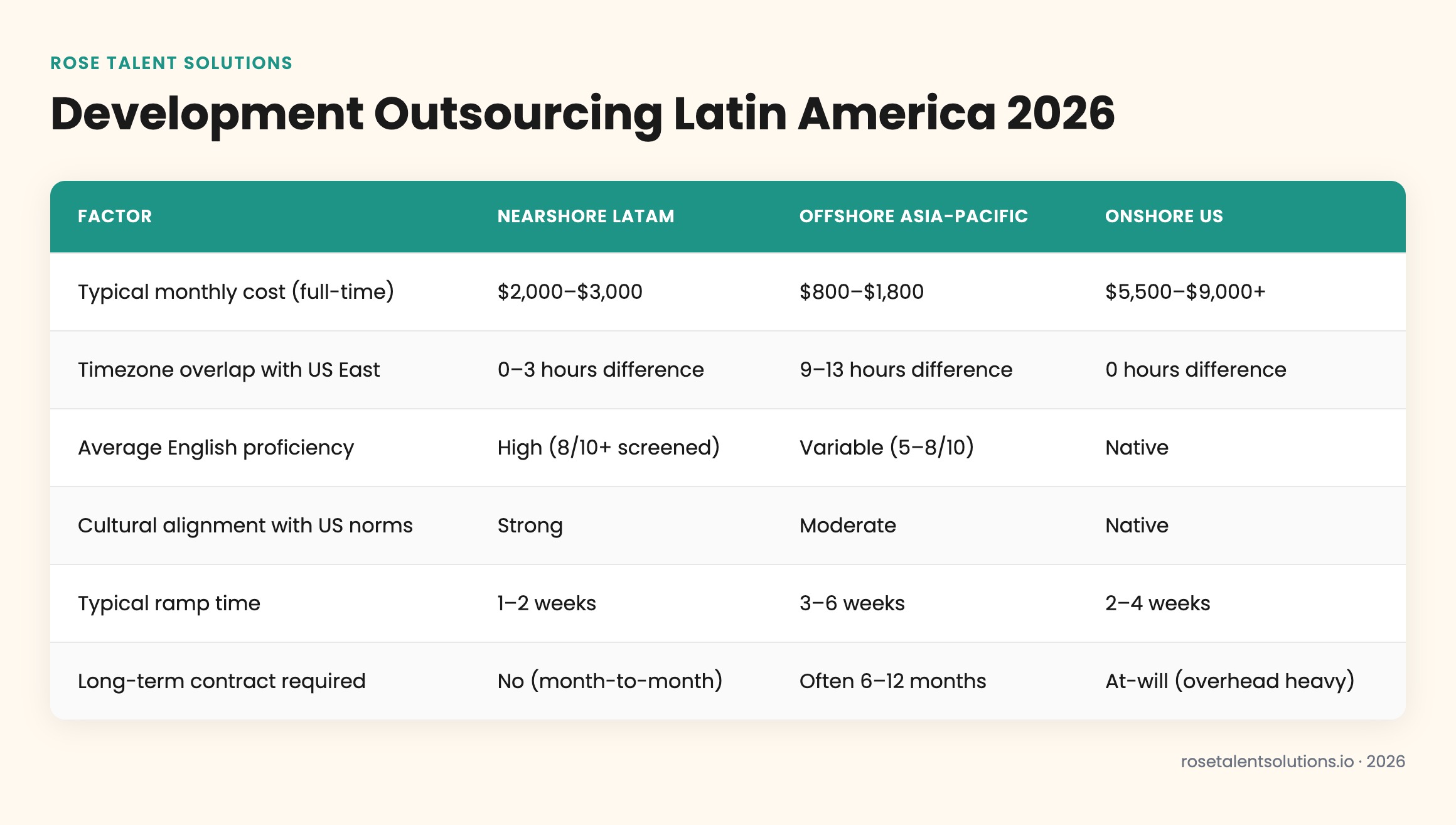
Offshore Asia-Pacific wins on sticker price. Onshore wins on zero language friction. But nearshore LATAM threads the needle — delivering most of the cost savings without the collaboration penalties that offshore creates. If you want to go deeper on the US vs. offshore tradeoffs specifically, this piece on onshore vs offshore virtual assistants breaks down where each model breaks down under real operating conditions.

What Does Development Outsourcing Latin America Actually Cost in 2026?
The word "development" in this keyword is broad. In practice, businesses outsourcing to Latin America in 2026 are hiring across a wide range of functions: software development, operations coordination, bookkeeping, customer support, executive assistance, and property management. The cost varies by role and by how you source talent — direct hire, freelance marketplace, or a managed staffing agency.
At Rose Talent Solutions, the model is a flat $2,500/month — that's full-time, 40 hours per week, and all-in. Recruiting, vetting, payroll processing, HR compliance, and ongoing management are included. There is no long-term contract; you can cancel with 30 days written notice. That simplicity eliminates the hidden costs that make direct-hire DIY outsourcing far more expensive than it looks on paper: job board fees, interviewing hours, compliance risk, and the cost of a bad hire sitting on payroll for months.
For context on what LATAM professionals themselves earn in these roles, see this detailed breakdown of average Latin America virtual assistant salaries — it explains the compensation structure in a way that helps you understand what's competitive and what's exploitative.
According to the U.S. Bureau of Labor Statistics (2024), the median US salary for an administrative or operations coordinator is $47,000/year — roughly $3,900/month in direct compensation alone, before benefits, payroll taxes, and overhead. The nearshore LATAM equivalent at $2,500/month all-in represents a 36% direct saving, with zero employer-side HR burden.
The real cost gap between nearshore LATAM and US domestic hiring isn't the wage difference — it's the combined weight of recruiting fees, employer taxes, benefits administration, and the 6–12 week ramp time that comes with every local hire. Nearshore eliminates most of that overhead on day one.
How AI Copilots Are Changing 2026 LATAM Outsourcing
The most significant shift in nearshore outsourcing between 2023 and 2026 isn't the talent pool — it's how AI is being layered on top of that talent. The best nearshore providers now ship team members with role-specific AI copilots trained on the exact software and workflows the client uses. A bookkeeper placed with a QuickBooks-heavy firm arrives with an AI assistant already fluent in QuickBooks reconciliation patterns. A property management coordinator knows AppFolio or Buildium from week one, not month three.
This matters because SHRM's HR benchmarking research (2024) consistently finds that new-hire ramp time is the single largest hidden cost in any staffing decision — averaging 8–26 weeks depending on role complexity. AI-augmented nearshore talent cuts that window dramatically because the copilot handles institutional knowledge that previously had to be absorbed manually.
At Rose, this is called the AI advantage — every team member is paired with a software-specific AI copilot before their first day. It's not a chatbot bolted on as a feature. It's a trained assistant built around the client's specific stack and SOPs.
AI-augmented nearshore talent also reduces the quality variance that has traditionally been the biggest complaint about outsourcing. When the copilot catches errors, flags missing data, and surfaces the right next step — the human's job becomes execution and judgment, not recall. The result is more consistent output, faster.

How to Choose a Nearshore Staffing Partner in Latin America
Not all nearshore staffing agencies operate the same way, and the difference between a great partner and a costly mistake often comes down to three things: their vetting process, their management structure post-placement, and their replacement policy.
"The agencies that wash out in nearshore are the ones treating it like a resume-forwarding service. The ones that last are managing the relationship on both sides — keeping the client accountable to onboarding, and keeping the talent accountable to output." — Matt Taibbi, Founder at NearU Staffing (2024)
Define the role precisely
Before contacting any agency, write a specific scope of work — not a job title. "Virtual assistant" is too vague. "AppFolio coordinator handling maintenance tickets, lease renewals, and vendor invoicing" gives a recruiter something to match against.
Verify the vetting process
Ask specifically how English proficiency is tested and at what threshold candidates are disqualified. Rose uses a minimum 8/10 English proficiency screen — a clear, auditable bar. If an agency can't name their cutoff, they don't have one.
Confirm timezone and hours
Your team member should work your business hours, not a hybrid schedule that cuts off at 2pm EST. Confirm that LATAM placements are contracted to operate in your timezone, not a "best effort" overlap window.
Understand the replacement policy
The honest sign of a confident agency is a clear replacement guarantee. Rose replaces any team member who isn't a fit at no additional cost — no long-term contract required to access that protection.
Start on month-to-month terms
Avoid any agency requiring a 6–12 month commitment upfront before you've validated the match. Month-to-month terms with 30 days written notice are the standard that protects your business without penalizing the relationship.
For a broader view of how to evaluate agencies specifically, this guide to choosing a nearshore staffing agency covers the questions to ask, the red flags to avoid, and the contract terms that matter most.
Which Roles Are Best Suited to 2026 Latin America Outsourcing?
The honest answer is: most knowledge-worker roles that don't require a physical US presence. The LATAM nearshore market has deepened significantly since 2020, and the talent pool now covers far more than entry-level admin support.
Roles that outsource exceptionally well to LATAM
- Operations coordination and project management
- Bookkeeping, accounts payable/receivable, QuickBooks/Xero management
- Property management coordination (AppFolio, Buildium, Yardi)
- Customer support and tenant communications
- Executive assistance and calendar management
- Data entry, reporting, and CRM management
- Marketing coordination and social media management
Roles that require more care or US-presence
- Senior software architecture (talent exists but costs approach US rates)
- Legal compliance requiring US bar admission
- In-person client-facing roles
- Roles requiring US security clearance
For businesses in property management specifically, the property management VA service at Rose is built around exactly this use case — coordinators who know AppFolio and Buildium before day one and can handle maintenance workflows, lease renewals, and owner reporting without a long ramp-up period. According to Buildium's State of the Property Management Industry Report (2024), 68% of property management companies cite staffing as their top growth constraint — which is precisely the problem a trained nearshore coordinator solves.
For finance and accounting functions, the nearshore bookkeeping and accounting service places QuickBooks-trained staff who can handle month-end close, reconciliations, and reporting inside your existing workflow from week one.
According to Gallup's State of the Global Workplace (2024), companies with highly engaged remote workers — regardless of geography — report 23% higher profitability than those with low engagement. The takeaway for nearshore outsourcing: the timezone and cultural alignment that LATAM offers makes engagement far easier to maintain than with distant offshore teams, and that engagement translates directly to output quality and retention.
If you're ready to move from research to action, the fastest path is a direct conversation about your specific role — get started with Rose to describe what you need and receive a matched candidate profile within days, not weeks.