
Nearshore CPA outsourcing for ecommerce is one of the highest-leverage decisions a scaling online store can make in 2026. While most founders are still toggling between overpriced local accountants and unreliable freelancers, the smartest operators are quietly plugging in full-time, Latin America-based CPAs who work their exact business hours, speak fluent English, and know Shopify reconciliation the way an in-house hire would — without the $90,000 salary. This post breaks down exactly how it works, what it costs, and how to avoid the traps that burn 60% of first-time outsourcers.
What Is CPA Outsourcing for an Ecommerce Firm — and Why Does It Matter in 2026?
CPA outsourcing for an ecommerce firm is the practice of delegating core accounting functions — bookkeeping, revenue reconciliation, COGS tracking, multi-state sales-tax compliance, and financial reporting — to a dedicated external accounting professional rather than managing those tasks in-house. The key word is dedicated. This is not a shared bookkeeper who gives you four hours a week. A properly structured outsourced CPA relationship means someone is in your accounts every single day, catching discrepancies before they compound.
Ecommerce accounting is materially more complex than a single-location service business. You may be selling across 12 states, processing returns through two payment processors, syncing inventory costs from a 3PL, and running promotions that create irregular revenue recognition. According to the IRS (2024), sales-tax nexus rules now trigger filing obligations in states where a seller has no physical presence — a change that tripped up thousands of ecommerce operators who didn't have a dedicated accountant watching the threshold numbers.
If you're still deciding whether outsourcing the accounting function makes sense at all — or trying to figure out the difference between hiring a bookkeeper and a CPA — our deeper guide on accounting outsourcing for ecommerce businesses covers the role hierarchy in plain language.
How Nearshore CPAs Outperform Offshore Alternatives for Ecommerce in 2026
The offshore vs. nearshore debate looks simple on a spreadsheet — both are cheaper than a domestic hire — but the real cost difference shows up in the work product, not the invoice. An accounting team operating far outside US time zones is typically 10–13 hours ahead of Eastern Time. That means every question you send at 2pm arrives while they're asleep. Every reconciliation dispute, every rush invoice, every "did we collect sales tax on this?" moment turns into a next-day thread.
Nearshore CPAs, by contrast, are in Colombia, Mexico, or Argentina. They log on at 8am EST because that is their morning. They're available for your Slack messages, your end-of-quarter Zoom, and your ad-hoc "we just got an audit notice" conversation in real time. Rose Talent Solutions screens all team members to an 8/10 or higher English proficiency floor — so written deliverables like management reports and board summaries are client-ready, not rough drafts that need editing.

The $2,500/month flat rate from Rose includes recruiting, vetting, payroll, HR, and ongoing management. You're not paying a recruiter fee up front, a separate payroll processing fee, and a management retainer on top. It's one number. Compare that to the total cost of a US-based junior CPA — salary, benefits, payroll taxes, and recruiting — which the Bureau of Labor Statistics (2024) puts at a median annual wage of $79,880 before benefits, which typically add another 20–30% on top.
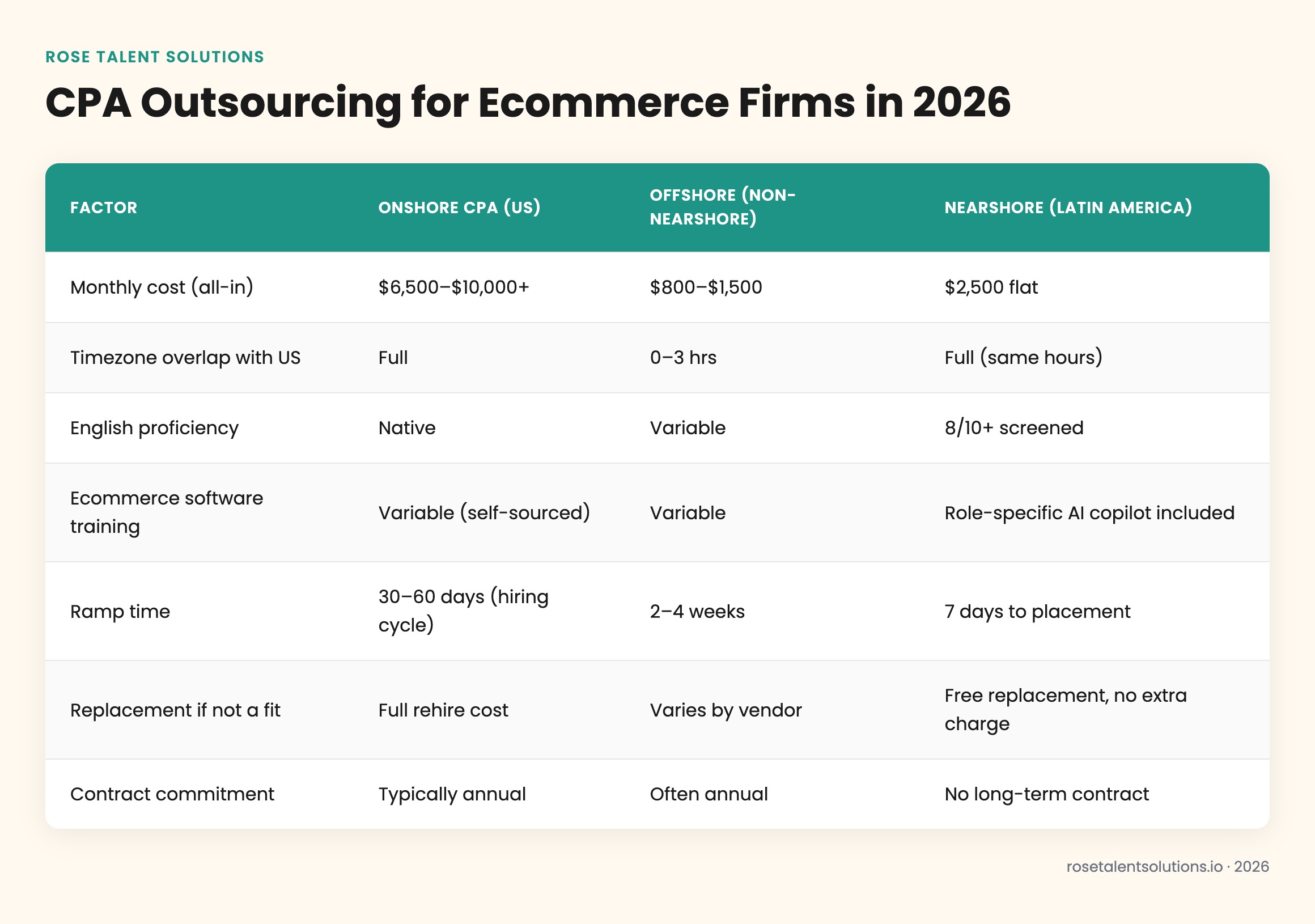
| Factor | Onshore CPA (US) | Offshore (non-nearshore) | Nearshore (Latin America) |
|---|---|---|---|
| Monthly cost (all-in) | $6,500–$10,000+ | $800–$1,500 | $2,500 flat |
| Timezone overlap with US | Full | 0–3 hrs | Full (same hours) |
| English proficiency | Native | Variable | 8/10+ screened |
| Ecommerce software training | Variable (self-sourced) | Variable | Role-specific AI copilot included |
| Ramp time | 30–60 days (hiring cycle) | 2–4 weeks | 7 days to placement |
| Replacement if not a fit | Full rehire cost | Varies by vendor | Free replacement, no extra charge |
| Contract commitment | Typically annual | Often annual | No long-term contract |
What Does an Outsourced Ecommerce CPA Actually Do Day-to-Day?
This is the question most founders don't ask until they've already hired someone. An outsourced ecommerce CPA is not just "keeping the books." Their daily work list looks more like this: reconciling Shopify or Amazon payouts against your bank feed, categorizing ad spend from Meta and Google, tracking inventory cost-of-goods as products move through your 3PL, and flagging any sales-tax threshold crossings in new states before you hit the filing trigger.
Monthly, they're producing a P&L that reflects real ecommerce economics — not a generic small-business P&L that lumps COGS, shipping, and returns into one line. Quarterly, they're coordinating with your tax CPA (or filing themselves, if they hold the credential) and preparing the cash-flow projections that tell you whether your next inventory buy is fundable from operations or needs a line of credit. This depth of work is what separates a real CPA engagement from basic bookkeeping — and it's why understanding the full spectrum of bookkeeping and accounting outsourcing options for ecommerce before you hire matters so much.
The hidden cost of generic bookkeeping isn't the monthly fee — it's the tax surprises, missed nexus thresholds, and inaccurate COGS numbers that distort every growth decision you make for the next 12 months. An ecommerce-trained CPA prevents all three.
Every Rose team member also ships with a role-specific AI copilot trained on the software stack they'll use in your business. If your CPA will be working in QuickBooks Commerce and A2X, their AI copilot is pre-loaded with those workflows. That's a capability you won't find in a freelancer marketplace hire. Learn more about how that works on the Rose AI Advantage page.
According to QuickBooks (2024), ecommerce businesses that automate reconciliation between their sales platform and accounting software reduce monthly close time by an average of 40%. A nearshore CPA who already knows how to configure those integrations gets you that result in week one, not month three.

How the Rose Nearshore CPA Placement Process Works in 2026
The biggest fear most founders have about outsourcing a CPA role is the ramp time — "How long before this person actually knows my business?" The Rose process is built to compress that window to days, not months, by pre-vetting candidates against your specific software stack and ecommerce vertical before you ever see a name.
Discovery call (Day 1)
You walk us through your platform stack (Shopify, Amazon, WooCommerce), your accounting software (QuickBooks, Xero, Wave), and what's broken in your current process. We document your exact requirements.
Candidate matching (Days 2–5)
Rose pulls from its pre-vetted Latin America talent pool — candidates who've already passed the English proficiency screen, skills assessment, and background check. We present the top 1–2 matches.
Interview & selection (Days 5–6)
You interview your top match. Most clients make a decision in one round because the pre-vetting eliminates the noise you'd filter through on a job board.
AI copilot activation (Day 7)
Your CPA's role-specific AI copilot is activated for their software stack. They begin onboarding to your accounts on day one of their start date.
Ongoing management (Month 1+)
Rose handles payroll, HR, and performance oversight. If for any reason the team member isn't a fit, we replace them at no additional cost — that's our sole risk reversal.
If you want to explore the full accounting service scope before starting, the Rose bookkeeping and accounting service page details every function a nearshore CPA team member typically covers for ecommerce clients.
Nearshore vs. Far-Offshore CPA Outsourcing — The Real Tradeoffs in 2026
It's worth being direct about the tradeoff, because some founders will look at a $900/month option from a far-offshore vendor and wonder if it's the same thing. It is not. The differences go beyond timezone — they affect the quality and timeliness of your financial data, which affects every business decision downstream.
Nearshore (Latin America) — Strengths
- Full US-hours overlap — real-time communication with your team
- Screened to 8/10+ English proficiency — reports and emails are client-ready
- Cultural alignment with US business norms — meetings, deadlines, communication style
- No long-term contract — cancel with 30 days written notice
- AI copilot pre-trained on your software stack included
Far-Offshore Vendors — Tradeoffs
- Large timezone gap — every question costs up to 24 hours
- Variable English proficiency — financial reports often need editing
- Higher management overhead — you absorb the coordination cost
- Software training is self-managed — no structured onboarding tool
- Replacement clauses vary widely by vendor
A SHRM (2023) analysis found that the cost of a bad hire can reach up to 50–60% of that employee's annual salary when you factor in lost productivity, re-hiring, and onboarding. In an accounting role, a bad hire has an additional tail — the errors they introduced into your books that you don't discover until the next audit cycle. That's why the replacement guarantee matters: if your Rose CPA isn't the right fit, you get a replacement at no additional cost, not an invoice for a new recruiting cycle.
"The biggest mistake I see ecommerce founders make is hiring a generalist bookkeeper and expecting CPA-level output. The job description matters — and so does finding someone who's done this specific work before." — Scott Scharf, Co-Founder at Catching Clouds (2022)
According to a McKinsey Global Institute report (2021, updated 2023), roles requiring digital financial skills are among the fastest-growing remote-work categories globally — and Latin America has been one of the fastest-developing talent pools for exactly these skills, driven by strong university accounting programs and growing English-language proficiency in the professional workforce.
If you're specifically evaluating Xero as your platform of choice, our guide on hiring a Xero virtual bookkeeper goes deep on what to look for in a Xero-trained hire and how to structure their onboarding. And if you're still in research mode on the broader outsourced accounting landscape, the post on outsourced accounting for ecommerce covers the market options end-to-end.
Ready to staff a role? The fastest path is the Rose start page — fill out a two-minute intake and you'll have a candidate match within the week. The flat rate is $2,500/month, no long-term contract required, with a free replacement if the team member isn't the right fit.