
Why Dermatology Practices Are Rethinking Billing Costs in 2026
Nearshore billing specialists have quietly become the fastest-growing staffing category inside dermatology practices — and the math is not subtle. A single full-time in-house medical biller costs far more than most practice managers realize once you stack salary, payroll taxes, benefits, software licensing, and the recruiting time to replace the one who just quit. Meanwhile, outsourced dermatology billing — particularly from Latin America-based nearshore teams working on your time zone — has matured into a reliable, cost-efficient alternative that many specialty practices are adopting in 2026.
This post breaks down every cost layer on both sides. You'll walk away knowing exactly what in-house billing really costs, what outsourced billing really costs, where the hidden expenses live on each side, and which model makes sense for a practice your size. No fluff — just numbers and the tradeoffs that come with them.
Medical Group Management Association data consistently shows that the "salary" number on a job offer understates true cost by 30–40% once employer-side payroll taxes, health insurance contributions, PTO, and billing software seats are added. According to the MGMA 2024 Cost Survey, median compensation for a full-time medical billing specialist ranges from $48,000 to $58,000 base — but fully-loaded cost to the practice lands closer to $70,000–$85,000 annually.
How In-House Dermatology Billing Costs Stack Up in 2026
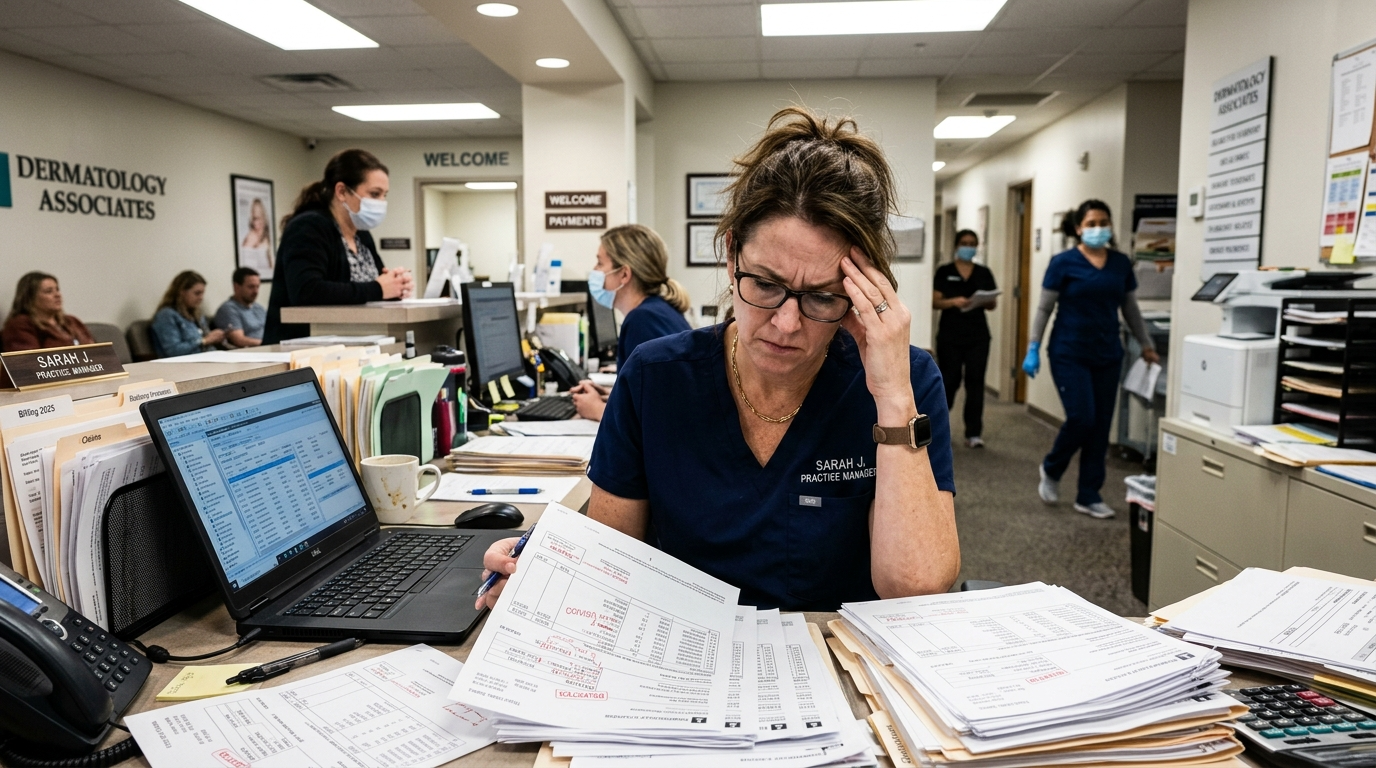
Building an internal billing team feels like the "safe" choice. You can see the person. You can walk over and ask a question. But the cost structure is punishing for small-to-mid dermatology groups, and turnover in medical billing is notoriously high.
Here's every cost category you need to account for when modeling in-house billing:
- Base salary: $48,000–$58,000/year for a certified professional biller in most US markets, per Bureau of Labor Statistics (2024)
- Employer payroll taxes (FICA, FUTA, SUTA): Approximately 7.65–10% of base salary, adding $3,700–$5,800/year
- Health, dental, vision insurance: Employer contribution averages $7,911/year per employee, according to KFF Employer Health Benefits Survey (2024)
- PTO, sick days, holidays: 15–20 days/year average means you're paying for 4 weeks of non-productive time
- Practice management / billing software seat: $200–$600/month per user depending on platform
- Recruiting and onboarding: The average cost to replace a billing employee runs 50–200% of annual salary when you include recruiter fees, lost productivity, and training time, according to SHRM (2023)
Add it all up for a single biller and you're typically at $70,000–$85,000 per year — and that's before the first denied claim or the productivity gap that opens up whenever they take vacation.
What Does Outsourced Dermatology Billing Actually Cost in 2026?
Outsourced dermatology billing comes in three flavors: domestic billing companies (US-based), offshore services (Philippines or India), and nearshore billing specialists (Latin America, working your time zone). The pricing, quality, and operational experience are dramatically different across all three — and confusing them is how practices end up with a bad outsourcing story to tell at their next conference.
Domestic billing companies typically charge 4–8% of monthly collections or a flat fee of $2,000–$6,000/month for a mid-size dermatology practice. They're responsive and HIPAA-fluent, but at 8% of collections on a $200K/month revenue practice, you're paying $16,000 per month — nearly $200K/year — just in billing fees.
Offshore billing services (India, Philippines) price lower — often $800–$1,500/month — but the timezone gap creates real operational drag. Denied claim follow-ups, payer calls, and prior authorization chases require real-time phone availability during US business hours. A team that's 10–13 hours ahead batches those calls overnight. That delay stretches your days-in-AR and frustrates your clinical staff. If you want to understand the full tradeoff, our breakdown of nearshore vs offshore vs onshore virtual assistant models covers every dimension that matters for healthcare support roles.
Nearshore billing specialists based in Latin America hit the sweet spot: US business hours, English fluency at 8/10+ proficiency, deep familiarity with US payer systems, and a cost structure that lands well below domestic options. Rose Talent Solutions places full-time, dedicated nearshore billing staff at $2,500/month flat — all-in, including recruiting, vetting, payroll, HR, and ongoing management.
| Billing Model | Annual Cost (Est.) | Time Zone Alignment | Flexibility | Dedicated Staff? |
|---|---|---|---|---|
| In-House Biller | $70,000–$85,000 | ✅ Perfect | ❌ Fixed headcount, hard to scale | ✅ Yes |
| Domestic Billing Company | $24,000–$96,000+ | ✅ US hours | ⚠️ Contract-dependent | ❌ Shared team |
| Offshore (India/Philippines) | $9,600–$18,000 | ❌ 10–13 hr gap | ✅ Flexible | ⚠️ Often shared |
| Nearshore (Latin America) | $30,000 | ✅ US business hours | ✅ No long-term contract | ✅ Dedicated FT |
How Hidden Costs Tip the Scales Toward Nearshore in 2026
The sticker price comparison above already favors nearshore billing. But the hidden costs are where in-house billing really loses the argument. Consider what doesn't show up on your P&L as a line item but quietly drains your practice's revenue cycle performance.
"Physician practices lose an estimated 5–11% of their net revenue due to billing errors, inefficiencies, and uncollected claims — most of which stem from undertrained or overwhelmed billing staff." — Usha Bhatt, Healthcare Revenue Cycle Analyst at Advisory Board (2023)
Claim denial rates in dermatology are higher than most specialties because of the coding complexity around medical versus cosmetic procedures. An in-house biller juggling front-desk duties (as many solo-practice billers do) isn't spending enough time on denial management. A dedicated nearshore billing specialist, focused 40 hours a week on your revenue cycle and trained on your specific EHR, catches more denied claims before they age out.
Days in accounts receivable (AR) is the metric that converts directly to cash. According to HFMA (Healthcare Financial Management Association, 2023), dermatology practices with best-in-class billing operations maintain AR days below 35. Practices relying on an overloaded in-house biller or a shared offshore team commonly run 50–70 AR days — meaning your cash is sitting uncollected for an extra two to five weeks per cycle.
The true cost of slow AR isn't just the float. It's write-offs on claims that age past timely filing limits and payer-imposed deadlines. A single $800 claim that gets written off because a denial wasn't worked in time is money gone forever. Understanding the real cost structure of nearshore virtual staff helps you frame this as an investment decision, not just an expense comparison.
The average dermatology practice collects $150,000–$400,000 per month in insurance reimbursements. A 5% improvement in net collection rate from better denial management — which a focused, dedicated billing specialist drives — is worth $7,500–$20,000 per month. That math makes a $2,500/month billing VA look like a very different kind of decision.

How Nearshore Dermatology Billing VAs Are Deployed in 2026
If you've never used a nearshore virtual staffing model before, the onboarding process is more straightforward than most practice managers expect. Rose Talent Solutions handles recruiting, vetting, and placement — you get a dedicated team member who shows up ready to work your hours from day one. Every placement includes a role-specific AI copilot trained on the relevant billing platform, whether that's Kareo, AdvancedMD, Modernizing Medicine, or any EHR your practice uses.
Role Scoping Call
Rose's team maps your exact billing workflow — payers, EHR, denial volume, prior auth load — and writes a role-specific brief so recruiting is targeted, not generic.
Candidate Matching
Candidates are screened for English fluency (8/10+ minimum), US payer experience, and your specific software stack. You typically review 2–3 finalists within 5–7 days.
Interview & Selection
You interview and select your specialist directly — this is your hire, not a shared service. You choose who joins your team.
Onboarding & AI Copilot Setup
The specialist starts on your schedule. Rose sets up their role-specific AI copilot trained on your billing platform, cutting ramp time significantly versus a cold-start hire.
Ongoing Management
Rose handles HR, payroll, compliance, and ongoing performance — you manage the work, not the employment relationship.
The month-to-month structure means you aren't locked in. If the specialist isn't the right fit for your practice's workflow, Rose replaces them at no additional cost. That's the only risk reversal that matters — not a free trial, just a genuine replacement guarantee that protects your investment from day one.
For practices curious about which Latin America-based staffing providers specialize in medical support roles, our overview of virtual assistant companies in Latin America covers the landscape across industries, including healthcare billing support. And if you're weighing whether nearshore is the right model at all, the onshore vs offshore virtual assistant comparison lays out the operational tradeoffs in plain language.
In-House vs Nearshore Billing: Honest Pros and Cons
There's no model that's right for every practice. A high-volume dermatology group with complex coding needs and a dedicated revenue cycle manager overseeing the team is in a different position than a three-provider practice where the office manager is also doing the billing. Here's an honest breakdown of both sides.
Nearshore Billing VA — Pros
- 40–60% lower fully-loaded cost vs in-house
- Works your time zone — real-time payer calls, not batched overnight
- Dedicated to your practice, not shared across 50 clients
- No long-term contract — month-to-month with free replacement guarantee
- AI copilot trained on your EHR accelerates ramp time
- No recruiting, HR, or payroll overhead on your team
In-House Billing — Pros (and real cons)
- ✅ Physical presence for in-person coordination
- ✅ Deep institutional knowledge over years of tenure
- ❌ $70K–$85K fully-loaded annual cost per biller
- ❌ Turnover cost of 50–100% of salary every time they leave
- ❌ You absorb all HR, payroll, benefits, and software overhead
- ❌ Coverage gaps during PTO, illness, or resignation
The decision usually comes down to volume and oversight capacity. If your monthly collections exceed $500K and you have a revenue cycle manager actively supervising billing staff, in-house can work — though outsourced still often wins on cost. Below $300K/month in collections, a dedicated nearshore billing VA almost always produces a better cost-per-dollar-collected ratio. Learn more about how Rose structures bookkeeping and financial back-office support alongside billing roles, which many practices combine into a single full-time nearshore position.
According to McKinsey's Healthcare Operations research (2023), specialty practices that outsource non-clinical administrative functions to dedicated specialists — rather than distributing those tasks among clinical or front-desk staff — recover an average of 12–15% more of eligible revenue annually. The reason is focus: a biller who does only billing, all day, catches more than one who splits time with scheduling, phones, and patient intake.
If you're ready to see what a dedicated nearshore billing specialist would look like for your practice, the fastest path is to start the conversation with Rose — the scoping call takes under 30 minutes and you'll have a candidate brief the same day.