
Nearshore accounting talent from Latin America has quietly become one of the smartest hiring moves US firms are making in 2026. The model is simple: you get a full-time, English-fluent accountant based in a Latin American country—someone who works your hours, communicates in real time, and costs a fraction of what you'd pay a domestic hire. The challenge isn't whether the talent exists. It's knowing which companies actually do this well.
This guide breaks down what to look for, how the best staffing companies in this space operate, and why the nearshore model specifically—not generic offshore outsourcing—is the approach that consistently delivers for US accounting teams.
According to SHRM (2024), nearly 4 in 10 US small businesses struggle to fill accounting and bookkeeping roles locally—a gap that Latin America's growing pool of finance professionals is well-positioned to fill.
What Does "Nearshore" Mean for Accounting Hires in 2026?
A nearshore accountant is a finance professional based in a geographically close region—in this context, Latin America—who works for a US, Canadian, or UK business during that client's standard business hours. Unlike offshore outsourcing, which typically involves teams in the Philippines or India operating 8–12 hours behind or ahead, nearshore talent in countries like Colombia, Mexico, or Argentina typically sits within 0–3 hours of US Eastern Time.
That timezone alignment isn't a minor detail. It means your LATAM accountant can join your Monday morning sync, respond to your CFO's Slack message by 10am, and close out a reconciliation before your 3pm deadline—without any batching, overnight delays, or communication lag. For accounting work specifically, where month-end timing and real-time collaboration matter enormously, that difference is decisive.
If you want a deeper look at how this model stacks up structurally, this complete comparison of nearshore vs. offshore vs. onshore virtual staffing walks through the tradeoffs in detail.

How to Evaluate Companies Helping US Firms Hire LATAM Accountants in 2026
Not every company in this space operates the same way. Some are pure job boards—they source a candidate, hand them off, and disappear. Others are managed staffing firms that handle recruiting, vetting, payroll, HR compliance, and ongoing performance management under one roof. The distinction matters significantly once you're three months into an engagement and something needs to be escalated.
Here's what separates strong providers from weak ones:
- English proficiency screening: Look for a published, verifiable bar—not just "we check for English." Rose Talent Solutions, for example, screens for 8/10 or higher on English proficiency tests before a candidate is ever presented to a client.
- Software vetting: An accountant who is fluent in QuickBooks Online but has never touched your AP workflow is only half-ready. The best firms pre-screen for the specific tools your team uses—QuickBooks, NetSuite, Xero, Bill.com, Gusto.
- Payroll and HR handling: If you're hiring across borders yourself, you're taking on compliance risk. Managed staffing firms absorb that—they employ the talent, handle local labor law, and pass you a single flat invoice.
- Replacement policy: Things don't always click. The best firms offer a free replacement if the team member isn't a fit—no additional cost, no negotiation required.
- Contract flexibility: Month-to-month terms with no long-term contract give you room to scale without locking in commitments before you've validated the role.
For a broader look at how Latin American staffing agencies are structured, this overview of Latin America staffing agency models covers the key operational differences between managed services and direct-hire platforms.
Nearshore vs. Offshore vs. Onshore: Which Is Right for Your Accounting Hire?
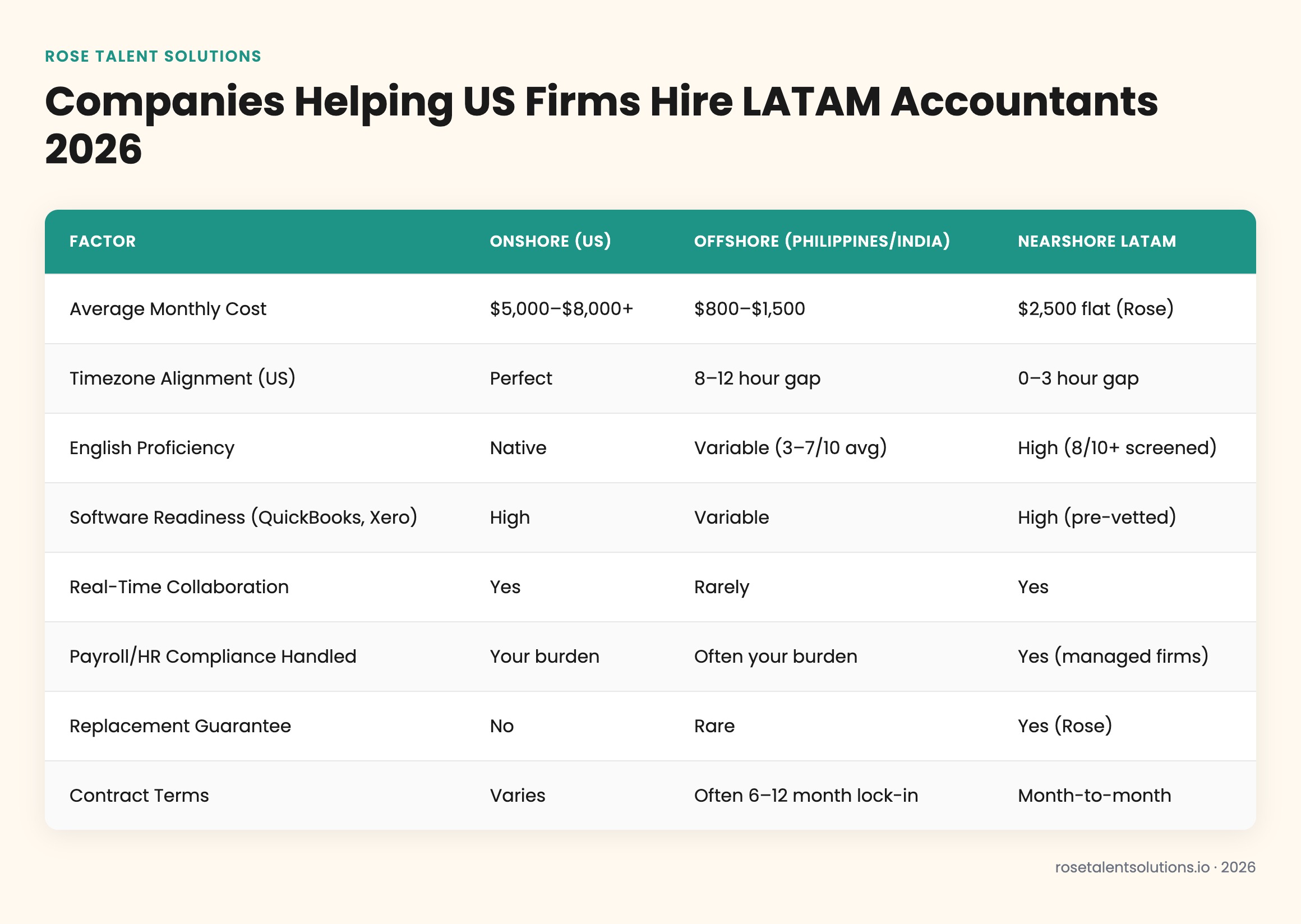
The table below is the clearest way to understand what you're actually choosing between. Many US firms default to offshore because the price point looks attractive in a headline, without accounting for the real operational costs of a 10-hour timezone gap in an accounting context.
| Factor | Onshore (US) | Offshore (Philippines/India) | Nearshore LATAM |
|---|---|---|---|
| Average Monthly Cost | $5,000–$8,000+ | $800–$1,500 | $2,500 flat (Rose) |
| Timezone Alignment (US) | Perfect | 8–12 hour gap | 0–3 hour gap |
| English Proficiency | Native | Variable (3–7/10 avg) | High (8/10+ screened) |
| Software Readiness (QuickBooks, Xero) | High | Variable | High (pre-vetted) |
| Real-Time Collaboration | Yes | Rarely | Yes |
| Payroll/HR Compliance Handled | Your burden | Often your burden | Yes (managed firms) |
| Replacement Guarantee | No | Rare | Yes (Rose) |
| Contract Terms | Varies | Often 6–12 month lock-in | Month-to-month |
"Nearshore outsourcing to Latin America is no longer a workaround—it's a strategic advantage. The combination of timezone parity, language fluency, and technical skill has closed the gap with domestic hiring in meaningful ways." — Agustín Rotondo, Co-founder at Near (nearshore staffing platform), cited in nearshore industry analysis (2024)
How AI-Augmented Accounting VAs Are Changing What's Possible in 2026
One trend reshaping this space is the addition of role-specific AI copilots to accounting team members. At Rose's AI Advantage program, every placed team member arrives equipped with an AI copilot trained on the specific software they'll use in your business—QuickBooks Online, Xero, NetSuite, Bill.com, or whichever platform your team runs on.
What that means practically: your LATAM accountant doesn't need a 90-day ramp to learn your stack from scratch. They arrive with pre-built workflow assistance that surfaces the right steps, flags anomalies, and reduces the error rate in reconciliation and AP tasks from day one. Software-trained team members ramp faster and make fewer early-stage errors—which matters enormously when you're trusting someone new with financial data.
The hidden cost of offshore accounting hires isn't the hourly rate—it's the 8–12 hour timezone gap that turns a 20-minute clarification into a 24-hour delay. In accounting, that delay compounds every time there's a discrepancy, a question from an auditor, or a vendor payment that needs approval before EOD.
According to the US Bureau of Labor Statistics (2024), accountants and auditors earn a median annual wage of $79,880 domestically—more than $6,600 per month before benefits, payroll taxes, or overhead. The nearshore model at $2,500/month all-in represents a substantial reduction in direct cost while preserving the real-time collaboration that domestic hires provide.

The McKinsey Global Institute (2023) found that remote, digitally fluent workers in lower-cost markets are increasingly taking on higher-skill finance and analytical roles previously considered "too complex" to offshore—a shift driven by better tooling, faster internet, and improving education pipelines in Latin America.
What the Onboarding Process Looks Like With a Quality LATAM Accounting Staffing Firm
If you've never hired nearshore accounting staff before, the process is simpler than you might expect when you work with a managed provider. Here's how Rose Talent Solutions structures it from initial conversation to your accountant's first day:
Intake & Role Definition
You tell Rose what the role needs to cover—AP/AR, month-end close, payroll support, controller-level work—and which software your team uses. This shapes the entire search and vetting process.
Sourcing & Screening
Rose recruits from its Latin American talent network, screens for English proficiency (8/10+ floor), software fluency, and accounting credentials. Only pre-vetted candidates move forward.
Client Interview
You interview your top match—same as you would any hire. If you don't feel confident, the search continues. You choose who joins your team.
Placement & AI Copilot Setup
Your accountant starts, equipped with their role-specific AI copilot trained on your software stack. Rose handles payroll, HR, and compliance from day one.
Ongoing Management Support
Rose stays engaged. If the fit isn't right, they replace the team member at no additional cost—no long-term contract required to get started.
You can explore the full service model on the Rose bookkeeping and accounting staffing page, which covers the specific accounting roles they place and what each engagement includes.
Why Latin America Specifically—and Why It Matters in 2026
Latin America's finance talent pipeline has expanded significantly over the past decade. Countries like Colombia, Mexico, Argentina, Costa Rica, and Chile have strong university accounting programs, growing CPA-equivalent certification rates, and a professional class that increasingly works for US companies remotely as a deliberate career path—not as a fallback option.
Why LATAM Works for US Accounting Firms
- 0–3 hour timezone gap means real-time collaboration during US business hours
- English proficiency rates among finance professionals are high and rising
- Familiarity with US GAAP, IRS concepts, and common US accounting software
- Cultural alignment with US business communication norms
- Lower cost of living means strong talent at a fraction of domestic rates
What to Watch Out For
- Quality varies widely without rigorous vetting—use managed providers, not raw job boards
- Not every LATAM accountant has US tax or regulatory experience—verify scope
- Direct hire requires you to manage cross-border payroll compliance yourself
- Candidates with strong resumes but weak English fluency can create communication friction
According to Statista (2024), Latin America's business process outsourcing market is projected to grow consistently through 2027, driven in large part by US firms seeking nearshore finance and accounting support. The talent pool is not shrinking—it's actively growing to meet demand.
If you're evaluating multiple types of Latin American staffing providers, this breakdown of virtual assistant companies operating in Latin America explains the structural differences between agency types and what each model means for your hiring experience. And if you're deciding between nearshore and a traditional onshore hire, this onshore vs. offshore comparison offers a clear framework for thinking through the tradeoffs specific to your business size and workflow.
When you're ready to move forward, the fastest path is a direct conversation about your specific accounting role. Start the process here and Rose will scope the role, identify candidates, and have a vetted LATAM accountant ready for your review—typically within days, not months.
The Pew Research Center (2022) found that business leaders increasingly view cross-border talent as a structural advantage rather than a cost-cutting measure—a framing that fits exactly what the best LATAM accounting hires deliver: real capability, real hours, and real collaboration at a price point that makes the numbers work.