
Nearshore cold calling VAs have quietly become the highest-leverage hire for US B2B sales teams in 2026 — and the gap between them and offshore or onshore alternatives is wider than most buyers realize before they sign their first contract. If you are evaluating cold calling VA services and trying to figure out which model actually moves pipeline, this comparison covers everything: cost structures, timezone realities, English proficiency standards, ramp time, and the hidden fees that turn a "cheap" offshore seat into an expensive lesson. The goal here is a decision you can defend to your board or your own P&L, not just the lowest sticker price.
What Is a Cold Calling VA — and How Does the Model Work in 2026?
A cold calling virtual assistant is a remote sales development representative who handles outbound prospecting on behalf of your business — dials, follow-up sequences, discovery qualification, and CRM logging — without sitting in your office or appearing on your W-2. The VA is sourced, vetted, and managed by a staffing partner rather than hired directly, which means the agency carries recruiting costs, HR compliance, and replacement risk. In 2026, the model has matured into three distinct flavors: nearshore (Latin America, US-adjacent time zones), offshore (Philippines, India, Eastern Europe), and onshore domestic freelance or agency placements.
Understanding which flavor fits your sales motion is the entire game. A company running an eight-hour US sales day needs a rep who is live and responsive during those same eight hours — not someone batching callbacks at 2 a.m. their time.
That statistic is why timezone alignment is not a nice-to-have — it is the foundational variable in cold calling VA performance. Every other factor (script quality, CRM hygiene, objection handling) sits downstream of whether your rep is actually live when your prospects pick up.
How the 2026 Pricing Models Actually Compare: Nearshore vs. Offshore vs. Onshore
Price is where most buyers start — and where they often get misled. Offshore vendors advertise hourly rates that look compelling until you add up management overhead, quality-control layers, and the cost of rework when calls get batched overnight. Onshore domestic VAs or fractional SDR agencies price well above what most SMBs can sustain for a full-time seat. Nearshore sits in the rational middle: full-time, dedicated coverage at a flat monthly rate with no recruiting or HR tail.
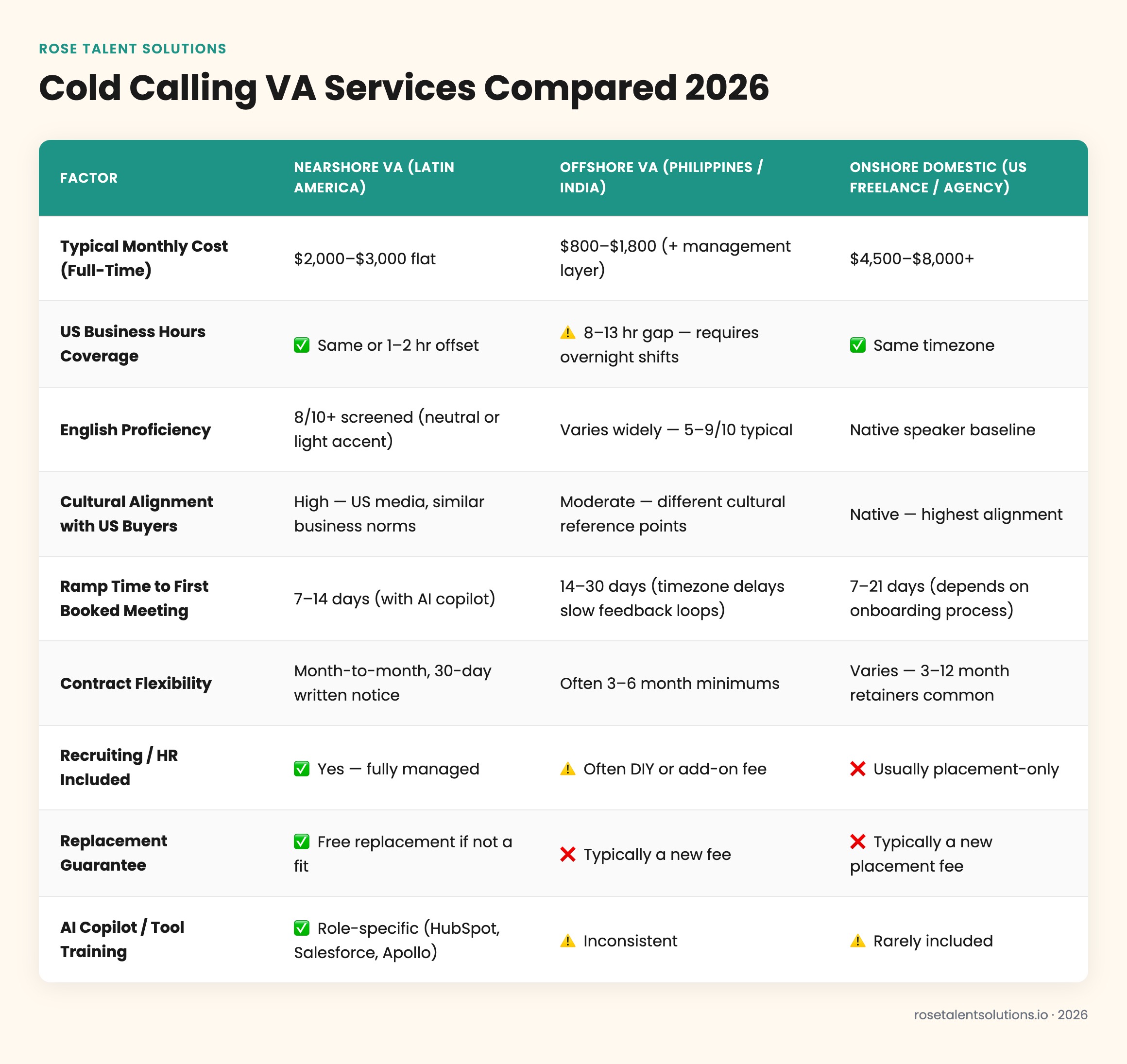
The table below compares the three main cold calling VA service models on the metrics that actually drive ROI for a US B2B sales team. Use this as your evaluation scorecard.
| Factor | Nearshore VA (Latin America) | Offshore VA (Philippines / India) | Onshore Domestic (US Freelance / Agency) |
|---|---|---|---|
| Typical Monthly Cost (Full-Time) | $2,000–$3,000 flat | $800–$1,800 (+ management layer) | $4,500–$8,000+ |
| US Business Hours Coverage | ✅ Same or 1–2 hr offset | ⚠️ 8–13 hr gap — requires overnight shifts | ✅ Same timezone |
| English Proficiency | 8/10+ screened (neutral or light accent) | Varies widely — 5–9/10 typical | Native speaker baseline |
| Cultural Alignment with US Buyers | High — US media, similar business norms | Moderate — different cultural reference points | Native — highest alignment |
| Ramp Time to First Booked Meeting | 7–14 days (with AI copilot) | 14–30 days (timezone delays slow feedback loops) | 7–21 days (depends on onboarding process) |
| Contract Flexibility | Month-to-month, 30-day written notice | Often 3–6 month minimums | Varies — 3–12 month retainers common |
| Recruiting / HR Included | ✅ Yes — fully managed | ⚠️ Often DIY or add-on fee | ❌ Usually placement-only |
| Replacement Guarantee | ✅ Free replacement if not a fit | ❌ Typically a new fee | ❌ Typically a new placement fee |
| AI Copilot / Tool Training | ✅ Role-specific (HubSpot, Salesforce, Apollo) | ⚠️ Inconsistent | ⚠️ Rarely included |
How Nearshore Cold Calling VAs Outperform Offshore for US Sales Teams in 2026
The performance gap between nearshore and offshore cold calling VAs comes down to three compounding advantages: real-time collaboration, cultural fluency, and feedback loop speed. When your nearshore rep books a call at 10 a.m. EST, you can debrief at 10:15. When an offshore rep working a night shift hits an objection they have never encountered, they queue it for a manager review that might happen fourteen hours later. Multiply that lag across a 20-call day and you understand why ramp times for offshore cold calling programs routinely stretch past thirty days.
Cultural alignment matters more in cold calling than in almost any other VA role. According to SHRM's research on communication effectiveness, shared cultural reference points — sports, news cycles, regional business norms — measurably reduce the friction in first-touch sales conversations. A Latin American rep who watches the same news, understands US holidays, and works the same hours as your prospects does not have to manufacture rapport. It is structural.
If you are a B2B startup trying to build your first outbound motion, the best nearshore SDR services for B2B startups deep-dive covers exactly how to structure that first hire so it compounds rather than stalls.
"Sales development is fundamentally a conversation-quality game. If your SDR sounds like they are reading from a script in a call center at midnight, your prospect knows it in the first thirty seconds. Accent is less important than authenticity and timing." — Trish Bertuzzi, Founder and CEO at The Bridge Group, The Bridge Group (2023)
The AI copilot advantage Rose builds into every placement accelerates this further. Each cold calling VA ships pre-trained on the specific CRM and sales engagement stack your team already uses — HubSpot sequences, Salesforce call logging, Apollo.io list management — so the rep is productive in days, not weeks. According to McKinsey's State of AI in Sales report, AI-assisted SDRs convert 20–30% more pipeline opportunities than non-AI-assisted peers working equivalent lists.
The real competitive moat of nearshore cold calling VAs in 2026 is not just cost — it is the compounding effect of same-timezone feedback loops, cultural fluency with US buyers, and AI-assisted outreach all arriving in one flat-rate seat. Offshore pricing looks cheaper on a spreadsheet until you model the actual cost of slow ramp, overnight lag, and replacement fees.
How to Evaluate Any Cold Calling VA Service: The 2026 Buyer Checklist
Most buyers evaluate cold calling VA services on price alone and end up disappointed within sixty days. The buyers who get it right treat it like a junior SDR hire: they evaluate the sourcing standard, the training infrastructure, the performance feedback loop, and the exit terms before they commit. Here is the process that separates a strategic VA hire from an expensive experiment.
Define your ideal call profile
Before contacting any vendor, document your target persona, typical call length, objection frequency, and CRM workflow. A good VA service will use this to match you to the right rep — a great one will build a pre-boarding training doc from it.
Screen for real-time US-hours availability
Ask specifically: "Will this rep be live during my 9–5 EST/PST window?" Get it in writing. Any hedging on this point is a red flag for an offshore operation running night shifts.
Request a live English proficiency sample
Listen to a recorded call or run a live screen call with the proposed rep before placement. Rose sets a published 8/10+ English floor — ask any vendor what their equivalent standard is and how it is measured.
Verify replacement terms in writing
If the rep is not a fit after the first few weeks, what happens? The right answer is a free replacement at no additional cost. If the vendor quotes a new placement fee, walk away.
Confirm contract flexibility
Month-to-month with 30 days written notice is the standard that protects you. Any vendor requiring a six-month or annual commitment for a cold calling VA seat is pricing their churn risk onto you.
If you are also weighing whether a VA-based outbound model makes more financial sense than hiring in-house, the outsourced vs. in-house SDR hiring ROI comparison breaks down the true fully-loaded cost of each path including benefits, management time, and ramp costs that most internal P&Ls miss.
According to the U.S. Bureau of Labor Statistics, the median annual salary for a domestic B2B sales development representative exceeded $52,000 in 2023 before benefits, payroll tax, recruiting, and management overhead — easily $75,000–$85,000 fully loaded. A nearshore cold calling VA at $2,500/month runs $30,000 annually, fully managed, with no recruiting cost and a free replacement guarantee if the fit is wrong. That delta funds two additional nearshore reps or goes straight back to EBITDA.
For smaller teams specifically — under twenty employees — the math compounds even faster because every internal hire displaces founder or manager attention. The best B2B lead generation services for under-20-employee teams covers how to structure that first outbound seat without over-engineering the stack.
Nearshore Cold Calling VAs: Pros, Cons, and When the Model Fits
No model is perfect for every sales motion. Nearshore cold calling VAs are the right call for most US B2B companies running a structured outbound program — but there are specific situations where a different approach makes more sense. Here is the honest breakdown.
Pros of Nearshore Cold Calling VAs
- Real-time US-hours coverage — no overnight lag on objections, coaching, or CRM updates
- Flat monthly pricing ($2,500/mo) with recruiting, HR, and management included
- 8/10+ English proficiency floor reduces call quality variance
- Cultural alignment with US business norms — sports, news, professional etiquette
- AI copilot pre-trained on your CRM stack cuts ramp time to 7–14 days
- Month-to-month terms with 30 days written notice — no long-term contract lock-in
- Free replacement if the rep is not a fit — zero additional cost to you
When Nearshore May Not Be the Fit
- Very early-stage companies with no defined ICP or call script yet — the VA needs a playbook to execute
- Highly technical products requiring deep domain expertise (e.g., enterprise cybersecurity) where a US-market senior SDR may be necessary
- Companies needing multi-language calling beyond English and Spanish
- Organizations that require on-site presence for compliance or security reasons
For SaaS companies specifically evaluating this model, the step-by-step guide on how to hire outsourced SDR services for SaaS walks through how to structure the handoff between your AE team and a nearshore VA so booked meetings actually show up with context, not just a calendar invite.
According to Gallup's State of the Global Workplace report, remote workers who operate within the same cultural and timezone context as their team report 23% higher engagement scores than those working across significant timezone gaps — and engagement directly predicts performance in high-volume outbound roles. That number should matter to anyone managing call volume KPIs.
If after reading this you are ready to place your first nearshore cold calling VA, the fastest path is through Rose's intake process — you describe your ICP, call cadence, and CRM stack, and placement typically happens within seven days. Every placement includes the AI copilot, no long-term contract, and a free replacement if the fit is wrong. There is no lower-risk way to put a dedicated outbound rep on your pipeline in 2026.