
What Is Coding Outsourcing — and Why Does the Model Matter in 2026?
Nearshore coding outsourcing is the practice of hiring technical talent in a neighboring region — for US and Canadian businesses, that almost always means Latin America — rather than building an in-house team or routing work to distant offshore markets like India or the Philippines. The model matters because not all outsourcing is created equal. Timezone gaps, language barriers, and contractor churn can quietly eat the savings you thought you were getting.
Coding outsourcing, in its broadest definition, covers any arrangement where a business delegates software development, QA, data engineering, or technical operations to staff outside its own payroll. That could be a freelance marketplace gig, a staff augmentation firm, or a fully managed nearshore placement. Each carries a different cost structure, risk profile, and output quality — and in 2026, the gap between the best and worst models has widened significantly.
The global IT outsourcing market is projected to reach $617.69 billion by 2030, according to Grand View Research (2024). That number alone tells you demand isn't slowing — but it also tells you the market is crowded with vendors making similar promises. Knowing exactly which outsourcing model fits your business is the only way to avoid the expensive mistakes.
If you want a deeper breakdown of how nearshore compares to offshore and onshore hiring across every dimension, the complete nearshore vs offshore vs onshore comparison on the Rose blog is the most thorough resource we've published. For now, let's focus specifically on how coding outsourcing plays out across those three models.
How Nearshore, Offshore, and Onshore Coding Outsourcing Compare in 2026
Most business owners default to offshore coding outsourcing because the hourly rates look cheap on paper. A developer in Southeast Asia or South Asia might quote $15–$25/hour versus $75–$150/hour for a US-based contractor. But that math ignores the compounding costs of miscommunication, delayed standups, and asynchronous code reviews that stretch a two-week sprint into six weeks.
Nearshore coding — specifically Latin America for North American businesses — closes most of those gaps. Developers in Colombia, Mexico, Argentina, and Brazil work real-time US business hours, carry strong English fluency, and operate in similar cultural contexts. The result is faster feedback loops, cleaner handoffs, and dramatically lower management overhead on your side.

| Factor | Nearshore (Latin America) | Offshore (Asia) | Onshore (US/Canada) |
|---|---|---|---|
| Monthly Cost (Full-Time) | ~$2,500–$4,000 | ~$1,500–$3,000 | ~$8,000–$15,000+ |
| Timezone Overlap (US East) | 6–8 hours/day | 0–2 hours/day | 8 hours/day |
| English Proficiency | High (8/10+ screens common) | Variable (5–8/10) | Native |
| Ramp Time to Productivity | 3–7 days | 7–21 days | 7–14 days |
| Contract Flexibility | Month-to-month available | Project-based or annual | W-2 or long-term contract |
| AI Copilot Integration | Yes (role-specific tools) | Varies by vendor | Depends on employer |
| Recruiter + HR Included | Yes (fully managed) | Rarely | No (internal HR required) |
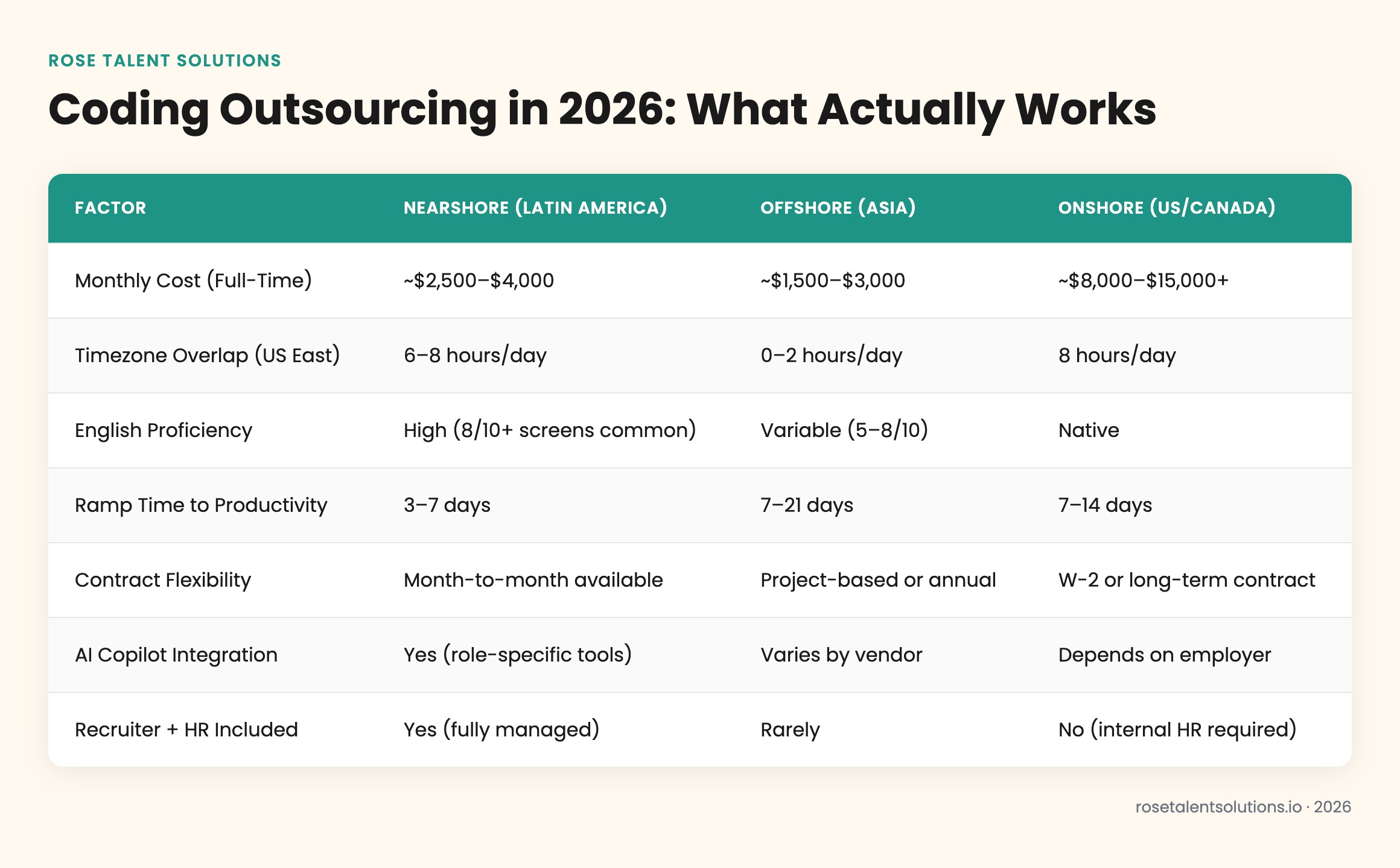
One detail that rarely shows up in cost calculators: hidden management time. When your offshore developer is 10–12 hours ahead, every clarification question becomes a 24-hour delay. Multiply that by a 3-person team and a 60-day project, and you've lost weeks of calendar time you'll never get back. That's the real cost of cheap offshore coding outsourcing, and it's one reason the onshore vs offshore hiring debate keeps tilting toward nearshore for US operators.
What Does Coding Outsourcing Actually Cost in 2026?
Pricing models for coding outsourcing fall into three buckets: hourly freelance rates, project-based contracts, and flat-rate staff augmentation. Each has legitimate use cases, but they're not interchangeable.
Hourly freelance platforms (Upwork, Toptal, Freelancer) put the rate negotiation in your hands, but they leave recruiting, vetting, payroll, HR, and quality control entirely on you. For a one-off script or a small bug fix, that's fine. For ongoing technical work — data pipelines, integrations, QA, dev ops support — the overhead of managing freelancers compounds fast. According to SHRM (2024), the cost of replacing a single skilled employee runs 50–200% of their annual salary. That math applies equally to contractor churn.
Project-based contracts with a dev shop give you a scoped deliverable but zero flexibility once the scope shifts — and scope always shifts. You'll pay change-order premiums for anything not explicitly written into the original statement of work.
Flat-rate staff augmentation, the model Rose Talent Solutions uses, bundles recruiting, vetting, payroll, HR, and ongoing management into one predictable monthly number — $2,500/month for a full-time (40 hrs/week) nearshore team member. No long-term contract. If the placement isn't a fit, Rose replaces them at no additional cost. That's the entire risk reversal. For businesses that need consistent technical output without the operational weight of a staffing department, flat-rate nearshore is the most capital-efficient structure available in 2026.
Curious how Latin American developer compensation benchmarks compare to what you'd pay through a managed agency? The average salary data for Latin America virtual assistants breaks down what the market actually looks like — and why the flat-rate model works in your favor.
How AI Is Changing Coding Outsourcing Productivity in 2026
The biggest shift in coding outsourcing between 2023 and 2026 isn't the geography — it's the AI layer sitting on top of every technical role. Developers and technical VAs who are actively using AI copilots (GitHub Copilot, Cursor, role-specific GPT integrations) are shipping measurably faster than those who aren't.
AI copilots don't replace your outsourced developer — they make your nearshore developer significantly more productive per dollar spent. A $2,500/month team member augmented with role-specific AI tooling can output work that previously required a $6,000–$8,000/month senior contractor. That's the 2026 nearshore arbitrage.
According to GitHub's developer productivity research (2023), developers using GitHub Copilot completed tasks 55% faster than those without AI assistance. When that productivity gain is applied to a nearshore team member already operating at a cost advantage, the effective output-per-dollar ratio becomes difficult for onshore hiring to match.

At Rose, every team member ships with a role-specific AI copilot trained on the software they'll actually use — whether that's a project management stack, a bookkeeping platform, or a custom CRM integration. This isn't a checkbox feature — it's the primary reason nearshore placements through Rose ramp faster than traditional offshore hires.
The AI advantage compounds over time. A nearshore developer who starts with an AI copilot on day one doesn't just write code faster — they catch bugs earlier, document more consistently, and require fewer back-and-forth clarifications with your senior engineers. That saves your internal team hours per week that would otherwise go to code review and rework.
According to McKinsey (2023), generative AI tools could automate 60–70% of employee time currently spent on routine software tasks. For coding outsourcing specifically, that means the roles that make the most sense to nearshore in 2026 are the ones where AI can handle the repetitive scaffolding while your nearshore developer handles the judgment-heavy work.
How to Choose the Right Coding Outsourcing Model for Your Business in 2026
The right outsourcing model depends on three variables: how ongoing the work is, how much management bandwidth you have, and how much timezone friction you can absorb. Here's how the decision actually plays out for most US and Canadian businesses.
Audit Your Technical Workload
Separate one-time projects (build a landing page, fix a specific bug) from ongoing work (QA, integrations, data pipelines, dev ops). Ongoing work almost always favors a dedicated nearshore hire over a freelance marketplace.
Calculate True All-In Cost
Get the fully loaded cost of your current approach: hourly rate × hours, plus your own time spent on recruiting, managing, and correcting errors. Most operators discover they're spending more than $2,500/month equivalent when they count management overhead honestly.
Test Timezone Fit First
Before signing any contract, run a single standup at your normal working hours with the proposed team. If they can't do a 9am ET call fluently and reliably, the timezone pitch is marketing, not reality. Rose's Latin America teams do this natively — no schedule gymnastics required.
Verify English Proficiency Screens
Ask your vendor what English proficiency score they screen for and how it's measured. Rose's published floor is 8/10+ on standardized proficiency screens. Anything below that and you're accepting communication risk on every technical ticket.
Lock In Flexibility on Exit
Avoid vendors requiring 6- or 12-month minimums for an initial placement. Rose operates on a month-to-month basis with 30 days written notice — which means you can scale up or pivot without penalty if your technical needs shift.
Working with a nearshore staffing agency that handles recruiting, vetting, payroll, and HR internally means you never have to rebuild that operational infrastructure yourself. That's a significant advantage for lean teams where the founder or CTO is already wearing too many hats.
Nearshore Coding Outsourcing — Strengths
- Real-time US timezone overlap (6–8 hours/day)
- High English fluency — 8/10+ proficiency screens standard
- Flat-rate pricing with no long-term contract required
- AI copilot augmentation from day one
- Recruiting, HR, payroll fully managed by the agency
- Free replacement if the placement isn't a fit
Where Nearshore Is Not the Right Fit
- Single-day, one-off tasks (a freelance marketplace is faster)
- Highly specialized niche roles with very thin LATAM talent pools
- Projects requiring on-site presence or US security clearance
For businesses that have already validated their need for ongoing technical support — whether that's bookkeeping and accounting automation, property management integrations, or general dev ops — the nearshore flat-rate model is the fastest path to consistent output without the overhead of a full internal hire.
If you're ready to scope out your first nearshore technical placement, the Rose intake process takes under 10 minutes and will match you with a pre-vetted candidate within days, not weeks. And for context on how Rose's broader property management VA practice applies these same nearshore principles to operational roles, that page shows how the model scales across different business functions.
According to Gallup (2023), only 23% of employees globally are engaged at work — a statistic that makes the case for smaller, more intentional team structures rather than large offshore pools where individual accountability is harder to maintain. Nearshore, fully-managed placements solve for accountability in a way that anonymous freelance marketplaces structurally cannot.
"Latin America has become the default answer for US tech companies that need real-time collaboration without the salary overhead of domestic hiring. The talent depth there in 2024 and beyond is genuinely underestimated." — Julián Torres, Co-Founder at Gorilla Logic (2024)
Coding outsourcing in 2026 is not a cost-cutting tactic — it's a talent strategy. The businesses winning with it aren't the ones who found the cheapest hourly rate. They're the ones who found the right timezone, the right English fluency, the right AI tooling, and a vendor willing to own the operational complexity so they didn't have to.