
Nearshore staffing partners exist precisely to remove the friction between "I need help" and "help is actually working." If you have ever wondered whether a staffing partner can help set up nearshore teams — the answer is yes, and it is the fastest path from overwhelmed to fully staffed. If you have tried to hire internationally on your own — posting on freelance platforms, navigating foreign payroll law, coordinating interviews across a 10-hour time gap — you already know why a managed partner changes the math entirely. This article walks through exactly what a staffing partner does to stand up a nearshore team, where the leverage comes from, and what to watch for when evaluating providers in 2026.
That overload is exactly the gap a nearshore team is designed to fill — and a staffing partner is the mechanism that makes filling it fast, compliant, and low-risk. Before diving into how the partner model works, it is worth defining what a nearshore virtual assistant actually is.
What Is a Nearshore Virtual Assistant, and Why Does It Matter in 2026?
A nearshore virtual assistant is a full-time remote professional based in Latin America — countries like Colombia, Mexico, Argentina, or Costa Rica — who works during US business hours and communicates in fluent English. Unlike offshore VAs based in the Philippines or India, nearshore hires share overlapping time zones with US clients, enabling real-time collaboration rather than asynchronous back-and-forth. Rose Talent Solutions screens every candidate to an 8/10 or higher English proficiency floor before a client ever sees a profile.
The question of whether a staffing partner can help set up nearshore teams is really a question of infrastructure: do you have the recruiting network, vetting process, payroll systems, and HR compliance framework to do it yourself? Most businesses do not — which is precisely why a managed partner exists. If you want a full breakdown of how the models compare on cost, communication quality, and management overhead, this complete nearshore vs. offshore vs. onshore VA comparison covers every dimension in detail.
According to the U.S. Bureau of Labor Statistics Job Openings and Labor Turnover Survey (2024), the average time-to-fill for an administrative role in the US is now 44 days — and that is before factoring in onboarding. A staffing partner that specializes in nearshore teams compresses that timeline dramatically, often delivering interview-ready candidates within a single week.

How a Staffing Partner Builds Your Nearshore Team in 2026
The value of a managed staffing partner is not just access to talent — it is the elimination of every non-core task that sits between you and a productive hire. A staffing partner can help set up nearshore teams precisely because they own the entire pipeline, from role design through ongoing HR. Here is the full sequence Rose Talent Solutions runs for every placement.
Role Discovery
A client success consultant maps your workflows, software stack, and communication preferences to build a precise candidate profile — not a generic job description.
Sourcing & Vetting
Recruiters pull from Rose's Latin America talent network, screen for English proficiency (8/10+ required), role-specific software experience, and cultural alignment with US business norms.
Client Interview & Selection
You interview shortlisted candidates — typically within 5–7 business days of kickoff — and choose the person you want to work with.
AI Copilot Activation
Before day one, Rose activates a role-specific AI copilot trained on the software your new team member will use — AppFolio, Buildium, QuickBooks, and others — so ramp time shrinks from weeks to days.
Ongoing HR & Management
Payroll, compliance, performance check-ins, and HR support stay with Rose — you stay focused on your business, not on managing an international employment relationship.
The flat $2,500/month rate covers recruiting, vetting, payroll, HR, and ongoing management — no per-hire fees stacked on top, no surprise invoices at year-end. The engagement runs month-to-month with no long-term contract, so you are not locked in if your needs change. And if the team member turns out not to be the right fit, Rose replaces them at no additional cost.
How Does Nearshore Staffing Compare to Offshore and Onshore Options in 2026?
Choosing a staffing model is one of the highest-leverage decisions a growing business makes. The table below compares the three primary models across eight dimensions that matter most to US operators — and makes clear why a staffing partner that specializes in nearshore teams delivers a fundamentally different outcome than a generic offshore agency.
| Dimension | Nearshore (Latin America) | Offshore (Philippines / India) | Onshore (US-Based) |
|---|---|---|---|
| Time Zone Alignment | ✅ Same or ±1–2 hrs US ET/PT | ❌ 9–13 hrs ahead — async by default | ✅ Perfect alignment |
| English Proficiency | ✅ 8/10+ screened | ⚠️ Variable; accent issues common | ✅ Native |
| Monthly Cost (Full-Time) | ✅ ~$2,500 all-in | ✅ ~$1,200–$2,000 | ❌ $4,500–$7,000+ salary + benefits |
| Cultural Alignment with US | ✅ High — US media, business norms | ⚠️ Moderate | ✅ Native |
| Real-Time Collaboration | ✅ Synchronous workday | ❌ Overnight turnaround typical | ✅ Synchronous workday |
| HR / Payroll Complexity | ✅ Managed by staffing partner | ⚠️ Managed or DIY agency | ❌ Full US employment law applies |
| AI Copilot Included | ✅ Role-specific (Rose) | ❌ Rarely included | ❌ Rarely included |
| Risk Reversal | ✅ Free replacement if not a fit | ⚠️ Varies by provider | ❌ Full severance / legal exposure |
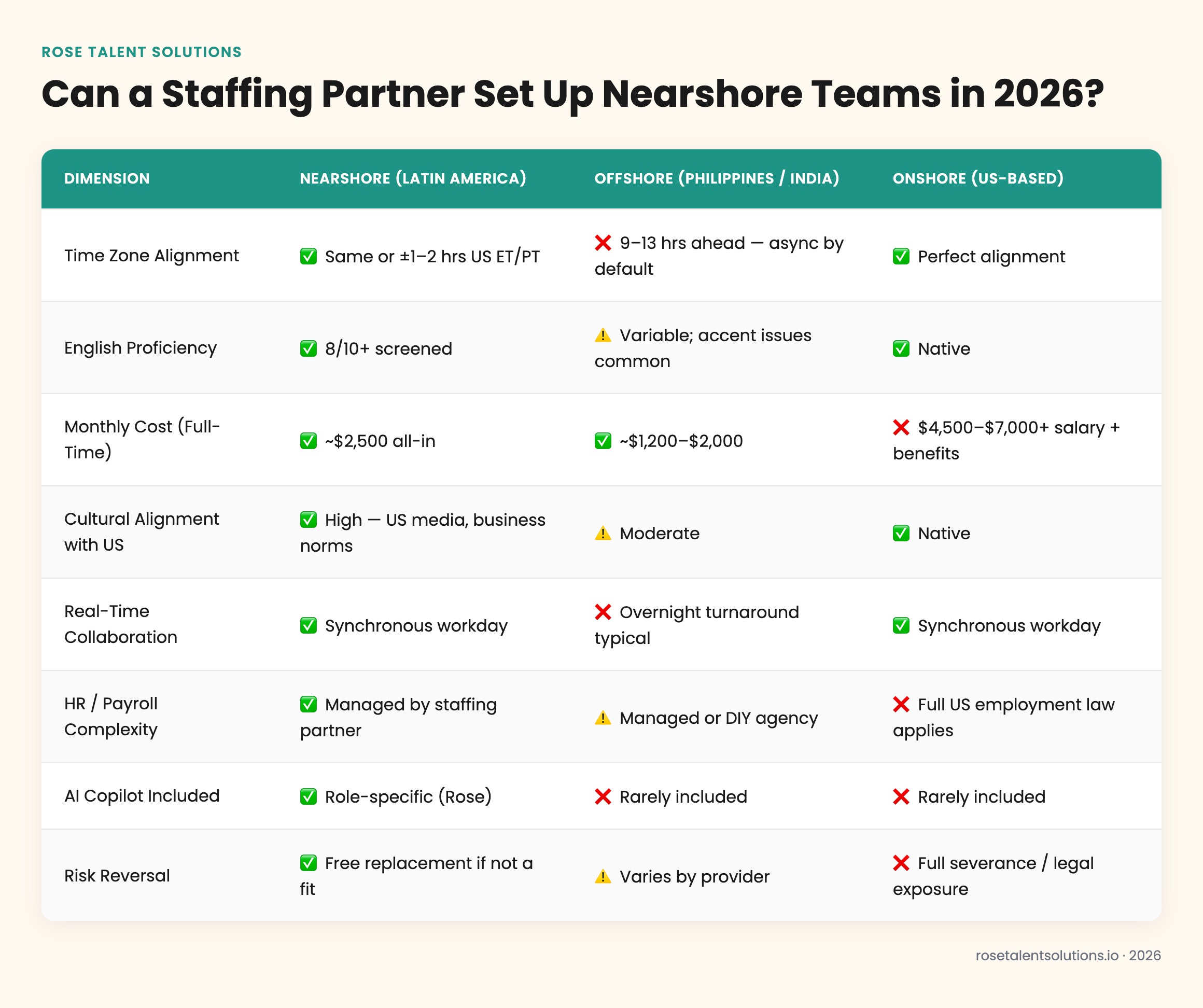
For a deeper look at how the onshore model stacks up specifically against offshore hiring — including total cost of employment comparisons — see this onshore vs. offshore virtual assistant breakdown. The nearshore sweet spot sits squarely between the two: the cost efficiency of offshore with the real-time collaboration of onshore.
"Organizations that implement structured remote talent programs with defined onboarding processes report 2.5× faster time-to-productivity compared to ad-hoc remote hiring." — Josh Bersin, HR Industry Analyst and Founder at The Josh Bersin Company (2024)
What Tasks Can a Nearshore Team Handle — and How Does AI Accelerate It in 2026?
One of the most common hesitations business owners have before asking whether a staffing partner can help set up nearshore teams is scope: what can they actually do? The answer is broader than most people expect. Nearshore VAs handle everything from inbox and calendar management to bookkeeping, CRM updates, customer support, leasing coordination, and financial reporting — provided they have the right software training and a clear system to plug into.
For a role-by-role breakdown of what specific tasks a nearshore hire can own from week one, this guide to what tasks a nearshore virtual assistant can handle maps it out by function — from administrative work to property management to bookkeeping support.
Rose addresses the productivity ramp directly through its AI copilot program. Every team member arrives with a copilot trained on the specific software they will use — AppFolio for leasing coordinators, QuickBooks or Xero for bookkeeping roles, Buildium for property management workflows. According to Buildium's 2024 Property Management Industry Report, property managers who use software-integrated virtual staff report significantly faster onboarding outcomes than those relying on general administrative hires.
The AI copilot program is not a chatbot bolted onto the side — it is a role-specific assistant trained on the exact workflows, software documentation, and process playbooks your new team member will use from day one. That is what drives the speed advantage Rose clients consistently report when they ask whether a staffing partner can help set up nearshore teams and then see the answer in action.

The hidden cost of an offshore VA is not the hourly rate — it is the 9–13 hour timezone gap that turns every urgent tenant issue, client revision, or data question into a next-day problem. Nearshore eliminates that delay entirely, which compounds into hours of recovered productivity every single week.
How Nearshore Team Costs Compare to US Hiring in 2026
Cost is always part of the conversation, and it should be — but the comparison needs to be made correctly. Hiring a full-time US-based administrative or operations employee in 2026 typically costs between $45,000 and $65,000 in base salary alone, before benefits, payroll taxes, PTO, equipment, and recruiting fees. According to Gallup's workforce research (2023), the cost of replacing a single employee averages one-half to two times that employee's annual salary — a figure that compounds every time a hire does not work out.
A Rose nearshore team member costs $2,500/month — $30,000/year, all-in, including every HR, recruiting, and management cost. That is typically 50–65% less than a comparable US hire when total employment cost is calculated. And because the engagement is month-to-month with no long-term contract, the risk profile is fundamentally different from a direct employee relationship. According to McKinsey's Future of Work research (2022), businesses that adopt flexible, distributed staffing models report lower per-output labor costs and higher retention compared to traditional fixed employment.
If you are curious about what Latin American professionals typically earn and how that translates into the flat-rate model, this breakdown of average Latin American virtual assistant salaries provides the underlying economics clearly — and helps explain why a staffing partner can set up nearshore teams at a price point that domestic hiring simply cannot match.
Why Businesses Choose a Staffing Partner to Set Up Nearshore Teams
- No recruiting infrastructure needed — partner handles sourcing, screening, and placement
- Payroll, HR, and compliance managed entirely by the partner
- Faster time-to-hire: days, not months
- Risk reversal — free replacement if the match is not right
- AI copilot included, reducing ramp time significantly
- Month-to-month terms with no long-term contract
What to Watch for When Evaluating Partners
- Vague English proficiency standards — ask for specific screening scores
- Hidden fees layered on top of the base rate
- No replacement guarantee — walk away if this is absent
- Offshore talent misrepresented as "nearshore" — confirm Latin America placement explicitly
- Lack of software-specific training or AI tools for your stack
How to Start Working with a Nearshore Staffing Partner in 2026
Getting started is simpler than most business owners expect. The intake process at Rose begins with a short discovery call where your workflows, software, and team gaps are mapped — no lengthy RFP process, no multi-month procurement cycle. From there, the recruiting and vetting work runs in the background while you stay focused on your business. A staffing partner can help set up nearshore teams across virtually any function, and the process is designed so the operational lift falls entirely on the partner, not on you.
If you manage properties, the property management VA service page outlines the specific roles — leasing coordinators, maintenance dispatchers, AppFolio administrators — that Rose places most frequently in that vertical. For finance and operations, the bookkeeping and accounting VA page covers the QuickBooks and Xero-trained roles that handle AP/AR, reconciliations, and financial reporting.
The single most important question to ask any staffing partner is: what happens if the placement is not right? If the answer is not a clear, unconditional replacement guarantee, that is a red flag. Rose's answer is simple: if the team member is not a fit, they replace them at no additional cost, with no dispute process and no finger-pointing.
Ready to see who Rose would match to your open role? Start the process here — most clients have a shortlist of vetted nearshore candidates within a week.