
What Is a Nearshore SDR — and Why Does the Definition Matter?
Nearshore sales development reps are full-time outbound specialists based in Latin America — not the Philippines, not India — who work on your timezone and speak fluent English. That last part isn't a nice-to-have. It is the entire product. A nearshore SDR operates inside your business hours, joins your Slack, attends your Monday standups, and dials your ICP prospects during the same window your AEs are available to take a handoff call. That's the model. The timezone alignment is what separates nearshore from traditional offshore outsourcing, and it's the reason meeting quality differs so dramatically between the two.
A sales development representative (SDR) is responsible for the top of the funnel: prospecting, cold outreach (email, phone, LinkedIn), qualifying interest, and booking meetings for an account executive or founder to close. In B2B SaaS specifically, the SDR role lives and dies by meeting quality — not just volume. Booking ten calls that never show, or showing up but can't buy, is worse than booking four that convert. The question of whether a nearshore SDR can hit that quality bar is really a question about language, process, and ICP knowledge — all three of which are solvable.
The cost gap is real, but savvy SaaS operators have learned not to lead with cost. They lead with whether the rep can hold a credible conversation with a VP of Engineering or a Head of Revenue Operations. If the answer is yes — and with the right vetting, it is — the $4,700/month in savings per SDR seat becomes the bonus, not the reason. According to the U.S. Bureau of Labor Statistics (2024), median annual wages for sales representatives in technical and scientific products exceed $97,000 before benefits or overhead — confirming why the fully-loaded US SDR seat routinely clears $7,000 per month.
How Nearshore SDRs Outperform Offshore for B2B SaaS Pipeline in 2026
The offshore model — reps based in Southeast Asia or South Asia running batch-and-blast email sequences on a 10–12 hour timezone gap — has a well-documented quality problem. The core issue isn't talent; it's structural. When your SDR is asleep during your prospect's decision window, personalization collapses into templates, and follow-up calls never happen in real time. According to Salesforce's State of Sales report (2024), 82% of business buyers expect an immediate response when they engage with outreach — "immediate" meaning within business hours, same day. An offshore rep simply cannot deliver that.
Nearshore reps flip that equation. Because they're in Colombia, Mexico, Costa Rica, or Argentina, the timezone delta to US Eastern, Central, or Pacific is one to three hours at most. Your SDR is online at 8am EST, can call a prospect in Chicago at 9am their time, and can loop in your AE for a live discovery extension the same morning. If you're evaluating your options for hiring outsourced SDR services for your SaaS company, timezone fit should be the first filter you apply — not price.
English fluency is the second structural variable. Rose Talent Solutions screens every SDR candidate to an 8/10 or above on English proficiency — written and spoken — before they reach your desk. That bar matters because B2B SaaS buyers are sophisticated. A VP at a mid-market logistics software firm can tell within ninety seconds of a cold call whether the person on the other end understands their world. Reps who clear the 8/10 threshold hold that conversation. Reps who don't lose the call in the first ninety seconds.
Nearshore vs. Offshore vs. US In-House SDR: 2026 Comparison
Before committing budget to any SDR model, it's worth mapping the real variables side by side. The table below covers the five dimensions that matter most for B2B SaaS pipeline generation: fully-loaded monthly cost, timezone alignment with US buyers, English fluency reliability, average ramp time to first booked meeting, and typical meeting-to-show rate. These figures are drawn from published industry benchmarks and Rose's own placement data.
| SDR Model | Monthly Cost (Fully Loaded) | US Timezone Fit | English Fluency (Avg) | Ramp to First Meeting | Meeting Show Rate |
|---|---|---|---|---|---|
| Nearshore (Latin America) | ~$2,500 flat | ✅ 1–3 hr overlap | 8/10+ screened | 7–14 days | 65–75% |
| Offshore (Philippines / India) | $1,200–$2,000 | ❌ 10–13 hr gap | 5–7/10 typical | 21–35 days | 40–55% |
| US In-House SDR | $6,500–$8,500 | ✅ Same timezone | Native | 30–60 days | 70–80% |
| US SDR Agency (outsourced) | $8,000–$15,000 | ✅ Same timezone | Native | 14–30 days | 60–70% |
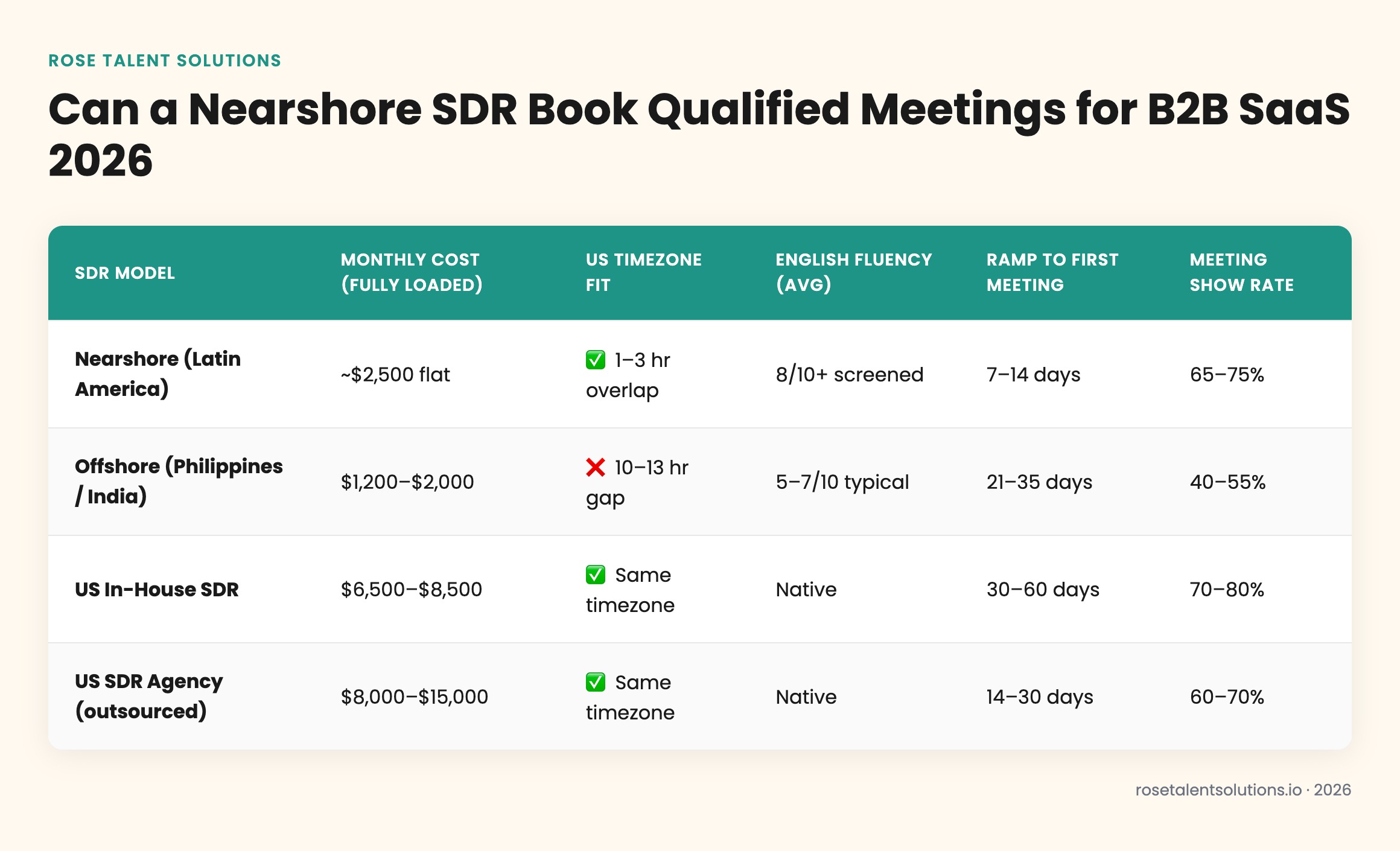
The nearshore model sits in a compelling middle position: show rates and fluency that match or approach in-house quality, at a cost structure that's 65–70% cheaper. For early-stage SaaS companies still validating ICP or testing messaging, that cost delta is the difference between running two SDR experiments simultaneously or betting everything on one expensive US hire. If you want a deeper breakdown of where the ROI math actually lands, the outsourced vs. in-house SDR ROI comparison is worth reading before you model your next quarter's pipeline budget.
What Does a Nearshore SDR Actually Do Day-to-Day for a SaaS Company?
The mechanics matter. A nearshore SDR embedded in a B2B SaaS team typically owns a defined set of workflows: building or enriching prospect lists from Apollo, ZoomInfo, or LinkedIn Sales Navigator; writing and A/B testing cold email sequences in tools like Outreach or Instantly; making 40–80 cold calls per day using a power dialer; managing LinkedIn connection cadences; and logging all activity in Salesforce or HubSpot. According to Gartner's SDR Benchmark research (2024), top-performing SDRs across all models run 8–12 touchpoints per prospect across at least three channels before qualifying or disqualifying — a workflow any well-trained nearshore rep can execute.
Where nearshore SDRs specifically excel is asynchronous follow-up with live reinforcement. Because they're on US hours, they can send a morning email, follow up with a call two hours later when the prospect has had time to open it, and then drop a LinkedIn message in the afternoon. That real-time sequencing is simply not possible with a rep operating on a 12-hour lag. For SaaS companies selling to SMB or mid-market segments — where response speed is a direct conversion variable — this single operational difference drives meaningful pipeline lift.
Every Rose nearshore SDR also ships with a role-specific AI copilot trained on their outreach stack — whether that's Salesforce, HubSpot, Apollo, or Outreach. This means faster personalization at scale, better call prep, and less time on manual data entry. The rep spends more of their 40-hour week on actual prospect conversations, not administrative cleanup. According to McKinsey's research on AI in sales (2024), sales reps who use AI assistance tools spend up to 20% more of their available time on direct selling activities — a material advantage when your SDR is measured on meetings booked.
The biggest hidden cost in SDR outsourcing isn't the hourly rate — it's the timezone gap. A rep who can't follow up in real time during your buyer's decision window will book fewer meetings, generate lower show rates, and produce pipeline that stalls before it ever reaches your AE.
How Rose Talent Solutions Places a Nearshore SDR: The 2026 Process
Understanding the placement process matters because speed and specificity are both pipeline variables. The faster your SDR is ramped and sequencing, the sooner your AE calendar fills. Rose's process is built around a defined five-step workflow from intake to first booked call.
ICP + Stack Intake
Rose collects your ideal customer profile, current outreach stack, sequencing cadences, and any existing messaging. This is the context your SDR needs to sound credible on day one.
Candidate Matching
Rose matches from a pre-vetted pool of Latin America-based SDRs who have cleared the 8/10+ English screen and have relevant SaaS or B2B outreach experience. You review a shortlist — typically within a week.
AI Copilot Configuration
Your SDR's role-specific AI copilot is configured to your stack — Salesforce, HubSpot, Apollo, or Outreach — so they're personalization-ready before day one, not week three.
Ramp Week
Your SDR shadows your AEs, reviews recorded discovery calls, internalizes your ICP one-pager, and sends their first live sequences. Most Rose SDRs book their first qualified meeting within 7–14 days of start.
Ongoing Management + Replacement Guarantee
Rose handles payroll, HR, and ongoing performance management. If the rep isn't the right fit, Rose replaces them at no additional cost — no renegotiation, no delay.
The month-to-month terms with no long-term contract mean you can scale a seat up or down as your pipeline needs shift. For early-stage SaaS teams, that flexibility is as valuable as the cost savings. If you're still mapping options, the guide on the best nearshore SDR services for B2B startups compares multiple providers side by side so you can benchmark Rose against the alternatives before you decide.
Is a Nearshore SDR Right for Your SaaS Stage in 2026?
Not every SaaS company is ready for an SDR, nearshore or otherwise. According to McKinsey's B2B Sales research (2024), outbound SDR motions generate the highest ROI when a company has validated at least one repeatable ICP, has an AE or founder available to take handoff calls, and has a documented sequence to test. If you're still in the "who is our buyer?" stage, an SDR — of any model — will spin cycles on the wrong targets. But if you have a working ICP and need to scale pipeline without a six-month US hiring cycle, a nearshore SDR is likely your fastest path to booked revenue.
The companies that get the most out of nearshore SDRs in 2026 tend to share a few traits: an ACV between $10k and $150k (where outbound economics work), a sales cycle between 30 and 120 days, a defined sequence in Outreach or a similar tool, and a founder or head of sales willing to spend 2–3 hours in week one transferring ICP knowledge. That last variable is consistently the strongest predictor of SDR ramp speed — more than the rep's prior experience, more than the tool stack. For small teams under twenty people that need full-funnel support beyond just outbound, the broader guide on B2B lead generation services for companies under 20 employees maps the full picture of what's available at your stage.
"Outbound still works in 2024 — but only if the rep doing it genuinely understands the buyer's pain. Training beats location every time." — Becc Holland, Founder & CEO at Flip the Script (2024)
According to SHRM's Human Capital Benchmarking data (2024), the average time-to-fill for a US-based sales role is 44 days — before ramp time even begins. A nearshore SDR through Rose can be sequencing your prospects within two weeks of kickoff. For a SaaS company with a quarterly pipeline target, that six-week head start is a meaningful competitive advantage in a market where speed-to-pipeline increasingly determines who closes the deal.
Gallup research on employee engagement and remote work consistently shows that teams with strong communication cadences — daily standups, shared dashboards, and synchronous check-ins — outperform siloed remote workers by a significant margin, according to Gallup's research on employee engagement (2024). This is precisely why nearshore reps — who can join your daily standup, debrief live after each call, and iterate on messaging in real time — consistently outperform offshore counterparts running on a delayed feedback loop.
If you're ready to add a dedicated SDR seat, Rose's all-in model is $2,500/month — flat, full-time, with recruiting, vetting, payroll, HR, and ongoing management included. Month-to-month terms with no long-term contract, and a free replacement if the match isn't right. You can review the full service model and start the process here.
Nearshore SDR: Best For
- SaaS companies with validated ICP and $10k–$150k ACV
- Founders who want pipeline but can't afford a $7k+/mo US hire
- Teams that need real-time US-hours outreach and live handoffs
- Companies testing messaging across two or three ICPs simultaneously
- Early-stage teams that need flexibility with no long-term contract
Nearshore SDR: Not Ideal If
- Your ICP is still undefined or your ACV is under $5k (volume math breaks)
- You have no AE or founder bandwidth to take discovery calls
- Your product is so technical it requires a native engineer on calls
- You need only part-time or project-based outreach (a full-time seat is overkill)