
Nearshore virtual assistants trained on Buildium are quietly becoming the single biggest efficiency lever available to small and mid-size property management companies in 2026. Before you book your Buildium demo — or if you already have one scheduled — this guide tells you exactly what you'll see, which questions to ask the rep, and how to turn the software into a 24/5 operational engine the moment your demo ends. Skip the fluff: the demo is step one. Staffing someone who actually runs the platform every day is step two.
What Is a Buildium Demo and Who Is It For in 2026?
A Buildium demo is a live, screen-shared walkthrough of Buildium's property management software, hosted by a Buildium sales rep and typically scheduled through the Buildium website. The session covers the platform's core modules — leasing pipelines, resident portals, maintenance request tracking, owner reporting, and integrated accounting. Most demos run 30 to 45 minutes, with time for Q&A at the end.
Buildium targets residential property managers overseeing anywhere from 50 to 5,000+ units. The platform is especially strong for companies running mixed portfolios — single-family rentals, multifamily, and community associations under one roof. According to Buildium's 2024 Property Management Industry Report (2024), 75% of property management companies plan to grow their portfolios in the next two years, which makes evaluating software like Buildium a near-universal priority right now.
If you manage fewer than 50 units, the full Buildium feature set may be more than you need today — but it's worth seeing the demo so you know what you're scaling toward. If you're above 100 units and still running maintenance requests through a shared Gmail inbox, the demo will feel like turning on the lights in a dark room. The U.S. rental housing market now includes more than 44 million renter-occupied housing units, according to the U.S. Census Bureau (2023) — and the operators managing those units are under constant pressure to do more with leaner teams.
How a 2026 Buildium Demo Is Structured: What You'll Actually See
Buildium demos follow a fairly consistent flow regardless of which rep you get. Here's what the session typically looks like and what each module means for your day-to-day operations.
Discovery Call (5 min)
The rep asks about your portfolio size, property types, and your biggest operational pain points. Be honest here — the more specific you are, the more the demo is tailored to your actual workflow.
Leasing & Resident Portal Walkthrough (10 min)
You'll see how applications flow in, how background checks are ordered, and how leases get executed electronically. The resident portal demo shows how tenants pay rent, submit maintenance requests, and receive notices.
Maintenance Tracking (8 min)
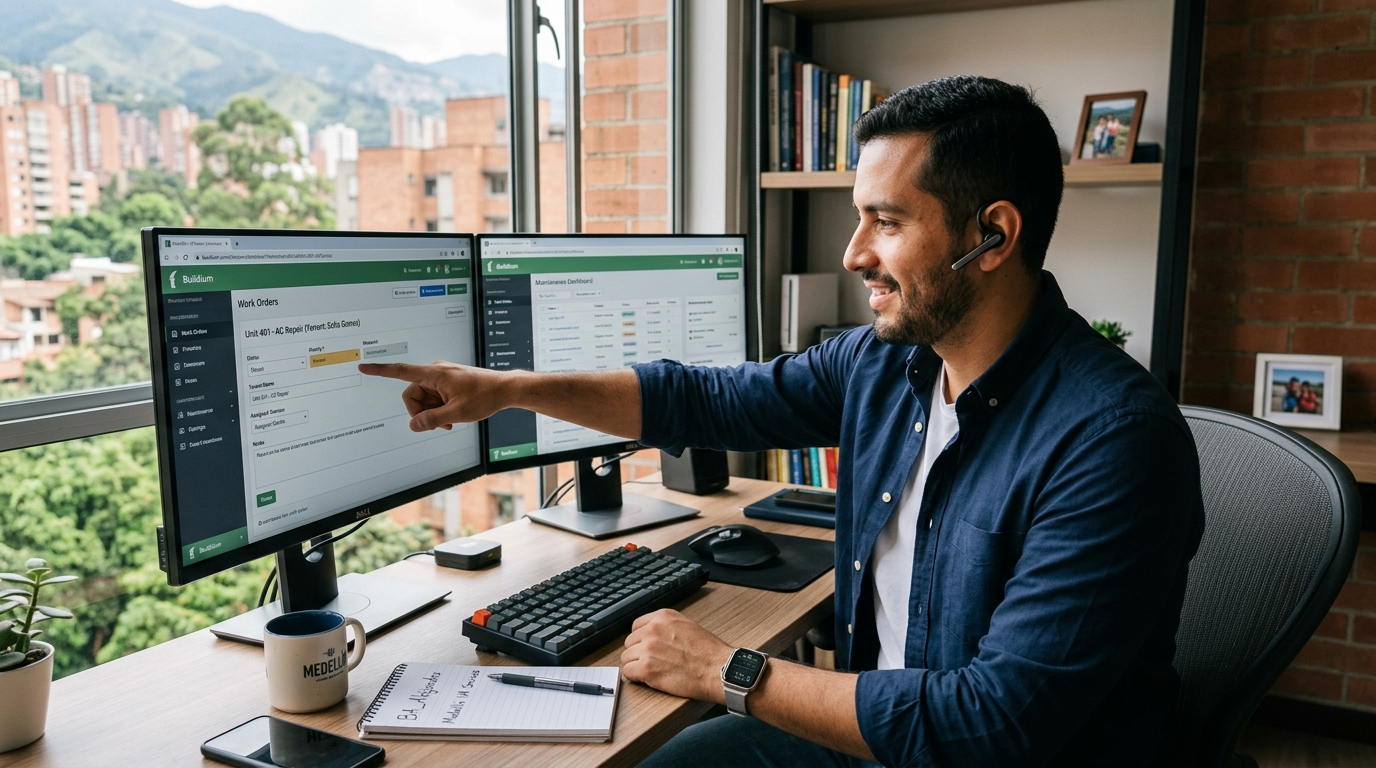
Work order creation, vendor assignment, status updates, and owner visibility are all shown here. This is often the module that converts skeptical PMs — seeing every work order in one place is a genuine revelation if you've been managing it via text chains.
Accounting & Owner Reporting (10 min)
Buildium's built-in accounting handles trust accounting, owner distributions, 1099 generation, and bank reconciliation. The owner report demo is usually the highlight for portfolio owners who want monthly financials without calling you.
Pricing & Q&A (10 min)
The rep walks through plan tiers (Essential, Growth, Premium) and pricing per unit. This is your window to ask about API access, bulk import, and what onboarding support looks like.
How to Compare Buildium Plans Before Your 2026 Demo
Buildium offers three core plan tiers. The rep will show all three, but knowing the differences before you walk in helps you avoid getting upsold on features you don't need — or undersold on features you do. The table below maps each tier to portfolio size, the key modules unlocked, and the role a nearshore virtual assistant plays at each level.
| Buildium Plan | Ideal Portfolio Size | Key Features Shown in Demo | Best VA Support Layer |
|---|---|---|---|
| Essential | 50–150 units | Leasing, resident portal, basic maintenance tracking, standard reports | Part-time admin VA handling applications, work orders, and tenant comms |
| Growth | 150–500 units | All Essential features + eSignature, performance analytics, priority support, bank reconciliation tools | Full-time dedicated Buildium VA managing leasing pipeline + owner reporting |
| Premium | 500+ units | All Growth features + unlimited eSignatures, dedicated customer success manager, advanced bank sync, open API | Dedicated VA team: leasing coordinator + bookkeeping VA running parallel workflows |
| Standalone Accounting (ePA) | Any size | Buildium's ePay + trust accounting without full PM suite | Bookkeeping VA handling reconciliation, owner distributions, and 1099 prep |
One thing most PMs miss during the demo: Buildium's accounting module is genuinely strong, but only if someone is inside it every day entering transactions, reconciling accounts, and running distributions on schedule. Software doesn't run itself. For a deeper look at how the VA staffing model differs across Buildium and AppFolio, the hiring considerations are similar but the specific workflow training diverges significantly by platform.
What Questions to Ask During Your Buildium Demo in 2026
Most property managers walk into a demo passively. The rep drives, you watch, and you leave with a brochure. Flip that dynamic. Go in with these specific questions and you'll get 3x more useful information from the session.
- What does the onboarding data migration actually look like? Ask how they handle importing existing leases, tenant histories, and open work orders from your current system. Get a timeline, not a vague answer.
- How does the API work, and what does it cost? If you have any plans to connect Buildium to showing software, CRMs, or AI tools, you need API access. Some tiers lock it behind Premium.
- What's the trust accounting audit trail? Regulators in most states require a defensible paper trail for trust funds. Ask the rep to show you exactly how the audit log works — not just that it exists.
- How does multi-entity management work? If you manage properties under multiple LLCs, ask how Buildium separates financials, owners, and reporting by entity. Not every tier handles this cleanly.
- What training resources exist for new staff? If you're bringing on a VA to run Buildium, you need to know whether Buildium provides a structured training library or whether you're piecing it together from YouTube.
"The biggest mistake managers make with property management software is treating it as a destination rather than a tool. A well-configured platform with a trained operator will outperform a poorly staffed platform every time." — Marc Frenkiel, Co-Founder at Buildium (2019, Buildium Blog)
The training question matters especially if you're considering a VA hire. Rose's nearshore team members arrive pre-trained on Buildium's core workflows — applications, work orders, owner reports, and bank reconciliation — so the ramp period is measured in days, not weeks. Every Rose VA also ships with a role-specific AI copilot built on the software they'll use daily, which you can read more about on the Rose AI advantage page.
How Nearshore Buildium VAs Outperform Offshore Hires in 2026
After the demo, the next question most PMs ask is: "Who's going to run this?" Hiring domestically for a full-time Buildium coordinator runs $45,000–$65,000 per year in salary alone, before benefits, payroll tax, and recruiting costs, according to the U.S. Bureau of Labor Statistics (2024). Offshore VAs in the Philippines or India are cheaper on paper, but the timezone gap — typically 10 to 13 hours — means tenant issues batch overnight instead of getting resolved in real time.
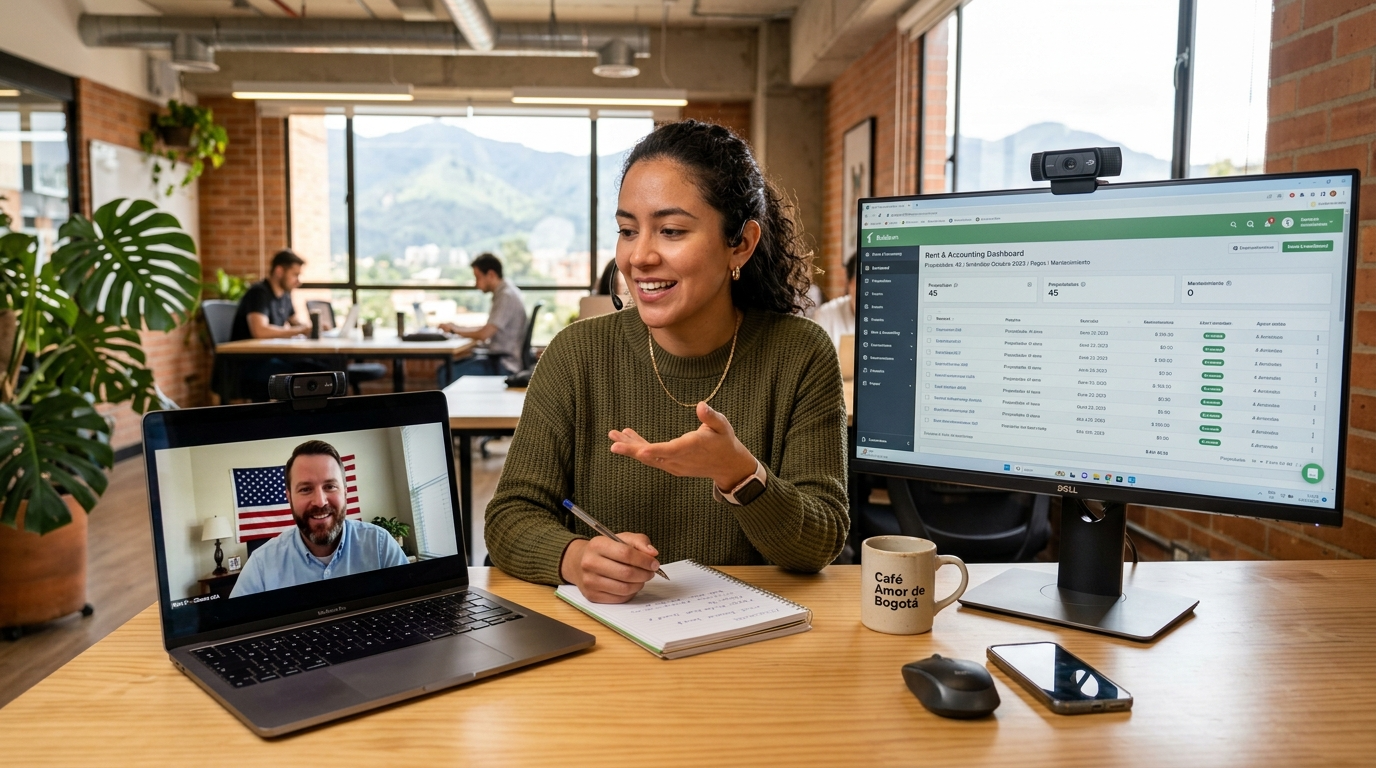
Nearshore VAs based in Latin America work your exact US business hours. English fluency is screened to an 8/10 or higher bar. When a tenant calls at 2pm EST with a maintenance emergency, your Buildium VA is at their desk, can open the work order, contact the vendor, and update the resident portal — in the same hour. Same-timezone responsiveness is the operational difference that offshore pricing can't compensate for.
The hidden cost of offshore VAs isn't the hourly rate — it's the 10–13 hour timezone gap that turns a 20-minute Buildium work order update into a next-day callback, eroding tenant satisfaction and owner trust simultaneously.
According to SHRM research (2022), replacing an employee costs an average of six to nine months of that employee's salary. For a $50,000 coordinator role, that's $25,000–$37,500 per turnover event — not counting the time your Buildium workflows sit understaffed. A nearshore VA through Rose at $2,500/month flat eliminates that risk with a free replacement guarantee if the team member isn't a fit. Meanwhile, Gallup estimates that U.S. businesses lose $1 trillion annually to voluntary turnover (2019) — a figure that underscores why retention-oriented staffing models are gaining traction across every sector, including property management.
For HOA portfolios specifically, the Buildium workflow demands are even more time-intensive — board meeting minutes, violation tracking, ARC request management, and assessment collections all live inside the platform. If you're managing associations alongside residential units, see how other operators are staffing HOA management with a dedicated virtual assistant to handle that workload without adding headcount to your W-2 payroll.
What Happens After Your Buildium Demo: The Smart Next Steps
Most PMs leave their Buildium demo and do one of three things: they sign up immediately, they schedule a follow-up, or they do nothing for six weeks. The last group almost always ends up back on a demo call six months later, having lost that time to manual processes. Here's the right sequence.
Do This After Your Demo
- Request a sandbox trial to explore the interface yourself before committing
- Map your current workflows to Buildium's modules — leasing, maintenance, accounting — so you know what needs to be migrated
- Identify who will run Buildium daily and whether that person has capacity or if you need to hire
- Compare your current per-unit software cost against Buildium's pricing at your portfolio size
- Start the VA hiring process in parallel — onboarding a Buildium-trained VA takes about the same time as a software migration
Avoid These Mistakes
- Signing up for Premium when Essential covers your current portfolio — you can upgrade later
- Assuming your existing staff will learn Buildium on their own without structured training time
- Waiting until after go-live to think about who runs the platform — this is how backlogs start
- Ignoring the accounting module because "we have a bookkeeper" — Buildium's trust accounting is state-compliance critical
- Evaluating the demo in isolation without factoring in the staffing cost of operating the software
The staffing question is where most operators underestimate costs. Software licensing is visible on a P&L. The cost of a full-time employee to run that software — salary, benefits, recruiting, turnover — is often 4x the software cost itself. Rose's property management VA cost guide for 2026 breaks down the true total cost comparison between an in-house hire and a nearshore VA across a 12-month horizon, including recruiting, payroll tax, and management overhead.
If you're ready to staff a Buildium coordinator now, the process through Rose starts with a 15-minute intake call. You describe your portfolio, your Buildium plan, and the specific workflows you need covered. Rose handles recruiting, vetting, payroll, HR, and ongoing management — all for $2,500/month flat, on a month-to-month basis with no long-term contract. Visit the Rose get-started page to book that call.
According to McKinsey's analysis of AI-augmented workflows (2023), workers using AI copilots complete tasks 25–40% faster than those using software alone. Rose VAs come paired with a Buildium-specific AI copilot — meaning your coordinator isn't just trained on the platform, they're actively assisted by an AI layer that flags overdue work orders, drafts owner report summaries, and surfaces lease renewal windows before they lapse. That combination — trained human plus AI layer — is what turns a Buildium subscription into a genuine competitive advantage. Learn more about how this works on the Rose property management staffing page.
The Buildium demo is a 45-minute commitment. The decision you make after it — who runs the platform — shapes your operational capacity for the next several years. Software without a skilled operator is just a monthly line item. With the right nearshore VA behind it, Buildium runs your leasing pipeline, keeps your owners informed, and closes work orders before tenants have to follow up. That's the difference between software as a cost and software as infrastructure.