
Nearshore bilingual virtual assistants have become one of the highest-ROI hires available to US, Canadian, and UK businesses in 2026 — and the math is no longer close. When you combine a 60–70% labor cost reduction with real-time timezone overlap, English fluency above 8/10, and role-specific AI tools, you get a team member who produces at or above the level of a domestic hire for a fraction of the cost. This post breaks down exactly where that return comes from, how to measure it, and what separates a high-ROI bilingual VA engagement from one that quietly bleeds money.
What Is a Bilingual Virtual Assistant (and Why Does "Bilingual" Move the ROI Needle)?
A bilingual virtual assistant is a remote professional who operates fluently in two languages — most commonly English and Spanish — and handles tasks ranging from customer communication and scheduling to bookkeeping, property management coordination, and social media. The "bilingual" component is not cosmetic. When a VA can speak directly with your Spanish-speaking customers, tenants, or vendors without routing through a translator or a second employee, you eliminate an entire layer of friction and payroll cost.
For industries with large Spanish-speaking customer bases — property management, healthcare administration, real estate, hospitality, and retail — that friction removal translates into measurable revenue retention. According to Pew Research Center (2023), there are more than 62 million Hispanic Americans, making Spanish the second most spoken language in the United States. A monolingual VA simply cannot serve that market at the same level.
Bilingual fluency also raises the ceiling on task complexity. A VA who can draft professional emails in both English and Spanish, handle inbound calls in either language, and interpret vendor contracts without assistance is doing work that would otherwise require a $55,000–$70,000 US-based coordinator. That capability gap is where the ROI argument becomes overwhelming.
How to Calculate Bilingual Virtual Assistant ROI in 2026
ROI on a VA hire is not abstract — it is a straightforward formula once you identify all the cost inputs. Most business owners undercount the true cost of a US-based employee because they focus on salary and ignore the burden. The U.S. Bureau of Labor Statistics (2023) consistently reports that benefits and employer taxes add 30–40% on top of base wages for private-sector employees. A $50,000-a-year US coordinator costs the business $65,000–$70,000 fully loaded before you add recruiting fees, onboarding time, or software licenses.
A nearshore bilingual VA through Rose Talent Solutions costs a flat $2,500/month — $30,000 per year, all-in. That single number covers recruiting, vetting, payroll, HR administration, and ongoing management. No benefits overhead. No employer payroll taxes. No recruiter invoice. The net annual saving versus a US hire sits between $35,000 and $40,000 in direct labor cost — before you account for productivity gains from timezone alignment and bilingual capability.
To build your own ROI calculation: take the fully loaded cost of the US role you would otherwise fill, subtract $30,000 (annual VA cost), then add back the value of the tasks your bilingual VA handles that a monolingual hire could not — translation services avoided, Spanish-speaking customer retention improved, vendor negotiations handled without an interpreter. That third column is where bilingual VA ROI consistently surprises owners. For a deeper look at how nearshore compares structurally to other sourcing options, see this complete nearshore vs offshore vs onshore VA comparison that breaks down all three models side by side.
How Nearshore vs. Offshore Bilingual VAs Compare on Real ROI Drivers in 2026
The offshore VA market — primarily Philippines and India — offers lower headline rates. But ROI is not headline rate. ROI is output per dollar, and output depends on timezone alignment, language fluency, and cultural fit. On all three dimensions, nearshore Latin America outperforms offshore for US businesses, and the data supports that claim.
| Factor | Nearshore (Latin America) | Offshore (Philippines / India) | Onshore (US-based) |
|---|---|---|---|
| Timezone overlap with US | Full overlap (same business hours) | 6–12 hour gap; async by default | Full overlap |
| Bilingual English/Spanish | Native or near-native Spanish; strong English | English yes; Spanish rare | Varies; bilingual talent commands premium |
| Monthly cost (full-time) | ~$2,500 all-in | $800–$1,800 (management costs extra) | $5,000–$7,000+ fully loaded |
| Cultural alignment with US clients | High — US media, norms, geography familiar | Moderate | High |
| Recruiting / HR overhead | Included in flat fee | Often DIY or separate agency cost | High (recruiter fees, benefits admin) |
| AI copilot included | Yes — role-specific (AppFolio, QuickBooks, etc.) | Rarely included | Rarely included |
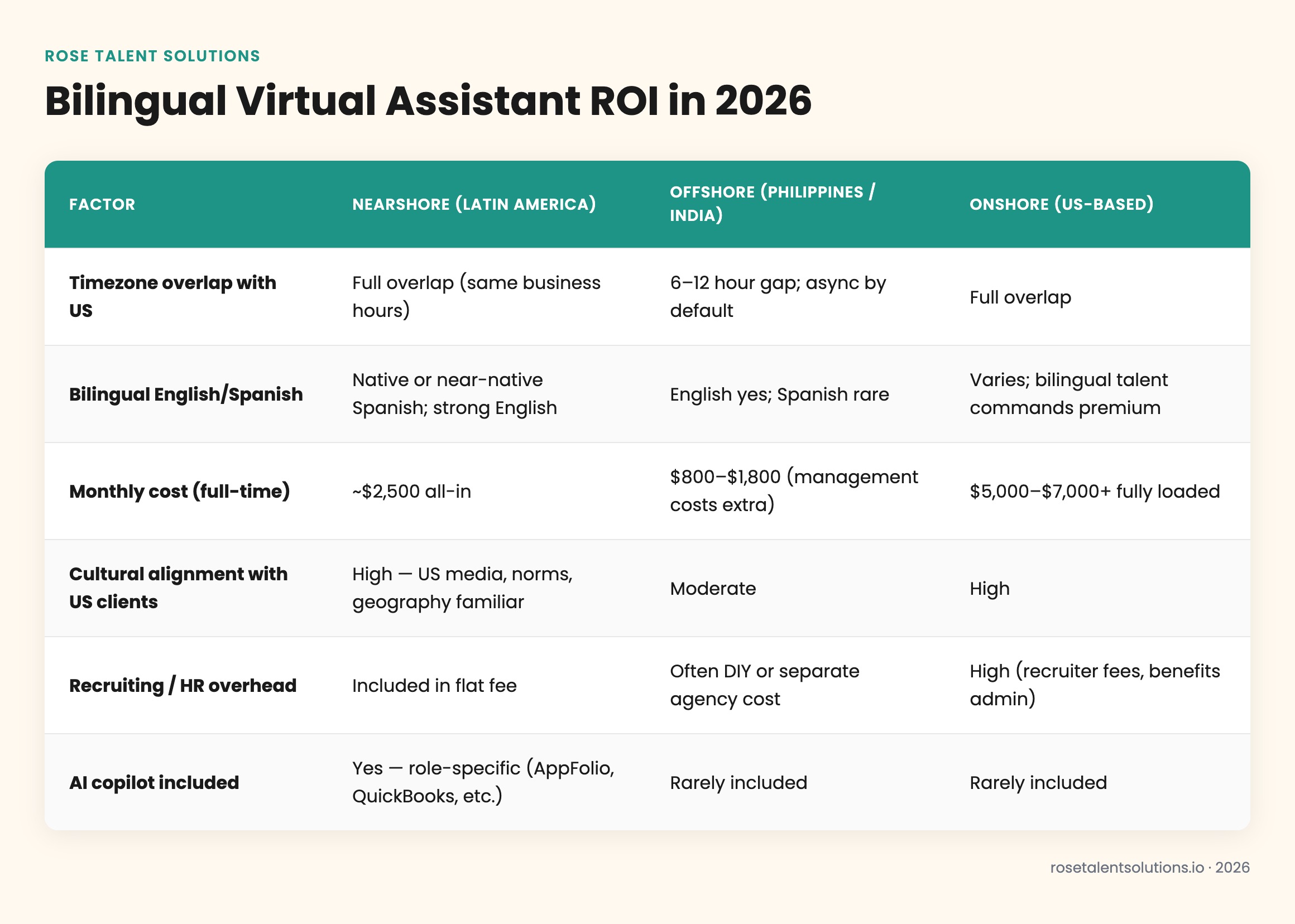
The timezone gap is a silent ROI killer. When your VA is 10–12 hours ahead, a question asked at 3pm on Tuesday doesn't get answered until Wednesday morning. For customer-facing roles, that lag directly costs you deals and tenant satisfaction scores. Nearshore VAs in Mexico City, Bogotá, or Buenos Aires work your hours — 9am to 5pm Eastern or Pacific — which means issues get resolved the same day, every day. If you want the full breakdown of how these models differ structurally, the onshore vs offshore virtual assistant guide covers the tradeoffs in detail.
How Role-Specific AI Copilots Multiply Bilingual VA Output in 2026
Labor cost savings are the floor of bilingual VA ROI, not the ceiling. The ceiling is lifted by what your VA can accomplish per hour — and in 2026, that number has risen sharply because every Rose team member ships with a role-specific AI copilot trained on the software they actually use. A VA equipped with an AI copilot trained on AppFolio handles maintenance requests, lease renewals, and tenant communications faster and more accurately than a human-only VA doing the same work. The same logic applies to bookkeeping VAs using QuickBooks, executive assistants using HubSpot, and property coordinators using Buildium.
"AI-augmented workers complete tasks 37% faster than those using traditional tools alone, with no measurable drop in quality — the productivity gain compounds over time as the AI learns team-specific workflows." — Erik Brynjolfsson, Professor, Stanford Digital Economy Lab (2023)
According to McKinsey & Company (2023), generative AI tools could add the equivalent of $2.6–$4.4 trillion annually to the global economy by automating and accelerating knowledge work tasks. When that productivity gain sits inside a VA who already costs 70% less than a US hire, the ROI multiplier effect is significant. A bilingual VA handling volume that previously required 1.5 US employees — at one-third the cost — is not a rounding error; it's a structural business advantage.
Bilingual VA ROI has two distinct layers: the labor cost arbitrage (immediate, calculable) and the AI-augmented output multiplier (compounding, grows over time). Most owners only model the first layer — and still find the math compelling. The second layer is where the real competitive advantage lives.
If you want to understand how this plays out in a specific function, the bookkeeping and accounting VA role is a clear example: a bilingual bookkeeper who handles English and Spanish vendor invoices, reconciles QuickBooks daily, and communicates directly with Spanish-speaking contractors replaces both a bookkeeper and a translator at a combined cost that's still well below one US junior accountant.

What Does the Onboarding Process Look Like in 2026?
A common objection to VA hiring is onboarding friction — the assumption that a remote worker in another country will take months to ramp. With a nearshore bilingual VA, real-world onboarding timelines are far shorter, for three reasons: timezone alignment means real-time training, English fluency eliminates communication barriers, and role-specific AI copilots compress the learning curve on software. Here's how the Rose onboarding sequence works:
Intake & Role Scoping (Day 1)
You describe the role, software stack, and communication preferences. Rose maps the brief to pre-vetted candidates who match the technical and language requirements.
Candidate Matching (Days 2–5)
Rose presents a matched candidate — already screened for 8/10+ English proficiency, bilingual capability, and relevant software experience. You interview and approve.
AI Copilot Activation (Day 1 of Work)
The team member's role-specific AI copilot is configured for your software environment before their first day, so they're productive from the start — not ramping from scratch.
Managed Ongoing Relationship
Rose handles HR, payroll, and performance management throughout. If the team member ever isn't a fit, Rose replaces them at no additional cost — no re-recruiting fees, no restart from zero.
The month-to-month terms with no long-term contract mean you are not locked into a placement that isn't working. The free replacement guarantee removes the residual risk. For businesses that have never hired a VA before, this structure eliminates the two biggest objections — commitment risk and ramp-time uncertainty — simultaneously. You can learn more about what to look for when choosing a provider in this overview of virtual assistant companies operating in Latin America.
Who Gets the Highest Bilingual Virtual Assistant ROI in 2026?
Not every business extracts the same return from a bilingual VA hire. ROI is highest when the role involves direct communication with Spanish-speaking stakeholders, high-volume repetitive tasks that benefit from AI augmentation, or coordination functions that require same-timezone availability. The verticals where we consistently see the strongest ROI are property management, real estate, healthcare administration, e-commerce customer support, and professional services firms with Spanish-speaking client bases.
Property management in particular is a standout case. According to Buildium's State of the Property Management Industry Report (2023), 78% of property management companies say finding qualified staff is their top operational challenge. A bilingual VA who handles tenant communications, maintenance coordination, and lease administration in both English and Spanish directly addresses that gap at a cost that fits even a sub-100-unit portfolio. You can explore the full scope of what a property management virtual assistant handles and how the role is structured for maximum ROI.
Businesses That See Highest ROI
- Property managers with diverse tenant bases
- Real estate teams covering Hispanic markets
- Healthcare practices with Spanish-speaking patients
- E-commerce brands with Latin American customer segments
- Professional services firms needing bilingual admin support
Businesses Where ROI Is Lower
- Highly specialized technical roles requiring niche US certifications
- Businesses with no Spanish-speaking customer touchpoints
- Roles requiring physical presence (in-person reception, field work)
- Organizations with rigid onshore compliance requirements for all staff
The Latin America staffing landscape has matured significantly in the last three years. University graduation rates in Colombia, Mexico, and Argentina have produced a deep bench of English-fluent, technically capable professionals who are eager for stable, well-paying remote roles with US companies. According to SHRM's 2023 Talent Trends, 77% of HR professionals report difficulty filling roles domestically — nearshore staffing directly relieves that pressure without sacrificing quality. For a broader view of the sourcing landscape, this guide to working with a Latin America staffing agency covers what the engagement model actually looks like from a business owner's perspective.
If you are ready to model the ROI for your specific business, the fastest path is a direct conversation — get started with Rose and have a matched bilingual VA candidate in front of you within days, not weeks.