
Why Nearshore Yardi Virtual Assistants Are Dominating Property Management in 2026
Nearshore Yardi virtual assistants — meaning VAs based in Latin America working US business hours — have become the default hire for growth-focused property management companies in 2026. The reason is straightforward: Yardi Voyager and Yardi Breeze are complex, workflow-intensive platforms, and the operators who scaled fastest this year stopped pairing them with generalist remote help and started pairing them with specialists trained specifically on the software their business runs on.
Property management has always been a high-coordination industry. Maintenance tickets, lease renewals, owner statements, delinquency follow-ups — every one of these tasks lives inside Yardi, and every one requires someone who can navigate that system without a two-hour onboarding call every morning. The shift toward nearshore, software-trained VAs isn't a trend. It's a structural change in how lean PMCs compete.
According to the National Multifamily Housing Council (NMHC) (2024), over 40% of mid-sized property management companies now employ at least one remote support staff member dedicated to their property management software platform — a figure that has nearly doubled since 2021.
What Is a Yardi Virtual Assistant — and What Should One Actually Do in 2026?
A Yardi virtual assistant is a trained remote team member whose primary responsibility is managing property operations workflows inside Yardi Voyager or Yardi Breeze. This includes processing work orders, managing lease abstracts, pulling owner and financial reports, handling tenant communications triggered by Yardi alerts, and supporting leasing pipelines tracked in the platform. A good Yardi VA is not a general admin who happens to log into Yardi — they are a platform-fluent operator who reduces the per-unit labor cost of your management operation.
The best Yardi VA services in 2026 go one step further: they equip each team member with a role-specific AI copilot trained on Yardi workflows. At Rose Talent Solutions, every placed VA ships with an AI advantage layer built around the exact software your business runs — so they're navigating Yardi faster and more accurately from week one, not week eight.
How Nearshore Yardi VAs Outperform Other Options in 2026
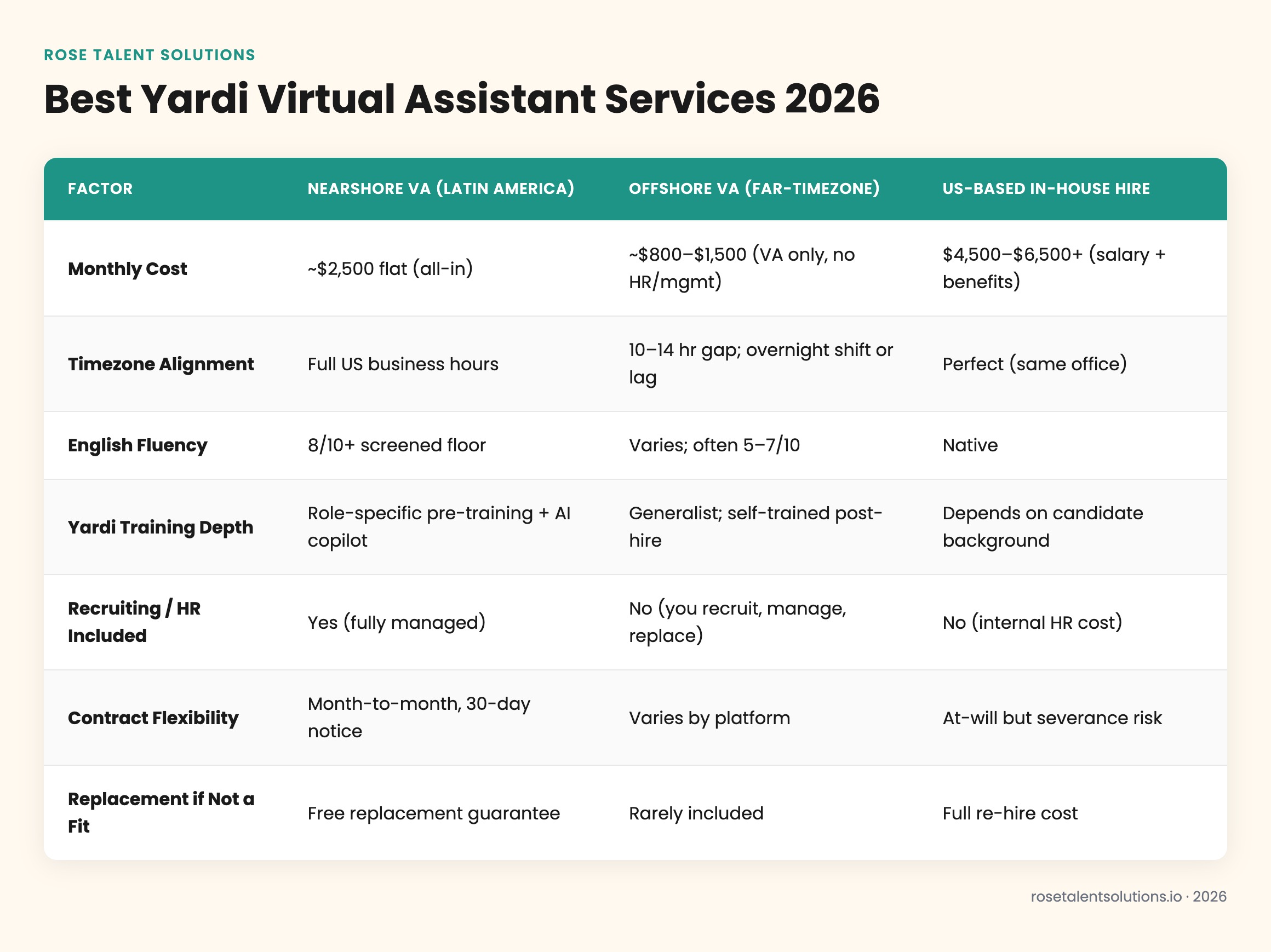
Some VA models rely on talent pools with a structural timezone problem for Yardi-dependent property managers: a 10-to-14-hour gap. When a tenant submits an emergency maintenance request at 8 p.m. EST, or an owner calls about a statement discrepancy at 11 a.m. on a Tuesday, a VA operating on the other side of the world is either asleep or working an overnight shift. The response lag compounds across every ticket, every day.
Nearshore VAs in Latin America — Colombia, Mexico, Argentina, Costa Rica, and similar markets — operate fully within EST/CST/PST business hours. They're on your Zoom calls. They're replying to Yardi alerts in real time. For a deeper breakdown of why timezone alignment is the most underrated factor in this decision, see our full comparison of nearshore virtual assistant property management options.
"The biggest mistake property managers make when hiring remote staff is optimizing for the hourly rate instead of the communication cost. Every hour of timezone misalignment adds invisible overhead that never shows up on an invoice." — Andrew Smallwood, Chief Customer Officer at Second Nature (2024)
English fluency is the second variable that separates nearshore from other remote models. Rose's published proficiency bar is 8/10 or higher on standardized English screens — meaning your Yardi VA can draft professional tenant emails, join owner calls, and coordinate with your vendors without translation friction. According to SHRM's State of the Workplace Report (2023), communication breakdowns are the leading cause of remote-team productivity loss, cited by 57% of managers overseeing distributed staff.
| Factor | Nearshore VA (Latin America) | Offshore VA (Far-Timezone) | US-Based In-House Hire |
|---|---|---|---|
| Monthly Cost | ~$2,500 flat (all-in) | ~$800–$1,500 (VA only, no HR/mgmt) | $4,500–$6,500+ (salary + benefits) |
| Timezone Alignment | Full US business hours | 10–14 hr gap; overnight shift or lag | Perfect (same office) |
| English Fluency | 8/10+ screened floor | Varies; often 5–7/10 | Native |
| Yardi Training Depth | Role-specific pre-training + AI copilot | Generalist; self-trained post-hire | Depends on candidate background |
| Recruiting / HR Included | Yes (fully managed) | No (you recruit, manage, replace) | No (internal HR cost) |
| Contract Flexibility | Month-to-month, 30-day notice | Varies by platform | At-will but severance risk |
| Replacement if Not a Fit | Free replacement guarantee | Rarely included | Full re-hire cost |
What Tasks Can a Yardi VA Handle for Your PMC in 2026?
One of the most common questions from operators new to virtual staffing is scope: what can a Yardi-trained VA realistically own, versus what still needs a licensed property manager? The answer, in practice, is more than most operators expect.
A well-placed Yardi VA typically handles: work order intake and vendor dispatch inside Yardi Voyager, lease renewal tracking and notice generation, delinquency reporting and follow-up coordination, tenant move-in/move-out checklists, owner statement preparation, and inbound leasing inquiries routed through your Yardi CRM. If your PMC also uses financial tools alongside Yardi, a VA placed through Rose's bookkeeping and accounting service can bridge Yardi's financial exports into QuickBooks or your preferred reporting stack.
The U.S. Bureau of Labor Statistics (2024) reports that property managers spend an average of 28% of their workweek on administrative coordination tasks that don't require a license — exactly the category a trained Yardi VA should absorb entirely.
A licensed property manager spending 28% of their week on Yardi admin tasks is billing their highest-value hours at their lowest-value work. A Yardi-trained VA recaptures that time and redeploys it toward owner retention, new business development, and portfolio growth — the work that actually scales revenue.
According to Gallup's research on workforce engagement (2023), employees who spend more time on high-skill, judgment-intensive work report significantly higher engagement scores — meaning offloading Yardi admin to a trained VA isn't just an efficiency play, it's a retention strategy for your core team.
If your portfolio runs on multiple platforms, the same logic applies across software stacks. Operators who've already explored best AppFolio virtual assistant services for mid-sized PMCs 2026 often find that the nearshore model transfers directly to Yardi environments — the platform changes, but the staffing principles don't.
How Rose Talent Solutions Places Yardi VAs: The 2026 Process
Rose's placement process is purpose-built for property management operators who need a trained, vetted, ready-to-work Yardi specialist — not a generalist they have to train from scratch. The process runs in five stages, typically from intake to first day in under two weeks.
Intake & Role Scoping
Rose's team maps your specific Yardi workflows, portfolio size, and business hours to define the exact role profile. This determines whether you need a Voyager specialist, a Breeze operator, or a hybrid who bridges Yardi and a secondary financial tool.
Candidate Vetting
Every candidate passes Rose's English proficiency screen (8/10+ floor), a Yardi platform skills assessment, and a background check before you ever see a profile. You're not sorting through applicants — you're selecting from pre-qualified finalists.
AI Copilot Configuration
Before day one, Rose builds a role-specific AI copilot calibrated to your Yardi setup — your work order categories, your lease templates, your owner report formats. The VA arrives already oriented to your system, not a generic one.
Placement & Onboarding
Your VA starts on your schedule, integrated into your tools, working US business hours. Rose handles payroll, HR, and ongoing performance management — you manage the work, not the employment relationship.
Ongoing Support & Free Replacement
If the placement isn't the right fit for any reason, Rose replaces the team member at no additional cost. There's no long-term contract — just a 30-day written notice to cancel if you ever need to.
You can start the intake process directly at rosetalentsolutions.io/start — the form takes under five minutes and triggers an intake call within one business day.
Nearshore Yardi VA vs. DIY Hiring: The Real Tradeoffs in 2026
Some operators consider bypassing a staffing service and recruiting a Yardi VA directly through Upwork, LinkedIn, or local job boards. It works — occasionally. But the full-cycle cost of independent hiring is routinely underestimated. According to SHRM's Human Capital Benchmarking data (2022), the average cost to recruit and onboard a single employee is $4,683, with a time-to-productivity window averaging 42 days. For a Yardi-specific role requiring platform training, that window stretches further.
A separate analysis by McKinsey & Company (2023) found that knowledge-worker turnover costs employers between 50% and 200% of that employee's annual salary when accounting for lost productivity, re-recruiting, and onboarding time — a risk that is largely eliminated when a replacement guarantee is built into your staffing arrangement.
The Rose model bundles recruiting, vetting, payroll, HR, and ongoing management into the $2,500/month flat rate. You don't hire a VA and then manage an employment relationship across international borders. You engage a fully managed team member and focus on running your portfolio. For operators running multi-platform environments, the same managed-staffing approach applies to Buildium-based operations — the platform is different, the operational model is identical.
Managed Nearshore Yardi VA (Rose)
- Pre-vetted, Yardi-trained on arrival
- Recruiting, HR, payroll fully handled
- AI copilot included — no extra licensing
- Free replacement guarantee if not a fit
- No long-term contract, 30-day exit
DIY Independent VA Hire
- You source, screen, and test Yardi skills yourself
- International payroll and compliance on you
- No AI tooling unless you build it
- Full re-hire cost if placement fails
- No guaranteed timezone alignment or English floor
The math is cleaner than it looks. When you factor in recruiter time, onboarding overhead, productivity ramp, and replacement risk, the managed model at $2,500/month typically costs less than a failed independent hire — before accounting for the revenue impact of a Yardi operator who isn't performing.
For operators who want to understand how this model applies specifically to residential property management portfolios, the Rose property management staffing page breaks down the role types, task categories, and portfolio size thresholds that signal it's time to hire. You can also explore the AppFolio virtual assistant hiring guide 2026 for a parallel look at how the same nearshore model performs across a different PM platform.