
Nearshore talent sourcing from Latin America has moved from a fringe experiment to a mainstream hiring strategy for US, Canadian, and UK businesses — and for good reason. The best LATAM talent sourcing companies give you fluent English speakers, same-timezone availability, and college-educated professionals at a fraction of domestic hiring costs. This guide breaks down exactly what separates the top providers from the crowd in 2026, what you should demand before signing anything, and how to avoid the hidden traps that burn most first-time buyers.
What Is a LATAM Talent Sourcing Company?
A LATAM talent sourcing company recruits, vets, and places professionals based in Latin America — countries like Colombia, Mexico, Argentina, Costa Rica, and Brazil — into roles supporting US or Canadian businesses. Unlike traditional offshore staffing that routes through the Philippines or India, nearshore providers match candidates who share your business hours without requiring split shifts or overnight coverage windows. The best firms handle everything from recruiting and English assessments to payroll and ongoing HR management, so the client never has to touch an employment contract.
The distinction matters because timezone overlap is the single biggest predictor of VA success. A team member in Bogotá or Mexico City works 9-to-5 Eastern or Pacific right alongside your team — no 12-hour delay, no batched replies, no overnight voicemails sitting until morning. If you want a fuller breakdown of how that compares to other staffing models, the nearshore vs. offshore vs. onshore comparison Rose published lays out the trade-offs in detail.
According to Clutch's SMB outsourcing research (2024), 63% of small business owners who tried offshore VAs cited timezone gaps as their primary pain point — not price, not quality, not communication style. Timezone. That single data point explains why LATAM sourcing has grown so fast among North American operators.
It also explains why Latin America has attracted significant foreign direct investment from US firms in the past decade. According to the International Trade Administration (2024), Latin America is among the fastest-growing destinations for US business process outsourcing specifically because of its workforce's cultural proximity, bilingual capabilities, and real-time timezone alignment with North American headquarters — advantages that Asia-Pacific destinations structurally cannot replicate.
How to Evaluate the Best LATAM Talent Sourcing Companies in 2026
Not every agency that claims to source from Latin America is actually doing nearshore staffing well. Here are the four criteria that separate serious providers from resume mills:
- English proficiency floor: Look for a documented, scored standard — not a vague "fluent English" claim. Rose Talent Solutions, for example, screens to 8/10 or higher on English proficiency assessments before any candidate advances.
- Role-specific vetting: A bookkeeper candidate should be tested on QuickBooks workflows, not just asked if they know accounting. Generic assessments produce generic hires.
- All-in pricing transparency: Recruiting fees, payroll administration, HR management, and replacement costs should all be baked into one number. Hidden per-placement fees are a red flag.
- Replacement policy: What happens if the placement isn't a fit at week three? The best providers replace at no additional cost, no questions asked.
For a curated list of agencies that clear these bars, the guide to virtual assistant companies in Latin America on the Rose blog is a solid starting point with provider-by-provider breakdowns.
Nearshore vs. Offshore vs. Onshore: 2026 Staffing Model Comparison
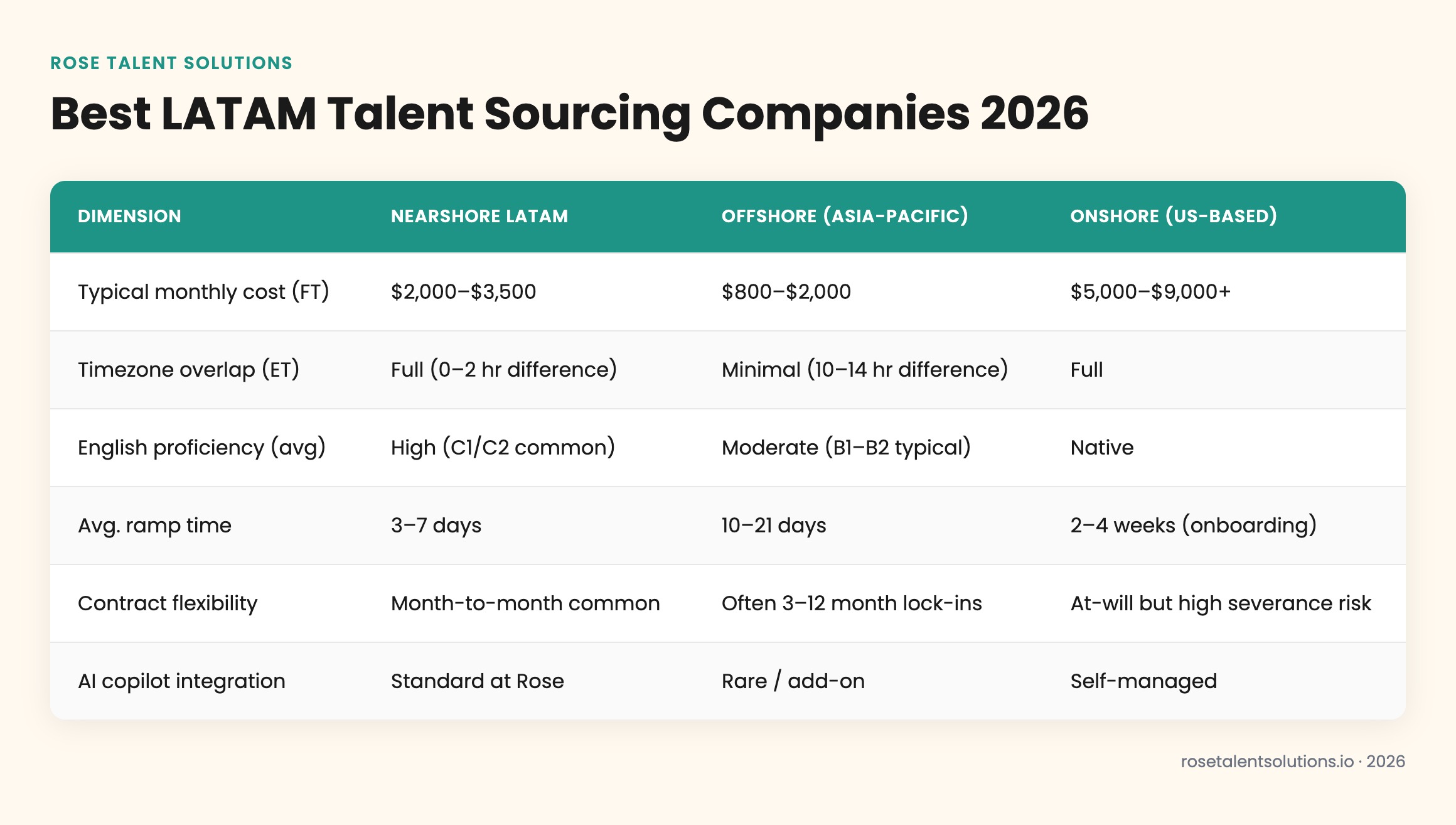
The table below compares the three main staffing models across the dimensions that actually affect day-to-day operations. The numbers reflect typical market rates and published industry benchmarks as of 2026. Use this as a quick-reference framework when evaluating proposals from any staffing vendor.
| Dimension | Nearshore LATAM | Offshore (Asia-Pacific) | Onshore (US-based) |
|---|---|---|---|
| Typical monthly cost (FT) | $2,000–$3,500 | $800–$2,000 | $5,000–$9,000+ |
| Timezone overlap (ET) | Full (0–2 hr difference) | Minimal (10–14 hr difference) | Full |
| English proficiency (avg) | High (C1/C2 common) | Moderate (B1–B2 typical) | Native |
| Avg. ramp time | 3–7 days | 10–21 days | 2–4 weeks (onboarding) |
| Contract flexibility | Month-to-month common | Often 3–12 month lock-ins | At-will but high severance risk |
| AI copilot integration | Standard at Rose | Rare / add-on | Self-managed |
"The future of work isn't about where talent sits — it's about whether they're operating in the same context as your team. Latin America gives you that context at a cost structure that makes scaling possible." — Taso Du Val, CEO at Toptal (2023)
The staffing cost gap between nearshore and onshore is not trivial. According to the Bureau of Labor Statistics Occupational Employment and Wage Statistics (2024), median annual wages for administrative support roles in the US now exceed $45,000 — which translates to $55,000–$65,000 fully loaded when you add benefits, payroll taxes, and recruiting overhead. A flat $2,500/month nearshore placement closes that gap by more than 50% with no reduction in real-time availability.
How Rose Talent Solutions Approaches LATAM Sourcing in 2026
Rose Talent Solutions places full-time virtual staff from Latin America into US businesses at a flat $2,500/month. That price covers recruiting, vetting, payroll, HR administration, and ongoing management — there are no add-on fees. The engagement runs month-to-month with 30 days written notice to cancel, meaning no long-term contract locks you into a placement that isn't working. And if the team member isn't a fit, Rose replaces them at no additional cost.
What makes Rose distinct from most Latin America staffing agencies is the AI copilot layer. Every placed team member ships with a role-specific AI assistant trained on the exact software stack they'll use — whether that's AppFolio or Buildium for property management, QuickBooks for bookkeeping, or other platforms. This is not a generic chatbot. It's a workflow-aware tool calibrated to the candidate's actual role. Learn more about how that system works on the AI advantage page.
The hidden cost of sourcing from a low-quality LATAM agency isn't the sticker price — it's the two to three weeks of lost productivity when a poorly vetted hire can't operate your software, can't communicate clearly with tenants or clients, and leaves you starting the process over from scratch.
According to SHRM's cost-per-hire benchmarks (2024), the average US employer spends $4,700 per hire when you factor in recruiting, onboarding, and lost productivity during ramp-up. Outsourcing that process to a specialized LATAM sourcing firm — one that handles recruiting and replacement — removes the largest variable in that cost equation. For roles with high turnover, that math compounds quickly: three bad hires in a year costs a small business north of $14,000 in recruiting friction alone before you account for the revenue impact of dropped tasks.
The SHRM figure also understates the true cost for specialized roles. A misaligned property management coordinator who can't operate AppFolio correctly doesn't just waste recruiting dollars — they create maintenance request backlogs, tenant communication failures, and lease renewal gaps that cost far more than the hire itself. That's why software-specific vetting at the sourcing stage isn't a nice-to-have; it's the core ROI driver of working with a specialized LATAM firm over a generalist VA marketplace.
Workforce engagement data reinforces the same point. According to Gallup's employee engagement research (2023), team members who receive role-specific training and clear tools from day one are 2.6× more likely to stay engaged past the 90-day mark. That finding applies directly to virtual placements — an onboarded, tooled-up LATAM hire outperforms a generically placed one at every stage. Churn at 60 days is where most bad LATAM placements die, and it's almost always a vetting or onboarding failure, not a work ethic problem.
How the Rose Hiring Process Works in 2026: From Brief to Day One
Role Discovery Call
Rose's team maps the exact scope of your role — software used, communication style, hours, task types — so the match is built on real requirements, not a generic job description.
Candidate Matching
Rose pulls from its vetted LATAM talent pool, filtering on English proficiency scores (8/10 minimum), software experience, and timezone. You receive a shortlist, not a firehose of resumes.
Client Interview
You interview your top candidate directly. No layers of recruiters translating your feedback — you make the call on fit.
AI Copilot Activation
Before day one, the team member's role-specific AI copilot is configured for your software stack, SOPs, and communication templates — so they arrive ready to execute, not to shadow.
Ongoing Management Support
Rose handles HR, payroll, and performance check-ins. If something isn't working, you flag it and Rose resolves it — including replacement at no extra cost if needed.
If you're ready to see what a placement looks like for your specific role, the getting started page walks through the intake process in under three minutes.
What Do the Best LATAM Talent Sourcing Companies Have in Common in 2026?
After reviewing the landscape of providers actively placing LATAM talent into North American businesses, the best ones share five non-negotiable traits. The pattern is consistent whether you're evaluating firms that specialize in property management staffing, financial back-office roles, or executive support — the quality signals are the same.
What top LATAM sourcing firms do
- Score English proficiency with documented, consistent assessments (not self-reported)
- Specialize by industry or role type — not generalist VA farms
- Offer month-to-month terms with no long-term contract
- Include replacement guarantees without extra fees
- Provide AI or software training built into onboarding
Red flags to walk away from
- Vague "fluent English" claims with no scoring methodology
- High per-placement fees on top of monthly retainers
- 6- or 12-month lock-in contracts with no exit clause
- No replacement policy — or one that requires a new placement fee
- Offshore talent rebranded as "nearshore" without actual LATAM sourcing
The demand for qualified remote workers in Latin America is also being shaped by broader macroeconomic trends. The McKinsey Global Institute's Future of Work report (2023) projects that cross-border remote work arrangements will grow substantially through 2030, with Latin America positioned as a top beneficiary due to its educated, digitally fluent workforce and geographic proximity to North America. That structural tailwind is why the best LATAM agencies are investing in specialization rather than volume — the clients who matter most are increasingly demanding vertical expertise, not just bodies.
The best nearshore virtual assistant companies of 2026 ranked by Rose's editorial team is also worth reading alongside this guide — it covers specific providers and how they stack up on the criteria above, including which firms have the deepest benches in property management, bookkeeping, and executive support roles.
The LATAM talent sourcing market is mature enough in 2026 that buyers have real choices. The mistake most operators make is optimizing purely on price and ending up with an agency that delivers a body, not a contributor. The best sourcing firms treat placement as the beginning of the relationship — not the end of it. That means proactive check-ins, performance benchmarks, and a replacement process that doesn't require you to start the intake process from zero when something goes sideways.
One final filter worth applying: ask any LATAM sourcing agency you're considering how they handle underperformance at 30, 60, and 90 days. The answer tells you everything about whether their business model is built around your success or around their next placement fee. Firms with replacement guarantees, month-to-month terms, and ongoing HR management are aligned with your outcome. Firms that disappear after the invoice clears are not. Use the comparison table above as your baseline, apply the red-flag checklist, and you'll be in a strong position to find the right nearshore partner for your team in 2026.