
Nearshore staffing has matured fast, and the bench vs pilot debate is now the central question every US business owner should answer before signing with a virtual assistant agency. Two years ago, most companies asking "how do I hire a VA?" got one generic answer: post a job, interview, hire, hope. Today, the conversation has split into two distinct philosophies — the bench model and the pilot model — and the difference between them will determine how quickly your new hire actually contributes. If you are evaluating virtual assistant options in 2026, understanding bench vs pilot is the most important decision you will make before you commit to anything.
What Is the Bench Model (and How Does It Work in 2026)?
The bench model works like a talent reserve. A staffing agency pre-recruits, vets, and maintains a roster of candidates who are actively available but not yet placed. When you submit a request, the agency matches you from that existing pool. Think of it like a sports roster — players are warmed up and ready before game day.
On paper, this sounds efficient. In practice, bench quality degrades fast. Candidates sitting on a bench for 30-60 days have often already accepted offers elsewhere, taken on freelance work, or simply gone stale on the specific software skills you need. A bench that looked strong in January may be entirely different talent by March. According to SHRM's Talent Acquisition research (2024), the average time-to-fill for skilled administrative roles is 36 days — meaning agencies running bench models are constantly fighting attrition within their own reserve pools before you even submit a request.
The bench model also creates a subtle misalignment of incentives. The agency's job is to keep the bench full and moving — not necessarily to find the right person for your specific workflow. When you are evaluating bench vs pilot, ask the agency directly: "did you search for me specifically, or did you filter a spreadsheet?" The answer tells you everything. For a structural breakdown of how staffing models compare, the nearshore vs. offshore vs. onshore virtual assistant complete comparison shows exactly where each approach breaks down under real operating conditions.
What Is the Pilot Model and Why Is It Winning the Bench vs Pilot Debate in 2026?
The pilot model flips the sequence. Instead of pulling from a standing inventory, the agency runs a targeted search for your specific role after you submit a brief. Candidates are recruited, screened, and presented specifically for your business — not whoever happened to be sitting on a shelf. The bench vs pilot distinction matters most here: one model optimizes for speed to seat, the other optimizes for speed to productivity.
This matters because role-fit at the detail level is what determines whether a VA actually sticks. A property management company using AppFolio needs someone who has worked in AppFolio — not someone who is "tech-savvy" and can "learn quickly." A pilot model allows the agency to source that specificity. Rose Talent Solutions, for example, pairs every placed team member with a role-specific AI copilot trained on the exact software stack the client uses — AppFolio, Buildium, QuickBooks, and others — so the pilot match includes both human fit and tool fit from day one.

Speed is the objection you will hear against the pilot model in every bench vs pilot conversation: "doesn't it take longer to search fresh than pull from a bench?" In reality, well-run nearshore agencies fill pilot placements in 5-7 business days — faster than the average bench model's match-and-onboard cycle once you account for availability mismatches and re-screening. According to McKinsey's People & Organizational Performance research (2023), companies that prioritize role-specific fit over speed-of-availability report 2.4× higher 90-day retention rates for contract hires.
Bench vs Pilot Head-to-Head: Comparison Table for 2026
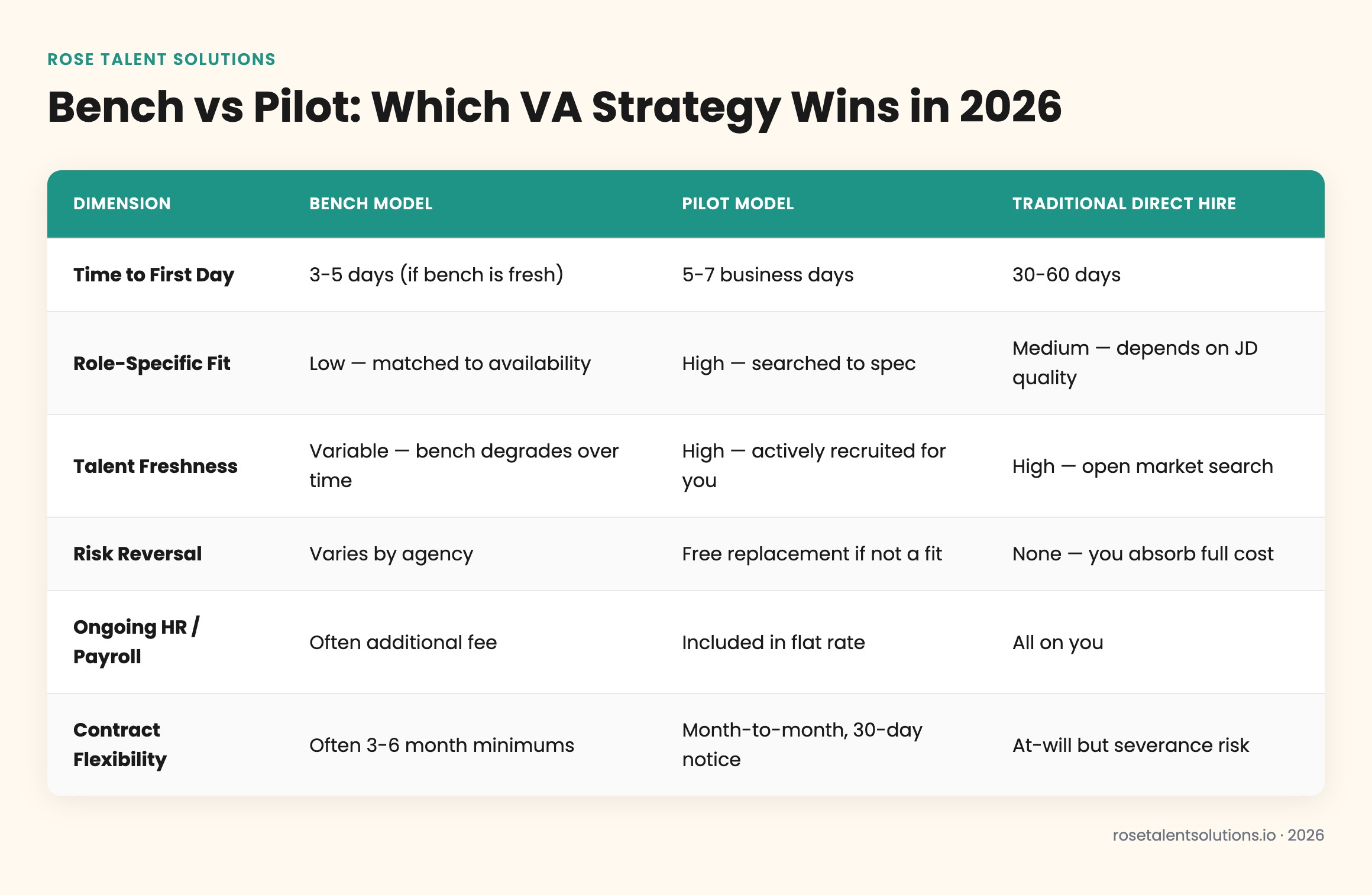
The table below compares the bench model, the pilot model, and traditional direct hiring across the six dimensions that matter most to US business owners evaluating virtual staffing in 2026. This bench vs pilot breakdown reflects how each model performs under real operating conditions — not just the pitch deck version.
| Dimension | Bench Model | Pilot Model | Traditional Direct Hire |
|---|---|---|---|
| Time to First Day | 3-5 days (if bench is fresh) | 5-7 business days | 30-60 days |
| Role-Specific Fit | Low — matched to availability | High — searched to spec | Medium — depends on JD quality |
| Talent Freshness | Variable — bench degrades over time | High — actively recruited for you | High — open market search |
| Risk Reversal | Varies by agency | Free replacement if not a fit | None — you absorb full cost |
| Ongoing HR / Payroll | Often additional fee | Included in flat rate | All on you |
| Contract Flexibility | Often 3-6 month minimums | Month-to-month, 30-day notice | At-will but severance risk |
How the Hidden Costs of the Bench Model Stack Up Against Pilot in 2026
The sticker appeal of the bench model is speed and apparent simplicity. But the real bench vs pilot cost equation shows up at 60 and 90 days. When a bench placement misses on role fit — and Gallup estimates (2023) that replacing an employee costs one-half to two times annual salary even at the junior level — you are not just losing the placement fee. You are losing the ramp time, the institutional knowledge built, and the opportunity cost of re-searching.
"Hiring the wrong person fast is more expensive than hiring the right person in a week." — Liz Ryan, Founder at Human Workplace (2022)
The pilot model's free replacement guarantee is the structural answer to this problem. If the team member is not a fit, the agency replaces them at no additional cost — no second search fee, no restart penalty. That single policy shifts the risk from your budget to the agency's, which is exactly where it belongs when the agency is doing the matching.
Pricing transparency is another fault line in the bench vs pilot comparison. Bench models often advertise a low hourly rate but layer on separate fees for HR administration, payroll processing, and ongoing management. A pilot model structured as a flat monthly rate — like Rose's $2,500/month all-in pricing — covers recruiting, vetting, payroll, HR, and ongoing management in one number. According to Deloitte's Global Human Capital Trends report (2024), hidden workforce costs now average 1.3× base compensation when HR administration and compliance overhead are included — a multiplier that all-in flat pricing eliminates entirely. For the full Latin America staffing cost picture, the breakdown of Latin America virtual assistant costs shows what "all-in" actually means line by line.
In every bench vs pilot evaluation, remember: a bench model that fills your seat in 3 days but misses on software fit will cost you more in re-training, re-placement, and lost productivity than a pilot model that takes 7 days and lands a team member who hits the ground running. Speed to seat and speed to productivity are not the same metric.

How Rose's Pilot Matching Process Resolves the Bench vs Pilot Problem — Step by Step
Understanding what a well-run pilot model actually looks like in practice helps you evaluate any agency you are considering. The sequence below is what Rose Talent Solutions uses from brief to first day — and it is what distinguishes a genuine pilot from a bench model dressed up with better marketing.
Role Brief (Day 1)
You submit a brief covering role scope, software stack, timezone, and communication style. This is not a generic job description — it is a targeted match spec that drives the entire search.
Targeted Search & Screen (Days 1-4)
Rose's recruiters source from their Latin America network specifically for your spec — not from a waiting bench. Every candidate clears an 8/10+ English proficiency screen and a software-skill assessment before you see their profile.
Shortlist Presentation (Day 5)
You receive 1-3 matched profiles with assessments attached. You choose who you want to meet — or Rose can recommend based on match scoring.
Interview & Selection (Days 5-6)
You run a 30-minute video interview. Most clients confirm their pick on the same call. Rose handles offer, onboarding paperwork, and payroll setup immediately after.
First Day with AI Copilot (Day 7)
Your new team member starts with a role-specific AI copilot already configured for your software stack — AppFolio, Buildium, QuickBooks, or others. Day one looks like week three in terms of tool fluency.
For more on what a quality Latin America staffing agency search process should look like end-to-end, the guide to evaluating Latin America staffing agencies covers the vetting questions worth asking before you commit. And if you are still weighing the broader location question, the onshore vs. offshore virtual assistant comparison explains why timezone alignment is the single variable most buyers underestimate.
Who Should Choose Each Model in 2026 — What the Bench vs Pilot Data Says
The bench model has a narrow legitimate use case: high-volume, low-specificity roles where you need bodies in seats immediately and role fit is genuinely interchangeable. Call center overflow is the textbook example. For any role requiring software fluency, client-facing communication, or judgment — property management coordination, bookkeeping, executive assistance — the bench vs pilot data consistently favors the pilot model on every metric that matters past week one.
According to Bureau of Labor Statistics Monthly Labor Review (2024), remote administrative workers show 18% higher output retention at 6 months when initial role-matching specificity was high — reinforcing that the extra 2-3 days a pilot search takes pays back within the first month. If your business falls into the property management, bookkeeping, or operations category, see how Rose structures property management VA placements and bookkeeping and accounting VA placements — both are built on the pilot model by design.
Pilot Model — Pros
- Matched to your specific software and workflow, not just availability
- Free replacement if not a fit — risk sits with the agency
- Month-to-month, no long-term contract required
- Flat all-in pricing covers HR, payroll, and ongoing management
- AI copilot included, configured to your stack from day one
Bench Model — Cons
- Talent freshness degrades — bench pools churn constantly
- Matched to availability, not role-specific fit
- Often layered fees: hourly rate plus HR, payroll, management add-ons
- Replacement policies vary widely — many have no guarantee
- High-volume pressure means less individual vetting per placement
The bench vs pilot verdict for 2026 is clear: if you are evaluating nearshore virtual staffing and an agency leads with how large their bench is, treat that as a yellow flag — not a selling point. Bench size is an inventory metric. Pilot quality is a fit metric. Only one of those predicts whether your new team member is still with you in six months. According to Pew Research Center (2024), 62% of workers report that tool-specific training in the first week is the single largest factor in their long-term job satisfaction — which is precisely why the pilot model's AI copilot integration at day one matters structurally, not just as a feature. Ready to see the pilot model in action? The getting started process takes under five minutes and triggers a targeted search the same day.