
Nearshore back end developer recruiting firms have quietly become the most cost-efficient hiring channel for US, Canadian, and UK companies that need server-side engineering talent without six-figure domestic salaries or the timezone chaos of traditional offshore outsourcing. In 2026, "nearshore" specifically means Latin America-based talent — not India, not the Philippines — working your business hours, in your time zone, fully fluent in English. If you've spent any time comparing options this year — domestic staffing agencies, freelance platforms, offshore dev shops — you already know the market is crowded, pricing is all over the place, and quality is wildly inconsistent. This guide cuts through the noise and shows you exactly what to look for, what to avoid, and how the nearshore model stacks up against every alternative.
Back end development roles — covering server logic, databases, APIs, and infrastructure — are among the hardest positions to fill quickly. According to the U.S. Bureau of Labor Statistics (2024), software developer employment is projected to grow 25% through 2032, far outpacing the overall labor market. That demand crunch is exactly why smart operators are turning to specialized recruiting firms rather than posting on job boards and waiting.
What Are Back End Developer Recruiting Firms — and How Do They Work in 2026?
A back end developer recruiting firm is a staffing or talent agency that specializes in sourcing, screening, and placing server-side engineers — developers who build the logic, databases, and APIs that power applications. Unlike generalist hiring platforms, these firms maintain talent pipelines pre-vetted for specific languages and frameworks: Node.js, Python, Java, Ruby on Rails, PostgreSQL, MongoDB, and more.
In 2026, the best firms go several steps further. They don't just find candidates — they handle skills assessments, technical interviews, background checks, payroll, HR compliance, and ongoing performance management. The all-in model means you get a productive developer without building a recruiting operation from scratch. Rose Talent Solutions, for example, prices its full-time nearshore placements at a flat $2,500/month — recruiting, vetting, payroll, HR, and management included, on a month-to-month basis with no long-term contract.
If you're still weighing the structural differences between staffing models, our breakdown of nearshore vs. offshore vs. onshore hiring covers the full picture with side-by-side comparisons across cost, timezone, and language factors.

How Nearshore Recruiting Firms Outperform Offshore in 2026
The offshore model dominated tech outsourcing for two decades. But in 2026, the tradeoffs are harder to ignore. The core problem isn't talent quality; it's operational friction. A 9-to-12-hour timezone gap means your back end developer is asleep when your product team needs a hotfix, and every async handoff adds 24 hours to your sprint cycle. Offshore in this context means teams located in regions like South and Southeast Asia — the geographic and timezone opposite of the US market.
Nearshore recruiting firms solve this structurally. Latin America — countries like Colombia, Mexico, Argentina, and Brazil — shares full or near-full timezone overlap with US business hours. A developer based in Medellín, Buenos Aires, or Mexico City is online when you are, able to join standups, respond to Slack messages in real time, and push code during your business day. According to Gallup's State of the Global Workplace report (2023), real-time collaboration is the single biggest driver of remote team productivity — and nearshore eliminates the asynchronous bottleneck that holds back offshore team output.
"The timezone issue with offshore development teams isn't just an inconvenience — it compounds across every sprint. One missed standup costs you a day. Ten missed standups costs you a product cycle." — Matt Charney, Executive Editor at Recruiting Daily (2024)
English fluency is the second structural advantage. Rose's published bar is 8/10 or higher on English proficiency screens — which means your developer can write clear technical documentation, communicate bugs precisely, and participate in client-facing calls without a language barrier slowing the team down. That's a non-trivial differentiator when you compare it to models where English proficiency varies widely and is rarely verified rigorously before placement.
For a detailed cost comparison between staffing models, see our analysis of onshore vs. offshore virtual assistants — the same cost dynamics apply directly to technical roles.
How to Compare Back End Developer Recruiting Firms: 2026 Criteria That Matter
Not all recruiting firms are built the same. The table below breaks down the four most important dimensions buyers use to evaluate back end developer recruiting firms in 2026 — and where each staffing model lands on each dimension.
| Criteria | Onshore (US/Canada) | Offshore (Asia-Pacific) | Nearshore (Latin America) |
|---|---|---|---|
| Average Monthly Cost (Full-Time) | $8,000–$15,000+ | $1,200–$2,000 | $2,500 (flat, all-in) |
| US Timezone Overlap | Full (100%) | Minimal (0–3 hrs) | Full to near-full (6–10 hrs) |
| English Proficiency | Native | Variable (4–7/10 typical) | Screened 8/10+ minimum |
| Avg. Time to First Placement | 30–60 days | 7–14 days | 7–14 days |
| HR, Payroll & Compliance Included | Rarely (adds cost) | Sometimes | Yes (Rose: fully managed) |
| Contract Flexibility | 6–12 month minimums common | Varies widely | Month-to-month, no long-term contract |
| AI Copilot / Tool Training | Not included | Not included | Yes (role-specific AI copilot) |
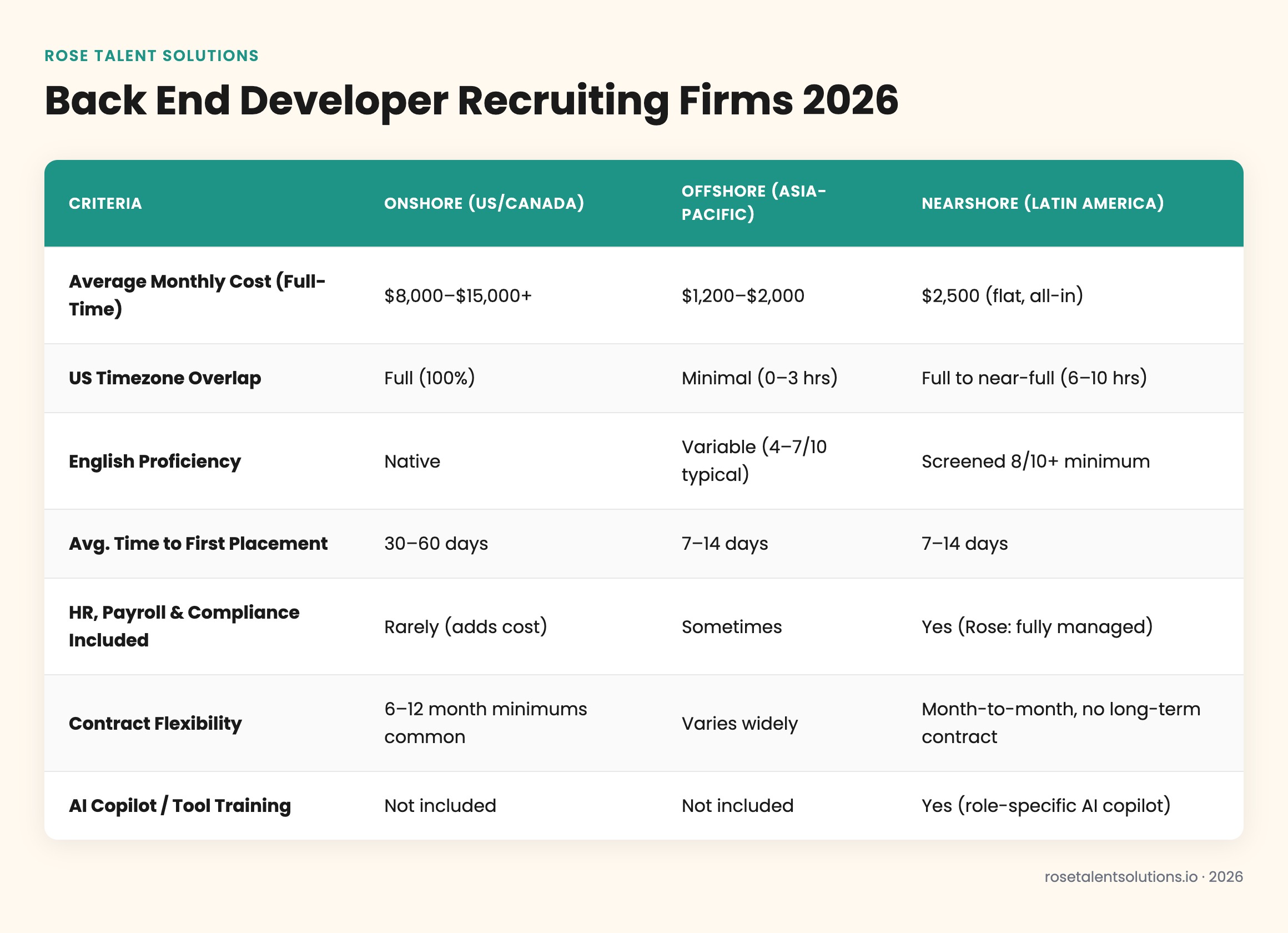
The AI copilot row in that table deserves special attention. Rose equips every placed team member — including back end developers — with a role-specific AI copilot trained on the tools they'll actually use. That means faster onboarding, fewer errors, and a developer who hits the ground running instead of spending week one figuring out your stack's conventions. Learn more about how that works on Rose's AI advantage page.
What Does a Back End Developer Recruiting Firm Actually Cost in 2026?
Cost transparency is the biggest pain point buyers report when evaluating recruiting firms. Most domestic agencies charge a placement fee equal to 15–25% of the hire's first-year salary — which on a $120,000 back end developer role means an $18,000–$30,000 one-time fee, before you've paid the developer a single paycheck. And that fee typically doesn't include payroll administration, benefits management, or any replacement guarantee if the hire doesn't work out.
The real cost of domestic back end developer recruiting isn't just the placement fee — it's the 45+ day time-to-fill, the onboarding ramp time, and the fact that most firms offer no replacement guarantee if the engineer underperforms. Nearshore all-in pricing flips this math completely.
According to SHRM's HR Benchmarking Data (2024), the average cost-per-hire across all roles is $4,683 — and for technical roles, that number climbs significantly higher when you factor in recruiter time, job board spend, and lost productivity during the vacancy window. The nearshore flat-rate model eliminates all of that variable cost and replaces it with a single predictable monthly line item.
Rose's $2,500/month includes recruiting, vetting, payroll, HR, and ongoing management. If the team member isn't a fit, Rose replaces them at no additional cost. That's the risk reversal — a genuine replacement guarantee that removes the downside from your decision.
Curious what Latin America-based technical talent actually earns? Our post on average salaries for Latin America virtual assistants shows the underlying wage data that makes the nearshore model work financially for both sides.

According to McKinsey's State of Organizations report (2023), companies that adopt flexible, managed staffing models reduce total workforce cost by an average of 40% compared to equivalent in-house hiring — without sacrificing output quality when roles are well-defined and communication infrastructure is in place.
How the Rose Talent Solutions Placement Process Works for Technical Roles
Understanding the mechanics of how a nearshore recruiting firm actually places a back end developer helps you evaluate whether the model fits your workflow. Rose's process is built around speed and fit accuracy — the two things traditional recruiting firms consistently fail on for technical roles.
Role Scoping Call
Rose's team learns your stack, your team structure, your sprint cadence, and the specific back end responsibilities the role needs to cover — Node, Python, database design, API architecture, whatever the actual need is.
Talent Matching from Pre-Vetted Pipeline
Rose matches from a pipeline of Latin America-based developers who have already cleared English proficiency screens (8/10+ minimum), technical skills assessments, and background verification — no cold sourcing delays.
Client Interview and Selection
You interview the top match. If the fit isn't right, Rose iterates. No pressure to accept a candidate who doesn't click with your team's culture or technical requirements.
Onboarding with AI Copilot Activation
Your new developer starts with a role-specific AI copilot already configured for their tools — cutting typical onboarding time significantly versus a cold placement from a traditional recruiter.
Ongoing HR and Performance Management
Rose handles payroll, HR compliance, and performance check-ins. If the developer isn't performing, Rose replaces them at no additional cost — the replacement guarantee applies from day one.
You can explore the full service model and get started with a role scoping call at Rose's start page. If you want to understand how nearshore staffing agencies are structured before committing to a discovery call, our guide to nearshore staffing agencies breaks down the operating model in plain language.
Nearshore vs. Offshore Developer Recruiting in 2026: Honest Pros and Cons
If you're coming into this evaluation with an existing offshore relationship — or you're being pitched by a distant-timezone firm alongside a nearshore option — here's the honest comparison operators in 2026 are working through. Offshore here refers to teams located in Asia-Pacific regions with 9–12 hour time differences from the US east coast.
Nearshore (Latin America) — Pros
- Full US timezone overlap — real-time standups, Slack, code reviews
- English proficiency screened and verified (8/10+ floor at Rose)
- Flat-rate all-in pricing — no hidden recruiter fees or payroll markups
- Month-to-month terms, no long-term contract commitment
- Role-specific AI copilot included — faster ramp, fewer errors
- Replacement guarantee if the hire isn't a fit
Distant-Timezone Offshore — Cons
- 9–12 hour timezone gap creates async bottlenecks on every sprint
- English proficiency varies widely and is rarely rigorously screened
- Pricing may appear lower but hidden coordination overhead adds cost
- Most firms charge placement fees with no replacement guarantee
- Cultural and communication friction increases with team size
- No AI copilot or tool-specific onboarding support
The math on nearshore is straightforward once you account for total cost of ownership. A $1,500/month developer who requires 20% more management time, produces 30% more rework due to communication gaps, and misses one sprint per quarter due to timezone misalignment ends up costing more in lost engineering output than a $2,500/month nearshore developer who operates inside your existing workflow without friction. According to Gallup's research on workforce engagement (2023), teams with high real-time collaboration scores report 21% higher productivity — a figure that directly favors timezone-aligned nearshore staffing over async-dependent offshore models.