
Nearshore hiring from Argentina has quietly become one of the smartest moves a US-based technology company or growing business can make in 2026. Argentina's developer talent pool combines university-level computer science training, strong English fluency, and time zones that overlap completely with the US East and Central coasts — which means your team stays in sync without anyone working at 2 a.m. If you've been researching developers in Argentina and wondering whether the hype is real, this guide gives you the unfiltered breakdown: skills, costs, risks, and how to source the right way.
Why Argentina Developers Have Become a Top Nearshore Choice in 2026
Argentina produces roughly 115,000 technology graduates per year, according to Argentina's Ministry of Economy (2023). That's a large, renewable pipeline of engineers — and unlike many offshore markets, a meaningful share of those graduates studied in English-language curricula or spent time at international companies. The country's universities, particularly the Universidad de Buenos Aires and UTN (Universidad Tecnológica Nacional), consistently rank among the top technical institutions in Latin America.
Argentina also benefits from decades of integration with US and European tech ecosystems. Major companies including Mercado Libre, Globant, and Despegar were founded there, creating a generation of developers who've shipped production-grade software at scale. When you hire developers in Argentina today, you're often hiring people who've already worked on distributed teams and know what "asynchronous-first" really means in practice.
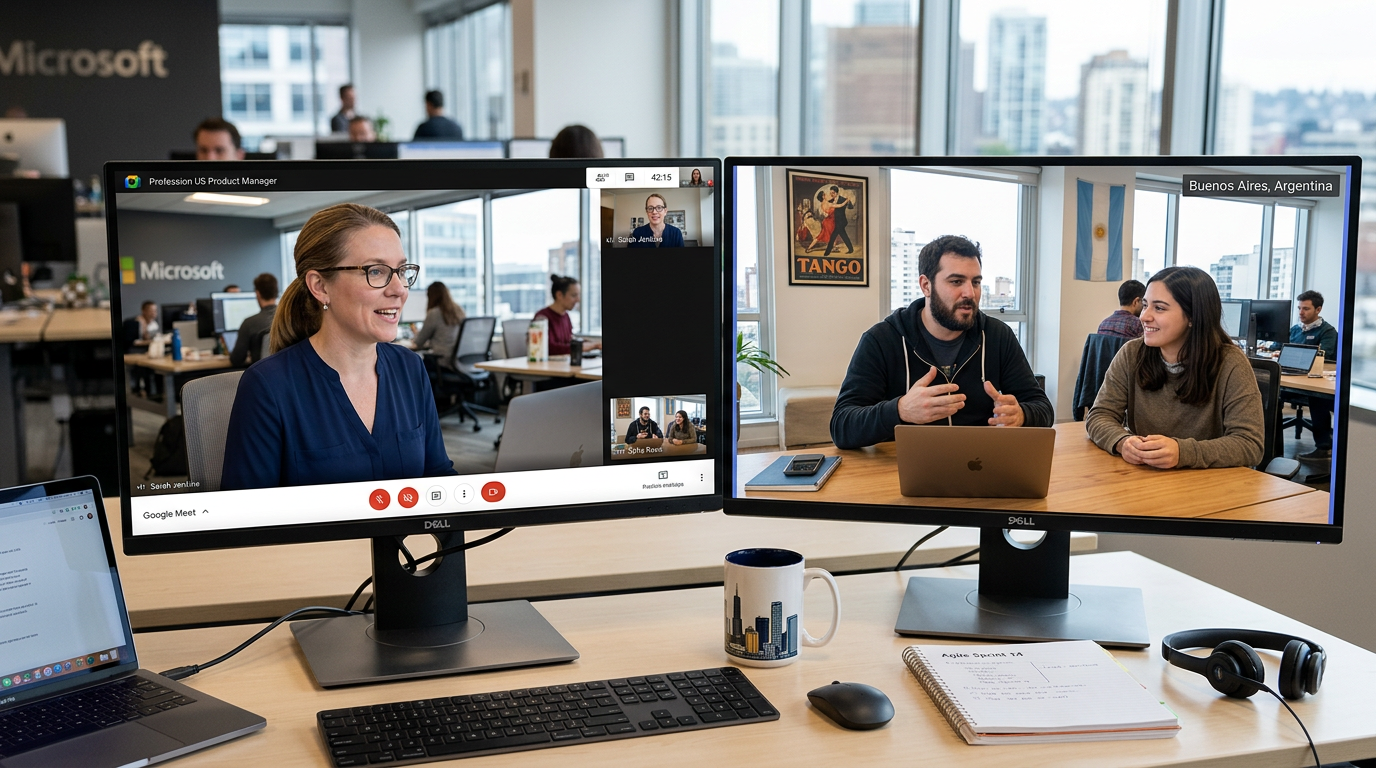
The timezone alignment is consistently underrated. Argentina Standard Time (ART) is UTC-3 year-round — the country does not observe daylight saving time. That puts Buenos Aires developers just 1 hour ahead of New York (EST), 2 hours ahead of Chicago, and 4 hours ahead of Los Angeles. For real-time collaboration, code reviews, standups, and incident response, that overlap is functionally seamless. Compare that to the 9–12 hour gaps common with Southeast Asian or South Asian outsourcing — those gaps don't just slow communication, they slow entire sprint cycles. If you want to understand how those timezone differences compound over months of collaboration, this complete comparison of nearshore vs. offshore vs. onshore hiring breaks down the true operational cost of each model.
What Skills Do Argentina Developers Bring to the Table in 2026?
Argentina's developer workforce skews heavily toward full-stack web development, backend engineering, and quality assurance. The most common technology stacks include JavaScript/TypeScript (React, Node.js, Next.js), Python (Django, FastAPI), Java (Spring Boot), and PHP (Laravel). Mobile development in Swift and Kotlin is growing fast, especially post-pandemic as Argentine startups scaled consumer apps regionally.
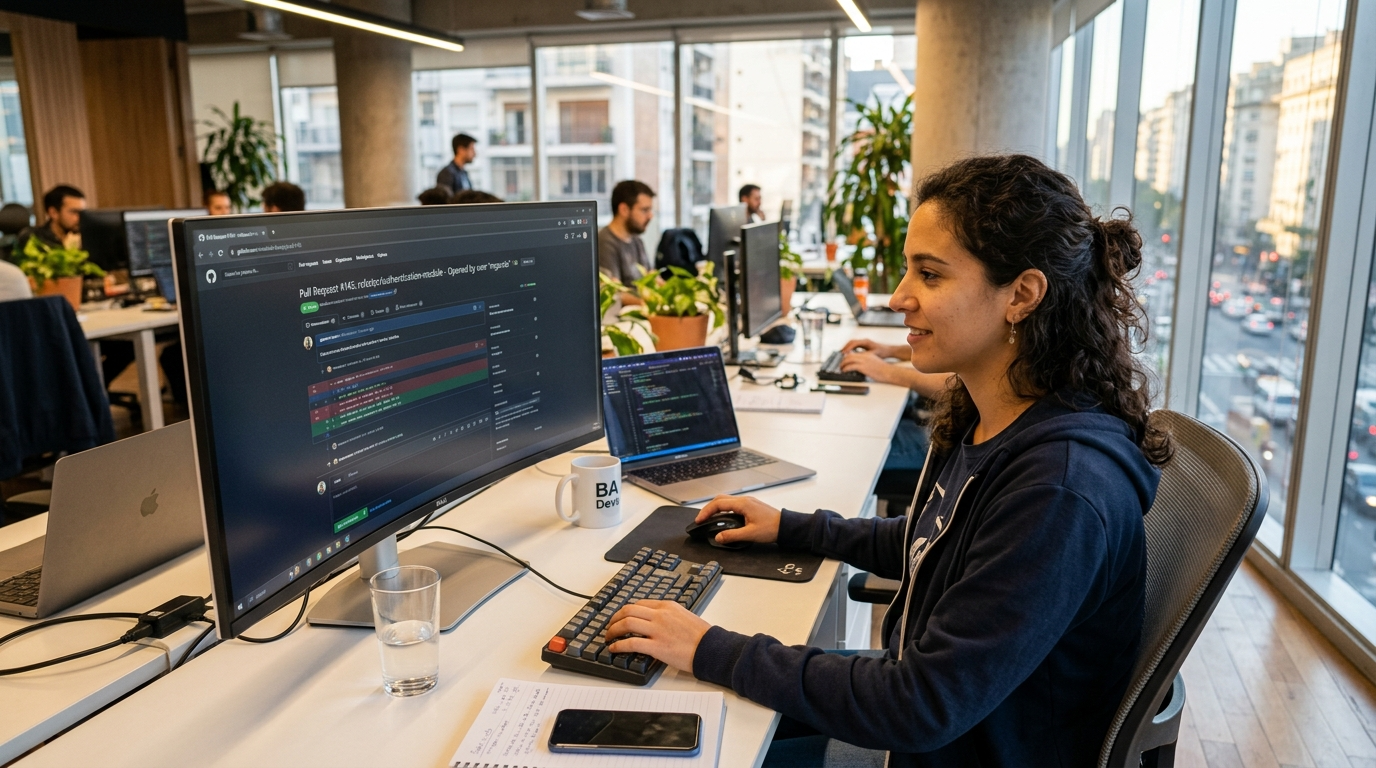
Beyond raw coding skills, Argentine developers tend to bring strong systems-thinking to product work. Argentina's economic volatility has, counterintuitively, produced engineers who are exceptionally good at doing more with less — building resilient architectures, writing efficient queries, and shipping under resource constraints. According to Coursera's Global Skills Report (2023), Latin American learners rank among the fastest-growing cohorts in cloud computing and data science upskilling globally.
English proficiency among Argentine developers is notably strong relative to other Latin American markets. Argentina's EF English Proficiency Index scores consistently place it in the "High Proficiency" band for Latin America, according to EF Education First's EPI (2023). That matters practically: code reviews happen in English, Slack threads happen in English, and your US-based product manager doesn't want to use a translator to leave a PR comment.
How Does Hiring Argentina Developers Compare to Other Options in 2026?
Cost is the obvious starting point, but it's not the whole story. A senior developer in the US commands $120,000–$180,000 per year in base salary alone, according to the US Bureau of Labor Statistics (2024). Freelance developers in Argentina on platforms like Toptal or Upwork typically bill $40–$80/hour depending on seniority and stack — competitive, but unmanaged and variable. A fully managed nearshore placement through a staffing partner runs roughly $2,500/month all-in for a full-time 40-hour-per-week team member, which includes recruiting, vetting, payroll, HR, and ongoing management. That's a materially different risk and overhead profile than going direct.
| Hiring Model | Typical Monthly Cost | Timezone Overlap (US East) | Vetting & Management | Contract Flexibility |
|---|---|---|---|---|
| Nearshore Agency (Argentina/LATAM) | ~$2,500/mo flat | 1–3 hrs difference | Fully managed — agency handles recruiting, HR, payroll | No long-term contract; month-to-month |
| Freelance Marketplace (Upwork/Toptal) | $6,400–$12,800/mo (at $40–$80/hr) | Varies — no guarantee | Self-managed; you vet, onboard, and manage directly | Per-project or hourly; can cancel anytime |
| Offshore Agency (Philippines/India) | $1,500–$2,500/mo | 9–12 hrs difference | Managed, but async-heavy due to timezone gap | Varies — often 3–6 month minimums |
| Onshore US Direct Hire | $10,000–$15,000/mo (fully loaded) | Same timezone | Fully self-managed; full employer burden | At-will employment; severance risk |
"The real value of nearshore isn't just cost savings — it's the elimination of the 12-hour communication lag that kills sprint velocity in offshore models. When your developer is in your timezone, you stop playing telephone." — Andy Tryba, CEO at Trilogy (as cited in nearshore staffing industry commentary, 2023)
How Nearshore Staffing Agencies Source and Vet Argentina Developers in 2026
The quality of your hire is almost entirely determined by the quality of the vetting process — and that's where going through a specialized nearshore staffing partner pays off. A reputable agency doesn't just post a job listing. They maintain active talent networks in Argentina, screen for technical skills through live assessments, and apply structured English proficiency screens (Rose Talent Solutions requires an 8/10 or higher on English proficiency for every placement). That standard matters because a developer who can't communicate clearly in English will create bottlenecks regardless of their coding skill.
According to SHRM (2023), the average cost of a bad hire is 50–200% of that employee's annual salary when you factor in lost productivity, re-recruiting, and onboarding time. Paying for rigorous pre-vetting upfront is almost always cheaper than fixing a bad placement 90 days in. If you want to see how the best agencies in the region approach this, this breakdown of top staffing agencies for Latin America developers walks through what separates the good ones from the ones that just forward résumés.
Needs Assessment
The agency maps your stack, seniority requirements, working hours, and collaboration style to define exactly what kind of Argentina developer will fit — before sourcing begins.
Talent Sourcing & Screening
Candidates are pulled from the agency's active LATAM network, then screened via technical assessments, English proficiency tests, and structured interviews — typically yielding 2–3 finalists.
Client Interview & Selection
You interview shortlisted candidates directly. Most clients make a hiring decision within 3–5 business days of receiving the shortlist.
Onboarding & Integration
The agency handles contracts, payroll, and HR. Your new team member joins your tools and workflows — typically fully productive within the first two weeks.
Ongoing Management & Replacement Guarantee
If the placement isn't a fit, the agency replaces them at no additional cost. Month-to-month terms mean no long-term contract locks you in.
What Are the Risks of Hiring Developers in Argentina — and How Do You Mitigate Them?
Argentina's macroeconomic volatility is the most-cited concern when US companies evaluate the market. The country has experienced significant currency fluctuations and periodic capital controls over the past decade. For businesses paying in USD through a managed staffing agency, this risk is largely absorbed by the agency's local payroll infrastructure — your invoice stays flat in dollars regardless of what the Argentine peso does. That's one of the core operational reasons to work with an agency rather than paying contractors directly in USD via international wire.
The other practical risk is developer attrition. Argentina's tech market is competitive; skilled developers receive offers regularly. A staffing agency with a replacement guarantee neutralizes the business impact — if your team member leaves or isn't working out, you get a replacement at no additional cost. That protection is worth more than it sounds: developer turnover costs an average of 1.5–2× annual salary when you include lost sprint velocity, re-onboarding, and context rebuild, according to Gallup's Workforce Research (2019).
The biggest risk in hiring Argentina developers isn't skill quality — it's payment infrastructure and attrition. Both risks shrink significantly when you work through a managed nearshore agency that absorbs local payroll complexity and provides a no-cost replacement guarantee.
Argentina's labor law is also notably employee-protective, with mandatory severance, notice periods, and benefits requirements. Navigating that as a US company paying a foreign contractor directly is complex and creates misclassification exposure. A reputable virtual assistant and staffing company operating in Latin America handles all of that locally, keeping your business out of the compliance thicket entirely. For businesses also weighing whether to hire support staff or operational talent alongside developers, Rose's bookkeeping and accounting staffing service and property management VA placements follow the same fully managed model — one monthly flat rate, no long-term contract, replacement guarantee included.
How to Decide If Argentina Developers Are the Right Fit for Your Business in 2026
Argentina developers are an excellent fit for US businesses that need real-time collaboration, strong English communication, and mid-to-senior technical talent without onshore salary overhead. They're particularly well-suited for product-focused companies, SaaS startups, and tech-enabled service businesses that run agile sprints, need consistent timezone overlap for standups and reviews, and value written English fluency in documentation and async communication.
They may be less optimal if your project is heavily documentation-translation-heavy in a non-English language, or if your team is entirely offshore-async and timezone overlap doesn't matter at all. In the latter case, the price differential with South Asian or Southeast Asian markets may outweigh the coordination benefits. If you're still weighing those tradeoffs, this deep comparison of onshore vs. offshore virtual assistant and staffing models gives a clear framework for the decision.
Why Hire Argentina Developers
- 1–3 hour timezone overlap with US East and Central
- Strong English fluency — EF High Proficiency band
- Large, renewable STEM graduate pipeline (115K/year)
- Experienced with distributed, agile US-style teams
- Fully managed agency model available for $2,500/mo all-in
- No long-term contract required through Rose Talent Solutions
Considerations to Plan For
- Argentina's macroeconomic volatility (mitigated by agency payroll infrastructure)
- Competitive local market means attrition risk without retention mechanisms
- Complex local labor law if paying contractors directly as a foreign company
- Senior full-stack rates on freelance platforms can approach mid-tier US costs
The bottom line: if you want developers in Argentina who show up synchronously, communicate clearly, and integrate into your existing team without a 12-hour async lag, nearshore staffing is the right model. If you want to explore how Rose Talent Solutions matches and manages nearshore developers specifically, the AI Advantage page covers how every placement ships with a role-specific AI copilot trained on your team's toolstack — which cuts ramp time significantly. And when you're ready to move, the fastest path is the Start page, where most clients get a shortlist of candidates within 7 days of their intake call.