
What Are Application Development Recruiters — and Why Does 2026 Demand a New Approach?
Nearshore application development recruiters are staffing specialists who source, screen, and place software developers — front-end, back-end, full-stack, mobile, and everything between — for companies that need technical talent without the nine-month internal hiring cycle. The "nearshore" part matters: it means your recruiter and your placed developer both sit in Latin America, working your time zone, not a 10-hour lag behind you.
The traditional model — post on LinkedIn, wait 6 weeks, interview 40 candidates, lose the finalist to a competing offer — is costing US companies far more than the recruiter fee. According to SHRM (2023), the average cost per hire in the US sits at $4,700, and that number balloons past $28,000 when you factor in lost productivity during vacancy. Application development roles routinely double that figure.
In 2026, the companies winning on technical hiring aren't the ones posting more job ads. They're the ones rethinking who does their recruiting — and where that talent lives. A nearshore staffing approach flips the equation: instead of a six-figure US salary and a months-long search, you get a vetted developer placed in days at a fraction of the cost, with no time-zone dysfunction baked in.
This guide breaks down exactly how application development recruiters work in 2026, what separates nearshore from offshore and onshore options, and how to evaluate any recruiter before you sign anything.
How Application Development Recruiters Actually Work in 2026
Not all technical recruiters operate the same way. Some are pure headhunters — they find a candidate, hand them off, and disappear. Others function as managed staffing agencies, handling recruiting, vetting, payroll, HR compliance, and ongoing performance management under one flat fee. The difference matters enormously when you're placing a developer who will have access to your codebase, your clients, and your internal tools.
The best application development recruiters in 2026 run a structured intake-to-placement process. Here's how Rose Talent Solutions approaches it:
Role Discovery Call
A staffing specialist maps the exact technical stack, seniority level, and soft-skill requirements — so the search is targeted from day one, not spray-and-pray.
Candidate Sourcing & Vetting
Recruiters pull from a pre-screened Latin American talent pool, running English proficiency screens (8/10+ minimum), technical assessments, and culture-fit interviews before you see a single résumé.
Client Interview & Match
You interview 1–3 finalists — not 40. Rose handles scheduling, feedback loops, and reference checks.
Placement & Onboarding
Once you select your developer, Rose manages payroll, HR compliance, and the role-specific AI copilot setup so your new hire is productive on day one.
Ongoing Management & Replacement Guarantee
If the team member isn't a fit, Rose replaces them at no additional cost. Month-to-month terms mean no long-term contract trapping you in a bad match.
The full-service model matters because technical hiring failures are expensive. According to Gallup (2019), US businesses lose $1 trillion per year to voluntary turnover — and bad placements accelerate that cycle. A recruiter who stays engaged after placement has a vested interest in the match working long-term.

Nearshore vs. Offshore vs. Onshore: 2026 Recruiter Comparison
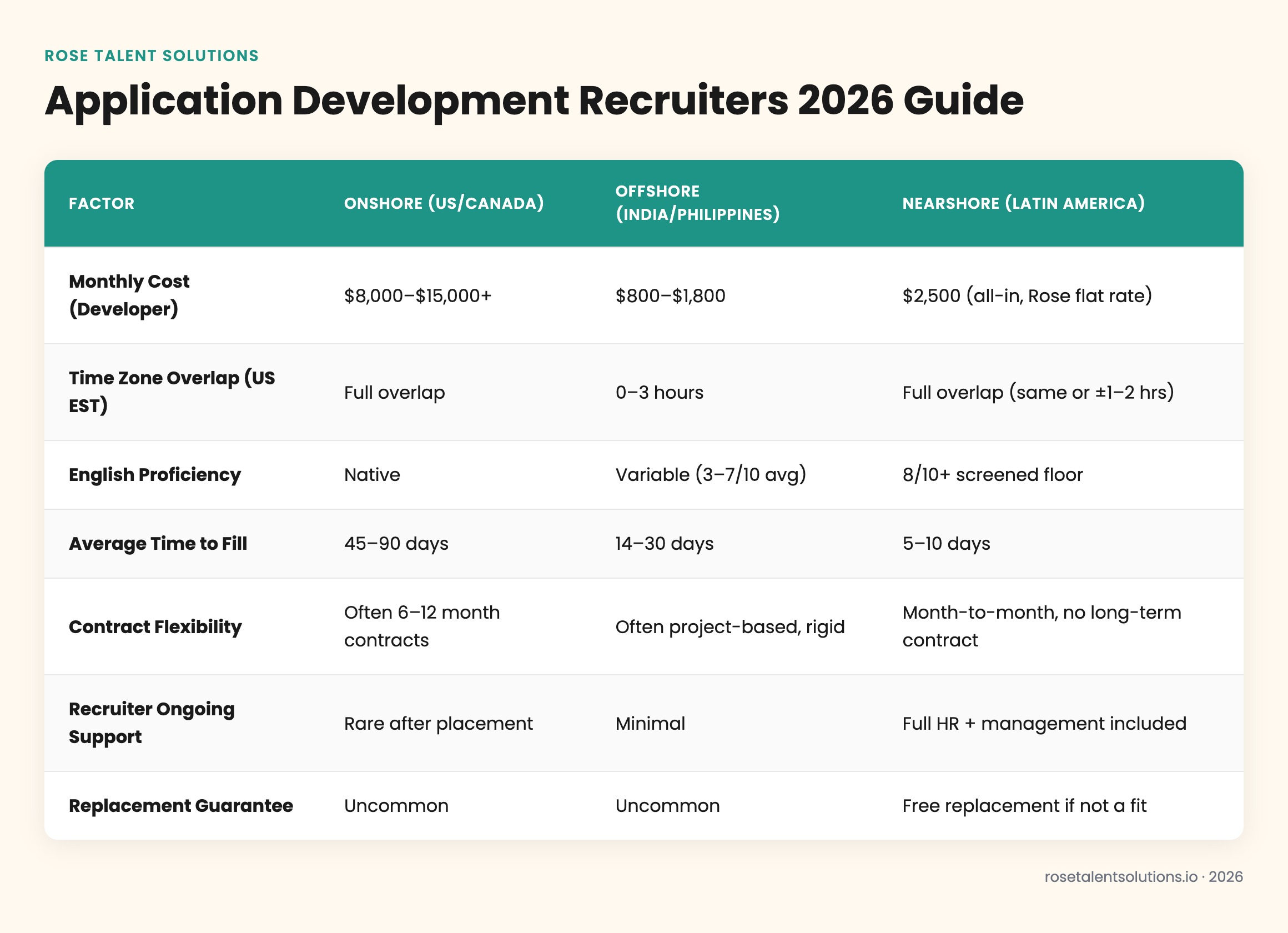
When you start evaluating application development recruiters, the geography question comes up fast. Onshore (US-based) developers are expensive. Offshore (India, Philippines) is cheap but creates real operational friction. Nearshore — Latin America, working your hours — sits in the middle on cost and at the top on collaboration quality.
If you want a deeper breakdown of the tradeoffs across all three models, Rose's guide on the nearshore vs offshore vs onshore virtual assistant comparison lays out the full picture. The short version is this: time zone alignment is not a soft benefit — it is an operational multiplier.
| Factor | Onshore (US/Canada) | Offshore (India/Philippines) | Nearshore (Latin America) |
|---|---|---|---|
| Monthly Cost (Developer) | $8,000–$15,000+ | $800–$1,800 | $2,500 (all-in, Rose flat rate) |
| Time Zone Overlap (US EST) | Full overlap | 0–3 hours | Full overlap (same or ±1–2 hrs) |
| English Proficiency | Native | Variable (3–7/10 avg) | 8/10+ screened floor |
| Average Time to Fill | 45–90 days | 14–30 days | 5–10 days |
| Contract Flexibility | Often 6–12 month contracts | Often project-based, rigid | Month-to-month, no long-term contract |
| Recruiter Ongoing Support | Rare after placement | Minimal | Full HR + management included |
| Replacement Guarantee | Uncommon | Uncommon | Free replacement if not a fit |
"The talent war for software developers isn't just about compensation anymore — it's about speed. Companies that can identify, assess, and onboard technical talent in under two weeks will outcompete those running 60-day hiring cycles, regardless of budget." — Josh Bersin, Founder at The Josh Bersin Company (2024)
What to Look for in Application Development Recruiters: 2026 Vetting Checklist
Most technical recruiting firms will tell you they specialize in "full-stack development." Very few can tell you specifically how they assess React versus Vue competency, or how they validate that a candidate claiming "5 years of AWS experience" actually architected production systems — versus read a tutorial.
Here's what separates a real application development recruiter from a résumé-shuffling generalist:
- Technical assessment methodology: Do they use live coding screens, take-home projects, or just read the résumé? Live coding is the gold standard for application developers.
- Stack-specific depth: A recruiter who places React developers and Python engineers and iOS developers and DevOps engineers equally is probably mediocre at all of them. Look for specialization.
- English proficiency standards: For client-facing developers or those attending standup calls, fluency matters. Rose requires 8/10+ on independent language screens — ask any recruiter what their actual bar is.
- Post-placement accountability: Does the recruiter disappear after day one? Or do they manage HR, payroll, and performance on an ongoing basis?
- Replacement policy: A recruiter confident in their placements offers a free replacement if the match isn't right. If a firm won't commit to this, they're telling you something about their vetting quality.
The hidden cost of a bad technical hire isn't the salary — it's the 3–6 months of slow productivity, code rework, and team friction before you admit the match failed. Rigorous upfront vetting by the recruiter is the only reliable protection against this cycle.
Understanding what application development recruiters should cost also matters. If you're curious how Latin American developer and virtual assistant salaries compare to US benchmarks, the numbers are more nuanced than the "cheap offshore labor" narrative — you're accessing highly educated, English-fluent professionals at a market rate that reflects their local cost of living, not cut-rate quality.
According to the US Bureau of Labor Statistics (2024), the median annual wage for software developers in the United States is $132,270 — approximately $11,000 per month. A nearshore developer placed at Rose's $2,500/month all-in rate represents an 77% cost reduction with full time-zone alignment and managed HR included.

How Rose's AI Advantage Separates Nearshore Developer Placements in 2026
One factor that most application development recruiters don't address at all: what happens after placement when your developer needs to ramp on your specific tooling. The average new technical hire spends 2–4 weeks just getting oriented to internal systems — project management tools, documentation standards, CI/CD pipelines, communication norms.
Rose addresses this with a role-specific AI copilot, trained on the software stack your developer will actually use. Whether that's GitHub workflows, Jira, Notion, AWS infrastructure patterns, or your internal API documentation, the AI advantage program cuts ramp time dramatically — so your developer is contributing to sprint goals in week one, not week four.
This matters more than most hiring managers realize. According to McKinsey & Company (2023), AI-augmented software developers complete coding tasks up to 45–50% faster than those working without AI assistance. A developer who ships with an AI copilot tuned to your stack is measurably more productive from day one — not just eventually.
The AI advantage is also why Rose operates differently from traditional nearshore staffing agencies that place talent and walk away. The copilot requires ongoing calibration, which keeps Rose's team engaged with your placement long after the contract is signed.
If you're evaluating whether onshore versus offshore staffing is the right framing for your dev team, the answer in 2026 is increasingly neither — nearshore with AI augmentation is becoming the default for growth-stage US companies that need speed, quality, and cost efficiency simultaneously.
According to Statista (2024), 75% of developers report that AI coding tools have meaningfully improved their productivity — but only when those tools are configured for the specific codebase and workflow. Generic AI tools help; role-specific AI copilots transform output.
Why Nearshore Application Development Recruiters Win
- Full US time zone overlap — live standups, real-time Slack, no async bottlenecks
- 8/10+ English fluency minimum — no lost-in-translation sprint planning
- All-in flat fee ($2,500/mo) covers recruiting, HR, payroll, and ongoing management
- Free replacement if the placement isn't a fit — zero additional cost
- AI copilot ships with every developer, tuned to your actual stack
- Month-to-month terms — no long-term contract locks you in
Where Traditional Recruiters Fall Short
- One-time placement fees with no post-hire accountability
- Offshore placements create 6–10 hour async gaps that slow every decision
- US onshore developers cost $8,000–$15,000+/month with no management included
- No replacement guarantees once the check clears
- No AI tooling support — developer ramp time measured in months
- Long-term contracts that lock you in before you know if the match works
Ready to see what a role-specific placement looks like for your team? Visit Rose's start page to describe your application development role and get matched within days.