
Nearshore application developer recruiters have quietly become the highest-leverage hiring move for US and Canadian companies in 2026. While traditional domestic tech staffing agencies charge 20–30% of a developer's first-year salary, nearshore recruiting models from Latin America deliver comparable — often superior — placement quality at a flat, predictable monthly rate. If your pipeline is blocked because you can't find vetted developers fast enough, this guide explains exactly how to fix that — covering what application developer recruiters actually do, how nearshore compares to every alternative, what AI-assisted recruiting looks like in practice, and what to look for when you're vetting any firm before you sign.
The global developer shortage is not letting up. The US Bureau of Labor Statistics projects software developer employment will grow 25% through 2032 — far outpacing the average for all occupations — according to BLS Occupational Outlook Handbook (2023). That gap means every week a role sits open is revenue left on the table. Companies that figure out how to recruit faster and smarter than their competitors don't just fill seats — they compound their advantage quarter over quarter.
What Do Application Developer Recruiters Actually Do in 2026?
An application developer recruiter is a specialist who identifies, screens, and delivers software engineering candidates — typically for roles like mobile app developers, full-stack engineers, API integrators, and platform-specific builders (iOS, Android, React, Node.js). Unlike generalist HR coordinators, developer recruiters understand tech stacks, can read a GitHub profile, and know the difference between a candidate who listed Python and one who actually shipped Python in production. They are, in short, technical talent agents who sit at the intersection of hiring and engineering.
What makes an application developer recruiter different from a general recruiter is depth of specialization. A generalist might spend two hours reviewing 50 resumes and still not know which candidate actually built APIs versus which one simply listed "API development" as a skill. A specialist developer recruiter gets that in a five-minute portfolio scan. That skill compression is exactly why companies with active engineering pipelines — startups, software firms, property tech companies, fintech operators — have moved toward specialized recruiters rather than generalist HR departments handling dev hiring as a side function.
In 2026, the best application developer recruiters also layer in AI-assisted candidate scoring, automated skills assessments, and async interview workflows that cut time-to-offer from the industry average of 42 days down to under two weeks. According to SHRM's Talent Acquisition Benchmarking Report (2023), the average cost-per-hire across all roles is $4,700 — for technical roles, that number climbs significantly higher. Specialist recruiters exist precisely to compress that cost and timeline without sacrificing quality at the top of the funnel.
What separates nearshore developer recruiters from their offshore counterparts isn't just price. It's the combination of real-time collaboration during US business hours, English fluency at an 8/10+ proficiency bar, and cultural familiarity with North American business norms. If you want a deeper breakdown of how these models compare across every dimension worth measuring, the complete nearshore vs. offshore vs. onshore comparison is the most thorough resource available.

How Nearshore Recruiters Outperform Offshore for Developer Hiring in 2026
The timezone argument alone is worth the conversation. An offshore recruiter in Manila or Bangalore operates 11–13 hours behind US Eastern time. Every question, every candidate update, every interview scheduling loop becomes a next-day event. For developer hiring — where top candidates are off the market in 10 days or fewer — that lag is a dealbreaker. You are not just losing time. You are losing specific, qualified people to competitors who could move faster because their recruiter was awake and available.
Nearshore recruiters based in Latin America — Colombia, Mexico, Argentina, Costa Rica — work your hours. A candidate who interviews at 2pm EST gets feedback by 5pm EST. That speed compounds. According to McKinsey & Company (2022), organizations that fill critical technical roles faster than competitors grow revenue 1.5× faster over a three-year window. Speed in developer recruiting isn't just operational — it's strategic. And the nearshore model is the only one that gives you offshore pricing without the offshore communication lag.
"The companies winning the war for developer talent aren't necessarily offering more money — they're offering faster decisions. Top engineers have three offers in two weeks. The recruiter who moves first, wins." — Karin Kimbrough, Chief Economist at LinkedIn (2023)
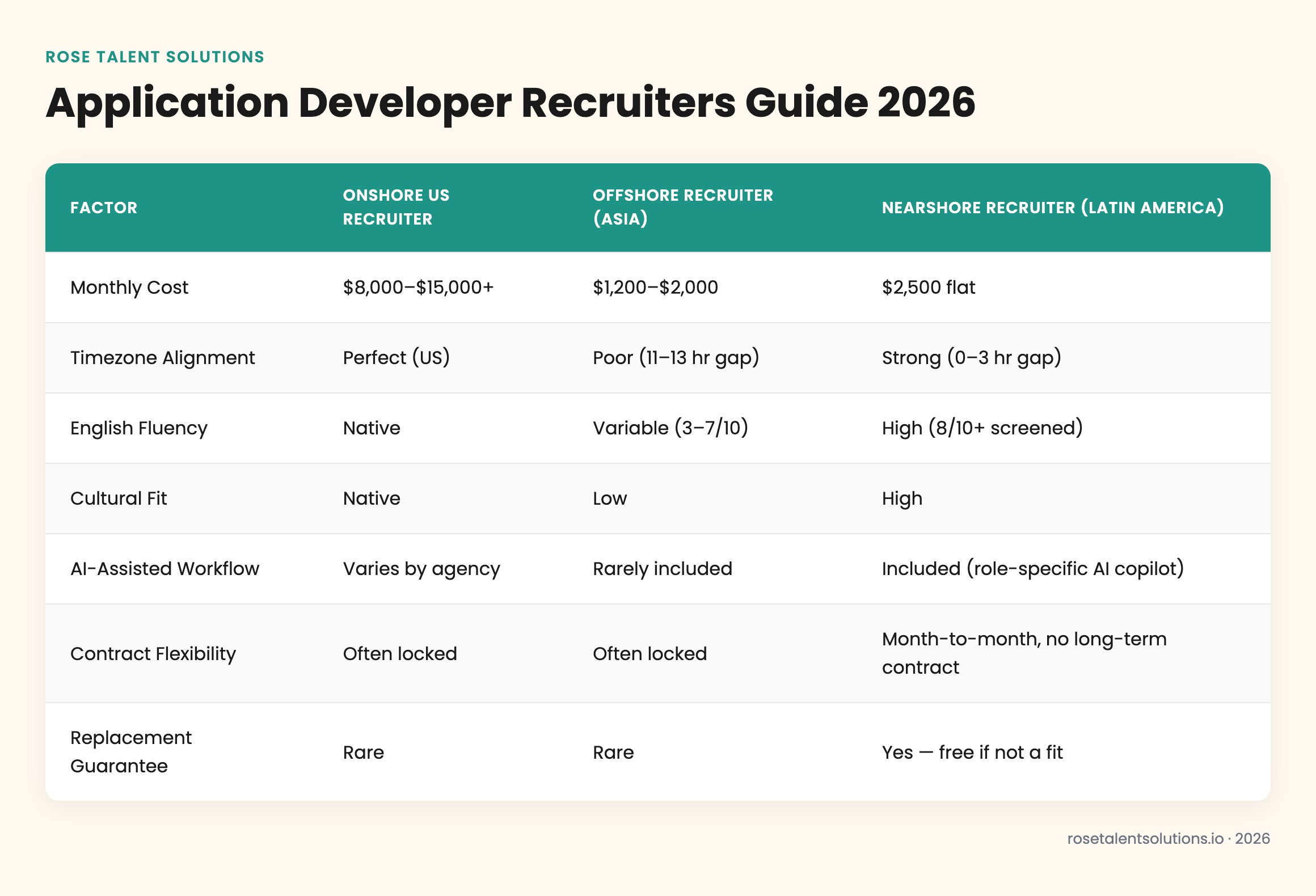
Comparing recruiting models side by side makes the nearshore advantage concrete. The table below maps the three primary models across the factors that matter most to US hiring managers choosing a recruiting partner in 2026.
| Factor | Onshore US Recruiter | Offshore Recruiter (Asia) | Nearshore Recruiter (Latin America) |
|---|---|---|---|
| Monthly Cost | $8,000–$15,000+ | $1,200–$2,000 | $2,500 flat |
| Timezone Alignment | Perfect (US) | Poor (11–13 hr gap) | Strong (0–3 hr gap) |
| English Fluency | Native | Variable (3–7/10) | High (8/10+ screened) |
| Cultural Fit | Native | Low | High |
| AI-Assisted Workflow | Varies by agency | Rarely included | Included (role-specific AI copilot) |
| Contract Flexibility | Often locked | Often locked | Month-to-month, no long-term contract |
| Replacement Guarantee | Rare | Rare | Yes — free if not a fit |
How the AI Copilot Changes What Developer Recruiters Can Deliver in 2026
Every Rose Talent Solutions team member ships with a role-specific AI copilot trained on the software and workflows relevant to their function. For application developer recruiters, that means the AI is pre-configured for sourcing workflows, ATS integrations, candidate scoring rubrics, and GitHub or portfolio analysis — not a generic chatbot bolted on after the fact. The distinction matters: a general-purpose AI tool is only as good as the prompts the user knows to write. A pre-scoped copilot is calibrated before day one and continues to improve as your recruiter uses it.
This matters because recruiter productivity is a direct function of how fast they can process the top of the funnel. A recruiter spending three hours manually reviewing 200 resumes is a recruiter who isn't building candidate relationships or pushing hiring managers for decisions. AI-assisted screening compresses that review window to under 30 minutes, freeing your recruiter to do the high-leverage human work that actually closes candidates. The sourcing becomes systematic; the relationship-building remains human. That balance is where the best developer hires come from.
The hidden cost of a slow recruiter isn't their salary — it's the developer salary you're not generating because that engineering role sat open for 60 days instead of 14. At a $120K developer salary, 46 extra days of vacancy costs you roughly $15,000 in lost productive output. That math makes the right recruiter one of the highest-ROI hires a growth-stage company can make.
You can explore how Rose's AI-assisted approach works in detail on the AI Advantage page — it's not a marketing abstraction. Each copilot is scoped to the recruiter's actual tool stack before they ever take their first candidate call. This is what separates a modern nearshore recruiting model from a traditional staffing firm that simply places a person and walks away.
Latin America has also become a genuine tech talent hub, not just a support-role labor pool. According to Statista (2023), Latin America is home to over 1.4 million professional software developers, with Brazil, Mexico, and Argentina producing the largest cohorts. That means your nearshore recruiter isn't just operating in your timezone — they're embedded in the same talent ecosystem they're sourcing from, giving them referral networks and community access that remote offshore firms in entirely different continents simply don't have. Passive candidate pipelines are built through trust and proximity; nearshore recruiters have both.

How Rose Talent Solutions Matches and Onboards Application Developer Recruiters
The process is built for speed without sacrificing fit. Rose handles recruiting, vetting, payroll, HR, and ongoing management — the $2,500/month flat rate covers all of it. You're not paying a placement fee plus a management fee plus a separate HR administration charge. It's one number, full stop. The structure is intentional: when every cost is bundled, you know exactly what you're spending and exactly what you're getting, without the invoice-line-item surprises that come with traditional staffing retainers.
Intake & Role Scoping
Rose's team meets with you to map your exact developer hiring needs — tech stacks, volume, ATS in use, candidate personas. This is where your AI copilot configuration starts, so your recruiter's tooling is ready before they ever review a single resume.
Candidate Matching
Rose's internal talent pool is screened against your role spec. English proficiency is verified at 8/10+ minimum. Technical recruiter knowledge is tested with role-specific assessments — not just a resume scan.
Interview & Selection
You interview your top 1–3 candidates. No pressure to accept anyone who isn't right — Rose replaces at no additional cost if the fit isn't there after placement.
Day-One Readiness
Your recruiter starts with their AI copilot configured, your ATS access provisioned, and a 30-day ramp plan in place. Rose's ongoing management layer means you have a point of contact if anything needs adjusting along the way.
The month-to-month structure means no long-term contract locks you in. If your hiring volume drops or your needs shift, 30 days written notice ends the engagement. For companies that have been burned by 12-month staffing retainers that outlived the original need, this flexibility alone changes the risk calculation. You can start the matching process directly at Rose's start page.
If you're evaluating what a full Latin America staffing build-out looks like — across recruiting, operations, finance, and admin — the Latin America staffing agency breakdown covers the full scope of functions available and how to sequence them as your team scales. Many clients start with a developer recruiter and expand from there once they see the model work.
What to Look for When Vetting Application Developer Recruiters in 2026
Not all developer recruiters are equal, and the wrong placement is worse than a slow one. According to Gallup (2023), the cost of a bad hire averages 50–200% of that employee's annual salary when you account for lost productivity, rehiring costs, and team disruption. For a $120K developer, that's $60K–$240K in real damage. The recruiter who places that bad hire costs you far more than their fee — they cost you everything downstream of a hire that wasn't right from day one.
Use the checklist below to separate strong developer recruiters from superficially credentialed ones. The difference usually shows up in the first conversation — specifically in whether they ask better questions than you do about the role.
Signs of a Strong Developer Recruiter
- Can explain the difference between a REST API and GraphQL without Googling it
- Uses structured technical assessments, not just resume keyword reviews
- Has active relationships with passive candidates, not just job-board scrapers
- Provides candidate scorecards with evidence, not gut-feel recommendations
- Operates during your business hours for real-time feedback loops
- Works within a model that includes a replacement guarantee if the placement doesn't work out
Red Flags to Screen Out
- Sends every resume that matches a keyword, not candidates filtered by fit
- Can't describe the tech stack your team uses when you bring it up
- Operates in a timezone 10+ hours away with next-day-only communication
- Offers no replacement guarantee if placement fails
- Charges placement fees on top of monthly retainers — costs that compound unpredictably
Understanding what drives pricing before you commit also helps calibrate expectations and avoid sticker shock mid-engagement. The Latin America virtual assistant cost breakdown gives a transparent look at what drives nearshore pricing and why flat-rate models outperform hourly billing for most business use cases. And if you're still weighing models, the onshore vs. offshore virtual assistant comparison offers a plain-language framework for making the final call without getting lost in vendor marketing language.
For businesses that also need support functions beyond recruiting — bookkeeping, operations, admin — Rose's bookkeeping and accounting virtual staff operate on the same flat-rate, month-to-month model. Building an integrated nearshore team across departments is straightforward when every function runs on the same pricing and management structure.
The bottom line: in 2026, the best application developer recruiters aren't necessarily based in Silicon Valley or even in your city. They're in Bogotá, Mexico City, and Buenos Aires — working your hours, speaking your language, and moving at the speed that competitive developer hiring demands. The candidate market doesn't wait for slow recruiting processes, slow feedback loops, or slow decision-makers. The question isn't whether nearshore recruiting works — the data, the timezone math, and the cost model all answer that clearly. The question is whether you can afford to keep running your pipeline the old way while your competitors move faster with better-structured teams.