
Nearshore Zapier automation virtual assistants are quietly becoming one of the highest-leverage hires for US small businesses in 2026. While most owners are still manually exporting CSVs, copy-pasting leads between CRMs, and firing off Slack messages that should be automated, the companies pulling ahead have a Latin America-based VA running their entire Zapier stack — full-time, US hours, for a flat monthly rate. This post breaks down exactly what a Zapier VA does, how to vet one, what they should cost, and why nearshore beats offshore for this specific role.
What Is a Zapier Automation Virtual Assistant?
A Zapier automation virtual assistant is a remote professional who specializes in building, maintaining, and optimizing automated workflows inside Zapier — the no-code integration platform that connects 6,000+ apps. They translate your manual, repetitive processes into Zaps that trigger automatically: a new lead in Typeform fires into your CRM, a closed deal in HubSpot creates a QuickBooks invoice, a calendar booking sends a personalized onboarding email without a human touching it.
This is distinct from a general VA who "knows Zapier a little." A true Zapier automation VA understands multi-step Zaps, filters, formatters, paths, webhooks, and error handling. They can diagnose a broken Zap at 9am, fix it before your sales team notices, and document what they changed — all without you writing a single line of code. Many also cross-train in adjacent tools; if you're evaluating broader no-code coverage, our post on Make.com automation virtual assistants covers how that skill set compares.
According to the Zapier State of Business Automation report (2023), 76% of workers say automation frees them to focus on higher-value tasks. Yet the majority of businesses still haven't hired anyone specifically accountable for keeping their automations healthy. That gap is where a dedicated Zapier VA creates immediate ROI.
Automation tool adoption is accelerating fast. According to Gartner (2024), by 2026 organizations that have deployed hyperautomation technologies will lower operational costs by 30%. A Zapier VA is the entry point for small businesses trying to capture a portion of those savings — without an enterprise IT budget.
How a Zapier VA Frees Your Team From Manual Work in 2026
The core value isn't the Zaps themselves — it's the compounding hours you reclaim every week. A single workflow that auto-creates a project in Asana every time a contract is signed in DocuSign might save your ops team 20 minutes per deal. At 50 deals a month, that's 1,000 minutes — over 16 hours — handed back to your team automatically. A full-time Zapier VA typically ships 8–15 new workflows per month during their first 90 days, then shifts to maintaining, improving, and auditing the stack they've built.
Here's what a typical Zapier VA handles week-to-week: auditing existing Zaps for errors, building new workflows from your SOPs or Loom recordings, setting up Zapier Tables or Interfaces for lightweight internal tools, connecting Zapier to your CRM (HubSpot, Salesforce, Pipedrive), and maintaining webhook-based integrations that push data to internal APIs. For more technically complex integrations that go beyond Zapier's no-code layer, many of our clients pair their Zapier VA with a specialist in API integration support for custom-built connectors.

Automation isn't just for sales pipelines. Property management companies use Zapier VAs to auto-route maintenance requests from tenant portals into work order systems. E-commerce brands use them to sync Shopify orders with 3PLs and update Google Sheets in real time. Agencies use them to trigger client reports, onboarding sequences, and invoice workflows. According to McKinsey Global Institute (2023), up to 30% of tasks across most business functions can be automated with current technology — yet adoption lags because no single person owns implementation. A dedicated Zapier VA closes exactly that gap. Learn how Rose matches and vets for this at our AI advantage page.
How Nearshore Zapier VAs Outperform Offshore in 2026
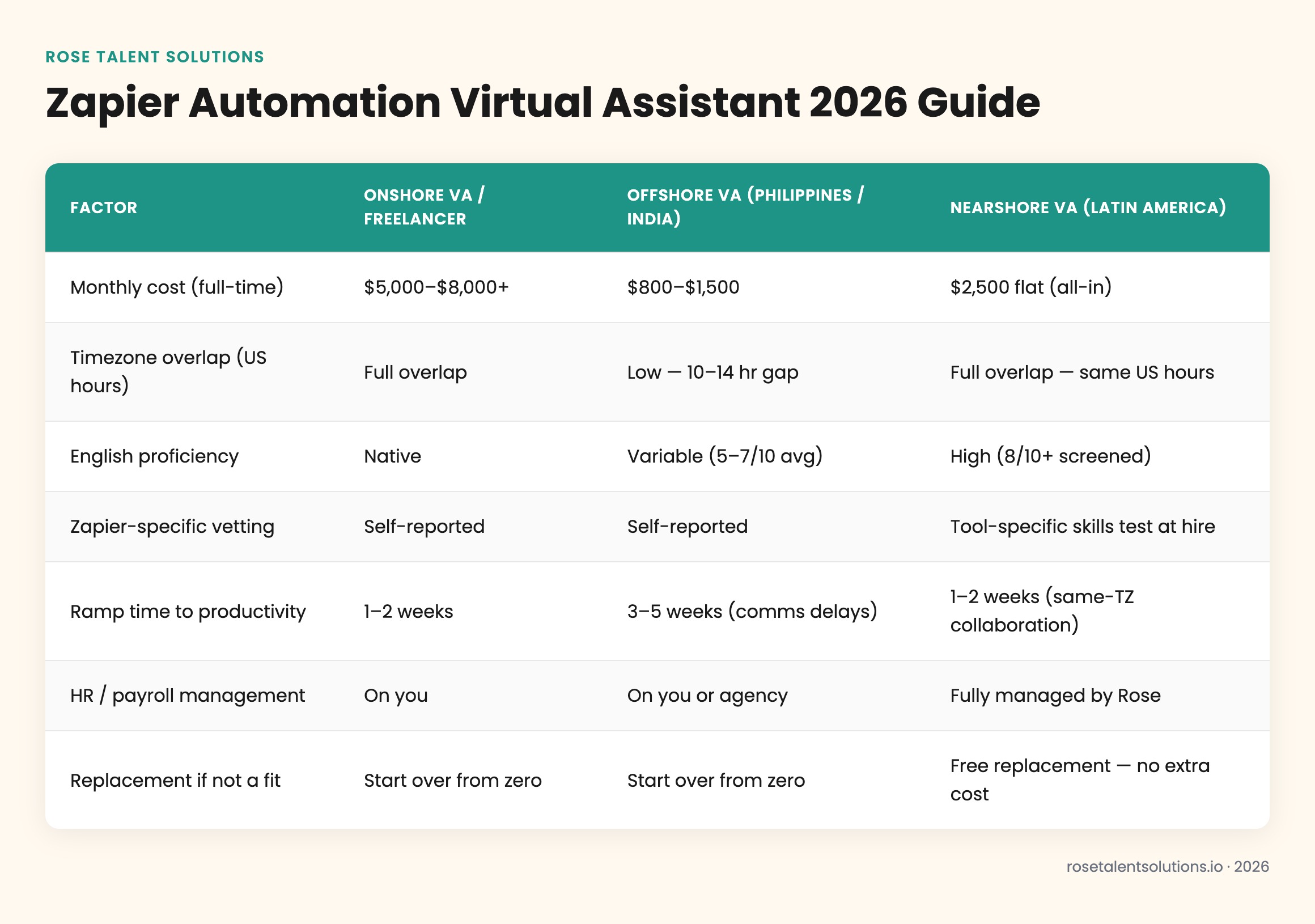
Timezone alignment is the most underrated factor in automation work. When a Zap breaks at 10am on a Tuesday and your offshore VA is 10–12 hours ahead, you're waiting until tomorrow for a fix. Every hour that Zap is broken is an hour your team is doing manually what the machine should be doing. Nearshore VAs based in Latin America work your US business hours — EST, CST, PST — so they're in Slack, in Zoom, and on it in real time.
"The number one reason automation projects fail inside small businesses isn't the technology — it's accountability. Nobody owns the stack. When something breaks, everyone assumes someone else will fix it." — Wade Foster, CEO at Zapier (2023)
Foster's point is exactly why a dedicated nearshore Zapier VA outperforms a freelancer or a generalist VA who "also does Zapier." Ownership matters. When one person is accountable for your entire automation stack — and they're available during your workday — things get fixed fast, documented properly, and improved continuously.
The talent quality argument is equally strong. According to the U.S. Bureau of Labor Statistics (2024), demand for operations and data-related roles is growing faster than the domestic labor supply can fill — which is one reason nearshore staffing is growing as a category. Latin American universities are producing strong technical graduates at a fraction of US salary expectations, giving businesses access to real Zapier skill without onshore wage pressure.
| Factor | Onshore VA / Freelancer | Offshore VA (Philippines / India) | Nearshore VA (Latin America) |
|---|---|---|---|
| Monthly cost (full-time) | $5,000–$8,000+ | $800–$1,500 | $2,500 flat (all-in) |
| Timezone overlap (US hours) | Full overlap | Low — 10–14 hr gap | Full overlap — same US hours |
| English proficiency | Native | Variable (5–7/10 avg) | High (8/10+ screened) |
| Zapier-specific vetting | Self-reported | Self-reported | Tool-specific skills test at hire |
| Ramp time to productivity | 1–2 weeks | 3–5 weeks (comms delays) | 1–2 weeks (same-TZ collaboration) |
| HR / payroll management | On you | On you or agency | Fully managed by Rose |
| Replacement if not a fit | Start over from zero | Start over from zero | Free replacement — no extra cost |
What Skills to Look for When Hiring a Zapier Automation VA in 2026
Not every VA who lists "Zapier" on their resume can build a production-grade multi-step workflow. Here's the skill hierarchy that actually matters, from foundational to advanced:
- Foundational: Trigger/action logic, connecting two apps, testing Zaps, reading Zap history for errors
- Intermediate: Multi-step Zaps, filters and conditions, formatter steps, delay actions, Zapier Paths
- Advanced: Webhook triggers and actions, Zapier Tables, Zapier Interfaces, code steps (Python/JavaScript), sub-Zaps, and Zapier's NLP-based AI features rolling out in 2025–2026
- Operational: Documenting Zap logic in Notion or Confluence, error alerting setups, Zapier usage monitoring and task optimization
A VA who can only do foundational work will hit a ceiling fast. Most businesses scaling past 20–30 Zaps need someone at the intermediate-to-advanced level. If your stack also involves project management and documentation, pairing your Zapier VA with someone experienced in Notion administration creates a powerful ops combo — the Zapier VA builds the automations, the Notion VA builds the system they feed data into.
The hidden cost of a generalist VA doing Zapier "on the side" isn't their hourly rate — it's the 3–5 hours per week of your time explaining what broke, why it matters, and what you need instead. A dedicated Zapier automation VA eliminates that overhead entirely.
According to SHRM's hiring cost research (2023), the average cost to recruit and onboard a single US-based technical employee exceeds $4,700 — before their first paycheck. A nearshore VA through Rose sidesteps that entirely: recruiting, vetting, and placement are included in the flat $2,500/month rate, with a free replacement guarantee if the match isn't right.
Employee engagement also plays a role in VA quality. Gallup's State of the Global Workplace report (2023) found that workers who report high role clarity and clear ownership of outcomes are significantly more productive — which is exactly why Rose structures each VA placement around a single accountable role rather than a shared-services model where Zapier work gets diluted across a dozen other tasks.

For businesses that run Salesforce alongside Zapier (a common enterprise stack), it's also worth considering whether your automation VA should have Salesforce admin skills baked in — or whether that's a separate hire. Our breakdown of Salesforce administrator virtual assistants covers when it makes sense to split those roles versus combine them.
How Rose's Onboarding Process Gets Your Zapier VA Productive in 7 Days
Most hiring processes for technical VAs take 4–8 weeks and still produce a mismatch. Rose's placement model is built to compress that timeline without sacrificing fit quality. Here's how it works:
Discovery Call — Day 1
You walk Rose through your current Zapier stack (or lack of one), your tools, and your biggest manual pain points. This call shapes the candidate brief — not a generic job description.
Candidate Matching — Days 2–4
Rose surfaces 1–3 pre-vetted candidates who've been screened on English proficiency (8/10+ floor), Zapier skill level, and your specific tool stack. No resume pile to sort through.
Your Interview — Day 5
You run a working interview — give the candidate a real Zap to build or debug. Rose structures this so you're evaluating actual output, not just answers to interview questions.
Placement and AI Copilot Setup — Day 6
Your VA is placed with a role-specific AI copilot trained on Zapier, your connected apps, and your internal SOPs — so they're not starting from scratch on day one.
First Zap Ships — Day 7
Most Rose Zapier VAs deliver their first working automation within the first week. Rose's ongoing management layer handles HR, payroll, and check-ins so you never manage the relationship overhead.
The entire model is month-to-month — no long-term contract. Cancel with 30 days written notice. If the team member turns out not to be the right fit, Rose replaces them at no additional cost. You can review the full engagement model on the get started page.
Is a Nearshore Zapier VA Right for Your Business in 2026?
A Zapier automation VA is the right hire if you can answer yes to at least three of these: you're manually moving data between apps more than 30 minutes per day; you've built Zaps that nobody maintains or understands; your team has asked for automations you haven't had time to build; you're paying for Zapier's higher tiers but not using the features; or you've had a Zap break and not noticed for days. Any one of those is a signal — three or more is a mandate.
Strong fit for a Zapier VA
- You run 10+ Zaps and want someone accountable for the whole stack
- Your team wastes hours on manual data transfer between tools
- You're scaling fast and need automation infrastructure to match
- You want real-time collaboration during US business hours
- You need Zapier connected to CRM, PM software, or financial tools
Not the right fit yet
- You only run 1–2 simple Zaps that never break
- Your team hasn't yet standardized their processes (automate chaos = faster chaos)
- You need a part-time or hourly contractor, not a full-time 40hr/week specialist
The hiring urgency is real. According to the U.S. Bureau of Labor Statistics Employment Outlook (2023), operations-adjacent roles are among the fastest-growing job categories through 2032 — and domestic hiring costs for technical ops talent keep rising. Nearshore staffing through Rose gives you access to the same skill level at a structurally lower cost, with none of the recruiting overhead. Visit the AI advantage overview to see how Rose equips every VA with role-specific AI tools from day one.
The businesses winning in 2026 aren't the ones with the most sophisticated tech stack — they're the ones with someone accountable for making that stack run. A nearshore Zapier automation virtual assistant, placed and managed through Rose, is the most cost-effective way to become one of them.