
Nearshore Amazon FBA virtual assistants are one of the fastest-growing hiring decisions among US e-commerce sellers right now — and for good reason. Running an FBA business means juggling inventory forecasts, listing optimization, PPC campaigns, supplier communications, and customer escalations simultaneously. Most seven-figure sellers didn't build their businesses by doing all of that themselves; they hired the right support at the right price point. This guide breaks down exactly what an Amazon FBA virtual assistant does, what to look for when hiring one, and why the location of that VA matters far more than most sellers realize.
What Does an Amazon FBA Virtual Assistant Actually Do in 2026?
An Amazon FBA virtual assistant is a remote team member who owns the recurring operational and administrative tasks that keep an FBA business running smoothly. The role is not a single job title — it's a cluster of responsibilities that grows with your catalog and your revenue. At the most basic level, an FBA VA handles tasks you shouldn't be spending your own hours on.
Core responsibilities typically include inventory tracking and reorder alerts, product listing creation and keyword optimization, Amazon PPC campaign management and bid adjustments, supplier communication and purchase order coordination, and competitor monitoring. Many sellers also use their FBA VA for the kind of Amazon customer service work that protects your seller metrics — responding to buyer messages within the 24-hour window, managing returns, and handling A-to-Z claims before they escalate.
The role can also extend into Amazon product research, where a VA digs into Helium 10 or Jungle Scout data to surface profitable ASINs before you commit sourcing capital. According to Statista (2024), third-party sellers now account for over 60% of Amazon's total sales volume — meaning the competitive pressure to operate efficiently has never been higher. Delegating these tasks to a trained VA is no longer optional for sellers who want to stay competitive.
How Nearshore FBA VAs Compare to Other Hiring Options in 2026
Where your FBA VA is based shapes nearly every aspect of the working relationship — timezone overlap, communication clarity, ramp speed, and cost. Nearshore VAs are based in Latin America and work fully within US business hours, typically spanning EST through PST. That is a fundamentally different model from hiring a remote VA overseas in a timezone 10–13 hours removed from your own operations.
Timezone alignment is not a soft perk — it is a hard operational requirement for FBA businesses. Amazon's performance metrics don't pause for overnight delays. If a listing goes suppressed at 2pm EST, you need someone who can diagnose and fix it in real time, not someone who will see it when they clock in the following morning.

A nearshore VA through Rose Talent Solutions is screened to an 8/10+ English proficiency floor, works 40 hours a week during your business hours, and costs $2,500/month — flat, all-in. According to the U.S. Bureau of Labor Statistics (2024), the fully-loaded annual cost of a US-based operations coordinator runs $55,000–$75,000 before benefits. The math is straightforward.
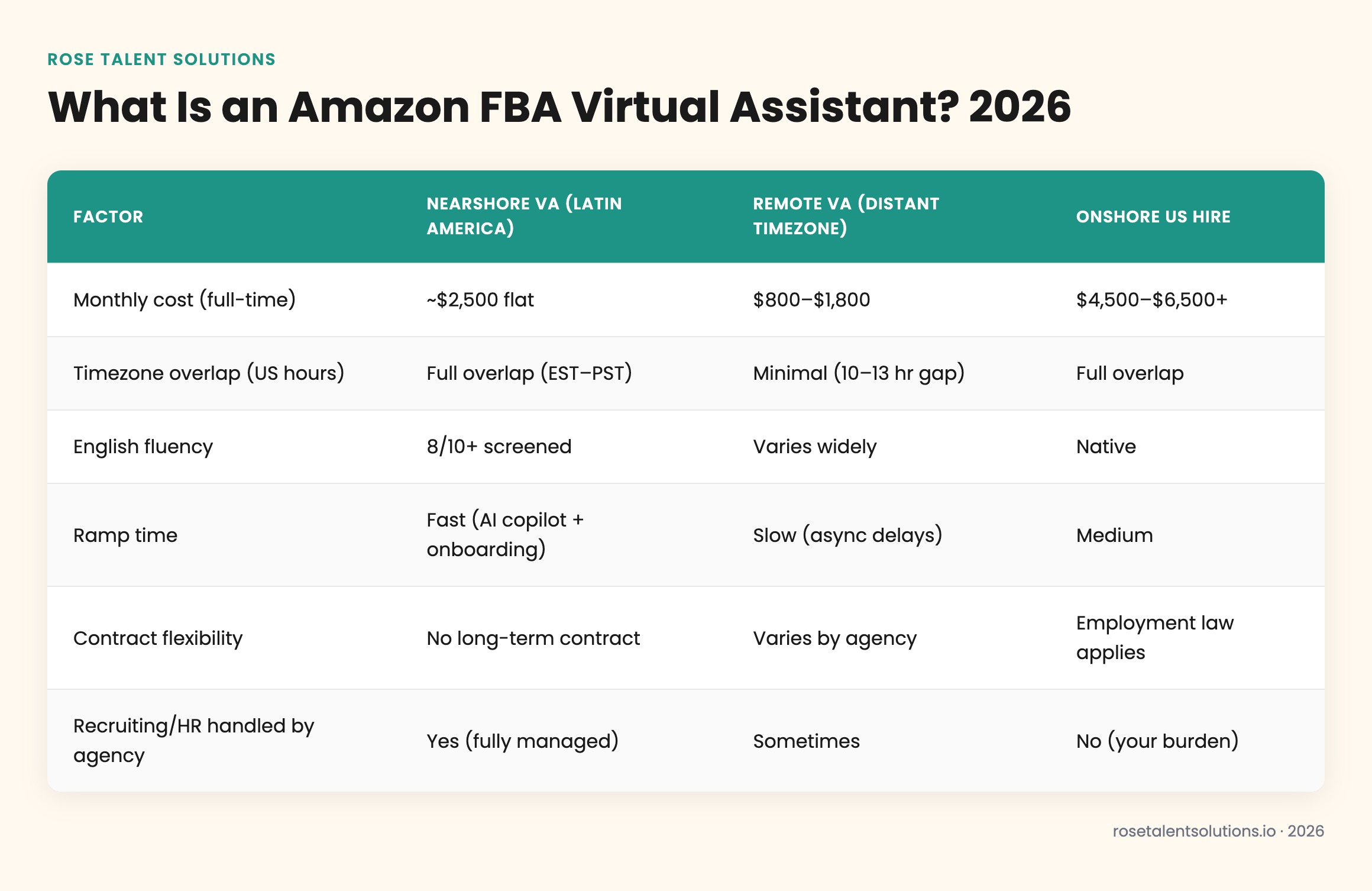
The table below maps the key decision variables across your three main hiring options:
| Factor | Nearshore VA (Latin America) | Remote VA (Distant Timezone) | Onshore US Hire |
|---|---|---|---|
| Monthly cost (full-time) | ~$2,500 flat | $800–$1,800 | $4,500–$6,500+ |
| Timezone overlap (US hours) | Full overlap (EST–PST) | Minimal (10–13 hr gap) | Full overlap |
| English fluency | 8/10+ screened | Varies widely | Native |
| Ramp time | Fast (AI copilot + onboarding) | Slow (async delays) | Medium |
| Contract flexibility | No long-term contract | Varies by agency | Employment law applies |
| Recruiting/HR handled by agency | Yes (fully managed) | Sometimes | No (your burden) |
How an AI-Powered FBA VA Outperforms a Standard Hire in 2026
The modern Amazon FBA virtual assistant is not just a task executor — the best ones arrive pre-trained on the software stack your business already runs. At Rose Talent Solutions, every VA ships with a role-specific AI copilot trained on platforms like Helium 10, Jungle Scout, and Amazon Seller Central workflows. That means your VA isn't learning your tools from scratch — they're using AI-assisted prompts to surface suppressed listings, flag restock thresholds, and draft optimized bullet points faster than a manually trained hire ever could.
"AI augmentation doesn't replace great virtual assistants — it multiplies them. The best VA programs I've seen in e-commerce pair strong human judgment with AI-assisted workflows to cut task time by 30–40%." — Nathan Hirsch, Founder of FreeeUp and EcomBalance (2024)
According to McKinsey & Company (2023), generative AI tools can automate 60–70% of the time employees spend on repetitive data-processing tasks. For an FBA VA, that means more time on high-judgment work — sourcing calls, listing strategy, PPC optimization — and less time on manual data entry and report pulls.
An AI-augmented FBA VA doesn't just complete tasks faster — they catch problems you wouldn't have caught until they became expensive. Automated restock alerts, listing suppression flags, and bid anomaly detection happen in real time, not on a weekly audit cadence.
Many sellers also rely on their FBA VA to manage the Seller Central back-end operations that most owners find tedious but critical: case logs with Amazon support, flat-file bulk uploads, ASIN troubleshooting, and account health monitoring. Delegating Seller Central management to a trained VA has a measurable impact on account health scores — the kind of metric that determines whether you keep the Buy Box.

How to Hire an Amazon FBA Virtual Assistant: The 2026 Process
Most sellers who try to hire an FBA VA on their own end up cycling through two or three bad fits before they find someone who sticks. The problem is usually the process — posting on a freelance platform, interviewing cold, and onboarding manually is slow and costly. A managed nearshore staffing approach eliminates that cycle entirely.
Define your task list
Before you hire, document the 10–15 recurring tasks you want to delegate. This becomes your VA's job description and the baseline for measuring performance in the first 30 days.
Match with a pre-vetted candidate
Rose screens for English fluency (8/10+ floor), FBA-specific platform experience, and US-hours availability. You review a shortlist rather than sifting through cold applications.
Onboard with AI copilot activated
Your VA arrives with a role-specific AI copilot pre-trained on your platforms. Day one is productive, not orientation-heavy.
Run a structured 30-day ramp
Rose handles ongoing HR and management support. If the team member isn't a fit, we replace them at no additional cost — that's the entire risk reversal.
Scale or stay flexible
There's no long-term contract. Cancel with 30 days written notice. Most sellers stay because the ROI is obvious inside the first 60 days.
If your business also runs a Shopify storefront alongside FBA, the same staffing model applies — a Shopify customer service VA can handle DTC support while your FBA VA manages the Amazon channel, giving you full coverage across both platforms without doubling your internal headcount.
According to a SHRM (2024) workforce survey, the average cost-per-hire for a US-based specialist role now exceeds $4,700 before the first paycheck clears. Managed nearshore placement eliminates that recruiting cost entirely — it's built into the flat monthly rate. You can get started at rosetalentsolutions.io/start with no long-term contract required.
What to Look for When Evaluating FBA VA Agencies in 2026
Not every virtual assistant agency that claims FBA expertise actually delivers it. The difference between a strong agency and a weak one comes down to a handful of verifiable factors.
Green flags in an FBA VA agency
- Screens specifically for Amazon Seller Central and FBA workflow experience — not just "e-commerce" generically
- Verifiable English fluency floor (Rose's is 8/10+)
- Nearshore Latin America placement for real-time US-hours responsiveness
- Ongoing HR, payroll, and management included in the flat rate
- Free replacement if the team member isn't a fit — no runaround
- No long-term contract — month-to-month with 30 days written notice
Red flags to walk away from
- Remote-only placement with no timezone disclosure upfront
- Hourly billing that balloons unpredictably as task volume grows
- No structured onboarding or ramp support after placement
- Vague "satisfaction guarantees" with no specific replacement policy
- Agencies that place the same VAs across completely unrelated industries with no specialization
According to Gallup (2023), employees who feel their manager has a clear plan for their role are 3.5× more likely to be engaged in the first 90 days. That statistic applies equally to remote VAs — a structured onboarding process isn't a nice-to-have, it's the difference between a VA who ramps in two weeks and one who drifts for two months before you cut them loose.
The $2,500/month flat rate at Rose covers recruiting, vetting, payroll, HR compliance, and ongoing management support. There are no add-on fees for the AI copilot, no setup fees, and no long-term contract locking you in. If you want to see what that looks like in practice, the AI advantage page breaks down exactly how each VA's copilot is configured for their role.