
Nearshore technical virtual assistants are reshaping how lean US businesses handle their software stack — and if you've been running your operations with a patchwork of half-configured tools and delayed IT tickets, you already know why. A technical VA isn't the same as a general virtual assistant who handles email and scheduling. They are trained, tool-specific operators who can manage your CRM, build automations, connect APIs, and keep your data architecture clean — all without you hiring a full-time in-house developer or paying agency rates.
This guide breaks down exactly what a technical virtual assistant is, what they do, what they cost, and how to hire one who's actually ready to work in your systems from week one.
That number isn't surprising. Most growing businesses have tools they're underusing — a CRM nobody keeps updated, a Zapier account full of broken zaps, a project management board that stopped reflecting reality in Q3. A technical VA fixes that. They're not consultants who audit and leave. They're operators embedded in your stack, Monday through Friday.
How a Technical Virtual Assistant Is Different from a General VA in 2026
A general virtual assistant handles tasks: booking meetings, managing inboxes, formatting reports. A technical virtual assistant handles systems. The distinction matters because systems break in ways tasks don't. If your Salesforce workflows aren't firing correctly, or your Make.com scenario is duplicating records, you need someone who can diagnose and fix — not just execute.
Technical VAs typically specialize in one or more of these domains:
- CRM administration — Salesforce, HubSpot, Zoho, Pipedrive setup, cleanup, and ongoing management
- Automation and workflow building — Zapier, Make.com, n8n, and native app automations
- API integrations — connecting software via REST APIs, webhooks, and middleware
- Project management systems — Notion, ClickUp, Asana, Monday.com architecture and admin
- Data operations — spreadsheet automation, database maintenance, reporting dashboards
- Software-specific support — platform-level admin for tools like QuickBooks, AppFolio, or Buildium
If you need someone to manage your Salesforce org — building custom objects, cleaning duplicate leads, and maintaining automation rules — that's a technical VA role, not a general VA role. The skill ceiling is higher. So is the output.
"The future of operations isn't hiring more people — it's hiring the right people who can make your existing tools work at full capacity." — Liam Martin, Co-founder at Time Doctor (2023)

What Tasks Does a Technical Virtual Assistant Actually Handle?
The best way to understand what a technical VA does is to look at what they prevent: the 3-day turnaround on an internal data request, the broken integration nobody has time to fix, the CRM that's 40% accurate because no one maintains it. Technical VAs are the operators who make sure your software works the way you paid for it to work.
Here are the most common task categories, with real examples:
- Automation builds: Creating multi-step workflows in Make.com that trigger actions across five tools whenever a form is submitted or a deal stage changes
- API connections: Building and maintaining the integrations that let your CRM talk to your accounting software or your e-commerce platform push data to your inventory system — your API integration VA owns that layer end-to-end
- Workspace architecture: Structuring your Notion workspace so it actually scales — databases, relations, rollups, templates, and permission hierarchies that don't collapse when you add headcount
- Reporting and dashboards: Building live Google Looker Studio or Tableau dashboards connected to your real data sources, refreshed automatically
- Data hygiene: Deduplicating CRM records, normalizing fields, migrating data between platforms without data loss
- Software onboarding support: Setting up new tools for your team, building SOPs, and training internal staff on platform workflows
According to McKinsey's Technology Trends Report (2024), businesses that invest in automation and systems integration see up to 30% improvement in operational efficiency. The bottleneck for most SMBs isn't knowledge of what to automate — it's having the hands to actually build and maintain those automations.
Gallup's research on workforce engagement reinforces this point: according to Gallup's State of the Global Workplace (2024), employees who spend time on repetitive, automatable tasks report significantly lower engagement scores — meaning your skilled in-house staff are being eroded by work a technical VA could own entirely.
Most businesses already own the tools they need to run efficiently. The gap isn't software — it's dedicated human capacity to configure, maintain, and improve those tools continuously. A technical VA fills that gap at a fraction of the cost of an in-house developer or IT contractor.
How Nearshore Technical VAs Compare to Offshore and Onshore Alternatives in 2026
Not all technical VAs are created equal — and the where matters as much as the what when you're embedding someone in your live systems. Here's how the three main hiring models stack up:
| Factor | Nearshore VA (Latin America) | Offshore VA (Philippines / India) | Onshore US Hire |
|---|---|---|---|
| Monthly Cost | ~$2,500 (all-in, managed) | $800–$1,500 (varies widely) | $5,000–$9,000+ salary + benefits |
| Timezone Overlap with US | Full overlap (same or +1 hr) | 6–13 hour gap — async only | Full overlap |
| English Proficiency | 8/10+ screened (Rose standard) | Varies — often 6–7/10 | Native |
| Technical Ramp Time | 3–7 days (AI copilot-assisted) | 2–4 weeks (timezone lag delays feedback) | 2–4 weeks (onboarding-dependent) |
| Management Overhead | Low (HR, payroll, QA included) | Medium–High (self-managed typically) | High (full employer of record) |
| Contract Flexibility | Month-to-month, 30-day notice | Varies — often locked in | At-will but high exit cost |
| Risk Reversal | Free replacement if not a fit | Usually none | None — full severance risk |
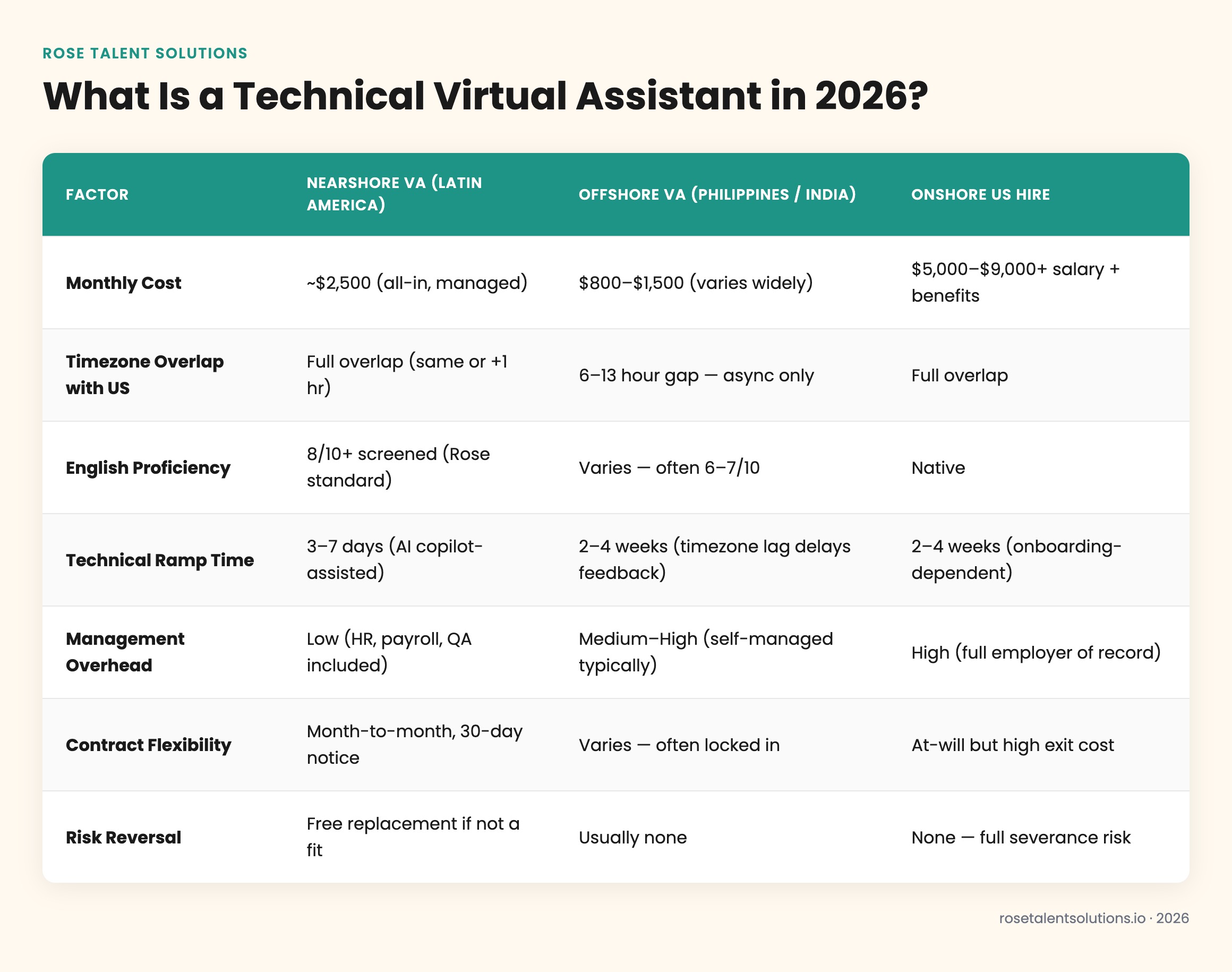
The timezone issue with offshore technical VAs is the hidden killer. When your Make.com automation breaks at 2pm EST and your VA is asleep, that's not a minor inconvenience — it's a pipeline stall. Nearshore VAs in Colombia, Mexico, or Argentina work your hours, which means real-time collaboration on technical problems instead of a 24-hour email chain to fix a broken webhook.

How Rose Talent Solutions Places a Technical VA in 2026
The placement process at Rose is designed to eliminate the two biggest failure modes in VA hiring: hiring someone who looks good on paper but can't operate your specific tools, and hiring someone great who leaves in 60 days. Here's how the process works:
Discovery Call
Rose maps your tech stack, identifies the exact tools the VA needs to own, and defines the role scope — so you're not hiring a generic "tech VA" but a specialist matched to your specific systems.
Candidate Matching
Rose recruits and vets candidates from its Latin America network, running English proficiency screens (minimum 8/10), technical skills assessments, and background checks — all before you meet anyone.
AI Copilot Activation
Every placed technical VA ships with a role-specific AI copilot trained on their assigned software — whether that's Salesforce, QuickBooks, AppFolio, or a custom stack — so they ramp faster and make fewer errors from day one. Learn more on the AI Advantage page.
Placement and Onboarding
Your VA starts within days. Rose handles payroll, HR compliance, and ongoing performance management — you manage the work, Rose manages everything else.
Replacement Guarantee
If the placement isn't the right fit for any reason, Rose replaces them at no additional cost. No long-term contract means you're never locked in.
This model sits at $2,500 per month — flat. That includes recruiting, vetting, payroll processing, HR overhead, and the AI copilot layer. There are no add-on fees for replacement, no hidden management costs, and no long-term contract. You can cancel with 30 days written notice.
For businesses that also need financial operations support, Rose's bookkeeping and accounting VAs can work alongside your technical VA as a complementary hire — one owning your systems layer, one owning your numbers. And if you're in property management, the property management VA service brings platform-trained operators for AppFolio, Buildium, and Yardi at the same flat rate.
Is a Technical Virtual Assistant Right for Your Business in 2026?
A technical VA delivers the most value in businesses that already have software but aren't fully using it. If you're paying for a CRM, a project management platform, and an automation tool — but those systems are only 50% configured — a technical VA pays for themselves in recovered productivity within the first 30 days.
According to SHRM's Workforce Research (2024), the average cost of a bad hire is 50–200% of the position's annual salary. Hiring an in-house technical admin or junior developer at $65,000/year who doesn't work out costs far more than a monthly nearshore VA with a built-in replacement guarantee.
The U.S. Bureau of Labor Statistics adds important cost context: according to the BLS Occupational Outlook Handbook (2024), the median annual wage for a computer and information systems manager in the US exceeds $169,000. A nearshore technical VA handles the operational layer of that function — system administration, workflow maintenance, integration management — at roughly 18% of that cost.
And the remote work trend only accelerates this calculus. Pew Research Center (2023) found that roughly a third of US workers who can work remotely now do so full-time — meaning the infrastructure for managing distributed technical talent is already normalized across most businesses. Adding a nearshore VA to that mix is no longer an operational stretch.
A Technical VA Is a Strong Fit If…
- You have tools you're underutilizing or that constantly break
- Your team loses hours weekly to manual data entry that should be automated
- You need CRM, automation, or API work done but can't justify a full-time developer salary
- You want real-time support — not async overnight turnaround
- You want flexibility: month-to-month, no long-term contract
A Technical VA May Not Be the Right Fit If…
- You need full-stack software development (custom code, new product builds)
- You have no existing tools or systems — you'd need a strategy consultant first
- Your workflows are entirely undocumented and you need deep internal training first
- Your security requirements prohibit any third-party system access (rare, but applies to some regulated industries)
The honest answer is that most growing businesses between $1M and $10M in revenue are underinvesting in systems maintenance. They have the tools. They don't have the dedicated operator. That's exactly the gap a nearshore technical VA closes — at a cost that doesn't require a board approval to justify.
If you're ready to stop leaving your software stack on the table, start the placement process here — Rose matches most clients within seven days.