
What Is a Shopify Virtual Assistant, Exactly?
Nearshore Shopify virtual assistants are remote professionals based in Latin America who run the operational side of your Shopify store during your business hours. That last part matters more than most store owners realize. A Shopify VA isn't a generic admin assistant who happens to log into your store once in a while — they are a dedicated ecommerce operator whose entire job is keeping your store healthy, your customers happy, and your revenue data clean.
The formal definition: a Shopify virtual assistant is a full-time or part-time remote employee who manages one or more functional areas of a Shopify-based ecommerce business — including product management, order fulfillment coordination, customer service, inventory tracking, SEO content, and paid-media support. They work inside Shopify's admin, plus whatever third-party apps your store runs: Klaviyo, Gorgias, ReCharge, Inventory Planner, and others.
In 2026, the role has evolved significantly. Ecommerce grew to represent over 22% of all US retail sales, according to the US Census Bureau (2024), which means the operational complexity of running a Shopify store has scaled alongside that growth. Store owners who tried to handle everything themselves two years ago are now drowning in tickets, listing updates, and abandoned-cart recovery campaigns — which is exactly why demand for specialized Shopify VAs has surged.
What Does a Shopify Virtual Assistant Actually Do in 2026?
The scope of a Shopify VA's work depends on your store's stage and your biggest bottlenecks. Early-stage stores typically need one person who can do a little of everything. Seven-figure stores need a VA with a defined specialty — customer service, operations, or growth support — so responsibilities don't blur. Here are the core task categories a Shopify VA covers:
- Product listing management — uploading new SKUs, writing and optimizing product descriptions, tagging, categorizing, and managing variants and inventory counts
- Order management and fulfillment coordination — processing orders, flagging exceptions, liaising with 3PLs, and resolving shipping issues before they become chargebacks
- Customer service — answering pre-sale questions, managing returns and exchanges, and handling post-purchase complaints through Gorgias, Zendesk, or Shopify Inbox. For a deeper look at this specific function, see how a Shopify customer service virtual assistant operates day-to-day.
- Email and SMS marketing support — building flows in Klaviyo, scheduling campaigns, and pulling performance reports
- Inventory and supplier coordination — tracking stock levels, generating purchase order drafts, and communicating with suppliers
- Analytics and reporting — pulling weekly dashboards from Shopify Analytics, Google Analytics 4, and any attribution tools you use
- SEO content updates — refreshing meta titles, alt text, and collection page copy to maintain organic ranking
The most effective Shopify VAs don't just execute tasks — they catch problems before you do. A well-trained VA will notice that a bestselling SKU is trending toward stockout, flag it in Slack, and draft the reorder email to your supplier before you've had your morning coffee. According to McKinsey's Operations Practice (2024), companies that delegate operational monitoring to trained staff reduce critical stock-out incidents by up to 35% compared to founder-managed operations.

How Nearshore Shopify VAs Compare to Offshore and Freelance Options in 2026
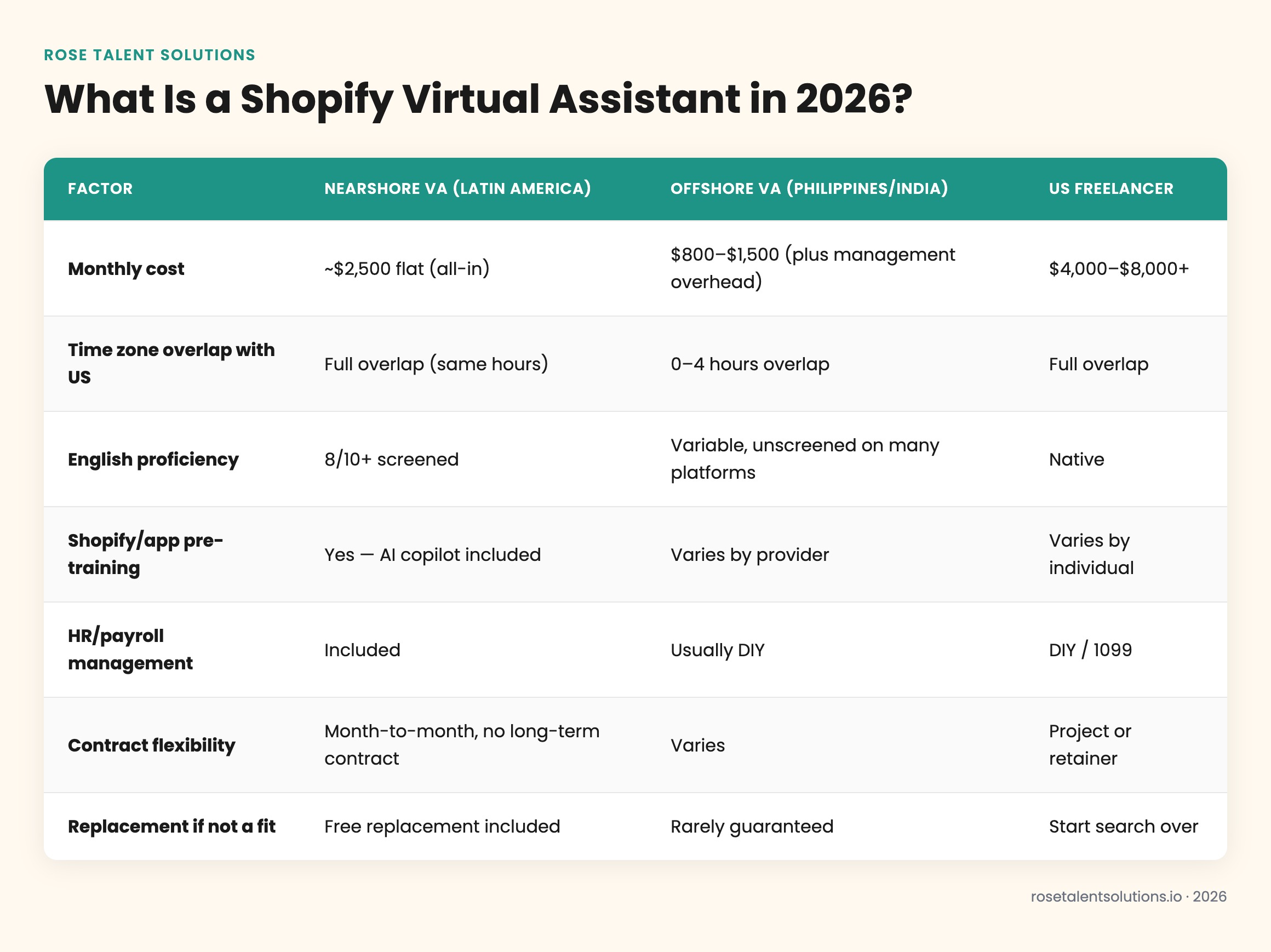
Not all Shopify VAs are the same, and the differences aren't just about price. Time zone alignment is the factor most store owners underestimate until they've lost a customer escalation that sat unanswered for 14 hours because their VA was asleep. The global ecommerce workforce market has expanded significantly — Statista (2024) projects the virtual assistant services market to exceed $25 billion by 2025, making provider differentiation more critical than ever. Here's how the three main models compare:
| Factor | Nearshore VA (Latin America) | Offshore VA (Philippines/India) | US Freelancer |
|---|---|---|---|
| Monthly cost | ~$2,500 flat (all-in) | $800–$1,500 (plus management overhead) | $4,000–$8,000+ |
| Time zone overlap with US | Full overlap (same hours) | 0–4 hours overlap | Full overlap |
| English proficiency | 8/10+ screened | Variable, unscreened on many platforms | Native |
| Shopify/app pre-training | Yes — AI copilot included | Varies by provider | Varies by individual |
| HR/payroll management | Included | Usually DIY | DIY / 1099 |
| Contract flexibility | Month-to-month, no long-term contract | Varies | Project or retainer |
| Replacement if not a fit | Free replacement included | Rarely guaranteed | Start search over |
"The talent pool in Latin America for ecommerce operations is genuinely world-class right now. These are university-educated professionals who grew up digitally native, speak English fluently, and work the same hours as your US team. The timezone arbitrage alone is worth the switch." — Noel Andrews, CEO at JobRack (2024)
How Rose's AI Copilot Makes a Shopify VA Faster From Day One in 2026
One of the most common objections store owners raise is ramp time. "How long before my VA is actually useful?" With a generalist hire from a freelance platform, that answer can be six to eight weeks. With a Rose nearshore Shopify VA, the ramp is measured in days — because every team member is paired with a role-specific AI copilot trained on the exact software your store runs.
If your store runs Klaviyo for email, Gorgias for support, and ReCharge for subscriptions, your VA's AI copilot already has workflow guides, decision trees, and escalation protocols loaded for all three. They're not Googling how to process a subscription swap on day two — they're executing. According to SHRM's 2024 Workforce Research, AI-assisted onboarding reduces time-to-productivity for remote hires by an average of 40% compared to traditional onboarding methods.
This matters especially for ecommerce, where a slow ramp costs real money. Every day a VA isn't fully productive is a day of customer tickets piling up, listing updates sitting in a queue, and revenue reports going unpulled. Software-trained, AI-augmented VAs don't just ramp faster — they maintain higher accuracy rates on repetitive tasks like order exception processing and inventory reconciliation, where errors are expensive.
The same principle applies across ecommerce platforms. If you also sell on Amazon, you'll find similar AI-augmented support available for Amazon Seller Central operations — so you can staff a multi-channel ecommerce operation without sacrificing ramp speed on either platform.
The real cost of a slow-ramp VA isn't the salary you paid during onboarding — it's the customer churn that happened while your support queue was unmanaged. A pre-trained, AI-augmented nearshore VA closes that gap before it opens.

How to Hire a Shopify Virtual Assistant: The Rose Process
Hiring a Shopify VA through Rose is designed to get you from decision to productive team member in under two weeks. Here's how the process works:
Discovery call and role scoping
You tell Rose what your store runs, what's breaking, and what a great first 30 days looks like. The team maps that to a specific VA profile — not a generic admin, but someone with hands-on Shopify experience in your exact task categories.
Candidate matching and vetting
Rose surfaces two to three pre-vetted candidates who clear the 8/10+ English proficiency screen and have demonstrated Shopify admin experience. You review their profiles and interview your top choice.
AI copilot configuration
Before day one, your VA's role-specific AI copilot is configured for your tech stack — Shopify, plus whatever apps you run. Workflow guides, SOPs, and escalation logic are loaded before they ever log in.
Onboarding and first week
Your VA starts at $2,500/month flat — full-time, 40 hours per week, working your business hours. Rose handles all payroll, HR, and ongoing management so you don't think about any of that.
Free replacement if needed
If the match isn't right for any reason, Rose replaces the team member at no additional cost. No long-term contract means you're never locked in — cancel with 30 days written notice if your needs change.
You can start this process today at the Rose Talent Solutions intake form — most store owners who complete the form receive their first candidate profiles within 72 hours.
Who Should Hire a Shopify Virtual Assistant — and When?
The inflection point for most store owners comes somewhere between $20,000 and $50,000 in monthly revenue. Below that threshold, founders can usually manage operations themselves. Above it, the operational complexity — customer ticket volume, SKU count, supplier relationships, marketing execution — consistently exceeds what one person can handle without dropping something important. According to Gallup's State of the American Workplace report, business owners who delegate operational tasks report 33% higher strategic focus scores than those who retain all operational responsibilities — and strategic focus is the lever that drives the next revenue tier.
The decision to hire is also shaped by workforce economics. The US Bureau of Labor Statistics (2024) reports that the median annual wage for a full-time US-based ecommerce operations coordinator exceeds $52,000 — before benefits, payroll taxes, or management overhead. A nearshore Shopify VA at $2,500/month ($30,000/year, all-in) delivers equivalent operational output at roughly 58% of that cost, with recruiting, HR, and management already handled.
A Shopify VA also makes sense if you're expanding channels. If you're running Shopify as your DTC hub and starting to push into Amazon, you'll need operational support on both sides. Rose places specialists for both — and if you're exploring what that looks like on the Amazon side, see how a dedicated Amazon product research virtual assistant can feed your catalog expansion without pulling your Shopify VA off their core responsibilities.
The profile of an ideal Shopify VA client in 2026 looks like this:
Great fit for a Shopify VA
- Store doing $20K–$500K/month in revenue
- Founder spending 10+ hours/week on operational tasks
- Customer ticket volume above 30/day
- SKU catalog of 50+ products with regular updates
- Plans to add channels (Amazon, TikTok Shop, wholesale)
- Needs consistent US-hours coverage
May not be the right time yet
- Pre-launch or under $5K/month revenue
- Fewer than 10 orders per day
- No documented SOPs or processes to hand off
- Looking for a one-time project, not ongoing operations
- No budget for full-time support
For store owners who are on the fence, the clearest signal is this: if you are personally doing tasks today that don't require your unique judgment as the founder, you are leaving money on the table. Delegation isn't overhead — it's the investment that unlocks the next growth stage. Rose's intake process starts the conversation without any pressure to commit on the first call.
It's also worth noting that ecommerce VA needs often extend beyond Shopify. Many Rose clients who start with a Shopify operations VA later add support for customer escalations across channels — the same model that works well for brands that also need a dedicated Amazon customer service virtual assistant handling marketplace reviews and A-to-Z claims in parallel.
The bottom line: a Shopify virtual assistant in 2026 is not a luxury for large brands. It is the operational infrastructure that allows a growing store to scale without the founder becoming the bottleneck. Nearshore, English-fluent, software-trained, and working your hours — that combination is what separates a productive VA relationship from a frustrating one.