
Nearshore bookkeeping has emerged as one of the sharpest alternatives to software-first services like Pilot Accounting — and in 2026, the gap is widening. Pilot built its name on automating small-business books for venture-backed startups, but business owners across real estate, e-commerce, and professional services are asking the same question: is there a service that gives me the same reliability, but more human support, more software depth, and a price that doesn't balloon as my company scales? This post answers that question directly, comparing Pilot to its real alternatives so you can make a clean decision.
What Is Pilot Accounting and Who Is It Built For?
Pilot Accounting is a US-based tech-enabled bookkeeping firm founded in 2017 and primarily designed for venture-backed startups and SaaS companies. It uses automated software to categorize transactions and assigns a human bookkeeper to review the output — a hybrid model that works well for simple, transaction-light books but shows friction when a business needs hands-on support, industry-specific accounting, or deep integration with tools like QuickBooks, AppFolio, or Buildium.
Pilot's pricing starts at $499/month for the Core plan (up to $30K in monthly expenses), rises to $989/month for the Select plan, and goes to custom pricing for anything more complex. Add-ons like CFO services, tax prep, and accrual accounting layer on additional fees. For a growing business, the all-in annual cost can easily exceed $15,000–$20,000 — for part-time, asynchronous support.
That confidence gap is exactly why businesses start shopping for Pilot alternatives. They want accuracy, yes — but they also want responsiveness. A bookkeeper who answers questions same-day, flags anomalies proactively, and understands their specific industry. Pilot's model is optimized for scale and automation; these alternatives are optimized for hands-on service. According to Intuit's Small Business Insights (2023), nearly two-thirds of small business owners have discovered errors in their books that their bookkeeping software did not flag automatically — underlining why human oversight still matters.
How the Top 2026 Pilot Accounting Alternatives Actually Compare
Below is an honest side-by-side of Pilot and the services most commonly evaluated alongside it. Pricing reflects published 2026 rates; "dedicated" means a named human assigned to your account full-time or close to it.
| Service | Starting Price | Hours / Week | Dedicated Bookkeeper? | Software Depth | Best For |
|---|---|---|---|---|---|
| Pilot Accounting | $499/mo (Core) | Part-time / async | Reviewer only | QuickBooks Online | Venture-backed startups |
| Bench | $299/mo | Part-time / async | Yes (shared) | Bench proprietary software | Solopreneurs, freelancers |
| Bookkeeper360 | $399/mo | Part-time to full-time | Yes | QuickBooks, Xero | SMBs needing payroll add-ons |
| Decimal | $395/mo | Part-time / async | Yes (team model) | QuickBooks Online | Service businesses, agencies |
| Rose Talent Solutions (nearshore VA) | $2,500/mo flat | 40 hrs/week, full-time | Yes — dedicated, named | QuickBooks, Xero, AppFolio, Buildium, and more | Growing SMBs, property managers, ops-heavy businesses |
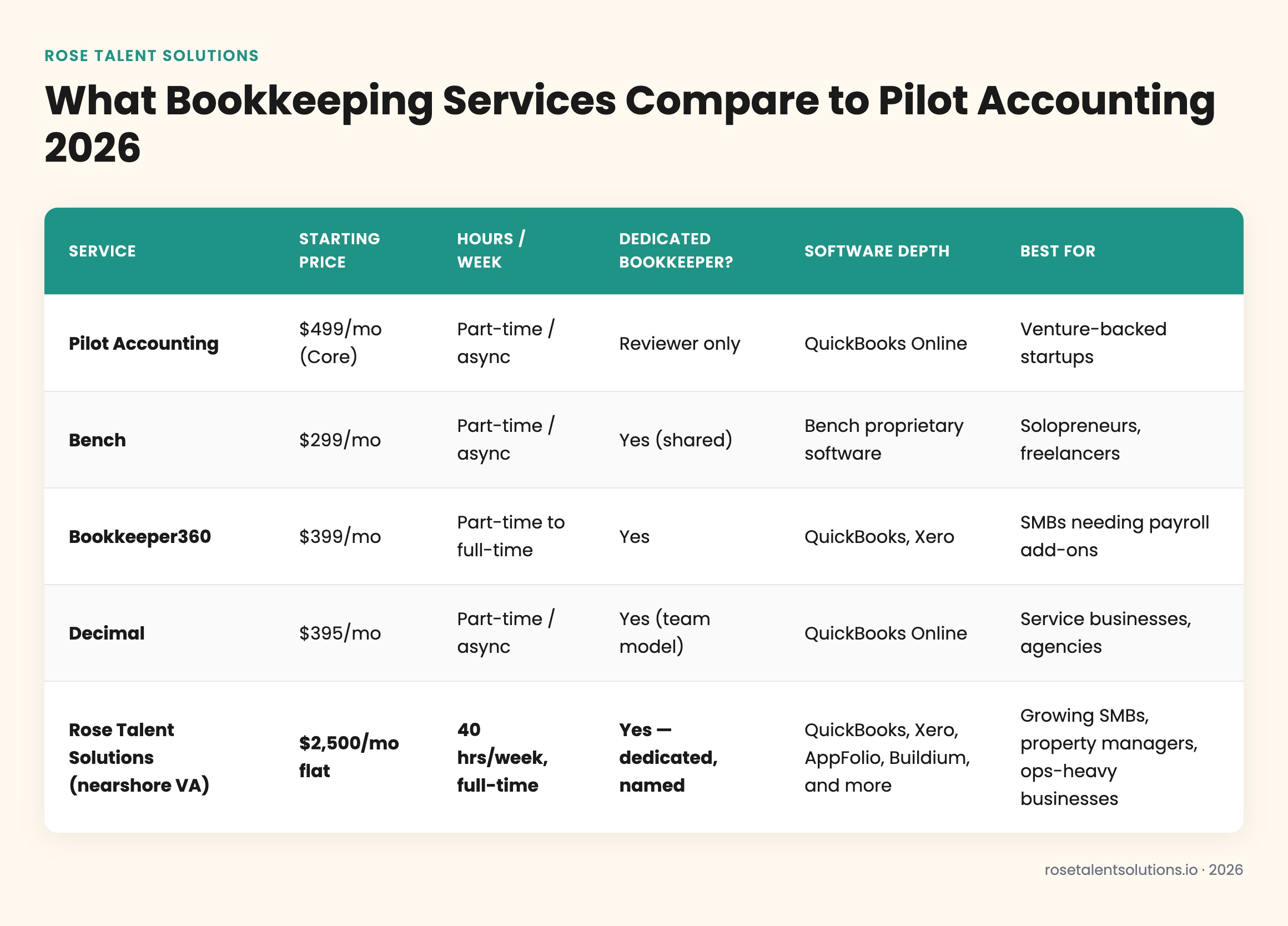
The pricing looks like an apples-to-apples comparison, but it isn't. The services at $299–$499/month give you part-time, asynchronous coverage — often a few hours per week, responses within 24–48 hours, and a bookkeeper shared across dozens of clients. Rose's dedicated nearshore bookkeeper works 40 hours a week, exclusively on your business, responding in real time during US business hours.
"The biggest misconception in outsourced accounting is that price-per-month equals coverage. A $499/month service might touch your books four hours a month. A $2,500/month dedicated hire works 160 hours. The math isn't close." — Ryan Lazanis, Founder at Future Firm & accounting outsourcing educator (2024)
How Nearshore Bookkeepers Deliver What Pilot's Model Can't in 2026

Pilot's automation handles routine categorization well. Where it falls short is proactive financial management — catching a vendor payment anomaly before it posts, reconciling a complex property management ledger, or jumping on a call to walk you through a P&L before your bank meeting. Those tasks require a human who is fully immersed in your business, not rotating across 50 client files.
Nearshore bookkeepers based in Latin America work in your time zone — EST, CST, MST, or PST — and are available during your actual business hours. This is structurally different from offshore bookkeeping teams in the Philippines or India, where a 10–12 hour time difference means asynchronous-only workflows. If you need to understand why accounts payable is up 18% this month, you shouldn't have to wait until tomorrow morning in Manila.
For businesses already using tools like QuickBooks Online or Xero, a nearshore bookkeeper integrates directly into your existing stack. Rose's QuickBooks bookkeeping service places staff who are trained and tested on the exact version of QuickBooks you use — Online or Desktop — and can manage categorization, reconciliation, invoicing, and reporting without a learning curve. Similarly, if you're on Xero, a Xero virtual bookkeeper placed by Rose arrives pre-screened on your specific workflow.
According to the U.S. Bureau of Labor Statistics (2024), the median annual wage for a full-time bookkeeper in the United States is $47,440 — that's roughly $3,953/month in salary alone, before you add payroll taxes, benefits, equipment, and recruiting costs. A dedicated nearshore bookkeeper at $2,500/month flat includes recruiting, vetting, HR, payroll, and ongoing management. The cost arithmetic alone makes it a serious conversation.
What to Watch Out For When Comparing Pilot Alternatives in 2026

Not every Pilot alternative solves the same problem. Here's what actually matters when evaluating any bookkeeping service — and where the hidden costs tend to pile up.
The sticker price of a bookkeeping service rarely reflects total cost. Add-on fees for tax prep, CFO advisory, catch-up bookkeeping, and accrual accounting can double or triple the base price of services like Pilot, Bench, and Bookkeeper360 within the first year.
Software lock-in: Bench runs on its own proprietary platform. If you ever leave Bench, you lose direct access to your historical data in the format your accountant or CPA needs. Pilot and Bookkeeper360 use QuickBooks, which is portable — but confirm this before you sign. A nearshore bookkeeper works inside your tools, not theirs. Note that Xero and QuickBooks each offer their own platform-specific free trials directly — those are Xero's and Intuit's offerings, not Rose's.
Catch-up bookkeeping costs: Pilot charges separately for catch-up work if your books are more than a month behind. This is common for new clients. Bench and Decimal have similar policies. Always ask: what does onboarding cost if my books need 3–6 months of catch-up?
Accounts payable depth: If your business has significant vendor payments, purchase orders, or invoice approvals, most part-time async services won't go deep enough. A dedicated virtual accounts payable specialist can manage the full AP cycle — from purchase order matching to payment approval — in a way that a shared bookkeeper logging 4 hours a month simply cannot.
According to SHRM's 2024 Employee Job Satisfaction research, replacing an employee costs on average 6–9 months of their salary. When a bookkeeping service gives you a "shared" bookkeeper who rotates off your account with no notice, you absorb that hidden transition cost — in errors, lost institutional knowledge, and retraining time. According to Gallup's workplace research on voluntary turnover (2023), US businesses lose over $1 trillion annually to employee turnover-related disruption — a figure that includes the downstream cost of knowledge gaps in financial roles.
Rose's model eliminates this friction. If your dedicated team member isn't a fit for any reason, Rose replaces them at no additional cost. No renegotiation. No placement fees. Month-to-month terms with 30 days written notice — no long-term contract required.
How Rose Talent Solutions' Bookkeeping Placement Process Works in 2026
Understanding the mechanics helps you evaluate whether a nearshore model fits your workflow. Rose doesn't drop a résumé in your inbox and wish you luck. The process is managed end-to-end.
Discovery Call
Rose's team maps your software stack, volume, and specific bookkeeping needs — whether that's QuickBooks Online reconciliation, Xero reporting, or full-cycle AP and AR management.
Candidate Matching
Rose sources from its pre-vetted Latin America talent pool, screens for English proficiency (8/10+ floor), software certifications, and role-specific experience. You receive 1–2 matched candidates, not a stack of résumés.
AI Copilot Onboarding
Every Rose bookkeeper ships with a role-specific AI copilot trained on their software — QuickBooks, Xero, or other tools — so they ramp faster and catch edge cases a manual reviewer might miss.
Week One Integration
Your bookkeeper joins your Slack, email, and accounting software with Rose managing all HR, payroll, and compliance in the background. You focus on your business.
Ongoing Management
Rose handles performance management, HR issues, time tracking, and payroll. If anything isn't working, Rose steps in — you don't manage the relationship alone.
Nearshore vs. Offshore vs. Onshore Bookkeeping — 2026 Reality Check
One of the most common confusions when searching for Pilot alternatives is conflating "nearshore" with "offshore." They are not the same model, and the operational difference is significant.
What is a nearshore bookkeeper? A nearshore bookkeeper is a finance professional based in Latin America — countries like Colombia, Mexico, Argentina, or Costa Rica — who works in US-aligned time zones, communicates in fluent English, and operates during your actual business hours. This is distinct from offshore bookkeeping (Philippines, India) where time zone gaps of 10–12 hours mean asynchronous-only workflows by default.
Nearshore Bookkeeper (Rose)
- Works your business hours — EST to PST coverage
- English fluency at 8/10+ screened floor
- Full-time, 40 hrs/week dedicated to your business
- AI copilot trained on your software stack
- Flat $2,500/mo — recruiting, HR, payroll included
- Free replacement if not a fit
Software-First Services (Pilot, Bench, Decimal)
- Async only — 24–48hr response windows
- Shared bookkeeper across many clients
- Add-on fees for tax, CFO, catch-up work
- Limited software depth outside their core stack
- No dedicated human for real-time questions
For businesses managing QuickBooks Online bookkeeping across multiple entities or properties, the async model breaks down quickly. A dedicated nearshore bookkeeper can run multi-entity consolidations, manage intercompany transactions, and produce monthly financials on a schedule you set — not on the platform's processing calendar.
According to McKinsey & Company's research on operations and automation (2023), businesses that combine automation tools with dedicated human oversight see 30–40% fewer financial errors than those relying on automation alone. That finding directly supports the hybrid model Rose uses — AI-assisted bookkeepers with human judgment, not software that flags exceptions only after the books close.
If you manage real estate — whether residential rentals, commercial properties, or short-term rentals — the bookkeeping complexity goes up another level. Property-specific tools like AppFolio and Buildium require bookkeepers who understand trust accounting, owner disbursements, maintenance reserve tracking, and CAM reconciliation. Rose's property management staffing places bookkeepers with direct experience in these platforms, backed by software-specific AI copilots. That's a capability no Pilot plan currently offers.
According to Buildium's 2024 Property Management Industry Report, 57% of property managers cite accounting and financial reporting as their top operational pain point — ahead of maintenance coordination and tenant communication. For this segment of the market, a generalist bookkeeping platform like Pilot is the wrong tool for the job.
The decision framework is straightforward: if your books are clean, simple, and you just need monthly reconciliation with a 24-hour turnaround window, Pilot or Bench may be adequate. If your business is growing, your books are complex, your software stack is industry-specific, or you need a real human available during your day — a dedicated nearshore bookkeeper is the model that scales with you.