
Nearshore virtual medical receptionists are quietly becoming the operational backbone of high-growth telemedicine practices. While offshore call centers promise low rates and domestic staff agencies charge premium fees, a third option has emerged that beats both on every dimension that actually matters to a telehealth operator: real-time availability during US hours, fluent English communication, HIPAA-aware workflows, and a flat monthly rate that doesn't spike as your patient volume grows. If you're running or scaling a telemedicine practice in 2026, this is the hiring decision worth getting right before your competitors do.
Telemedicine itself has crossed from pandemic experiment to permanent infrastructure. Telehealth visit volume is now more than 38 times higher than pre-pandemic levels, according to McKinsey & Company (2023). That explosion of virtual visits has exposed a persistent gap: the clinical side scaled fast, but the administrative front desk did not. Patients still need someone to answer the phone, verify their insurance, collect intake information, and confirm their appointment link — and they need that person available right now, not twelve hours from now in a different time zone.
What Is a Virtual Medical Receptionist in Telemedicine?
A virtual medical receptionist is a trained remote professional who handles the full administrative front desk for a healthcare provider — without sitting in a physical waiting room. In a telemedicine context, that means managing the digital touchpoints patients hit before, during, and after their virtual visit: scheduling via patient portals, collecting and processing intake forms, handling inbound calls and chat messages, verifying insurance eligibility, and sending appointment reminders with the correct telehealth link.
A nearshore virtual medical receptionist specifically is based in Latin America, works your US business hours in real time, and communicates in fluent English — Rose's published minimum is 8/10 on standardized English proficiency screens. This distinguishes them sharply from offshore alternatives in the Philippines or India, where an 8-to-12-hour time zone gap means patient calls go to voicemail during your busiest windows. For a telemedicine practice where the entire patient experience is digital, a receptionist who responds live at 9 a.m. Eastern is not a luxury — it is a clinical access requirement.
The administrative workload in telehealth is heavier than most practice owners anticipate. Beyond scheduling, a virtual medical receptionist in telemedicine typically owns real-time insurance verification before every visit, patient callback queues, portal message triage, and no-show follow-up workflows. Each of those tasks, done poorly or delayed, directly increases patient churn.
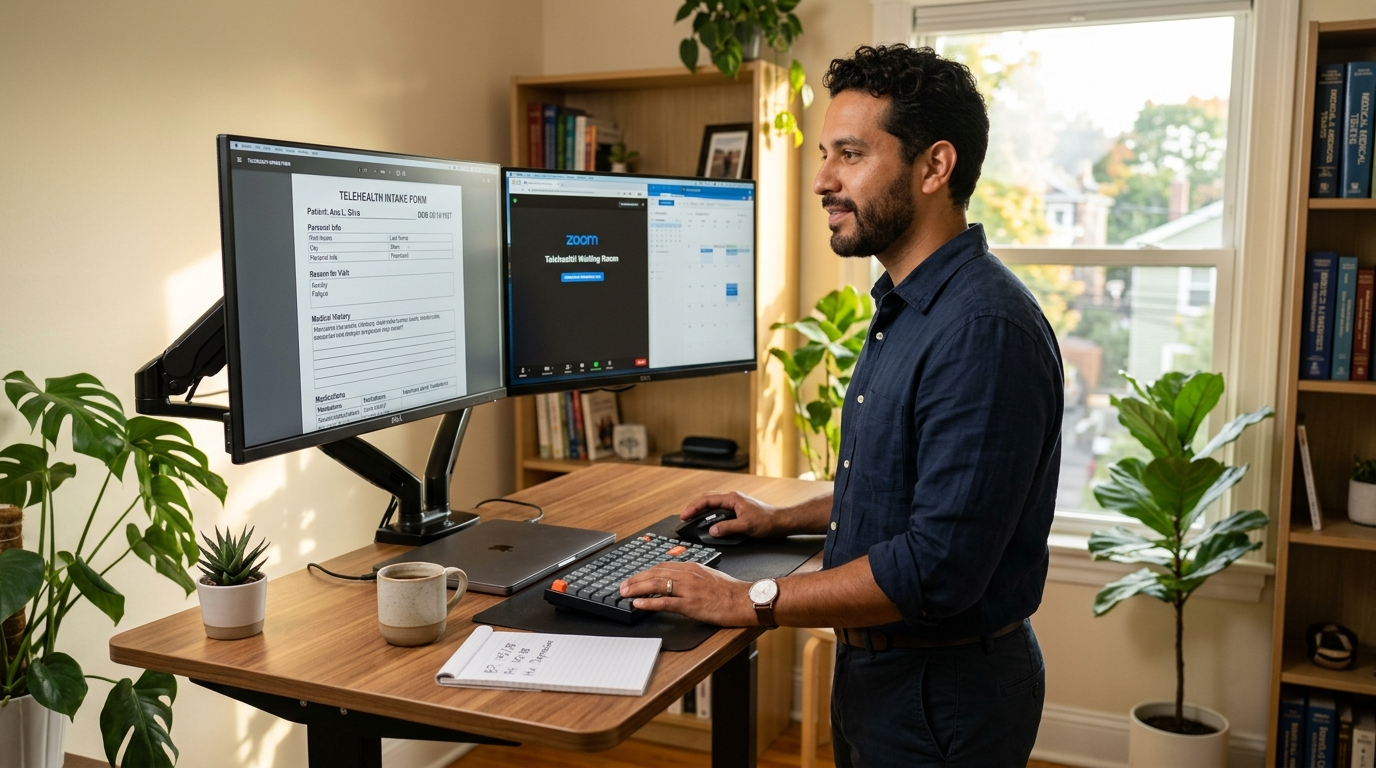
How Virtual Medical Receptionists Handle Telemedicine's Unique 2026 Workflows
Telemedicine front-desk work is not the same as in-clinic reception. The workflows are entirely digital, the failure points are different, and the speed requirements are higher because patients can — and do — book with a competitor in under three minutes if they hit friction. A trained virtual medical receptionist in telemedicine handles six core workflow categories that make or break the patient experience.
Appointment scheduling and portal management. Most telehealth practices use platforms like Athenahealth, Kareo, or SimplePractice. A well-trained virtual receptionist knows how to manage the scheduling queue, block provider time correctly, and ensure patients receive the right visit link — not just a calendar invite with no instructions. If your practice also handles complex multi-provider scheduling across specialties, a dedicated virtual receptionist prevents the double-booking errors that eat into provider revenue.
Insurance verification and eligibility checks. Pre-visit insurance verification is the single highest-leverage administrative task in telemedicine. An unverified patient who completes a visit and then disputes the claim creates a billing nightmare that can take 90 days to resolve. According to CAQH's Index Report (2023), manual eligibility verification costs the US healthcare system an estimated $11.1 billion annually in avoidable administrative spend — a burden that falls hardest on independent and virtual practices with thin margins.
Intake form collection and EHR data entry. Patients who arrive at a telehealth visit without completing their intake forms slow down the provider and compress session time. A virtual receptionist follows up proactively — via text, email, or portal message — to ensure forms are in before the appointment slot opens.
No-show management and appointment reminders. The average telemedicine no-show rate sits between 5% and 30% depending on specialty and patient population, according to research published in the National Library of Medicine (2021). Automated reminders reduce no-shows, but they don't eliminate them. A live virtual receptionist who calls or texts a patient 2 hours before an appointment catches the cases that automation misses.
Prior authorization coordination. For specialties like psychiatry, dermatology, and chronic disease management — all of which have seen massive telemedicine adoption — prior authorizations are a daily bottleneck. Practices that assign a dedicated prior authorization coordinator to this workflow report dramatically faster approval cycles and fewer denied claims.
"Administrative burden is the number-one driver of physician burnout. When you give clinicians back the time they spend on phone calls, scheduling fixes, and insurance paperwork, you don't just improve their wellbeing — you improve patient outcomes." — Dr. Christine Sinsky, Vice President of Professional Satisfaction, American Medical Association (2023)
Nearshore vs. Offshore vs. Domestic: 2026 Comparison for Telemedicine Practices
The staffing decision for your telemedicine front desk comes down to three realistic options: a domestic hire, an offshore VA service, or a nearshore virtual receptionist. Each has a different cost profile, availability pattern, and risk level. The table below breaks down the real-world differences — not the marketing claims.
| Factor | Nearshore VA (Latin America) | Offshore VA (Philippines / India) | Domestic Hire (US-based) |
|---|---|---|---|
| Monthly Cost | ~$2,500 flat (all-in) | $800–$1,500 (hourly, often variable) | $4,000–$6,000+ (salary + benefits) |
| US Hours Coverage | Real-time (same time zone or ±1–2 hrs) | 8–12 hr gap; often overnight shift required | Real-time, but expensive |
| English Proficiency | 8/10+ screened minimum | Variable; accent barriers common for calls | Native or near-native |
| HIPAA Awareness | Trained on HIPAA protocols | Inconsistent; depends on agency | Typically trained; legally under US law |
| Ramp Time | ~7 days to placement; AI copilot trained on your EHR | 2–4 weeks; frequent turnover | 3–6 weeks (recruiting + onboarding) |
| Contract Flexibility | Month-to-month; 30 days written notice | Variable; often locked in | At-will, but high severance risk |
| Replacement if Not a Fit | Yes — free replacement included | Often a fee or restart cost | Full rehire cost ($5,000–$15,000) |
The real cost of an offshore virtual receptionist isn't the hourly rate — it's the 8-to-12-hour time zone gap that routes your 9 a.m. patient calls to voicemail, pushes insurance verifications past same-day cutoffs, and forces your providers to start every session without confirmed eligibility. Nearshore eliminates that gap entirely.
How Rose Talent Solutions Places Virtual Medical Receptionists in Telemedicine Practices in 2026
Rose Talent Solutions is a nearshore staffing agency that recruits, vets, and manages virtual staff from Latin America for US, Canadian, and UK businesses. Every placement is full-time at 40 hours per week, all-in at $2,500/month, and operates on a no long-term contract basis — 30 days written notice to cancel. The $2,500 covers recruiting, skills vetting, payroll, HR, and ongoing management. You don't add benefits, payroll taxes, or agency markups on top.
What makes the medical receptionist placement different from a generic VA hire is the role-specific AI copilot every team member ships with. For telemedicine receptionists, that means an AI assistant trained on your specific EHR or practice management platform — whether that's Athenahealth, Kareo, SimplePractice, or another tool your practice uses. The copilot handles routine lookup tasks and drafts responses, while the receptionist manages patient relationships and judgment calls. The combination ramps faster and performs at a higher consistency level than a traditional hire.

Discovery Call
Rose maps your telemedicine practice's specific front-desk workflows — scheduling cadence, EHR platform, insurance payer mix, and call volume — to define the exact skill profile needed.
Candidate Matching
From Rose's vetted Latin America talent pool, candidates are matched on English proficiency (8/10+ minimum), healthcare admin experience, and familiarity with your specific software stack.
AI Copilot Configuration
The selected team member's AI copilot is trained on your EHR workflows, insurance verification protocols, and practice-specific SOPs before their first day.
First Placement — Typically Within 7 Days
Your virtual receptionist begins working your US business hours from day one, with Rose handling all ongoing HR, payroll, and performance management in the background.
Free Replacement if Not a Fit
If the match isn't right, Rose replaces the team member at no additional cost — eliminating the financial risk that makes traditional hiring so costly to get wrong.
Is a Virtual Medical Receptionist Right for Your Telemedicine Practice in 2026?
The ROI case for virtual medical receptionists in telemedicine is straightforward. A single missed appointment due to an unanswered scheduling call costs $150–$300 in lost revenue for most specialties. A billing error from an unverified insurance policy can cost multiples of that in rework and write-offs. The $2,500/month flat rate for a full-time, trained, AI-assisted virtual receptionist pays for itself if it prevents fewer than 10–15 scheduling failures per month — a bar most practices clear in the first week.
According to SHRM's workforce research (2024), the total cost of replacing a single administrative employee averages 50%–200% of that employee's annual salary when recruiting, onboarding, and lost productivity are included. Nearshore virtual staffing on a month-to-month arrangement eliminates that replacement risk entirely — you're never locked in, and if the fit isn't right, a replacement is included at no extra cost.
Practices that are already using virtual staff for adjacent functions — such as chiropractic front-desk operations — are finding that the telemedicine receptionist role is the natural next hire as they expand their virtual care offerings. The workflow skills transfer directly, and the time zone advantage becomes even more valuable when your patient panel spans multiple US states.
If you're ready to staff your telemedicine front desk without a long-term contract and without the overhead of a W-2 hire, the place to start is a conversation about what your specific practice needs. Get started with Rose Talent Solutions here — most placements are active within a week.
Why Nearshore Works for Telemedicine
- Real-time US hours — no lag on patient calls or portal messages
- Fluent English at a screened 8/10+ minimum — zero accent barrier on sensitive patient calls
- Flat $2,500/month — no benefits, payroll taxes, or HR overhead on your end
- AI copilot trained on your EHR out of the box — faster ramp, higher consistency
- Month-to-month terms — cancel with 30 days written notice, no penalties
- Free replacement guarantee — zero financial risk if the fit isn't right
When Nearshore May Not Be the Right Fit
- Practices that require in-person front desk presence (physical clinic only — not telemedicine)
- Workflows requiring US-licensed medical credentials (virtual receptionists handle admin, not clinical tasks)
- Practices with no existing SOPs — some onboarding documentation is required before placement