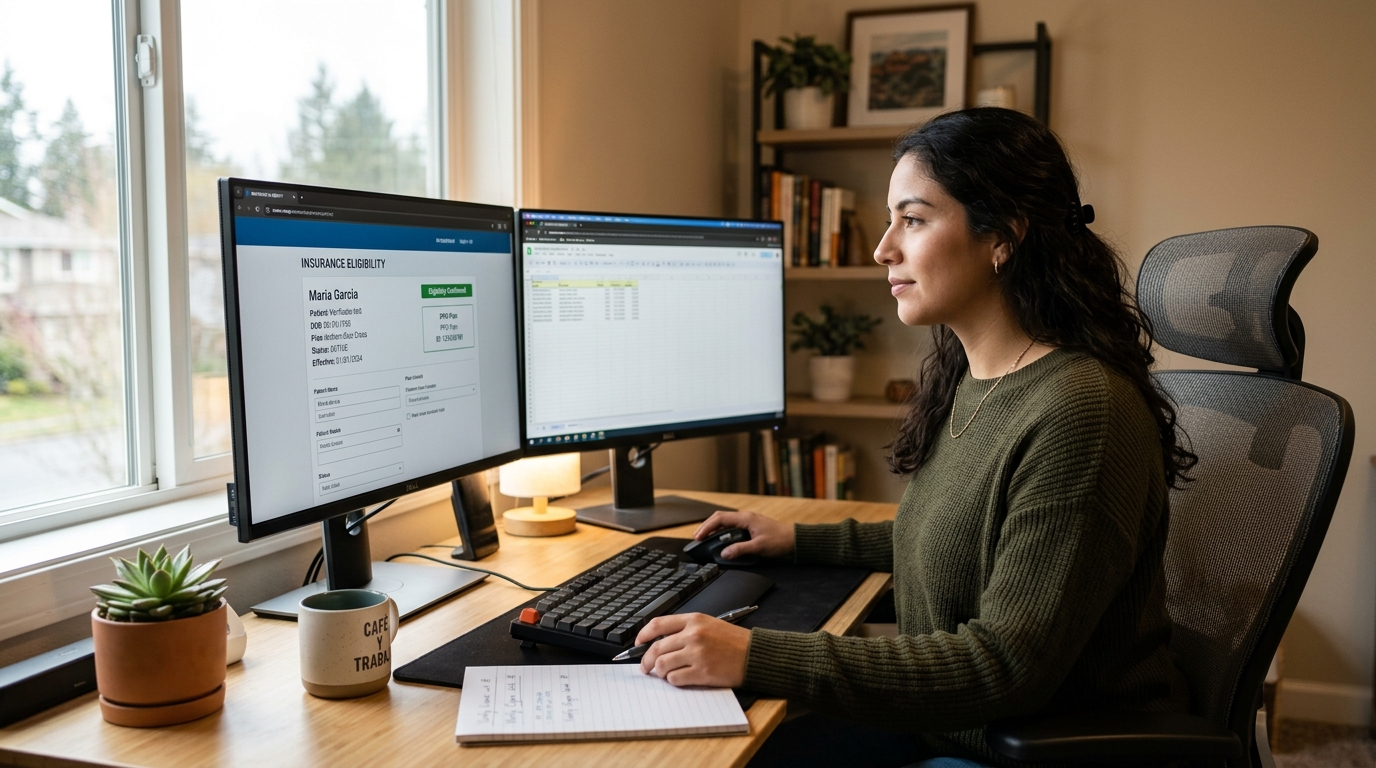
What Is an Insurance Verification Virtual Assistant?
Nearshore insurance verification virtual assistants are remote medical-admin professionals who confirm patient coverage, check benefits eligibility, obtain prior authorizations, and document payer rules — all before the patient ever walks through your door. They work inside your existing practice management software (Kareo, AdvancedMD, DrChrono, Athenahealth) and communicate directly with insurance carriers on your behalf. They are not general-purpose VAs doing email triage; they are trained on the specific CPT codes, payer portals, and EOB formats your specialty uses.
A precise definition matters here: insurance verification is the process of contacting a patient's health plan before a scheduled appointment to confirm active coverage, co-pay amounts, deductible status, out-of-pocket maximums, and any prior-authorization requirements for the planned service. When this step is skipped or done incorrectly, claims deny at the back end — and CAQH research shows that a single denied claim costs a practice an average of $25 to rework. Multiply that across hundreds of visits per month and the math turns ugly fast.
Practices that delegate this work to a dedicated, software-trained virtual assistant recover that time for revenue-generating clinical activity. If you already use a DrChrono virtual assistant for medical billing, insurance verification is the natural upstream complement — verify first, bill clean second.
How Insurance Verification VAs Save 2026 Medical Practices Real Money
The financial case for hiring an insurance verification virtual assistant is straightforward once you understand where revenue leaks. Front-desk staff who are also answering phones, checking in patients, and collecting co-pays simply cannot give eligibility verification the focused attention it requires. The result is rushed checks, missed secondary coverage, and undocumented authorization numbers — all of which become denial reasons after the claim ships.

According to MGMA (Medical Group Management Association), practices lose an average of 3–5% of net patient revenue to preventable claim denials, with eligibility errors ranking as the number-one root cause. For a practice billing $2M annually, that's up to $100,000 in avoidable write-offs every year.
A dedicated insurance verification VA eliminates the root cause by running eligibility checks 24–72 hours before every appointment — not the morning of, not at check-in. They document coverage in your EHR, flag any authorization gaps, and alert the scheduling team before the patient arrives. Your front desk collects the right co-pay on day one because the VA confirmed it two days earlier.
This same principle applies across specialties. Chiropractic offices, for example, deal with notoriously complex insurance rules around visit limits and medical necessity. If you run a chiropractic practice, see how a chiropractic office virtual assistant handles the full front-office workflow — insurance verification included.
Nearshore vs. Offshore vs. Onshore: 2026 Comparison for Insurance Verification
Not all virtual assistants are created equal for insurance verification work. The three hiring models — onshore (US-based), nearshore (Latin America), and offshore (Philippines, India) — differ meaningfully on the dimensions that matter most for payer communication: real-time availability, English articulation under pressure, and timezone overlap with insurance carrier call centers.
| Factor | Onshore (US-Based) | Nearshore (Latin America) | Offshore (Philippines/India) |
|---|---|---|---|
| Typical Monthly Cost (FT) | $4,500–$6,500+ | $2,500 flat | $1,200–$1,800 |
| US Business Hours Coverage | Full overlap | Full overlap | Partial or night-shift only |
| English Fluency for Payer Calls | Native | 8/10+ screened | Variable (4–8/10 typical) |
| Cultural Alignment with US Payers | High | High | Moderate |
| Turnaround on Live Payer Calls | Real-time | Real-time | Next-day batch common |
| Recruiting + HR Included | Rarely | Yes (Rose model) | Sometimes |
| Contract Flexibility | Varies | No long-term contract | Often 6–12 month minimums |
The nearshore model wins on value-per-dollar for most US medical practices. You get full US-hours availability for real-time insurance carrier calls, English fluency that holds up under the pressure of a live authorization dispute, and a flat monthly rate that's roughly half the cost of a US-based hire — without the timezone roulette that offshore staffing introduces.
"Practices that invest in dedicated front-end revenue cycle staff — even virtually — consistently outperform those that treat eligibility as a side task for the front desk. The ROI shows up in first-pass claim rates within 60 days." — Kem Tolliver, Revenue Cycle Expert and Contributor, Healthcare Financial Management Association (HFMA) (2024)
What Tasks Does an Insurance Verification Virtual Assistant Handle in 2026?
The scope of an insurance verification VA goes well beyond a simple coverage check. A well-trained nearshore VA running your eligibility workflow covers the following on a daily basis:
- Eligibility and benefits verification — confirms active coverage, plan type (HMO/PPO/EPO), in-network status, co-pay, co-insurance, deductible, and out-of-pocket maximum via payer portal or live call
- Prior authorization requests — submits auth requests, tracks approval status, and documents auth numbers in the patient chart before the appointment
- Secondary insurance coordination — identifies and verifies secondary payers so claims route correctly the first time
- Denial prevention flags — spots coverage gaps or lapsed policies 48–72 hours out and alerts the scheduling team to collect updated information or reschedule
- EHR documentation — enters all verified insurance details directly into Kareo, AdvancedMD, Athenahealth, or your system of record
- Patient benefit communication — provides the front desk with a clear benefits summary so staff can accurately quote patient responsibility at check-in
Insurance verification is not just a pre-appointment checkbox — it is the first line of defense in your revenue cycle. Every unverified appointment is a potential denial. A dedicated VA running this workflow full-time can process 40–80 verifications per day, far exceeding what a dual-role front-desk employee can manage without errors.
Dental and medical practices often share these administrative challenges. The same discipline that drives clean claims in a physician's office applies equally in dental settings — which is why dental office virtual assistant services increasingly include insurance verification as a core deliverable, not an add-on.
According to the US Bureau of Labor Statistics, medical billing and coding roles command median wages of $48,780/year in 2024 — roughly $4,000/month before benefits, payroll tax, PTO, and turnover costs. A nearshore VA at $2,500/month flat (recruiting, HR, management, and AI copilot included) costs 30–40% less with zero administrative overhead on your side.
How Rose Talent's AI Copilot Makes Insurance Verification Faster in 2026
Every VA placed through Rose ships with a role-specific AI copilot trained on the software they use — Kareo, AdvancedMD, DrChrono, Athenahealth — plus the payer-specific rules that govern your top five insurance carriers. This is not a generic ChatGPT wrapper. It is a workflow assistant that surfaces the right payer portal URL, flags CPT codes that routinely require auth for a given payer, and pre-populates auth request templates based on the procedure and diagnosis code.
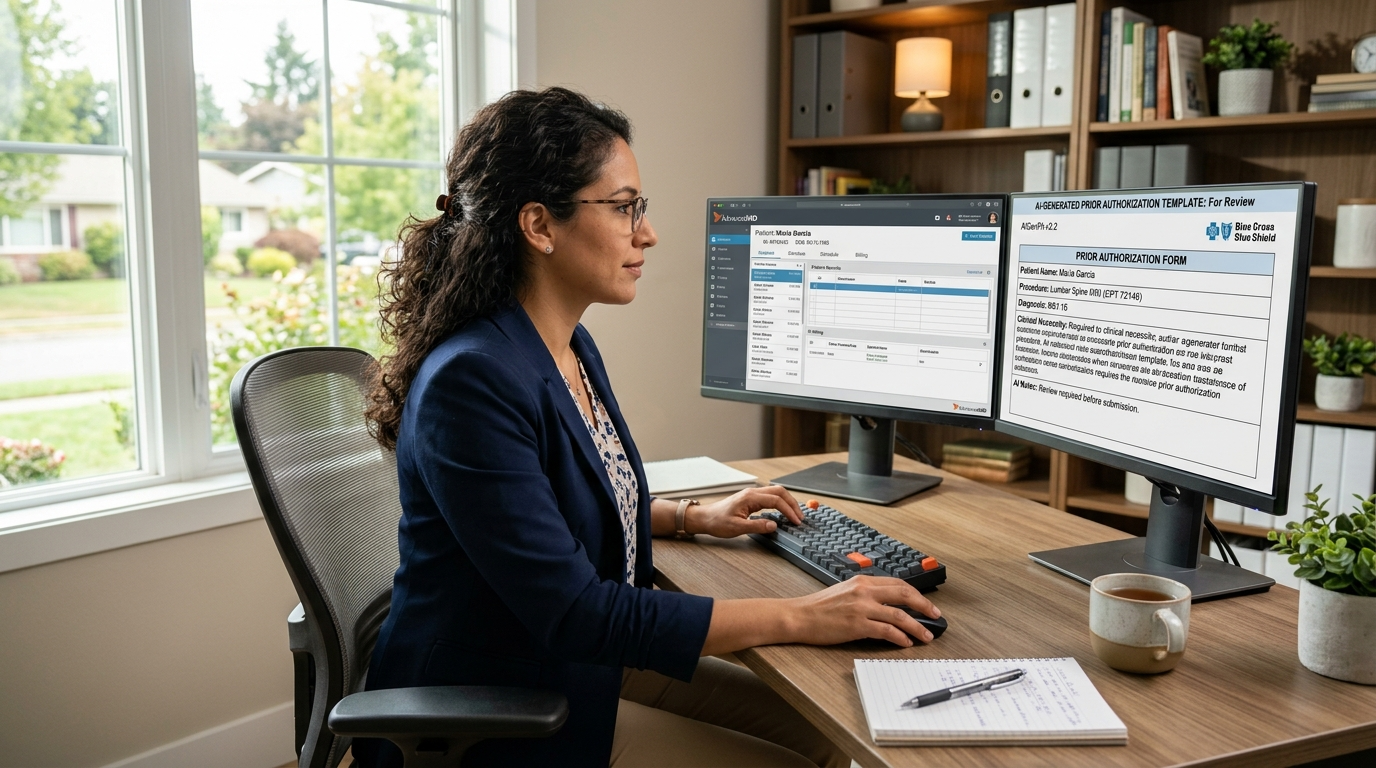
The practical impact: new VAs reach full productivity faster because the copilot handles the lookup work while the VA handles the judgment and communication work. According to McKinsey's research on generative AI in knowledge work, AI assistance reduces time-on-task for structured data workflows — like eligibility verification — by 20–45%. That time savings translates directly into higher daily verification volume per VA.
If your practice also needs help on the billing side, the best medical billing virtual assistant services in 2026 post covers how to pair a verification VA upstream with a billing VA downstream for a fully delegated revenue cycle.
How to Hire an Insurance Verification VA Through Rose Talent: 2026 Process
Discovery Call
You describe your specialty, EHR, top payers, and daily verification volume. Rose maps the role scope and confirms fit before recruiting begins — no time wasted matching a billing specialist to a prior-auth-heavy orthopedic practice.
Candidate Matching
Rose screens candidates on English proficiency (8/10+ floor), insurance verification experience, and EHR familiarity. You receive a shortlist of two to three vetted profiles within approximately seven business days.
Interview and Select
You interview the shortlisted candidates and choose your hire. Rose handles the offer, onboarding paperwork, payroll setup, and NPI/HIPAA compliance orientation — all included in the flat rate.
AI Copilot Configuration
Before day one, the VA's role-specific AI copilot is configured for your EHR and your top five payers — so they arrive with the knowledge scaffolding already in place, not a blank screen.
Ongoing Management
Rose provides ongoing HR, performance oversight, and replacement coordination. If the VA is not the right fit at any point, Rose replaces them at no additional cost — that is the sole risk reversal built into every engagement.
The entire model runs month-to-month with 30 days written notice to cancel. No long-term contract. No buried renewal clauses. You stay because performance earns it, not because paperwork traps you.
Ready to delegate your eligibility queue? Get started with Rose Talent Solutions and have a placement conversation this week.
Is a Nearshore Insurance Verification VA Right for Your Practice?
The nearshore model works best for practices that schedule more than 30 appointments per week, have at least two insurance-heavy payers in their mix, and are currently seeing their front-desk staff split attention between check-in duties and eligibility calls. If that describes your operation, a dedicated VA pays for itself within the first month in recovered denials and staff time.
Best Fit For
- Multi-provider practices billing 200+ claims/month
- Specialties with high prior-auth volume (orthopedics, mental health, chiropractic, physical therapy)
- Practices using cloud EHRs (Kareo, AdvancedMD, DrChrono, Athenahealth)
- Groups that want to scale without adding W-2 headcount
- Offices tired of claim denials from eligibility errors at the front end
Less Ideal For
- Practices with fewer than 15 appointments/week (verification volume may not justify full-time hours)
- Providers who are cash-pay only and have no insurance billing
- Offices that require a physical presence for check-in or copay collection at the front desk
According to SHRM's Human Capital Benchmarking data, the average cost to replace an employee earning under $50,000 is approximately 50% of their annual salary. For a front-desk coordinator, that's $20,000–$25,000 in turnover cost every time the seat turns over. A nearshore VA through Rose sidesteps that entirely — Rose owns the recruiting and replacement risk, not you.
You can also explore the broader virtual staffing solutions for service-based businesses to understand how the same model scales across departments beyond medical admin.