
Nearshore virtual medical receptionist services are quietly replacing the traditional front-desk hire at independent clinics, group practices, and specialty offices across the US. Instead of paying $45,000–$55,000 per year in salary plus benefits for a local receptionist, practices are staffing fully dedicated, English-fluent coordinators based in Latin America — available during US business hours, trained on the exact software your office already runs, and managed start-to-finish by a staffing partner. The cost is $2,500 per month, flat, with no long-term contract required.
This guide covers everything you need to evaluate virtual medical receptionist services in 2026: what they actually do, how nearshore compares to offshore and in-house, what the data says about front-desk outsourcing, and how to get your first coordinator placed without disrupting patient care.
What Is a Virtual Medical Receptionist — and What Do They Actually Do in 2026?
A virtual medical receptionist is a remote administrative professional who manages the front-desk functions of a medical practice without sitting in your physical office. They answer inbound calls, schedule and confirm appointments, handle patient intake paperwork, verify insurance eligibility, manage recall lists, and route urgent messages to clinical staff — all during your normal business hours.
The term "virtual" sometimes gets confused with an answering service or a chatbot. This is not that. A dedicated virtual medical receptionist is a single, named team member assigned exclusively to your practice. They learn your scheduling rules, your EHR system, your providers' preferences, and your patient communication style. Think of them as a full-time employee who works remotely — not a shared call center agent who picks up overflow calls.
In 2026, the most competitive virtual medical receptionist services layer an AI copilot on top of the human coordinator. At Rose Talent Solutions, every team member ships with a role-specific AI copilot trained on their software — whether that's Kareo, Athenahealth, Jane App, or another platform your team uses daily. That means faster lookup times, fewer data-entry errors, and more bandwidth for your coordinator to focus on patient experience rather than busywork.
According to the U.S. Bureau of Labor Statistics (2024), the median annual wage for medical secretaries and administrative assistants in the United States is $38,500 — and that figure does not include employer payroll taxes, health insurance, PTO, or recruiting costs, which routinely add another 25–30% on top.

How Nearshore Outperforms Other Options for Virtual Medical Receptionist Services in 2026
The most common alternative to nearshore staffing is a domestic hire — expensive, slow to recruit, and subject to the front-desk turnover problem that plagues healthcare offices. The second most common alternative is an offshore provider. Nearshore Latin America beats both on the metrics that actually matter to a medical practice.
Nearshore coordinators, based in countries like Colombia, Mexico, and Costa Rica, operate in the same or adjacent US time zones. A coordinator in Bogotá is EST+1. A coordinator in Mexico City is CST. They show up at their desk when your front door opens, and they're available for same-day scheduling issues, urgent call-backs, and real-time coordination with your clinical team. There is no overnight batch processing of patient calls — coverage is live, during your hours.
Response time is the metric that separates good front desks from great ones — nearshore coordinators answer patient calls in real-time while teams operating on a large time-zone offset are forced to batch messages for the next business day. For a primary care practice averaging 80–120 patient calls per day, that difference compounds quickly into no-show rates and patient satisfaction scores.
Rose's published English proficiency floor is 8 out of 10 on screening assessments. Every candidate goes through communication vetting before placement — not after. Medical terminology, regional US accents, and insurance jargon are assessed explicitly during the intake screen. If you've ever dealt with the frustration of a coordinator who struggled to confirm a patient's co-pay structure clearly, this bar matters more than the rate differential.
If your practice has multiple specialties or locations, you might also be interested in how similar nearshore models apply to dental office virtual assistant services — the coordination challenges are nearly identical, and the staffing solution follows the same framework.
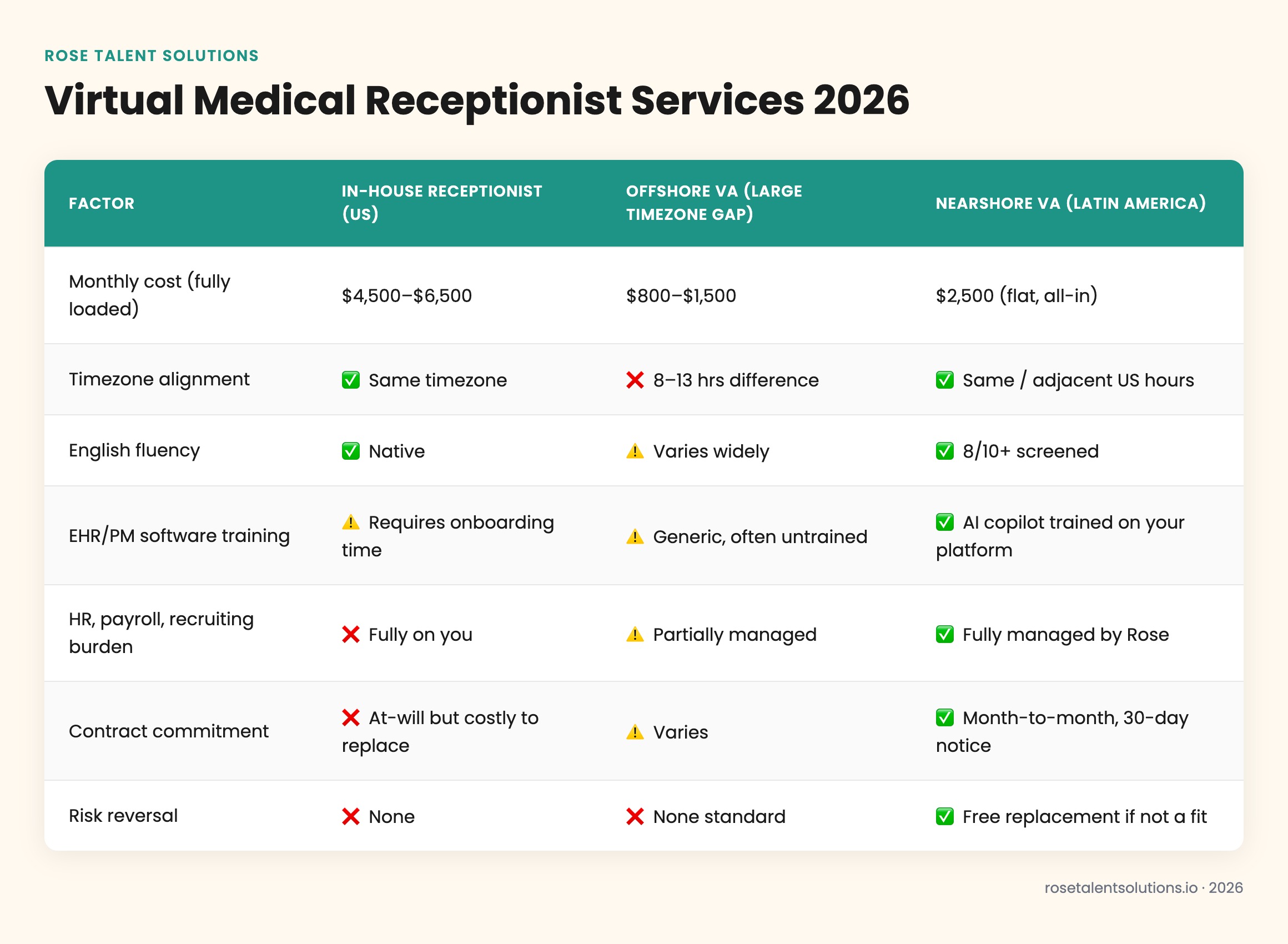
| Factor | In-House Receptionist (US) | Offshore VA (large timezone gap) | Nearshore VA (Latin America) |
|---|---|---|---|
| Monthly cost (fully loaded) | $4,500–$6,500 | $800–$1,500 | $2,500 (flat, all-in) |
| Timezone alignment | ✅ Same timezone | ❌ 8–13 hrs difference | ✅ Same / adjacent US hours |
| English fluency | ✅ Native | ⚠️ Varies widely | ✅ 8/10+ screened |
| EHR/PM software training | ⚠️ Requires onboarding time | ⚠️ Generic, often untrained | ✅ AI copilot trained on your platform |
| HR, payroll, recruiting burden | ❌ Fully on you | ⚠️ Partially managed | ✅ Fully managed by Rose |
| Contract commitment | ❌ At-will but costly to replace | ⚠️ Varies | ✅ Month-to-month, 30-day notice |
| Risk reversal | ❌ None | ❌ None standard | ✅ Free replacement if not a fit |
What Tasks Should You Delegate to a Virtual Medical Receptionist?
The highest-ROI delegations are the ones that currently consume your clinical staff's time or cause patient drop-off. Start with the tasks that are high-volume, rules-based, and don't require physical presence in the office.
Appointment scheduling and confirmation calls are the most obvious starting point. According to Accenture's Healthcare Consumer Survey (2023), 77% of patients say the ability to book, change, or cancel appointments by phone — without being put on hold — significantly influences their choice of provider. A dedicated virtual receptionist who answers within three rings and confirms appointments 48 hours in advance directly moves this needle.
Insurance verification is the second highest-leverage task. Getting eligibility wrong upstream creates claim denials, patient billing confusion, and staff time spent on corrections. According to the CAQH Index (2023), the healthcare industry spends an estimated $13.3 billion annually on administrative transactions that could be streamlined — eligibility verification being one of the largest manual cost drivers. If you want to go deeper on this specific function, Rose has a dedicated resource on insurance verification virtual assistants that walks through exactly how a remote coordinator handles payer portals in real time.
Other common delegations include: new patient intake forms and data entry into your EHR, referral coordination, recall outreach for overdue preventive visits, prior authorization follow-up, and end-of-day scheduling reconciliation. For practices that bill in-house, a virtual medical receptionist often works in tandem with a separate billing coordinator — see Rose's overview of medical billing virtual assistant services for how that split-role model works.
"Delegating appointment confirmation and insurance pre-verification to a dedicated remote coordinator typically recovers 6–8 hours of clinical staff time per week in a practice seeing 150+ patients." — Kareo Practice Management Blog, Reducing Administrative Burden in Independent Practices (2023)
The hidden cost of a missed front-desk call isn't the lost appointment — it's the patient who booked with a competitor and never came back. Independent practices that track "call abandonment rate" consistently find it's 3–5× higher than they assumed before installing call analytics.
How Rose Talent Solutions Places a Virtual Medical Receptionist: The 2026 Process
The staffing process at Rose is structured to get a vetted coordinator in front of you fast — typically within seven days of your intake call. Here's how it works from submission to day one:
Intake & Role Scoping
You complete a short brief describing your EHR system, call volume, scheduling complexity, and any specialty-specific requirements (e.g., prior auth workflows for a cardiology practice vs. a dermatology office). This takes about 20 minutes and drives the entire match.
Candidate Matching & Vetting
Rose sources from its existing Latin America talent network, filters for candidates with medical admin experience, and runs English proficiency screens to confirm 8/10+ before you see any profile. You're not sorting through 40 resumes — you're reviewing 2–3 pre-vetted finalists.
Interview & Selection
You interview your top choice (or choices) over video. Most practices confirm a match within 48 hours of seeing the shortlist. If nobody feels right, Rose re-searches at no additional cost.
AI Copilot Onboarding
Before day one, your coordinator's AI copilot is configured for your specific platform — Kareo, Athenahealth, Jane App, or whichever system you run. They arrive trained, not learning on your patients' time. This is Rose's AI Advantage in action.
Live & Fully Managed
Your coordinator starts during your business hours on day one. Rose handles payroll, HR, and ongoing performance management. If the fit isn't right, you get a free replacement — no awkward termination conversation, no re-recruiting cost on your side.

Is a Virtual Medical Receptionist Right for Your Practice Size in 2026?
The most common objection from smaller practices is: "We only have one provider — do we really need a full-time receptionist?" The answer is usually yes, faster than you'd expect. A solo-provider primary care practice seeing 20 patients per day generates roughly 40–60 administrative touchpoints per day once you count scheduling calls, insurance checks, prescription refill requests, and patient messages. That's a full-time job — and when the physician or an MA is absorbing it, you're paying clinician wages for administrative work.
According to MGMA's Medical Practice Operations Survey (2023), the optimal front-desk-to-provider ratio for outpatient practices is 1:1 for practices seeing more than 15 patients per day. Most solo and two-provider practices are understaffed on the administrative side, not the clinical side.
For multi-location practices or those with complex prior auth workflows — common in orthopedics, psychiatry, and pain management — a single virtual coordinator often handles one specific function (e.g., pure scheduling) while a second handles insurance and billing. Rose's start page walks through how to structure a multi-role engagement from day one.
Chiropractic offices face a nearly identical set of front-desk challenges — high appointment volume, recall-heavy scheduling, and insurance verification at every visit. If you run or work with a chiro practice, the breakdown in Rose's post on chiropractic office virtual assistants is directly applicable to the staffing model described here.
When a Virtual Medical Receptionist Is the Right Call
- Your front-desk staff is handling 50+ calls per day and dropping some
- Your clinical team is absorbing administrative tasks during patient hours
- You're spending $4,500+/month on a local receptionist plus employer costs
- Your no-show rate exceeds 10% and you lack a confirmation workflow
- You're opening a second location and need fast, affordable front-desk coverage
When You May Need to Reconsider the Timing
- Your practice sees fewer than 8–10 patients per day and call volume is minimal
- You have no EHR or scheduling system in place yet — get the tech stack right first
- Your workflows aren't documented — a VA can only follow a process, not invent one
- You need someone to physically greet patients and handle in-person check-in
On the financial side, practices that have already optimized billing can redirect those savings into front-desk coverage. Rose's bookkeeping and accounting virtual staff model follows the same flat-rate structure, making it straightforward to build a two-person remote administrative team for well under what one full-time in-house employee costs.
According to SHRM's Employee Turnover Cost Research (2022), replacing a single employee costs an average of six to nine months of that employee's salary — meaning a $40,000 receptionist costs $20,000–$30,000 to replace when they leave. Front-desk turnover in healthcare runs notoriously high. According to Gallup's Workplace Research (2023), voluntary employee turnover costs US businesses more than $1 trillion per year — a burden felt acutely in high-churn administrative roles like front-desk reception. A managed nearshore model eliminates that replacement cost entirely; if your coordinator isn't a fit, Rose replaces them at no additional cost to you.
The combination of cost predictability, timezone alignment, software fluency, and managed HR makes nearshore virtual medical receptionist services one of the clearest ROI decisions a practice administrator can make in 2026. The question isn't whether the model works — the data above makes that case. The question is how quickly your practice can absorb the capacity once your coordinator is live. Start here to get your intake brief in front of Rose's matching team.