
Nearshore virtual medical assistants have quietly become one of the fastest-growing staffing decisions in US healthcare administration — and for good reason. Practices stretched thin by rising labor costs, sky-high turnover, and insurance paperwork backlogs are discovering that a full-time remote MA based in Latin America can handle the same administrative workload as an in-house hire at a fraction of the total cost. This guide breaks down exactly how the two models compare in 2026, where each one wins, and what the real numbers look like when you stack them side by side.
What Is a Virtual Medical Assistant — and What Can They Actually Do in 2026?
A virtual medical assistant (VMA) is a trained administrative professional who works remotely, handling the non-clinical back-office functions of a medical practice. This includes patient scheduling, insurance verification, prior authorization submissions, EHR data entry, referral coordination, billing follow-up, and patient communication. VMAs do not perform clinical tasks — they free up your in-office clinical staff so those staff can focus on patients, not paperwork.
A nearshore VMA specifically is based in Latin America — countries like Colombia, Mexico, Costa Rica, or Argentina — and works on US business hours with English fluency screened at 8/10 or higher. This is meaningfully different from offshore outsourcing to the Philippines or India, where timezone gaps of 6–13 hours make real-time collaboration with your front desk nearly impossible. Nearshore VMAs attend your morning huddles, answer calls in real time, and communicate with your team throughout the day as if they were down the hall.
The administrative scope is broader than most practice managers expect. A well-matched VMA can handle complex patient scheduling workflows, including multi-provider calendars, recall campaigns, and same-day cancellation fills — tasks that typically eat 2–3 hours of a front desk coordinator's day.
How the True 2026 Cost of an In-House Medical Assistant Compares to a Virtual One
The Bureau of Labor Statistics puts the median annual wage for a medical assistant in the US at $42,000, according to the US Bureau of Labor Statistics Occupational Outlook Handbook (2024). But that's the salary line only. When you layer in employer payroll taxes (roughly 7.65% FICA), health insurance contributions, paid time off, recruiting fees, and onboarding time, the fully-loaded annual cost of a single in-house MA routinely lands between $58,000 and $68,000 — sometimes higher in competitive metro markets like Austin, Denver, or Miami.
A full-time nearshore VMA through a flat-rate staffing model runs $2,500 per month — $30,000 per year — with recruiting, vetting, payroll, HR, and ongoing management included in that single number. That's a $28,000–$38,000 annual gap per seat. For a two-provider practice running two admin roles, the difference compounds quickly.
Turnover is the cost that rarely shows up in budget models until it's already bleeding. According to SHRM (2023), replacing an employee costs an average of 50–200% of their annual salary when you include lost productivity, re-recruiting, and retraining. Medical assistant turnover in outpatient settings runs notoriously high — many practices replace MAs every 12–18 months. A replacement guarantee (where your staffing partner replaces the VA at no additional cost if they aren't a fit) changes that math entirely.
The administrative cost burden extends beyond wages. According to the CDC National Center for Health Statistics (2023), US physician practices spend an average of 15.1 hours per physician per week on administrative tasks — a workload that falls disproportionately on front-office and MA staff when dedicated admin roles go unfilled.

Virtual Medical Assistant vs In-House Medical Assistant: 2026 Side-by-Side Comparison
The table below compares the two models across the dimensions that matter most to practice administrators making this decision in 2026. The goal isn't to declare a universal winner — it's to show you exactly where each model is strong and where it has limits, so you can match the right hire to the right gap in your practice.
| Factor | In-House Medical Assistant | Nearshore Virtual Medical Assistant |
|---|---|---|
| Annual fully-loaded cost | $58,000–$68,000+ | $30,000 (flat, all-in) |
| Clinical task capability | Yes (vitals, injections, rooming) | No — administrative only |
| Administrative task coverage | Yes, but often split with clinical duties | 100% dedicated to admin |
| Insurance verification | Yes — if time allows | Yes — primary focus |
| Prior authorization | Inconsistent — frequently backlogged | Yes — trained, dedicated workflow |
| EHR data entry (Epic, Athena, etc.) | Yes | Yes — role-specific AI copilot included |
| Time zone alignment with US practice | Full overlap | Full overlap (Latin America, US hours) |
| Average time to fill vacancy | 45–90 days | ~7 days to first placement |
| Turnover risk | High (12–18 month average tenure) | Low — replacement guarantee included |
| Benefits / payroll burden on practice | Full employer cost | None — handled by staffing partner |
| Contract commitment | At-will, but rehiring risk on departure | Month-to-month, no long-term contract |
| HIPAA training | Practice-administered | Pre-vetted; practice confirms supplemental training |
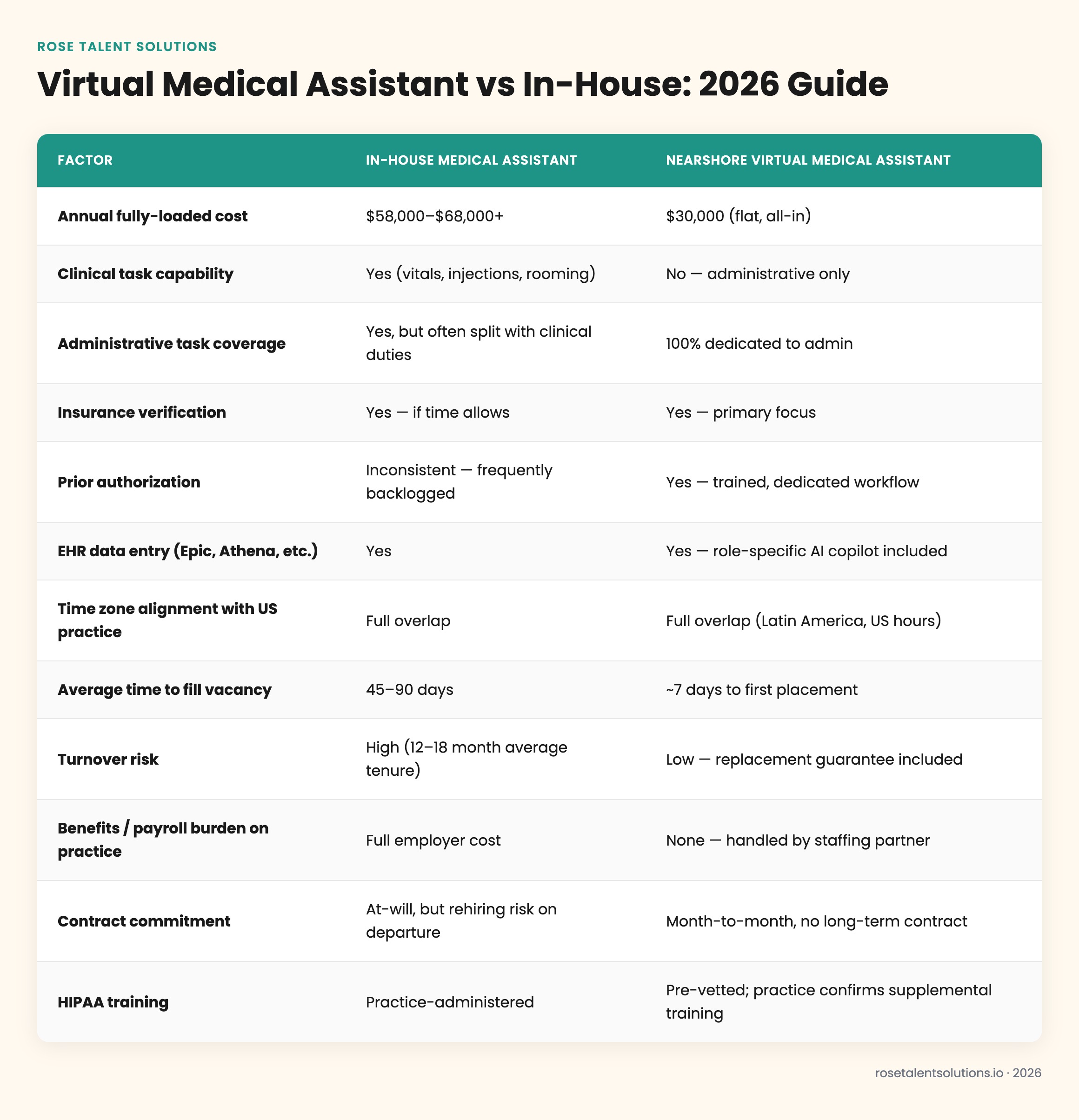
Where In-House Medical Assistants Still Win — and Where They Don't
In-house MAs are irreplaceable for clinical tasks. Rooming patients, taking vitals, administering injections, performing EKGs, assisting with minor procedures — none of that moves to a screen. If your MA role is genuinely 50%+ clinical, a virtual model doesn't cover the full job description, and you need bodies on-site. That's the honest truth, and any staffing partner worth working with will tell you the same thing.
Where in-house MAs consistently underperform is in dedicated administrative throughput. When a clinical MA is pulled between rooming patients and chasing prior authorizations, one or both tasks suffers. Practices that hire a nearshore VMA specifically to own the administrative lane — handling the prior authorization queue and insurance verification while the in-office MA stays clinical — report dramatically lower backlogs and faster claims turnaround.
The hybrid model is increasingly common among growing practices: one or two in-office MAs handling clinical duties, paired with a nearshore VMA managing the administrative stack. The combined cost is still lower than hiring two fully-loaded in-house staff, and each role operates in its true area of competency. According to KFF Health System Tracker (2024), healthcare labor costs have grown faster than overall inflation for four consecutive years — a trend that makes cost-efficient staffing models more strategically important, not less.
"Practices that offload administrative tasks to dedicated remote staff see measurable improvements in both front-desk throughput and physician satisfaction scores — the key is task specificity, not just headcount." — Halee Fischer-Wright, MD, President and CEO at MGMA (Medical Group Management Association), MGMA Stat Poll Commentary (2023)
The strongest argument for a virtual medical assistant isn't cost — it's specialization. A nearshore VMA who does nothing but insurance verification and prior auth all day will outperform a clinical MA who handles those tasks between patient rooms, every single time. Dedicated focus produces fewer errors, faster turnaround, and better payer relationships.
How AI-Equipped VMAs Are Changing 2026 Medical Admin Standards
The latest generation of virtual medical assistants isn't just remote — they're AI-assisted. Every team member placed through Rose ships with a role-specific AI copilot trained on the software they'll actually use: Epic, Athena Health, Kareo, ModMed, and others. This means faster EHR data entry, automated eligibility check workflows, and smarter prior auth tracking — without your practice having to build or maintain any of that infrastructure.
According to McKinsey's healthcare operations research (2023), administrative automation in medical practices can reduce per-claim processing time by up to 40% when combined with trained staff who know how to leverage it. AI doesn't replace the VMA — it amplifies what a skilled, trained VMA can accomplish per hour.
Practices running dedicated insurance verification workflows through a VMA with AI tooling report a measurable drop in claim denials tied to eligibility errors — one of the top three denial drivers in outpatient billing. The combination of human judgment and AI-assisted checks creates a more reliable verification process than either alone.
Remote work reliability has also matured significantly. According to Pew Research Center (2023), more than 35% of workers who can do their jobs remotely now do so full-time — and the infrastructure, security tooling, and collaboration norms that make remote work effective have become standardized across most industries, including healthcare administration.

How Rose Places a Nearshore Virtual Medical Assistant in Your Practice
The placement process is designed to eliminate the friction that makes most practices hesitant to try a remote model. There's no 90-day recruiting cycle, no benefits enrollment to configure, and no ambiguity about what the role covers. Here's how it works from inquiry to day one.
Role Scoping Call
Rose's team maps your exact administrative bottlenecks — scheduling volume, prior auth load, insurance verification backlog — and builds a precise role brief before recruiting begins.
Candidate Matching
Rose recruits from its Latin America network, screens for English proficiency (8/10+ minimum), relevant EHR experience, and HIPAA awareness before any candidate reaches your desk.
You Interview and Approve
You meet shortlisted candidates — typically 2–3 — and choose who joins your team. No surprise placements. Your approval is required before anyone starts.
AI Copilot Onboarding
Your VMA is equipped with a role-specific AI copilot trained on your EHR and payer workflows before day one, so ramp time is measured in days, not weeks.
Ongoing HR and Management
Payroll, HR, and performance oversight are handled by Rose. You manage the day-to-day work; Rose manages the employment relationship.
The flat rate of $2,500/month covers everything above. Month-to-month terms with 30 days written notice — no long-term contract. If the team member isn't a fit, Rose replaces them at no additional cost.
Is a Virtual Medical Assistant Right for Your Practice in 2026? Pros and Cons
Not every practice is ready for a virtual model, and the right answer depends on your admin-to-clinical task ratio, your team's comfort with remote collaboration tools, and the specific bottlenecks you're trying to solve. The grid below gives you an honest read on both sides — including the considerations that often get glossed over in vendor marketing.
Pros of a Nearshore VMA
- 60–70% lower fully-loaded cost vs. in-house hire
- 100% dedicated to administrative tasks — no clinical interruptions
- Works US business hours with real-time communication
- Replaces in days, not months, if not a fit
- No employer payroll tax, benefits, or PTO burden
- AI copilot included — faster ramp, fewer errors
- Month-to-month terms, no long-term contract
Cons / Limitations
- Cannot perform clinical tasks (rooming, vitals, injections)
- Requires stable internet and video/phone setup on both ends
- Practice must provide HIPAA training confirmation and system access
- Some EHR platforms require IT configuration for remote login security
- Not ideal if your admin role is less than 50% of total duties
Practices with a high administrative burden — multi-provider groups, specialty clinics with heavy prior auth loads, or any office running a high-volume appointment model like chiropractic or physical therapy — tend to see the strongest ROI from a dedicated nearshore VMA. If your admin volume is low and your MA is genuinely 70%+ clinical, an in-house model may still make more sense for that seat.
If you're ready to explore what the role could look like for your specific practice, the fastest path is a scoping call where Rose maps your workflow before recommending a model. According to Gallup's workplace research (2023), teams with clearly defined roles and dedicated task ownership report 23% higher productivity — the same principle applies when you split administrative and clinical duties between dedicated roles rather than stacking them on one person.
The bottom line: a virtual medical assistant doesn't replace your in-house clinical team — it completes it. The practices winning on administrative efficiency in 2026 aren't choosing between virtual and in-house. They're using each model for what it's actually built to do. Explore the full range of nearshore staffing options to see where a VMA fits your specific practice workflow.