
Nearshore virtual bookkeepers have quietly become one of the most cost-effective hires a small or mid-size business can make in 2026. But "virtual bookkeeping rates" is a phrase that gets thrown around loosely — and the number you find on a Google search can be anywhere from $15 an hour to $8,000 a month depending on who's selling and what they're including. This guide breaks down every major pricing model, what you actually get for the money, and how to avoid the hidden costs that make a "cheap" rate expensive.
Whether you run a property management company, an e-commerce brand, or a service business with growing payables, the structure of your bookkeeping arrangement matters as much as the headline rate. A dedicated virtual bookkeeping hire looks very different from a per-task freelancer — and 2026 has made that difference starker than ever.
According to QuickBooks (2024), 78% of small businesses that outsource bookkeeping report saving more than 10 hours per week on financial admin. That's not a rounding error — that's a part-time employee's worth of time handed back to you every single week.
How Virtual Bookkeeping Rates Are Structured in 2026
There are four main pricing models you'll encounter when shopping for virtual bookkeeping help. Understanding which model you're looking at — before you compare dollar figures — is the only way to make an apples-to-apples decision.
Hourly freelancer: You hire a solo bookkeeper through a platform like Upwork or Fiverr. You pay only for hours worked, typically $15–$45/hour depending on location and experience. Sounds cheap. But you handle your own recruiting, vetting, onboarding, supervision, and replacement if it doesn't work out.
US-based bookkeeping firm: You engage a CPA-led firm that assigns you a dedicated or shared bookkeeper. Rates run $50–$150/hour, or $500–$5,000+/month for packages. High quality, high cost — built for businesses that need audit-ready financials or complex tax work.
Budget offshore VA: You hire through a staffing marketplace or agency. Rates are low — often $8–$18/hour — but you absorb a 6–12 hour timezone gap, inconsistent English proficiency, and typically no software pre-training. These teams are often based in regions far outside North American time zones, which creates real collaboration friction.
Nearshore VA (Latin America): You hire through a managed staffing agency. Rates are mid-range but all-inclusive — typically $2,000–$2,800/month flat for a full-time (40 hrs/week) bookkeeper who works your time zone, speaks fluent English, and arrives pre-vetted on your accounting software.

If you're evaluating a QuickBooks-trained virtual bookkeeper, the pre-training factor alone can shave 2–3 weeks off your onboarding ramp. That's time and money most rate comparisons don't capture.
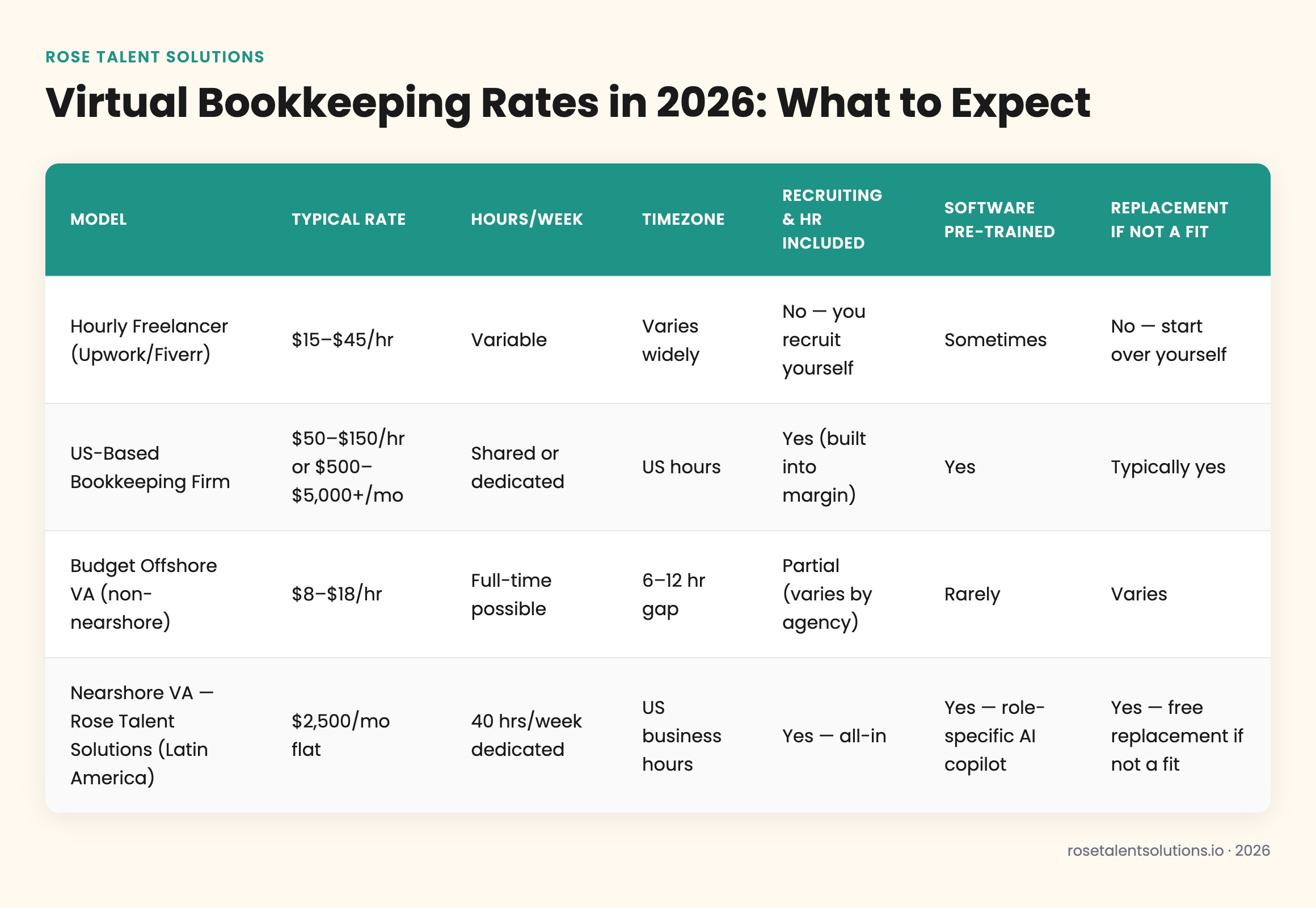
2026 Virtual Bookkeeping Rates: Full Comparison Table
The table below puts all four models side-by-side across the dimensions that actually affect your total cost — not just the rate card.
| Model | Typical Rate | Hours/Week | Timezone | Recruiting & HR Included | Software Pre-Trained | Replacement if Not a Fit |
|---|---|---|---|---|---|---|
| Hourly Freelancer (Upwork/Fiverr) | $15–$45/hr | Variable | Varies widely | No — you recruit yourself | Sometimes | No — start over yourself |
| US-Based Bookkeeping Firm | $50–$150/hr or $500–$5,000+/mo | Shared or dedicated | US hours | Yes (built into margin) | Yes | Typically yes |
| Budget Offshore VA (non-nearshore) | $8–$18/hr | Full-time possible | 6–12 hr gap | Partial (varies by agency) | Rarely | Varies |
| Nearshore VA — Rose Talent Solutions (Latin America) | $2,500/mo flat | 40 hrs/week dedicated | US business hours | Yes — all-in | Yes — role-specific AI copilot | Yes — free replacement if not a fit |
"The biggest mistake small business owners make when comparing bookkeeping services is looking only at the hourly rate. The true cost includes your time recruiting, managing, and replacing — and that's where flat-rate managed services often win decisively." — Joe Woodard, CEO at Woodard Events and nationally recognized accounting industry consultant (2024)
What Hidden Costs Actually Do to Virtual Bookkeeping Rates in 2026
The rate you see advertised is rarely the rate you pay. Every pricing model carries embedded costs that only show up after you've signed on. Understanding them is how you avoid the "cheap hire that cost us a fortune" story.
Recruiting time: Finding, interviewing, and vetting a freelance bookkeeper takes the average small business owner 8–15 hours, according to SHRM (2023). At $100/hour opportunity cost for a founder, that's $800–$1,500 before anyone opens a ledger.
Software onboarding: A bookkeeper unfamiliar with your stack — QuickBooks, Xero, AppFolio, Buildium — needs 2–4 weeks to reach full productivity. If you're paying hourly during that ramp, you're paying for learning, not output. Rose's team members arrive with a role-specific AI copilot already trained on the relevant software, which compresses that ramp dramatically.
Replacement cost: When a freelancer ghosts or underperforms, you restart the entire recruiting process. A managed nearshore arrangement — like the one described on Rose's bookkeeping and accounting staffing page — includes free replacement if the team member isn't a fit. That one clause eliminates the single biggest financial risk of a virtual hire.
Timezone drag: A bookkeeper working 9–12 hours outside your time zone can't answer a time-sensitive vendor question in real time. Every back-and-forth that takes 5 minutes in person takes 24–48 hours asynchronously. Multiply that across accounts payable, reconciliations, and month-end close — and you're looking at a structural bottleneck that hourly rates don't capture. Nearshore bookkeepers in Latin America eliminate this entirely by working standard US business hours.
The hidden cost of a misaligned timezone isn't the hourly rate — it's the lag that turns a 10-minute clarification into a 48-hour delay, compounding across every reconciliation and close cycle all month long. Nearshore staffing from Latin America solves this structurally, not just tactically.
According to the U.S. Bureau of Labor Statistics (2024), the median annual wage for bookkeeping, accounting, and auditing clerks in the United States is $47,440 — or roughly $22.80/hour. A full-time nearshore bookkeeper at $2,500/month works out to approximately $14.42/hour all-in, including recruiting, HR, payroll administration, and ongoing management. That's below the US median for the role alone, before any overhead.
If your business also handles vendor payments at scale, it's worth understanding how virtual accounts payable support can pair with your bookkeeping hire — one team member can often cover both functions when scoped correctly.
Businesses that use Xero instead of QuickBooks face the same calculus. A Xero-trained virtual bookkeeper from Latin America costs roughly the same monthly rate but brings software fluency out of the box — no paid ramp time, no tutorial videos, no hand-holding through bank feeds.
How to Choose the Right Virtual Bookkeeping Rate Model for Your Business in 2026
The right model depends on three variables: your transaction volume, your timeline flexibility, and how much management bandwidth you want to spend on the hire.
Low transaction volume, irregular schedule: An hourly freelancer probably makes sense if you have fewer than 100 transactions a month and can tolerate some variability. Budget $200–$600/month and accept that you own the recruiting and management overhead.
High volume, time-sensitive close cycles: If you're running month-end close under deadline pressure, reconciling 500+ transactions, or managing AP for multiple entities, a full-time dedicated hire is the right call. The hourly model breaks down when the work is continuous — you end up paying for availability even on an hourly contract, or you don't get it.
Growth stage, no in-house finance team: This is where nearshore flat-rate models shine. You get full-time dedicated capacity, software-trained staff, and zero recruiting overhead — all for less than half what a US bookkeeper costs. According to Statista (2024), the global business process outsourcing market is projected to exceed $525 billion by 2030 — largely driven by small and mid-market businesses moving exactly this kind of function to nearshore and managed staffing models.
For businesses managing outsourced accounts payable services alongside bookkeeping, bundling both under one dedicated nearshore hire often reduces total cost by 30–40% compared to hiring two part-time freelancers separately.
Nearshore Flat-Rate Model — Pros
- Predictable monthly cost — no surprise invoices based on hours
- Full-time dedicated capacity (40 hrs/week)
- Works US business hours — real-time collaboration possible
- Recruiting, HR, payroll, and management all included
- Free replacement if the team member isn't a fit
- Software-trained with AI copilot (QuickBooks, Xero, AppFolio, etc.)
Nearshore Flat-Rate Model — Cons
- Higher monthly commitment than a part-time hourly freelancer
- Best value at higher transaction volumes — may be overkill for very small books
- You work through the agency's matching process (typically 5–7 business days)
How Rose Talent Solutions Prices Virtual Bookkeeping in 2026
Rose Talent Solutions charges $2,500/month flat for a full-time (40 hrs/week) nearshore virtual bookkeeper based in Latin America. That rate is all-in: it covers recruiting, vetting, payroll administration, HR, and ongoing management. There is no long-term contract — you can cancel with 30 days written notice. If the team member isn't a fit, Rose replaces them at no additional cost.
Every team member ships with a role-specific AI copilot trained on the software they'll actually use — QuickBooks, Xero, AppFolio, Buildium, or whichever platform your business runs on. Rose's published English proficiency floor is 8/10 on screening assessments, which means real-time voice calls, Slack threads, and Zoom check-ins work without friction.
Submit Your Role Brief
Tell Rose what software you use, your transaction volume, and any specific bookkeeping scope (AP, AR, reconciliation, payroll support). Takes about 10 minutes.
Review Matched Candidates
Rose's team sources and pre-screens candidates against your brief. You typically receive 2–3 matched profiles within 5–7 business days.
Interview and Select
You interview your top match. If none feel right, Rose keeps searching at no additional cost until you find the right person.
Onboard and Start
Your bookkeeper starts on your schedule. Rose handles payroll and HR from day one — you focus on getting them into your systems and workflow.
If you're ready to hire, the fastest path is the Rose intake form — you can specify bookkeeping scope, software stack, and preferred start date directly. For businesses that want to explore role options first, the property management staffing page illustrates how Rose structures dedicated hires across overlapping financial and operational functions.
The accounting outsourcing market is only moving in one direction. According to IBM Institute for Business Value (2023), 87% of finance executives say AI-augmented roles will be standard in their departments within three years. The businesses hiring nearshore bookkeepers from Latin America with built-in AI tooling today are building a structural cost advantage that will compound as labor markets tighten. A flat $2,500/month all-in rate for a software-fluent, AI-assisted bookkeeper working your time zone isn't just a good deal in 2026 — it's likely the baseline expectation by 2028.