
Nearshore telehealth virtual assistant services are quietly becoming the operational backbone of remote-care practices across the US. While your providers focus on patient consultations, a dedicated virtual admin — based in Latin America, working your exact business hours — handles the intake queue, insurance verifications, appointment reminders, and the dozen other tasks that used to pile up on your front-desk staff. The result is a leaner overhead structure and a patient experience that doesn't fall apart between sessions.
This guide breaks down exactly what a telehealth VA does, how nearshore compares to other staffing models, what to look for when hiring, and what a realistic onboarding timeline looks like in 2026.
What Is a Telehealth Virtual Assistant — and What Do They Actually Do?
A telehealth virtual assistant is a remote administrative professional trained specifically to support virtual healthcare practices. They are not clinical staff and do not provide medical advice. Their scope covers every non-clinical task that keeps a telehealth operation running: scheduling, patient communication, prior authorizations, EHR data entry, billing coordination, and portal management.
The critical distinction from a general VA is specialization. A telehealth VA understands HIPAA-compliant communication workflows, knows how to navigate platforms like Athenahealth, SimplePractice, and Kareo, and can coordinate with payers on eligibility and benefits — tasks that a generalist VA would need months to learn on the job.
Administrative friction — missed intake forms, delayed insurance checks, no-show rates that spike without reminder workflows — is the single biggest drag on telehealth revenue. According to the American Medical Association's 2023 Telehealth Survey, administrative burden is the top operational pain point cited by telehealth providers, outranking technology issues and reimbursement complexity. A well-trained VA eliminates most of that friction before it reaches your providers.

How Nearshore VAs Outperform Offshore for Telehealth Admin in 2026
The offshore staffing model — typically Philippines- or India-based — works fine for asynchronous tasks like data entry and back-office processing. Telehealth administration is not asynchronous. When a patient calls at 10am EST to reschedule, or when a payer needs a callback for a prior authorization, a 10-12 hour timezone gap makes same-day resolution nearly impossible.
Nearshore VAs based in Latin America work in your timezone — Eastern, Central, Mountain, or Pacific — from day one. That's the structural advantage no amount of offshore process redesign can overcome. Spanish-English bilingualism is also a meaningful clinical asset: roughly 42 million people in the US speak Spanish as a primary language, according to the US Census Bureau, and telehealth has expanded access to this population significantly.
Rose Talent Solutions places nearshore telehealth VAs at a flat $2,500/month. That rate covers recruiting, vetting, payroll, HR administration, and ongoing management — no hidden markups. The engagement runs month-to-month with no long-term contract: cancel with 30 days written notice. If the team member isn't the right fit, Rose replaces them at no additional cost.
For practices that also need help with revenue cycle work, our guide on the best medical billing virtual assistant services in 2026 covers that specific function in depth.
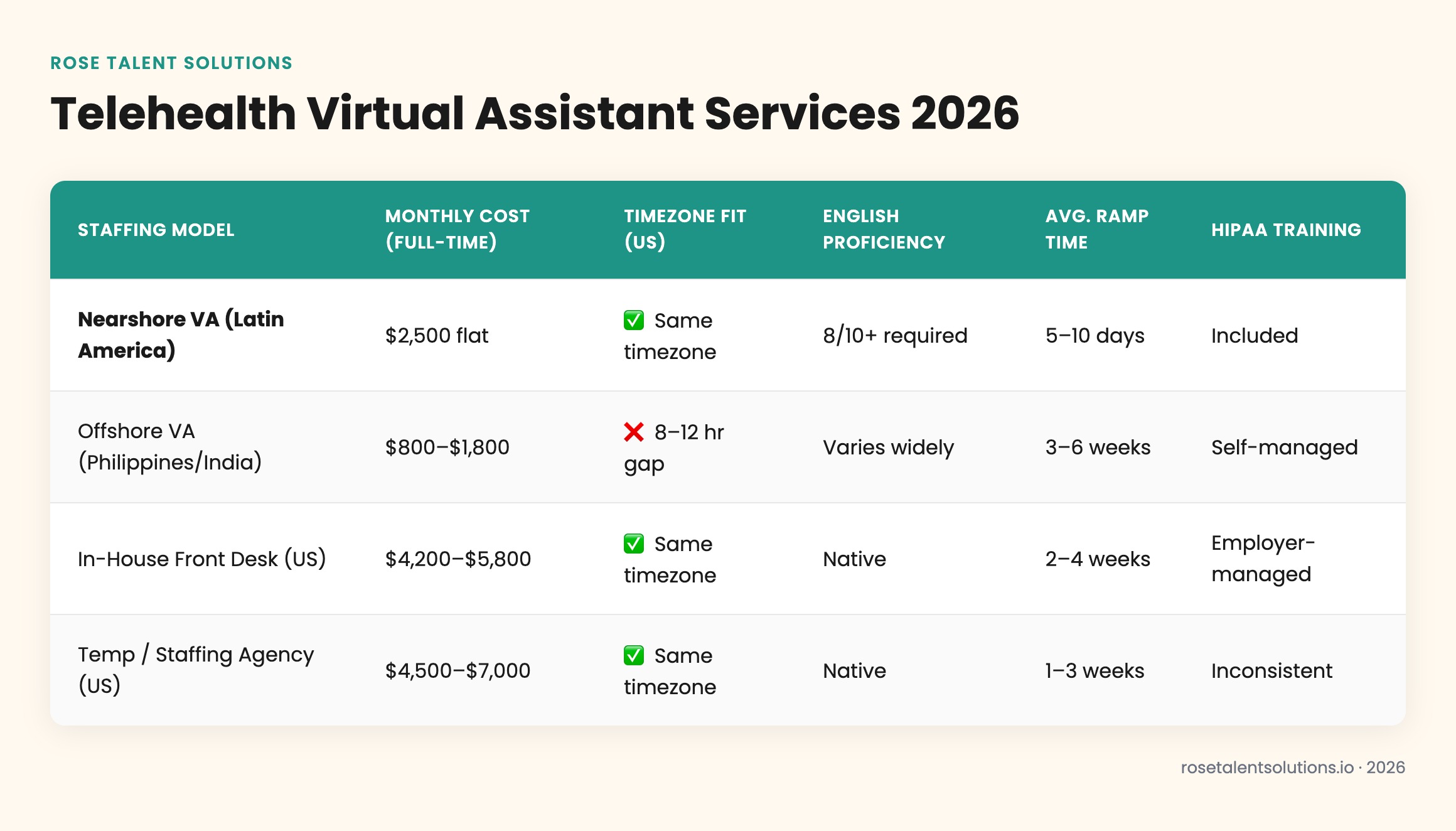
| Staffing Model | Monthly Cost (Full-Time) | Timezone Fit (US) | English Proficiency | Avg. Ramp Time | HIPAA Training |
|---|---|---|---|---|---|
| Nearshore VA (Latin America) | $2,500 flat | ✅ Same timezone | 8/10+ required | 5–10 days | Included |
| Offshore VA (Philippines/India) | $800–$1,800 | ❌ 8–12 hr gap | Varies widely | 3–6 weeks | Self-managed |
| In-House Front Desk (US) | $4,200–$5,800 | ✅ Same timezone | Native | 2–4 weeks | Employer-managed |
| Temp / Staffing Agency (US) | $4,500–$7,000 | ✅ Same timezone | Native | 1–3 weeks | Inconsistent |
What Tasks Should Your 2026 Telehealth VA Own?
The most effective telehealth VAs own an end-to-end administrative lane rather than picking up one-off tasks. Here's how that typically breaks down across a virtual practice:
- Patient scheduling and rescheduling — managing the calendar inside your EHR or scheduling tool (SimplePractice, Acuity, Healthie, etc.)
- Insurance verification and eligibility checks — confirming coverage before each visit so your billing team isn't chasing denials
- Intake form follow-up — ensuring patients complete forms before their appointment, reducing no-shows and session delays
- Prior authorization coordination — tracking PA requests, submitting documentation, and following up with payers
- Patient portal management — responding to messages, uploading documents, and routing clinical questions to the appropriate provider
- Appointment reminders and follow-up — automated and manual outreach via phone, text, or email per your protocol
- Referral coordination — sending records, confirming specialist appointments, and closing the loop with referring providers
Practices with a higher claims volume often pair a telehealth VA with a dedicated billing specialist. If that's your situation, our breakdown of what an insurance verification virtual assistant handles day-to-day explains how to split those responsibilities cleanly so nothing falls through the cracks.
"Remote patient interaction is now table stakes — the practices winning in 2026 are the ones that built the administrative infrastructure to support it." — Shawn Martin, Senior Vice President at the American Academy of Family Physicians (2023)
Insurance verification is the single highest-leverage task you can delegate to a telehealth VA. One denied claim from an unchecked eligibility issue can wipe out an entire week of VA cost — catching it upstream is pure margin recovery.
How Rose's AI Advantage Makes Telehealth VAs Faster in 2026
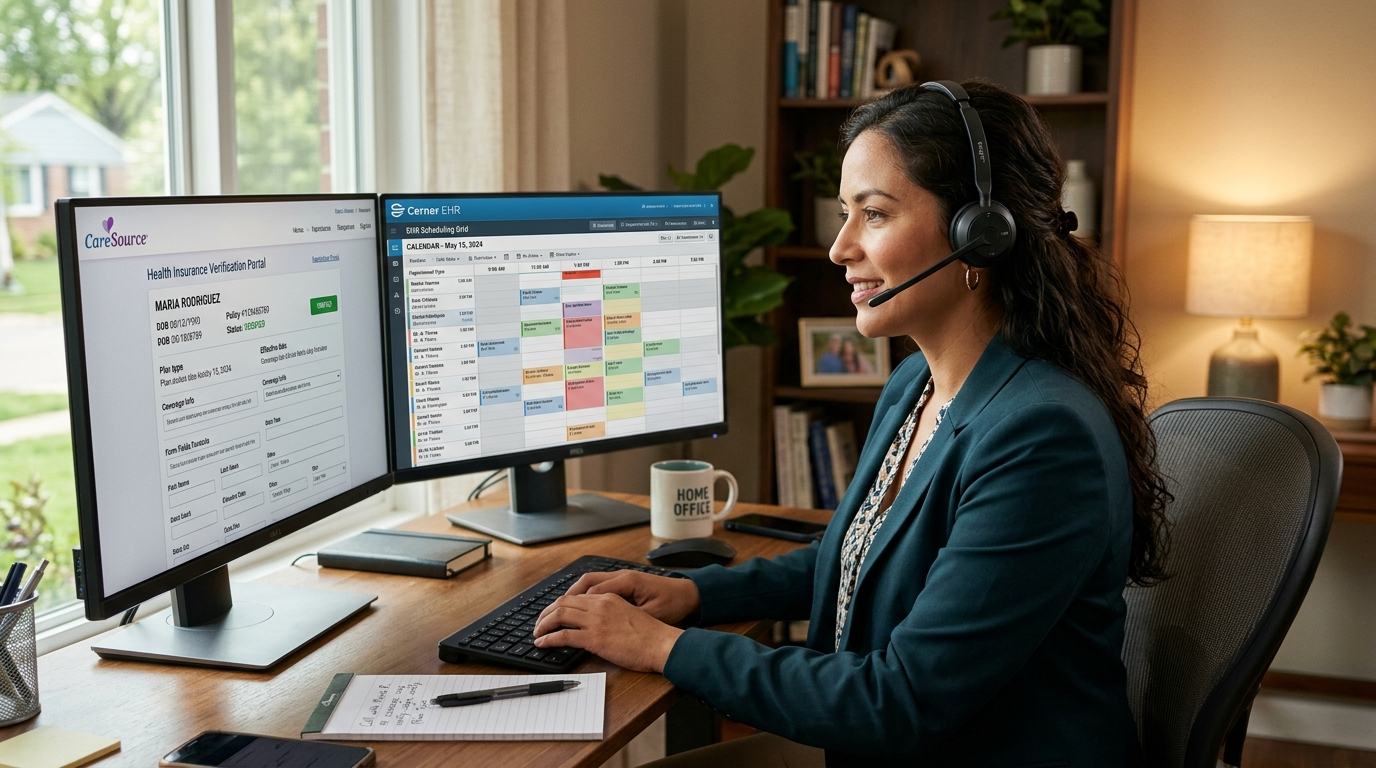
Every Rose team member ships with a role-specific AI copilot trained on the software they'll actually use. For a telehealth VA, that means custom AI tooling built around your EHR, your payer mix, and your intake workflows — not a generic chatbot. According to McKinsey's State of AI report (2024), AI-assisted administrative workers complete structured tasks 35–40% faster than unassisted peers. For a role defined by volume and repetition, that gap compounds quickly.
What this looks like in practice: your VA uses AI-assisted templates for prior auth documentation, auto-suggested responses for portal messages, and smart scheduling logic that fills gaps in your calendar based on provider availability rules you've already set. The Rose AI Advantage framework is built into the placement — you don't need to build the tooling yourself.
Telehealth isn't the only healthcare vertical where this AI-assisted model creates a measurable operational edge. Similar gains apply in adjacent practices — if you run a multi-provider group that includes chiropractic care, the specifics of how a chiropractic office virtual assistant operates within the same model are worth reviewing.
The labor market data supports the urgency here. The US Bureau of Labor Statistics (2024) projects 10% growth in medical administrative assistant roles through 2032 — a field already under significant hiring pressure. Practices competing for the same thin local labor pool are going to lose that competition repeatedly. Nearshore VAs sidestep the competition entirely.
How Rose Places a Telehealth VA: The 2026 Onboarding Process
The most common concern practice owners have is time-to-productivity. A VA who needs six weeks of ramp time before they can own the scheduling queue independently isn't solving an urgent problem. Rose's placement and onboarding process is structured to compress that timeline.
Discovery Call
Rose scopes your specific administrative workflows, EHR platform, payer mix, and volume expectations. This call takes 30–45 minutes and drives the candidate brief.
Candidate Matching
Rose surfaces 1–3 pre-vetted candidates with verified telehealth admin experience and platform familiarity. You review profiles and select who to interview — typically within 5–7 business days.
Interview & Selection
You conduct a live interview. Rose handles the offer, payroll setup, and HIPAA training coordination. No paperwork lands on your desk.
AI Copilot Activation
Your VA's role-specific AI tooling is configured for your EHR and workflows before their first day, so they arrive ready to work — not waiting on system access.
First Week Live
Your VA starts handling real tasks under a structured ramp: shadow first, then co-manage, then own. Rose checks in at day 3 and day 7 to catch any fit issues early.
If you also need front-office support for an in-person complement to your telehealth practice — say, a dental or multi-specialty group — the same model applies. Our post on dental office virtual assistant services walks through how the placement works for a different clinical context.
Ready to see the full service menu? Start your search for a telehealth VA here — the intake form takes under five minutes.
Is a Telehealth VA Right for Your Practice? Pros and Cons
Not every practice is at the right stage for a full-time virtual admin. Here's an honest look at where the model excels and where it requires more setup investment.
Where It Works Best
- Practices with 150+ patient visits/month who need consistent front-desk coverage
- Solo or small-group providers drowning in admin between clinical sessions
- Multi-state telehealth groups that need coverage across time zones
- Practices using major EHR platforms (SimplePractice, Athenahealth, Kareo, Healthie)
- Operators who want to reduce dependency on local job market hiring
Where You'll Need More Prep
- Practices with no documented SOPs — the VA can help build them, but you need to invest time upfront
- Providers who need a clinical coordinator (MAs, RNs) rather than an admin specialist
- Practices on highly proprietary or legacy EHR platforms with minimal training resources
The honest bottom line: if your providers are spending more than 90 minutes per day on administrative tasks that don't require a clinical license, a telehealth VA will pay for itself within the first month. According to SHRM's benchmarking data (2024), the average cost to hire a single in-house admin employee in the US is $4,683 — and that's before salary, benefits, or training. The $2,500 flat rate looks very different in that context.
For practices looking to build out a full virtual administrative team — combining a telehealth VA with a bookkeeping or billing specialist — the Rose bookkeeping and accounting staffing page shows how those roles are structured and priced.