
Nearshore Shopify VAs — based in Latin America, working US business hours — are quietly becoming the secret weapon of fast-growing US e-commerce brands in 2026. While some hiring guides still default to generic offshore recommendations, operators who've actually scaled a Shopify store know that a 10-hour timezone gap kills momentum. Real-time responsiveness is worth more than a slightly lower hourly rate, and a Latin America-based Shopify VA delivers exactly that: full schedule overlap, fluent English, and a fraction of the cost of a US hire.
This guide covers everything you need to know: what a Shopify VA actually does, how to compare your hiring options, what questions to ask before you sign anything, and what a fair 2026 price looks like. If you already know you want to move fast, you can start the hiring process here — but read this first so you know exactly what you're buying.
What Is a Shopify VA — and What Do They Actually Do in 2026?
A Shopify VA (virtual assistant) is a remote team member trained specifically to manage the operational and administrative functions of a Shopify store. This is not a general admin who happens to have a Shopify login. A skilled Shopify VA understands the platform's backend — products, collections, discount codes, apps, fulfillment workflows, and customer-facing pages — and can operate it independently without hand-holding.
The role typically covers a wide range of repeatable, high-frequency tasks that eat founders' time every single day. According to Shopify's Future of Commerce research (2024), order management and customer communication together account for over 60% of the daily workload for stores doing $1M–$5M in annual revenue. That's the exact workload a trained VA absorbs.
Common Shopify VA tasks include:
- Order processing, tracking updates, and fulfillment coordination
- Customer service via email, chat, and social DMs
- Product listing creation and optimization (titles, descriptions, images, tags)
- Inventory monitoring and reorder alerts
- Returns and refund processing
- App management (reviews, loyalty programs, upsell tools)
- Basic Shopify analytics reporting
- Supplier and vendor communication
If your store also runs on Amazon, the parallel is exact — the same logic that makes a dedicated Amazon Seller Central virtual assistant valuable applies here. Platform-specific training beats generalist support every time.

How Nearshore Compares to Offshore and Onshore Shopify VAs in 2026
Not all virtual assistants are created equal — and the geography matters more than most hiring guides admit. The three main options for Shopify store owners are nearshore (Latin America), offshore (various lower-cost regions outside the Americas), and onshore (US-based). Each has a different cost profile, availability window, and communication overhead. Here's an honest breakdown.
| Factor | Nearshore VA (Latin America) | Offshore VA (Non-Americas) | Onshore VA (US-Based) |
|---|---|---|---|
| Monthly Cost (Full-Time) | ~$2,500 flat | $1,200–$2,000 | $4,500–$7,000+ |
| US Business Hours Overlap | Full overlap (same time zones) | Partial (6–10 hr gap) | Full overlap |
| English Proficiency | High (Rose requires 8/10+) | Moderate–High (varies) | Native |
| Cultural Alignment with US | Strong | Moderate | Native |
| Ramp Time to Productivity | Fast (AI copilot included) | Moderate | Fast (but expensive) |
| Contract Flexibility | Month-to-month | Varies | Often annual |
| Payroll / HR Overhead | Included (managed service) | DIY or agency fee | DIY (W-2 cost + benefits) |
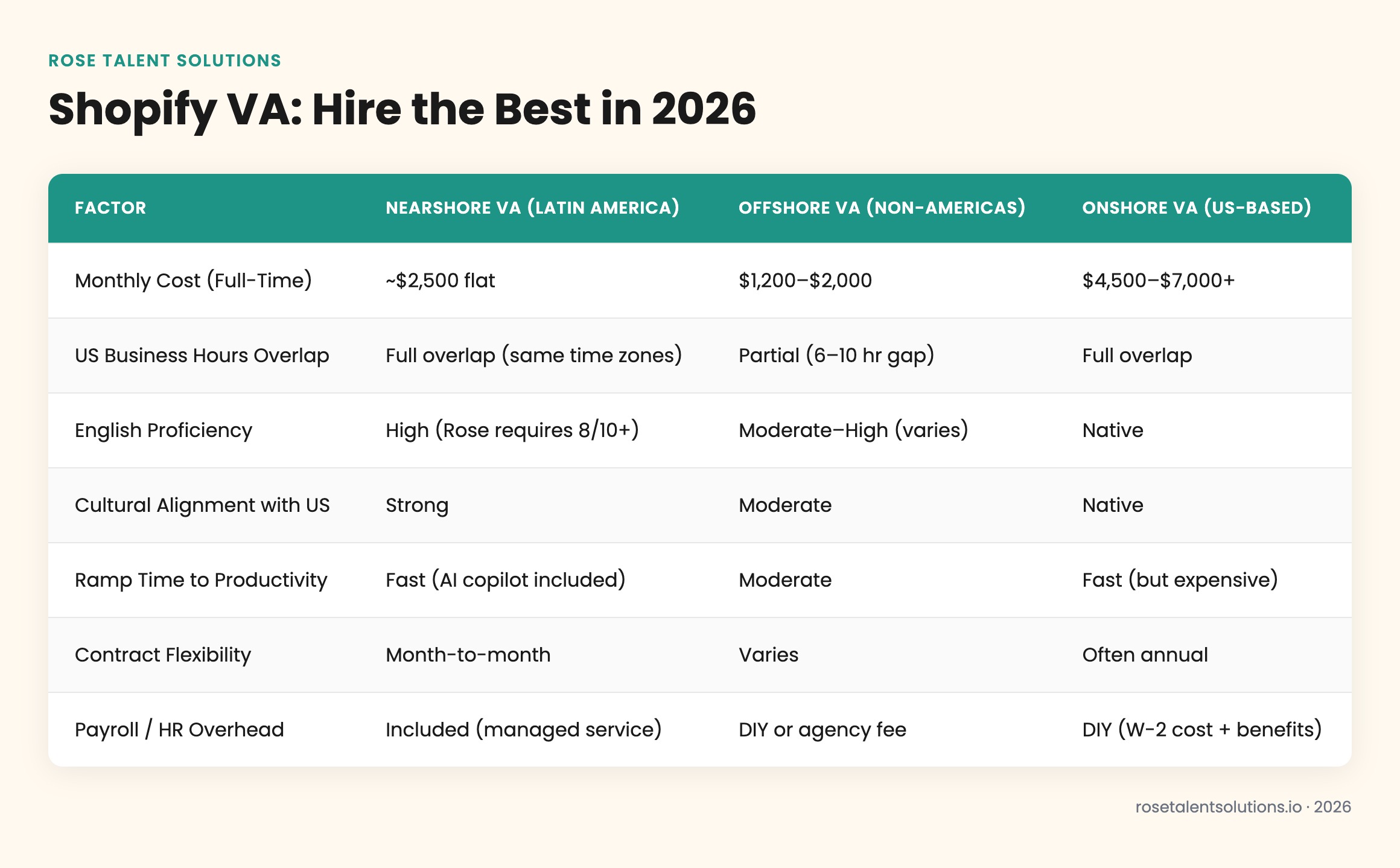
The offshore cost advantage looks compelling on paper. But according to Gallup's State of the American Workplace (2023), the productivity cost of miscommunication and delayed response cycles averages 20–40% of a remote worker's effective output — a tax that hits hardest when time zones don't align. For a Shopify store fielding live customer tickets and real-time fulfillment issues, that's an expensive gap.
What Does a Shopify VA Cost in 2026 — and What Should You Expect for That Price?
Pricing for Shopify VAs in 2026 ranges widely depending on hiring model, geography, and what's included. Freelance platforms like Upwork list Shopify VAs at $8–$25/hour, which sounds cheap until you factor in recruitment time, vetting risk, payroll complexity, and zero replacement coverage if the hire doesn't work out. At 40 hours/week, a $15/hr freelancer already costs $2,400/month — before any overhead.
Managed agency models like Rose Talent Solutions price at $2,500/month flat for a dedicated full-time (40 hrs/week) Shopify VA. That rate is all-in: recruiting, vetting, onboarding, payroll, HR, and ongoing management are included. There's no long-term contract — month-to-month terms with 30 days written notice. And if the team member isn't a fit, Rose replaces them at no additional cost.
According to the U.S. Bureau of Labor Statistics (2024), the fully-loaded cost of a US-based e-commerce coordinator (salary + benefits + payroll taxes) runs $58,000–$72,000 per year — that's $4,800–$6,000/month before a single overhead line item. At $2,500/month flat, a nearshore Shopify VA delivers comparable output at roughly 40–50 cents on the dollar.
The real comparison isn't "VA vs. no VA" — it's "VA vs. the hidden cost of doing it yourself." Founders who handle their own order management, customer tickets, and product uploads are trading $200+/hour decisions for $15/hour tasks. That math never works in your favor.
E-commerce staffing decisions also have ripple effects across your entire channel mix. If you're also selling on Amazon, a dedicated Amazon product research virtual assistant can run parallel to your Shopify VA — each platform-trained, each focused, neither generalist. That specialization is what separates operators doing $500K/year from those doing $5M.

How the AI Copilot Advantage Makes a 2026 Shopify VA Faster Than Any Previous Hire
One of the biggest ramp-time killers with any new VA hire is platform learning curve. Even an experienced e-commerce assistant takes 2–4 weeks to get comfortable inside a new Shopify store's specific setup — apps, automation rules, custom fulfillment workflows, and naming conventions all vary by merchant. In 2026, that lag is compressed significantly by AI.
Every Rose Talent Solutions team member ships with a role-specific AI copilot trained on their assigned software stack. For a Shopify VA, that means the AI is pre-loaded with Shopify admin workflows, common app integrations (Klaviyo, ReCharge, Gorgias, Yotpo), order management SOPs, and customer communication templates. The VA uses the copilot to surface answers, draft responses, and flag edge cases — without needing to interrupt you.
According to McKinsey's report on Generative AI's economic potential (2023), AI-assisted workers complete customer service and data entry tasks 30–40% faster than unassisted counterparts. For a Shopify VA handling 50+ customer tickets and 20+ order updates per day, that speed multiplier is material.
This AI advantage also extends naturally into adjacent e-commerce functions. If you need a VA managing your paid traffic as well, a trained PPC virtual assistant operates with the same copilot model — platform-specific, faster to ramp, and accountable to data rather than guesswork.
"AI-augmented virtual assistants aren't just faster — they're more consistent. The copilot enforces the SOP every single time, which means fewer errors and less re-work for the business owner." — Liam Martin, Co-Founder at Time Doctor (2024)
The AI copilot advantage isn't a feature you pay extra for at Rose — it's baked into the $2,500/month flat rate. Every Shopify VA placement comes with it by default.
How to Hire a Shopify VA Through Rose Talent Solutions in 2026
The hiring process at Rose is built for operators who don't have time to interview 30 candidates or build a vetting rubric from scratch. The entire sequence from intake to first day runs in under two weeks for most placements.
Intake Call
You spend 30 minutes with a Rose placement specialist walking through your Shopify store's specific needs — task volume, apps used, customer communication style, and any platform quirks. This is where your VA profile gets built.
Candidate Matching
Rose sources from a pre-vetted Latin America talent pool — every candidate has passed English proficiency screening (8/10+ required), a platform skills assessment, and a background check. You receive 1–3 matched candidates, not a stack of 40 resumes.
Interview & Selection
You interview your top match (or matches) directly. Rose facilitates scheduling and provides a structured interview guide so you're evaluating the right things — not just vibes.
Onboarding & AI Copilot Setup
Rose handles payroll, HR paperwork, and AI copilot configuration for your store's specific stack. Your VA's first day is productive — not a setup scramble.
Ongoing Management
Rose manages HR, payroll, and performance oversight on an ongoing basis. You manage the work; Rose manages the employment. If the VA isn't a fit at any point, Rose replaces them at no additional cost.
Ready to start? The intake form takes under five minutes: get matched with a Shopify VA here.
Nearshore vs. Other Shopify VA Models: Pros and Cons in 2026
The nearshore vs. non-nearshore debate comes down to three variables: cost delta, communication quality, and availability. Here's an honest look at both sides so you can make the call that fits your store's stage and complexity.
Nearshore (Latin America) Pros
- Full US business hours overlap — no overnight ticket queues
- Strong English fluency (Rose requires 8/10+ proficiency)
- High cultural alignment with US customer expectations
- Month-to-month terms — no long-term contract lock-in
- AI copilot included — faster ramp, fewer errors
- Free replacement if not a fit — zero additional cost risk
Remote-Only Offshore Model Cons
- 6–12 hour timezone gap creates response delays on live issues
- English fluency varies significantly by candidate and region
- Often requires DIY payroll and HR management
- No standard replacement guarantee on most platforms
- Lower base cost, but higher coordination overhead
- Ramp time longer without platform-specific AI tooling
According to SHRM's Human Capital Benchmarking Report (2023), the average cost of replacing a failed hire is 50–200% of that role's annual salary. For a $2,500/month VA that doesn't work out, the replacement cost at the high end could exceed $6,000 in lost productivity, re-recruiting, and retraining time. A built-in replacement guarantee eliminates that exposure entirely.
If your store also manages high-volume customer communication across channels — not just Shopify but Amazon too — consider pairing your Shopify VA with a dedicated Amazon customer service virtual assistant who handles the marketplace side of your operation. The same nearshore model applies across both channels, giving you real-time coverage without channel confusion.
For a broader look at how Rose structures support across business functions and verticals, the property management staffing page is a useful reference for seeing how the managed-service model scales — the pricing structure and replacement guarantee are consistent across all placements.