
Why This Pilot Bookkeeping vs Bench Accounting Comparison Matters in 2026
Nearshore bookkeeping has quietly become the most cost-effective alternative to software-first services like Pilot and Bench — and more business owners are doing the math. If you've been comparing Pilot bookkeeping vs Bench accounting, you're likely asking a deeper question: am I getting a real person who understands my business, or a dashboard that auto-categorizes transactions and calls it done? This guide breaks down both services honestly, then shows you where a dedicated nearshore bookkeeper fits into that picture.
Pilot and Bench both launched on a compelling premise — use technology to make bookkeeping cheaper and faster for small businesses. Both have loyal users. But in 2026, the cracks in the software-only model are showing: category errors, delayed human support, and pricing that climbs fast as your transaction volume grows. According to SHRM's Workforce Research (2024), businesses that rely on automated-only financial processes report significantly higher error correction time than those with a dedicated human bookkeeper in the loop.
Understanding where Pilot and Bench each excel — and where they fall short — is the starting point. But if you want a fuller picture of the three-way cost and quality comparison, our breakdown of Bench vs Pilot vs nearshore bookkeeper cost and quality runs the numbers side by side.
What Is Pilot Bookkeeping and How Does It Work in 2026?
Pilot is a US-based bookkeeping service founded in 2017 and headquartered in San Francisco. It uses a combination of proprietary software and US-based human bookkeepers to deliver monthly financial statements — primarily targeting venture-backed startups and high-growth tech companies. Pilot integrates directly with QuickBooks Online and syncs with bank feeds to automate the categorization layer, while a dedicated bookkeeper reviews the output monthly.
Pilot's pricing starts at $499/month for the Core plan (up to $30K in monthly expenses), scaling to $849/month for the Select tier and custom enterprise pricing beyond that. Add-ons like tax filing and CFO advisory services push the total cost significantly higher for growing companies. According to the U.S. Bureau of Labor Statistics (2024), the average US bookkeeper earns $47,440 per year — Pilot's pricing reflects that labor cost baked into a managed service margin.
The core Pilot value proposition is accuracy backed by human review — but that human is shared across many clients, not dedicated to yours. Response time on ad hoc questions is typically measured in business days, not hours. Pilot does offer its own onboarding flow, and new customers pay from month one with no trial period advertised on their standard plans.
What Is Bench Accounting and How Does It Work in 2026?
Bench is a Canadian-founded bookkeeping platform that pairs its proprietary software with a team of in-house bookkeepers. It targets small US businesses across industries — retail, e-commerce, restaurants, freelancers — that want clean monthly books without hiring a full-time employee. Bench uses its own accounting software (not QuickBooks or Xero), which is a meaningful limitation for businesses that need to hand off books to a CPA or migrate to another platform later.
Bench pricing starts at $299/month (Essential) for straightforward books and rises to $499/month (Premium), which includes tax advisory. Like Pilot, Bench scales pricing based on monthly expenses, and businesses with higher volume face substantially higher invoices. The Bench model suffered a notable disruption in late 2024 when the company briefly shut down before being acquired — a reminder that SaaS-dependent bookkeeping carries platform risk that a human team member does not. Bench advertises a 30-day trial on its own platform for new sign-ups; that promotion belongs to Bench and is separate from anything Rose Talent offers.
"The biggest hidden cost of automated bookkeeping platforms isn't the subscription fee — it's the time your CFO or founder spends correcting miscategorizations and waiting on async support queues instead of making decisions." — Ryan Lazanis, Founder at Future Firm & CPA (2024)
For a direct feature-by-feature breakdown of these two platforms alone, see our post on the Bench vs Pilot accounting comparison, which covers software, integrations, and support in detail.
How Pilot vs Bench Stack Up: 2026 Feature Comparison Table
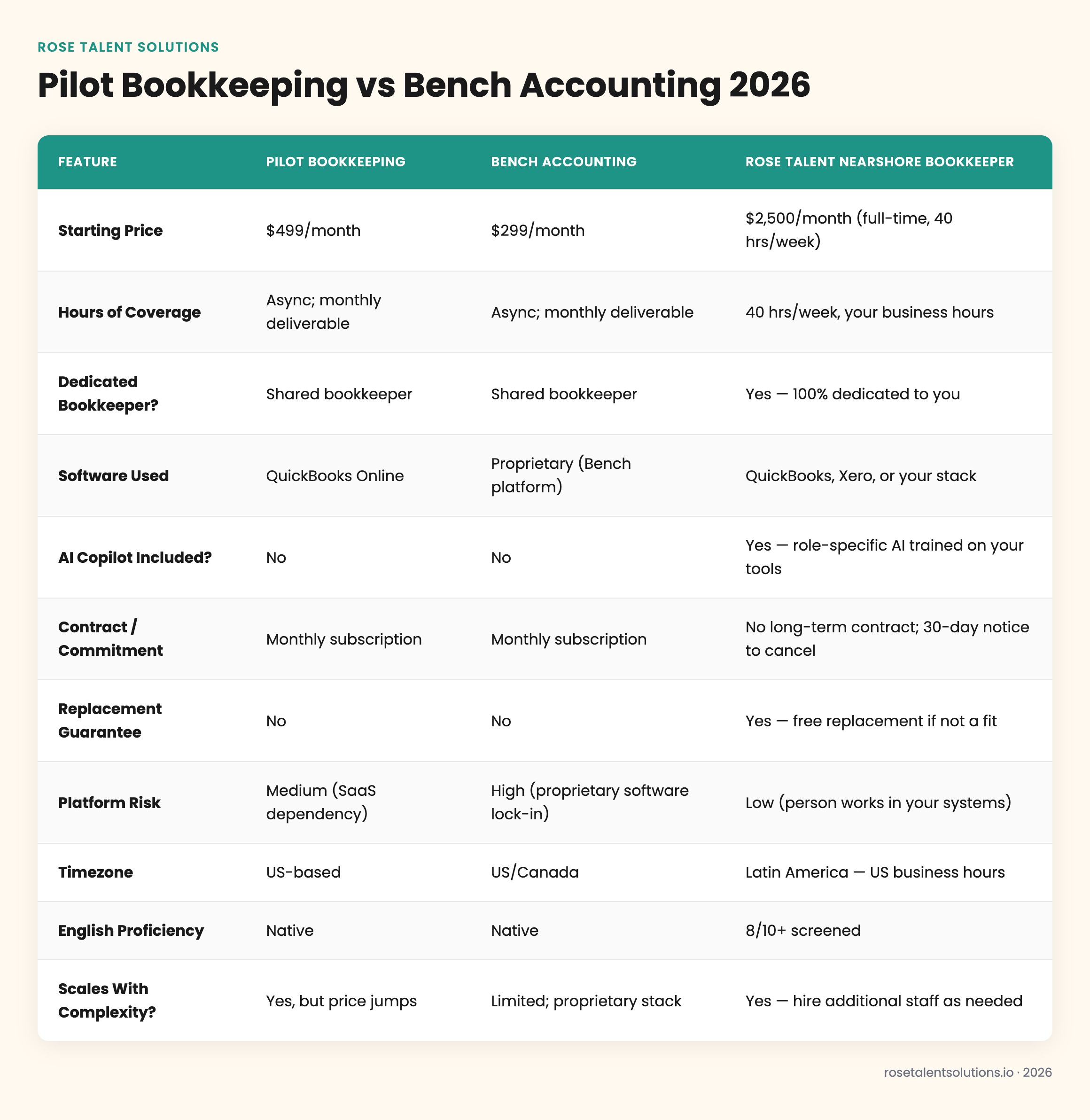
The table below compares Pilot, Bench, and a Rose Talent nearshore bookkeeper across the dimensions that matter most to business owners: pricing, software, human access, flexibility, and risk. Use this to orient your decision before diving into the deeper sections below.

| Feature | Pilot Bookkeeping | Bench Accounting | Rose Talent Nearshore Bookkeeper |
|---|---|---|---|
| Starting Price | $499/month | $299/month | $2,500/month (full-time, 40 hrs/week) |
| Hours of Coverage | Async; monthly deliverable | Async; monthly deliverable | 40 hrs/week, your business hours |
| Dedicated Bookkeeper? | Shared bookkeeper | Shared bookkeeper | Yes — 100% dedicated to you |
| Software Used | QuickBooks Online | Proprietary (Bench platform) | QuickBooks, Xero, or your stack |
| AI Copilot Included? | No | No | Yes — role-specific AI trained on your tools |
| Contract / Commitment | Monthly subscription | Monthly subscription | No long-term contract; 30-day notice to cancel |
| Replacement Guarantee | No | No | Yes — free replacement if not a fit |
| Platform Risk | Medium (SaaS dependency) | High (proprietary software lock-in) | Low (person works in your systems) |
| Timezone | US-based | US/Canada | Latin America — US business hours |
| English Proficiency | Native | Native | 8/10+ screened |
| Scales With Complexity? | Yes, but price jumps | Limited; proprietary stack | Yes — hire additional staff as needed |
How Pricing Actually Compares Once Your Books Get Complex
The sticker price of Pilot and Bench looks attractive until your transaction volume climbs. Both services tier their pricing by monthly expenses — and the jumps are steep. A business processing $150K/month in expenses will pay Pilot upwards of $849/month just for the Core bookkeeping layer. Add tax filing ($1,200–$2,500/year), CFO advisory ($600–$2,000/month), and ad hoc catch-up fees, and a mid-market business can easily spend $18,000–$30,000 annually on Pilot's full stack.
Bench's proprietary software creates a different problem: data portability. When you eventually move to a CPA or migrate to QuickBooks or Xero, you're exporting from a closed system — a process that can require weeks of reformatting work. According to Intuit QuickBooks (2024), 64% of small businesses that switch accounting platforms report unexpected data migration costs averaging $1,200 per migration event.
A Rose Talent nearshore bookkeeper costs $2,500/month flat — full-time, 40 hours a week, working inside your existing software stack. That's a predictable cost that doesn't scale with transaction volume, doesn't add line items for tax season, and doesn't charge you for a question asked on a Thursday afternoon. Our deeper guide on which is better between Bench and Pilot walks through the cost scenarios in granular detail if you want to run the numbers for your specific business size.
How a Nearshore Bookkeeper Outperforms Both Platforms in 2026
Pilot and Bench are products. A nearshore bookkeeper is a person — one who works your hours, learns your business, and can be reached on Slack, Zoom, or email in real time. That distinction sounds simple, but it changes everything about how financial information flows through your organization.
According to Gallup's State of the American Workplace (2023), teams with a dedicated point of contact for operational functions resolve issues 37% faster than those relying on shared-service queues. A bookkeeper who knows your vendors, your chart of accounts, and your recurring journal entries doesn't need to be briefed every time a question arises — she already knows the answer.
The real cost of Pilot and Bench isn't the monthly subscription — it's the founder or CFO hours spent waiting on async support, correcting auto-categorization errors, and re-exporting data every tax season. A dedicated nearshore bookkeeper eliminates that friction entirely.
Every Rose Talent bookkeeper also ships with a role-specific AI copilot trained on their software — whether that's QuickBooks Online, Xero, or a niche accounting tool specific to your industry. This isn't a generic AI assistant; it's a tool calibrated to the exact workflows your bookkeeper runs daily. The result is faster reconciliation, fewer errors, and a team member who keeps getting better at your specific books month over month.
If you're already leaning toward Xero as your accounting platform, our guide on hiring a Xero virtual bookkeeper covers how to find, vet, and onboard someone who's already expert in that environment.

What Does Getting Started with a Nearshore Bookkeeper Look Like?
One of the most common objections to switching from a platform like Pilot or Bench is the perceived hassle of onboarding a new person. In reality, the Rose Talent process is structured to get your bookkeeper productive fast — typically within the first week of engagement.
Discovery Call
You describe your books, software stack, volume, and pain points. Rose matches you with bookkeepers who have direct experience in your tools and industry vertical.
Candidate Review
Rose presents 2–3 pre-vetted candidates within days. You review their profiles, software certifications, and English proficiency scores before committing.
Kickoff & Access
Your bookkeeper gets access to your accounting software, reviews existing books, and establishes your preferred communication cadence — Slack, email, or video standup.
First Month in Your Books
Your bookkeeper reconciles the current period, flags any categorization issues from prior months, and begins building familiarity with your vendors and recurring transactions.
Ongoing Relationship
Month two and beyond, your bookkeeper is a functional team member — proactively flagging anomalies, prepping for tax season, and supporting financial decision-making with clean data.
If the placement isn't right, Rose replaces your bookkeeper at no additional cost. There's no long-term contract, and you can cancel with 30 days' written notice. Getting started takes a single conversation.
Pilot vs Bench vs Nearshore: Which Is Right for Your Business in 2026?
The honest answer depends on where you are as a business. Pilot is a reasonable fit if you're a seed-stage startup with a simple cap table, clean revenue streams, and a CFO who just wants tidy monthly statements without managing a person. Bench makes sense for a solo operator or very small retail business that has genuinely simple books and doesn't need real-time answers.
But if you're a growing business — one with multiple revenue streams, payroll complexity, multiple entities, or a need for someone who can actually join a Monday morning call — a dedicated nearshore bookkeeper is the better investment. According to McKinsey's State of AI (2024), finance functions that pair skilled human operators with AI-assisted tools outperform fully automated workflows on accuracy and cycle time.
Pilot / Bench: Best For
- Businesses with very simple, low-volume books
- Founders who want zero people management
- Early-stage startups on tight variable budgets
- One-person operations with clean revenue
Nearshore Bookkeeper: Best For
- Businesses spending $500+/month on Pilot or Bench already
- Companies needing real-time answers and daily coverage
- Growing teams with complex or multi-entity books
- Operators who want a bookkeeper embedded in their workflow
At $2,500/month all-in, a Rose Talent nearshore bookkeeper is already cost-competitive with Pilot's mid-tier plans the moment you add tax prep or advisory services. And unlike a platform, your bookkeeper doesn't go on pause when your subscription lapses — she's part of your team.