
Nearshore outsourced legal intake specialists are quietly replacing in-house intake coordinators at small and mid-size law firms across the US — and the numbers make it hard to argue against. When a firm pays $55,000–$65,000 per year in salary alone for one in-house intake coordinator (before benefits, payroll taxes, and PTO), and a nearshore specialist delivers the same coverage at a flat $2,500 per month, the math becomes uncomfortable to ignore. This guide breaks down exactly what an outsourced legal intake specialist does, where to find the best ones, what they cost in 2026, and what separates a high-converting intake operation from a leaky one.
What Is an Outsourced Legal Intake Specialist?
An outsourced legal intake specialist is a trained legal-admin professional who manages the first contact between a prospective client and your firm — typically answering inbound calls, qualifying leads against your case criteria, conducting conflict-of-interest checks, collecting retainer agreements, and entering all data into your practice management system. They are not paralegals and they do not provide legal advice. Their job is to convert a warm lead into a signed client before that lead calls your competitor.
The "outsourced" part simply means this person works remotely and is sourced through a staffing partner rather than hired directly on your W-2. Nearshore outsourcing specifically refers to staffing from Latin American countries — Colombia, Mexico, Argentina, Costa Rica — where workers share or closely overlap with US time zones, making real-time collaboration seamless. This is meaningfully different from offshore outsourcing to the Philippines or India, where a 10–13 hour time gap makes synchronous intake work structurally difficult.
Speed-to-answer is the single most important variable in legal intake. According to the Clio Legal Trends Report (2023), 42% of legal consumers hire the first firm that responds. A missed call at 9:15 a.m. isn't a minor inconvenience — it's a lost client. That's the core reason law firms are moving intake off the attorney's desk and off the paralegal's already-overloaded plate.
How Much Does an Outsourced Legal Intake Specialist Cost in 2026?
Cost is the question every managing partner asks first, so let's answer it directly. Hiring a full-time in-house intake coordinator in a mid-tier US market runs $48,000–$68,000 in base salary, according to the U.S. Bureau of Labor Statistics (2024). Add 20–30% for benefits, employer payroll taxes, and workers' comp, and the total employer cost lands between $58,000 and $88,000 annually — or roughly $4,800–$7,300 per month.
At Rose Talent Solutions, the flat rate is $2,500 per month — full-time, 40 hours per week. That price includes recruiting, vetting, payroll, HR administration, and ongoing management. There are no hidden per-hour overages, no benefits cliff, and no long-term contract. If the placement isn't the right fit, Rose replaces them at no additional cost. For firms comparing options, this structure eliminates most of the hidden cost variables that make offshore staffing unpredictable.
If you're also evaluating broader support roles for your firm, the comparison in our law firm virtual assistant vs. in-house staff breakdown gives you a full cost model including turnover costs and training time — numbers that shift the comparison even further toward outsourcing.

Nearshore vs. Offshore vs. In-House: How Do They Actually Compare in 2026?
The staffing market uses "outsourced" and "offshore" interchangeably, but they are not the same thing. For legal intake specifically, the differences are operationally significant. A lead who calls at 10 a.m. Eastern needs someone on the phone within minutes — not someone processing a voicemail transcript at 11 p.m. in Manila.
| Factor | In-House (US) | Offshore (Philippines/India) | Nearshore (Latin America) |
|---|---|---|---|
| Monthly employer cost | $4,800–$7,300 | $800–$1,400 | $2,500 (flat, all-in) |
| Timezone overlap with US hours | Full | Low (10–13 hr gap) | Full (0–2 hr gap) |
| English proficiency | Native | Variable (5–7/10 avg) | 8/10+ (screened floor) |
| Real-time phone intake | Yes | Rarely feasible | Yes |
| Ramp time | 4–8 weeks | 4–10 weeks | 1–2 weeks |
| Turnover risk | High (avg 1.5 yrs tenure) | High | Low (managed relationship) |
| Replacement if not a fit | Full rehire cost | Variable | Included at no added cost |
The timezone column in that table is the one most firms underestimate. Real-time intake is not a luxury for consumer-facing practice areas like personal injury, immigration, family law, or criminal defense. Clients in those areas are often in acute distress. They will call the next firm on their list if you send them to voicemail. Offshore teams working overnight shifts can handle some administrative tasks — but they structurally cannot do synchronous, empathetic phone intake during your peak hours.
What Does an Outsourced Legal Intake Specialist Actually Do Day-to-Day?
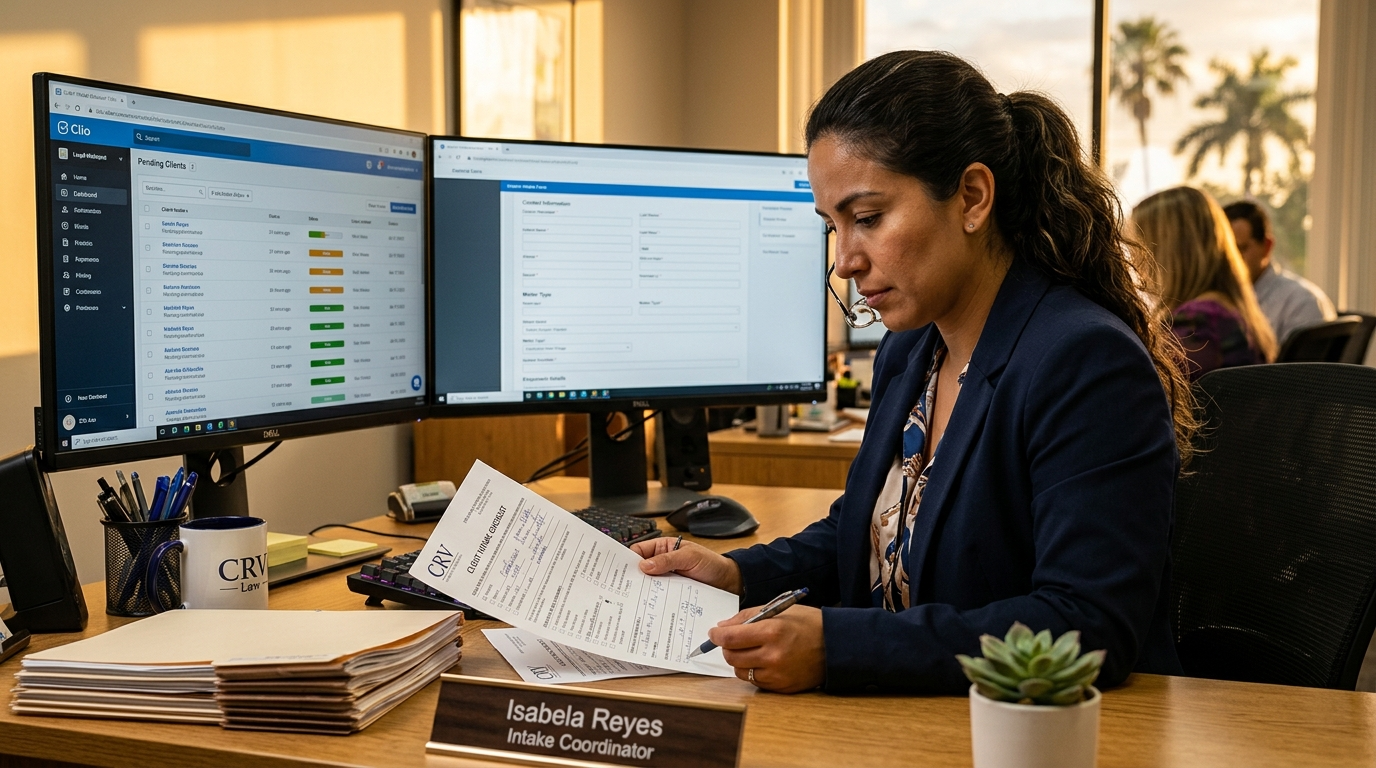
The scope of a legal intake specialist's daily work is broader than most attorneys expect when they first consider outsourcing it. This is not just a call-answering role. A trained specialist owns the entire top-of-funnel process from first contact through signed retainer or qualified rejection. That includes answering inbound calls within the first ring or two, walking prospective clients through your intake questionnaire, running basic conflict checks in your case management system, sending out and tracking engagement letters or retainer agreements via DocuSign or similar tools, and logging every touchpoint in your CRM.
Many firms also use their intake specialist to manage lead follow-up — calling back web form submissions, responding to chat inquiries, and re-engaging cold leads that went silent. According to SHRM (2024), the average cost of a bad hire is 50–60% of that employee's annual salary. In intake, a low-quality hire doesn't just cost money — they lose leads that become someone else's clients.
"The intake process is the most underleveraged revenue lever in a law firm. Most attorneys treat it as overhead. The ones who systematize it treat it as a sales function — and their conversion rates reflect that." — Joshua Lenon, Lawyer in Residence at Clio (2023)
Nearshore specialists through Rose also come equipped with a role-specific AI copilot — trained on the software your firm actually uses. Whether that's Clio, MyCase, PracticePanther, or Lawmatics, your intake specialist arrives already fluent in the platform rather than spending week two clicking through tutorials. You can read more about how that AI layer works on the Rose AI Advantage page.
The hidden cost of a slow or untrained intake function isn't the salary line — it's the signed retainers that never happened. A firm doing 30 inbound inquiries per week that converts at 25% instead of 40% is leaving 4–5 clients per week on the table. At even a $3,000 average case value, that's $12,000–$15,000 in lost weekly revenue that never appears in any report.
The scale of that missed revenue compounds quickly. Response time is the variable that drives it — and it's the one variable that nearshore specialists, working live during your office hours, can actually control. According to research published by Harvard Business Review (2011), companies that attempt to contact leads within one hour are nearly seven times more likely to qualify that lead than those that wait even 60 minutes longer. That finding has held across every subsequent replication in professional services — and legal intake is no exception.
How to Onboard an Outsourced Legal Intake Specialist in 2026
Onboarding a remote intake specialist is faster than most firms expect — especially when the staffing partner handles recruiting and initial vetting. A structured onboarding typically runs 5–10 business days from placement to live call-handling. Here's how that sequence works with Rose:
Intake Discovery Call
Rose's team documents your practice areas, case criteria, conflict-check process, and preferred software stack. This brief typically takes 45 minutes and drives the matching criteria.
Candidate Match (2–5 Days)
Rose surfaces 1–2 pre-vetted specialists with relevant legal-admin backgrounds. You interview and approve before anyone starts — you always have final say on who joins your team.
Platform Access & AI Copilot Setup
Your specialist is granted access to your case management system and paired with a role-specific AI copilot trained on your software. Most specialists are navigating your CRM independently by day two.
Shadow Period (Days 3–5)
The specialist listens to recorded calls, reviews your intake script, and handles low-stakes inbound under light supervision before going fully live.
Live Intake (Day 6+)
Your specialist is handling inbound calls, running qualification, and logging data independently. Rose's management layer stays in the background to handle any HR or performance issues without pulling you in.
For firms that also need support beyond intake — document drafting, calendar management, or court filing coordination — it's worth reviewing whether a broader virtual legal assistant for your law firm might make sense alongside or instead of a dedicated intake specialist. Some smaller practices combine both roles into one position; larger firms keep them separate.
Is an Outsourced Legal Intake Specialist Right for Your Firm? 2026 Pros and Cons
Outsourcing intake is not the right move for every firm at every stage. Solo practitioners with fewer than 10 inbound inquiries per week may find that a virtual receptionist for their law firm covers their needs at lower volume. Firms running 30+ inquiries per week and losing leads to voicemail are the clearest candidates for a dedicated outsourced specialist. Here's an honest look at both sides.
Pros of Outsourcing Intake
- 60–70% cost reduction vs. in-house salary + benefits
- Full US-hours coverage without overtime or PTO gaps
- Faster ramp time with software-trained specialists
- No recruiting, HR, or payroll burden on your team
- Month-to-month terms — no long-term contract
- Free replacement if the specialist isn't the right fit
- Scales easily across multiple practice groups
Cons to Consider
- Requires a documented intake script and process upfront
- Remote specialist cannot physically accept walk-in clients
- Initial trust-building period before full autonomy
- Not suitable for practices with highly classified matters requiring on-site presence
The cons are real but largely solvable with a structured onboarding document and a clear intake script — both of which your firm should have regardless of whether you outsource. According to a McKinsey & Company organizational effectiveness report (2023), firms with documented processes for customer-facing roles see 30% higher consistency in output quality compared to those relying on tribal knowledge. Intake is the last function where tribal knowledge should govern outcomes.
Turnover compounds the problem further. The Gallup Workplace Report (2019) estimates that voluntary employee turnover costs US businesses $1 trillion annually, with replacement costs running 50–200% of the departing employee's annual salary depending on role complexity. In-house intake coordinators turn over at roughly the same rate as any other administrative role — meaning the true annual cost of that position almost always exceeds its salary line when you account for the rehire cycle. A nearshore managed-staffing model transfers that risk entirely to the staffing partner.
For firms that also generate significant documentation volume — deposition summaries, hearing notes, or client correspondence — pairing intake support with a legal transcription virtual assistant creates a complete back-office operation that handles both the front door and the paper trail.
If you're ready to stop losing leads to voicemail and want to see what a matched specialist looks like for your firm, the starting point is a 20-minute scoping call. You can get started with Rose here — the process is fast, and you'll have a matched candidate to review within a week.