
Nearshore outsourced bookkeeping services have quietly become one of the highest-leverage moves a small or mid-sized US business can make in 2026. Instead of paying a local bookkeeper $55,000–$70,000 a year — plus benefits, payroll taxes, and PTO — you get a full-time, software-trained financial professional based in Latin America, working your hours, for a flat monthly rate. The timezone overlap is real. The English fluency is real. And the cost savings are dramatic enough to show up on your P&L within the first quarter.
This guide breaks down exactly what outsourced bookkeeping services include, how nearshore compares to offshore and onshore alternatives, what software your outsourced bookkeeper should already know, and how to vet a provider so you don't end up with a generalist who Googles QuickBooks shortcuts. If you're running a property management firm, an e-commerce brand, a construction company, or any business where cash flow visibility is non-negotiable, read this before you hire.
What Are Outsourced Bookkeeping Services — and What Do They Actually Cover?
Outsourced bookkeeping services refer to hiring an external professional or team to manage your business's day-to-day financial records — instead of keeping that function in-house. The scope typically includes accounts payable and receivable, bank reconciliations, monthly financial close, expense categorization, payroll support, and financial reporting. Some providers also handle tax-prep support and job costing, depending on your industry.
The term gets used loosely, so it's worth being precise. Bookkeeping is not accounting — a bookkeeper maintains the records; a CPA or controller interprets them for strategic decisions. A good outsourced bookkeeping service fills the operational layer: keeping your books clean, current, and audit-ready so your accountant (or CFO) has accurate data to work from. Many growing businesses outsource bookkeeping first, then layer in a fractional CFO once their revenue justifies it.
What's changed in 2026 is the software layer. The best outsourced bookkeeping providers don't just hire people who "know QuickBooks" — they deploy team members trained specifically on your software stack. If you're running a QuickBooks bookkeeping service, your outsourced hire should know bank feeds, rules automation, and class tracking cold — not just basic data entry. That depth is what separates a $12/hr generalist from a $2,500/month professional who actually moves your books forward.

How Nearshore Compares to Offshore and Onshore Bookkeeping in 2026
When most business owners Google "outsourced bookkeeping services," they're comparing three buckets: US-based firms, offshore providers (Philippines, India), and nearshore providers (Latin America). The price differences are real, but so are the operational differences. Here's how they stack up honestly.
| Factor | Onshore (US-Based) | Offshore (Philippines/India) | Nearshore (Latin America) |
|---|---|---|---|
| Monthly Cost (Full-Time) | $5,000–$8,500+ | $800–$1,800 | $2,500 flat |
| US Business Hours Coverage | Yes | Partial (6–10 hr gap) | Yes (same timezone band) |
| English Proficiency | Native | Variable (3–7/10) | High (8/10+ screened) |
| Software Fluency (QBO, Xero, etc.) | High | Variable | High (role-specific trained) |
| Turnover Risk | Low–Medium | High | Low (managed relationship) |
| Payroll/HR Overhead on You | High | Medium (compliance risk) | None (fully managed) |
| Contract Flexibility | Often annual | Variable | Month-to-month, 30-day notice |
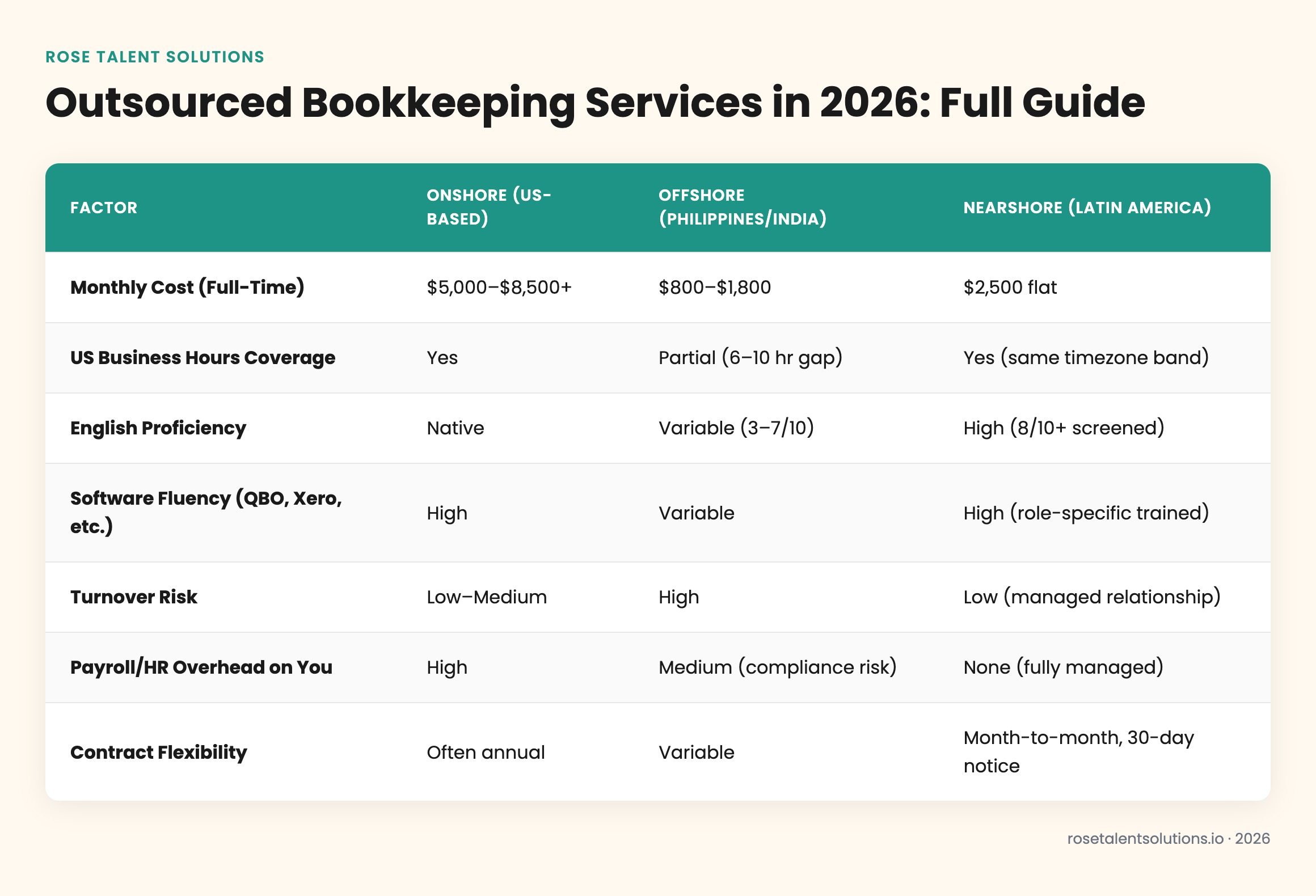
The offshore model looks cheap on paper until you account for the lag. If your bookkeeper is 10–13 hours ahead, a simple clarification about a vendor invoice can take 48 hours to resolve. Multiply that across a full month-end close and you're looking at consistently late financials — which means your decisions are always based on stale data. According to SHRM's research on global workforce timezone alignment (2024), real-time collaboration between remote staff and their managers is one of the top drivers of outsourcing satisfaction — something nearshore makes structurally easier than offshore.
Turnover is the other hidden cost of offshore bookkeeping. Gallup's research on employee turnover (2023) estimates that replacing a single employee costs one-half to two times that employee's annual salary. In offshore markets with high attrition rates, businesses often cycle through multiple bookkeepers per year — restarting onboarding, re-explaining workflows, and absorbing errors during the gap. A managed nearshore model with a replacement guarantee eliminates that cycle entirely.
What Software Should Your Outsourced Bookkeeper Already Know?
Software fluency is the single biggest differentiator between a bookkeeper who hits the ground running and one who costs you two weeks of onboarding time. In 2026, the standard stack for US small and mid-market businesses includes QuickBooks Online, Xero, Bill.com, Gusto, and — for property managers — AppFolio or Buildium.
If you're running your books on Xero, you want someone who's already managed Xero virtual bookkeeper workflows — bank rules, multi-currency reconciliation, Hubdoc integration — not someone who needs to watch YouTube tutorials on your dime. Same principle applies to QuickBooks: a bookkeeper fluent in QuickBooks Online bookkeeping services should know payroll sync, class and location tracking, and how to export clean reports for your CPA.
At Rose Talent Solutions, every outsourced bookkeeper ships with a role-specific AI copilot trained on their primary software — whether that's QuickBooks, Xero, or AppFolio. That means faster reconciliations, fewer data-entry errors, and smarter exception flagging. You can learn more about how that works on our AI advantage page. It's not a gimmick — AI-assisted bookkeeping catches duplicate transactions and miscategorizations that manual review misses, especially at volume.
According to the U.S. Bureau of Labor Statistics (2024), the median annual wage for a US-based bookkeeper is $47,440 — and that's before employer taxes, benefits, and software licenses. When you outsource to a nearshore provider at $2,500/month ($30,000/year all-in), you're saving over $17,000 annually on the salary line alone, before you factor in the eliminated overhead.
"Outsourcing bookkeeping isn't about cutting corners — it's about applying your capital where it creates the most value. A trained remote bookkeeper with the right software stack outperforms a generalist in-house hire at half the cost." — Michael Ly, Founder & CEO at Reconciled (2023)
How to Know If Your Business Is Ready to Outsource Bookkeeping in 2026
Not every business is ready to outsource bookkeeping on day one — and that's okay. But there are clear signals that tell you it's time to stop doing it yourself (or stop relying on a part-time local hire who's stretched thin).
If your books are more than 30 days behind, you're making pricing, hiring, and cash flow decisions based on fiction. That's the most expensive mistake a growing business makes — and it's exactly what a dedicated outsourced bookkeeper fixes in the first month.
The readiness signals are straightforward: you're generating over $20K/month in revenue, you have more than 50 transactions per month to categorize, your CPA is spending billable hours cleaning up your books before they can file, or you've missed a tax deadline because your records weren't ready. Any one of these is enough. All four together means you needed to outsource six months ago.
Property management companies hit this threshold faster than most because of transaction volume. A portfolio of 50 units generates hundreds of monthly transactions — owner disbursements, maintenance vendor payments, security deposit tracking, late fees, utility reimbursements. Managing that manually or with a generalist bookkeeper creates reconciliation errors that compound fast. Our outsourced bookkeeping and accounting service is built specifically for this volume — team members are pre-trained on property management workflows, not just generic accounting.
Accounts payable is another early pressure point. As your vendor count grows, manual AP becomes a liability — late payments, duplicate invoices, and missed discounts add up. Handing that function to a dedicated virtual accounts payable specialist removes that bottleneck entirely and creates a clean, auditable payment trail. According to the Institute of Finance & Management (IOFM) (2024), organizations that automate and outsource AP processing reduce per-invoice processing costs by up to 80% compared to fully manual, in-house methods.

How the Rose Talent Solutions Outsourced Bookkeeping Process Works in 2026
Getting started with outsourced bookkeeping services through Rose is a structured process, not a freelancer marketplace spin. Here's how it works from intake to your first clean month-end close.
Intake & Role Scoping
You tell us your software stack, transaction volume, and specific pain points (late closes, AP backlog, reconciliation errors). We scope the exact role — bookkeeper, AP specialist, or full-charge bookkeeper — based on your actual needs, not a generic package.
Vetting & Matching
Rose recruits, screens, and vets candidates against your software requirements and an 8/10+ English proficiency bar. You review 2–3 pre-vetted profiles and select your hire — no sifting through 50 unqualified applicants.
AI Copilot Onboarding
Your new bookkeeper is activated with a role-specific AI copilot trained on your software (QuickBooks, Xero, AppFolio, etc.). This cuts software ramp time dramatically and improves accuracy from day one.
Managed Ongoing Relationship
Rose handles payroll, HR, and performance management. You manage the daily work. If the team member ever isn't a fit, we replace them at no additional cost — that's our replacement guarantee.
Pricing is $2,500/month flat — full-time, all-in, no long-term contract. You can cancel with 30 days written notice. Everything from recruiting to ongoing HR is included in that number. If you want to see what the right role looks like for your business, the fastest path is our get started intake form — it takes under three minutes.
Why Nearshore Outsourced Bookkeeping Works
- Same business hours — no overnight lag on questions or corrections
- High English fluency (8/10+ screened) means clear communication with your CPA and vendors
- Flat $2,500/month covers recruiting, payroll, HR, and ongoing management
- Software-trained from day one — QuickBooks, Xero, Buildium, AppFolio
- Month-to-month terms — no long-term contract locks you in
- Free replacement if the team member isn't a fit
What to Watch Out For
- Cheap offshore providers often have 6–10 hour timezone gaps that slow your close cycle
- Generalist freelancers lack deep software fluency — expect a training tax
- Platforms without managed HR shift compliance risk onto you
- No replacement guarantee means you restart the hiring process (and the cost) if someone leaves
The global outsourced accounting market is projected to reach $19.6 billion by 2030, according to Grand View Research (2024) — driven by exactly this shift: businesses recognizing that keeping bookkeeping in-house is a cost center, not a competitive advantage. The businesses winning in 2026 aren't hiring more local staff — they're deploying nearshore talent with AI-augmented workflows and reinvesting the savings into growth.
Remote work adoption has accelerated this trend significantly. McKinsey Global Institute (2023) found that finance and accounting roles are among the most transferable to remote execution — with minimal productivity loss compared to in-person equivalents — making outsourced bookkeeping a structurally sound long-term decision, not just a cost-cutting tactic.
If you're managing a property portfolio specifically, our property management virtual assistant service details how nearshore team members handle the full financial back-office — from owner statements to vendor reconciliation — within AppFolio or Buildium. The setup is the same as standard bookkeeping outsourcing, just with property-specific workflow training layered on top.