
Nearshore virtual paralegal services are quietly reshaping how lean US law firms operate in 2026. Instead of paying $60,000–$85,000 a year for an in-house paralegal — plus benefits, office space, and turnover risk — attorneys are hiring full-time legal support staff from Latin America at a fraction of the cost, with zero timezone friction and English fluency that clears any communication bar your clients set. If your firm is losing billable hours to intake calls, deadline tracking, or document drafting, this is the hiring model worth understanding right now.
What Are Nearshore Virtual Paralegal Services?
A nearshore virtual paralegal is a trained legal support professional based in Latin America who works exclusively for your firm during your standard US business hours. These team members operate in the same or adjacent time zones as US firms — Eastern through Pacific — meaning real-time collaboration, same-day turnaround, and no batched overnight communications.
The "virtual" component means they work remotely, typically from a dedicated home office or co-working setup, integrated into your firm's tech stack — case management software, document systems, scheduling tools — from day one. Nearshore is not a synonym for offshore. Latin America's geographic and cultural proximity to the US makes a measurable difference in how quickly a virtual paralegal becomes a productive, embedded member of your team.
According to the U.S. Bureau of Labor Statistics (2024), the median annual wage for paralegals and legal assistants in the United States is $59,200 — and that figure does not include employer payroll taxes, health insurance, paid time off, or office overhead, which can push the true cost well past $80,000 for a single full-time hire.
How Nearshore Virtual Paralegals Handle Real Law Firm Work in 2026
The scope of work a nearshore virtual paralegal can own is broader than most attorneys expect the first time they hire one. These are not general administrative assistants — they are legal support specialists trained in the terminology, workflows, and software your practice depends on. Rose Talent Solutions equips every team member with a role-specific AI copilot trained on the tools and documents relevant to their specialty, so they arrive ready to work rather than spending weeks learning your systems.
Common paralegal task categories handled virtually include:
- Client intake and conflict checks — screening new inquiries, gathering initial facts, running conflict-check protocols before the supervising attorney engages
- Legal research and case summaries — pulling relevant statutes, case law, and regulatory updates; preparing digestible memos attorneys can act on immediately
- Document drafting and review — preparing demand letters, discovery requests and responses, contracts, and pleading templates under attorney supervision
- Court deadline and docket management — tracking filing deadlines, court dates, statute of limitations, and jurisdiction-specific calendaring rules
- E-discovery and file management — organizing and Bates-numbering documents, maintaining digital case files, coordinating with e-discovery platforms
- Billing and time-entry support — logging billable entries in practice management software, reconciling pre-bills, and preparing client invoices for attorney review
For firms that also need front-end legal communications handled professionally, it is worth knowing that law firm virtual receptionist services can run alongside a paralegal hire — the two roles complement each other without overlap, covering intake calls while the paralegal handles substantive case work.

Nearshore vs. Offshore vs. Onshore: How Do the Options Compare in 2026?
Attorneys shopping for virtual paralegal support in 2026 are typically weighing three sourcing models: nearshore (Latin America), offshore (various distant time zones), or US-based remote. Each has a different cost-quality-timezone tradeoff. The table below lays out the honest comparison across the factors that matter most for a working law firm.
| Factor | Nearshore (Latin America) | Offshore (Distant Time Zones) | US-Based Remote |
|---|---|---|---|
| Monthly Cost (Full-Time) | ~$2,500 flat | $1,200–$2,000 | $5,000–$8,000+ |
| Timezone Overlap (US Eastern) | 0–2 hours difference | 9–13 hours difference | 0 hours |
| English Fluency | High (8/10+ screened) | Variable (6–8/10 typical) | Native |
| Legal Software Readiness | AI copilot pre-trained on firm tools | General training only | Varies by candidate |
| Real-Time Availability | Yes — same business hours | No — batched responses | Yes |
| Recruiting / HR / Payroll | Fully managed by Rose | Often self-managed platforms | Firm handles internally |
| Replacement if Not a Fit | Free replacement included | Rare; typically re-hire fees | Full recruiting cycle cost |
| Contract Terms | Month-to-month | Varies | Employment law applies |
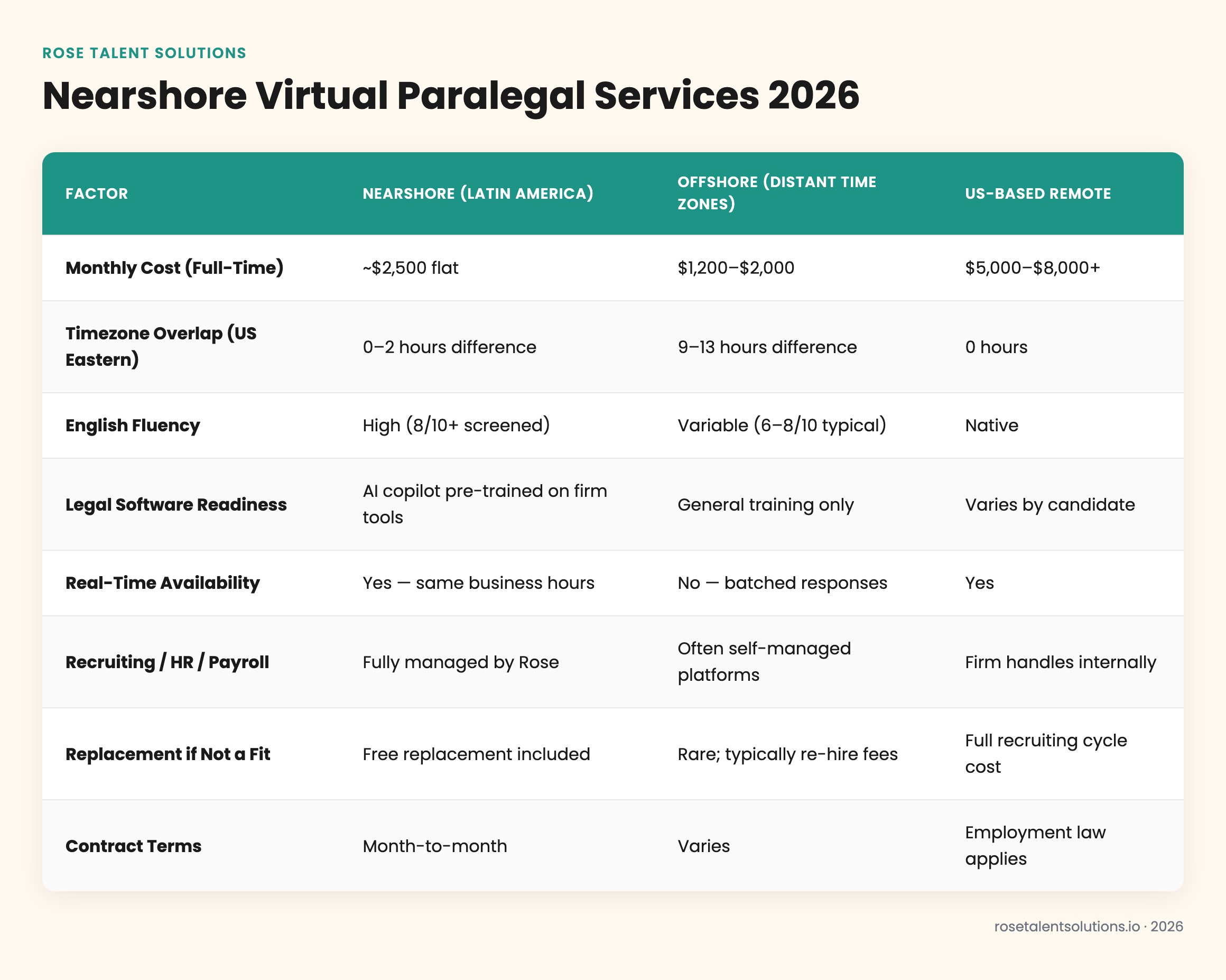
The cost delta between nearshore and US-based remote is significant — firms typically save $30,000–$66,000 per year per paralegal role. But the more decisive advantage over distant-timezone offshore is the alignment with US business hours. A paralegal who is online, responsive, and reachable when your partners are at their desks removes an entire category of operational risk that far-offshore providers cannot solve regardless of price.
What Does Rose's Hiring and Onboarding Process Actually Look Like?
One of the most common questions firms ask is how long it takes from "we're interested" to "they're working." Rose's process is designed to compress that timeline without cutting corners on vetting. Every candidate goes through English proficiency screening (minimum 8/10), a legal knowledge assessment, background verification, and a structured interview before they are ever presented to a client firm.
Discovery Call
Rose's team documents your practice area, case volume, software stack, and the specific paralegal tasks you need covered — so the match is role-specific, not generic.
Candidate Matching
Within days, you receive a shortlist of pre-vetted nearshore paralegals from Latin America whose legal backgrounds align with your practice area — litigation, real estate, family law, immigration, or corporate.
Interview and Selection
You interview your top candidates directly. Rose facilitates scheduling and provides structured evaluation criteria to help you compare candidates fairly.
AI Copilot Configuration
Before day one, your paralegal's role-specific AI copilot is configured for your firm's software — practice management platforms, document systems, and communication tools. Learn more about the AI advantage Rose builds into every placement.
Day-One Integration
Your paralegal starts on your schedule, in your timezone, with Rose handling all payroll, HR compliance, and ongoing management in the background.
If at any point the placement is not the right fit, Rose replaces the team member at no additional cost. That is the complete risk reversal — no long-term contract, month-to-month terms, and a free replacement if the match does not work. Ready to see who is available for your firm? Visit the getting started page to submit your requirements.
How Virtual Paralegals Affect Law Firm Profitability in 2026
The financial case for hiring a nearshore virtual paralegal is straightforward once you do the math on attorney time. According to the American Bar Association (2024), the average attorney spends roughly 48% of their working time on non-billable administrative tasks. That is nearly half a lawyer's productive hours consumed by work that does not generate revenue.
If your attorneys bill at $300/hour and each recovers just 5 billable hours per week by offloading paralegal tasks, that is $1,500/week — or $78,000/year — in recovered revenue per attorney. A nearshore virtual paralegal at $2,500/month costs $30,000/year. The ROI math is not close.
Beyond direct billable hour recovery, virtual paralegals affect firm profitability through client experience. Faster intake responses, timely document delivery, and proactive deadline communication reduce client churn and improve referral rates. A Clio Legal Trends Report (2024) found that 71% of legal clients who did not return to a firm cited slow communication as a primary reason — a problem a dedicated paralegal based in Latin America can directly address during US business hours.
Firms that also need specialized document work handled at scale often pair their paralegal with a dedicated resource for transcription and verbatim documentation — a role covered in detail in this overview of legal transcription virtual assistant capabilities. The two roles divide labor cleanly: the paralegal owns substantive legal support, while a transcription specialist handles recorded depositions, client calls, and verbatim court documents.

"The best investment a small law firm can make is a trained paralegal who understands your practice area deeply — whether that person sits in your office or in Bogotá is increasingly irrelevant if the timezone and communication bar are met." — Ivy Grey, Legal Technology Strategist and Contributing Editor at Above the Law (2024)
Nearshore Virtual Paralegals vs. In-House Staff: Is the Tradeoff Worth It in 2026?
Attorneys who have only ever hired in-house often raise the same concerns: Will a remote paralegal really understand my practice? Can they handle confidential documents securely? Will they feel like part of the team? These are legitimate questions, and the honest answer is that the tradeoff depends almost entirely on how the role is structured and how well the sourcing partner vets for the right profile.
Nearshore Virtual Paralegal — Advantages
- Flat $2,500/month — no benefits, payroll taxes, or office overhead
- Same-day responsiveness during US business hours
- Month-to-month terms — no long-term contract commitment
- AI copilot pre-configured for your practice management software
- Rose handles recruiting, HR, payroll, and replacements
- Access to a deep talent pool across Latin America
In-House Paralegal — Tradeoffs to Weigh
- $60,000–$85,000+ fully loaded annual cost
- 6–12 week recruiting timeline; full re-hire cost if turnover occurs
- Firm absorbs all HR, benefits administration, and compliance burden
- Geographic limitation restricts talent pool to local market
- Fixed overhead even during slow periods or case slowdowns
For a deeper breakdown of how this cost and capability calculus plays out across different firm sizes, the comparison of law firm virtual assistant vs in-house staff covers the full spectrum — from solo practitioners to mid-size practices with multiple attorneys. The core finding holds across firm sizes: the all-in cost of in-house support is rarely justified when a managed nearshore model delivers the same output at 30–40 cents on the dollar.
According to SHRM (2024), the cost of replacing an employee ranges from 50% to 200% of their annual salary. For a paralegal earning $60,000, that is $30,000–$120,000 in replacement cost every time turnover occurs — a risk that Rose's free-replacement model eliminates entirely for virtual placements.
Firms exploring a fuller virtual support stack — including general legal administrative work beyond paralegal functions — often start with a broader look at how to hire a virtual legal assistant for a law firm, which covers role scoping, vetting criteria, and integration best practices in practical detail. The paralegal placement layer builds directly on that foundation.
Rose also supports law firms with bookkeeping and accounting virtual staff for trust accounting, IOLTA reconciliation, and billing workflows — a natural complement to paralegal support for firms looking to reduce administrative overhead across departments, not just in the legal support lane.
The structural shift in how law firms hire support staff is not a trend — it is a response to real market pressure. McKinsey Global Institute (2023) identified legal document review and paralegal research as among the highest-automation-potential knowledge work categories, meaning the role of the virtual paralegal is evolving rapidly — and firms that hire AI-augmented virtual paralegals now will have a measurable productivity advantage over those that wait. The firms winning in 2026 are not the ones with the largest headcount — they are the ones with the leanest, highest-leverage support structures built around the AI-augmented virtual staffing model.