
Nearshore virtual medical scribes have quietly become one of the highest-leverage hires in American medicine — and in 2026, the case for them is stronger than ever. A nearshore scribe works from Latin America during your exact business hours, listens live to patient encounters via a HIPAA-compliant audio connection, and finishes your notes before the next patient is roomed. No time-zone lag. No overnight batch uploads. No deciphering broken English in your SOAP notes at 10 p.m. If you are still charting after clinic, this post is for you.
Physician burnout is not a vague wellness problem — it has a measurable cause. Administrative burden, primarily documentation, accounts for the majority of after-hours work physicians log. According to the American Medical Association (2023), more than 60% of physicians report at least one burnout symptom, with excessive administrative tasks cited as the top driver. A virtual scribe attacks that root cause directly.
What Is a Nearshore Virtual Medical Scribe?
A nearshore virtual medical scribe is a trained documentation specialist who works remotely from Latin America — countries like Colombia, Mexico, Costa Rica, or Argentina — during US business hours. They join patient encounters via a secure, HIPAA-compliant audio or video link, transcribe the visit in real time, and populate your EHR with a structured clinical note that only needs physician review and signature. Unlike a transcriptionist who works from a recording after the fact, a live scribe captures the encounter as it happens, flags missing HPI elements, and can even pull up previous visit data mid-encounter.
The "nearshore" distinction matters enormously in healthcare. Offshore scribes based in the Philippines or India operate 10–14 hours out of sync with US clinics. That gap turns every clarification — a missing allergy, an ambiguous medication dose, a conflicting chief complaint — into a 24-hour delay. Nearshore scribes in Latin America share your time zone or are within one to two hours, so they finish notes while the chart is still warm and the physician still remembers the encounter.
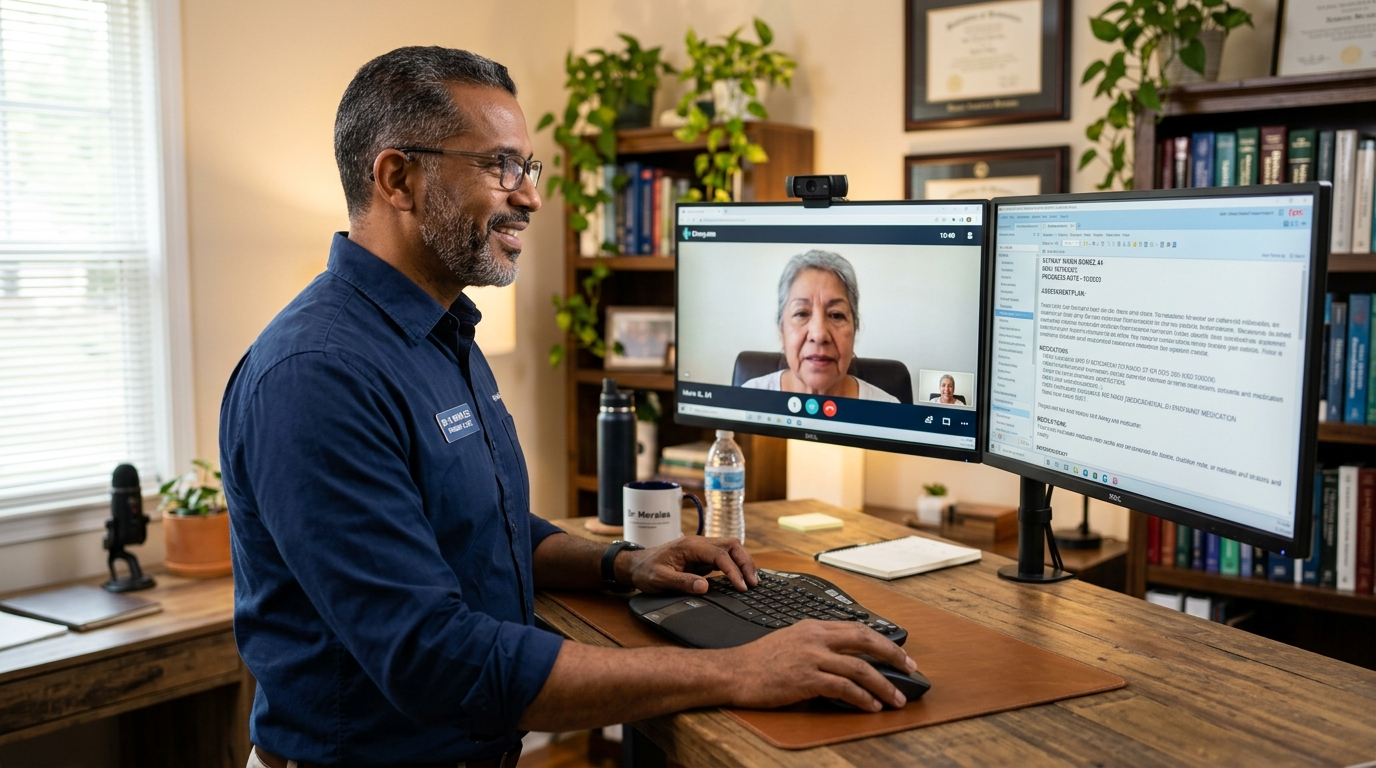
How Physician Documentation Time Has Become a 2026 Crisis
The numbers are not subtle. Physicians spend an average of 4.5 hours per day on EHR and desk work for every 3.9 hours of direct patient care time, according to a landmark study published in the Annals of Internal Medicine (2017) — and follow-up research suggests that ratio has worsened, not improved, as EHRs have grown more complex. The result is a systemic drag on practice revenue: every hour a physician spends charting instead of seeing patients is an hour of billable encounters that never happen.
The Bureau of Labor Statistics (2024) projects physician demand to grow 3% through 2032, but medical school enrollment cannot keep pace. That means the physicians practicing today are seeing more patients per day with no corresponding reduction in documentation requirements. Something has to give — and for a growing number of practices, what gives is the charting, handed off to a trained nearshore scribe.
Many practices also layer scribing with broader administrative relief. If your front desk is drowning alongside your physicians, it is worth reading how practices are using a dedicated virtual assistant for insurance verification to strip pre-authorization delays out of the schedule before the patient even arrives — a complementary move that amplifies the scribe's downstream impact on throughput.
Nearshore vs. Offshore vs. In-Person: The 2026 Medical Scribe Comparison
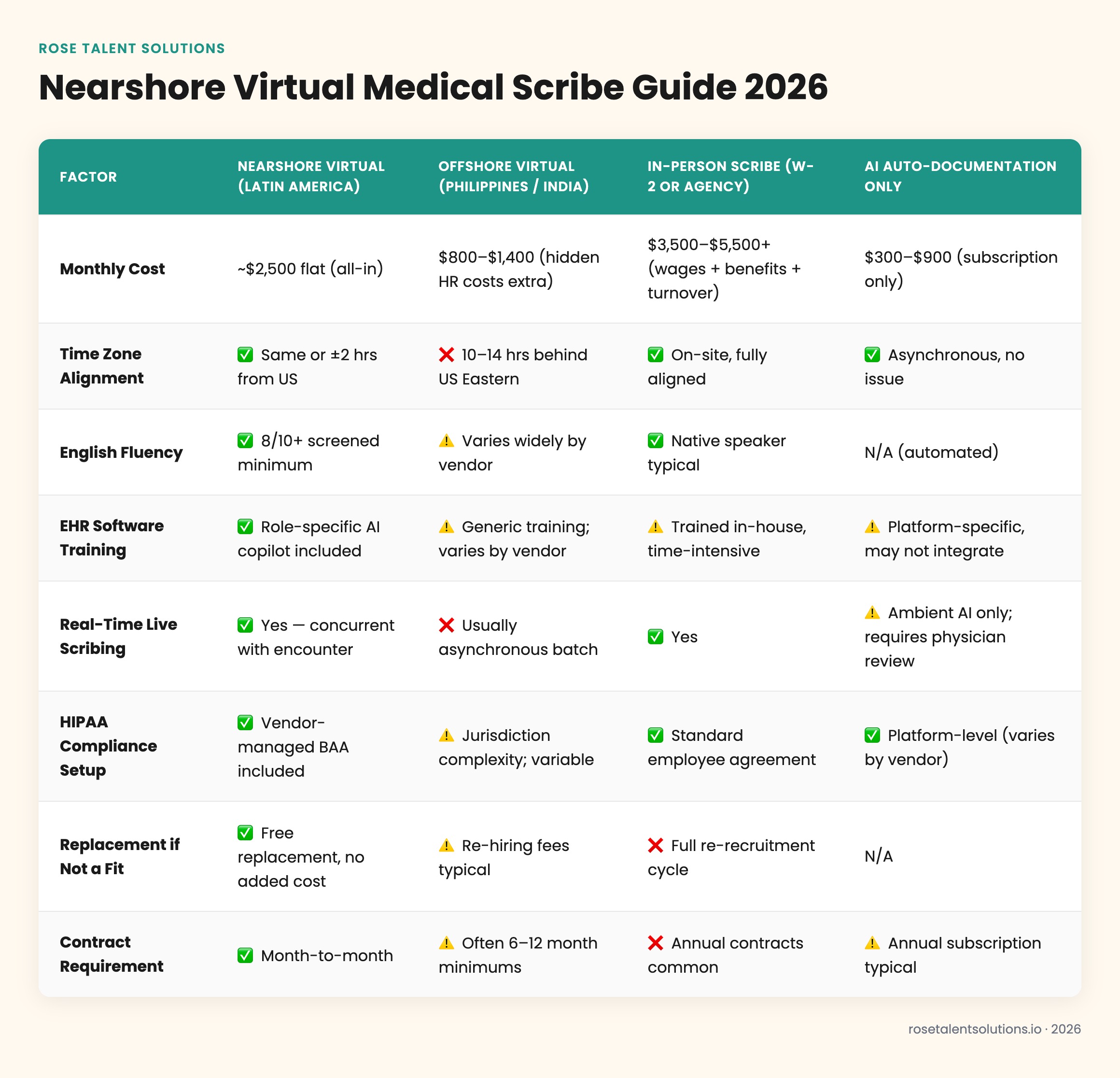
Before committing to any scribing model, practice managers need to compare the real cost drivers — not just the headline rate. The table below maps the four most common options against the variables that actually affect documentation quality, physician satisfaction, and total cost of ownership.
| Factor | Nearshore Virtual (Latin America) | Offshore Virtual (Philippines / India) | In-Person Scribe (W-2 or Agency) | AI Auto-Documentation Only |
|---|---|---|---|---|
| Monthly Cost | ~$2,500 flat (all-in) | $800–$1,400 (hidden HR costs extra) | $3,500–$5,500+ (wages + benefits + turnover) | $300–$900 (subscription only) |
| Time Zone Alignment | ✅ Same or ±2 hrs from US | ❌ 10–14 hrs behind US Eastern | ✅ On-site, fully aligned | ✅ Asynchronous, no issue |
| English Fluency | ✅ 8/10+ screened minimum | ⚠️ Varies widely by vendor | ✅ Native speaker typical | N/A (automated) |
| EHR Software Training | ✅ Role-specific AI copilot included | ⚠️ Generic training; varies by vendor | ⚠️ Trained in-house, time-intensive | ⚠️ Platform-specific, may not integrate |
| Real-Time Live Scribing | ✅ Yes — concurrent with encounter | ❌ Usually asynchronous batch | ✅ Yes | ⚠️ Ambient AI only; requires physician review |
| HIPAA Compliance Setup | ✅ Vendor-managed BAA included | ⚠️ Jurisdiction complexity; variable | ✅ Standard employee agreement | ✅ Platform-level (varies by vendor) |
| Replacement if Not a Fit | ✅ Free replacement, no added cost | ⚠️ Re-hiring fees typical | ❌ Full re-recruitment cycle | N/A |
| Contract Requirement | ✅ Month-to-month | ⚠️ Often 6–12 month minimums | ❌ Annual contracts common | ⚠️ Annual subscription typical |
How Rose Talent Solutions Matches and Trains Your Virtual Medical Scribe in 2026
Rose Talent Solutions sources, vets, and places nearshore virtual medical scribes from Latin America at a flat rate of $2,500 per month — full-time, 40 hours per week, with recruiting, payroll, HR, and ongoing management all included in that number. There are no hidden seat fees, no per-note charges, and no long-term contract required. If the scribe isn't a fit for your practice, Rose replaces them at no additional cost.
Every scribe placed through Rose ships with a role-specific AI copilot trained on your EHR platform — whether that's athenahealth, Epic, eClinicalWorks, DrChrono, or another system. For DrChrono specifically, the platform's billing and documentation workflows have enough unique quirks that purpose-built training makes a measurable difference; practices have found it helpful to pair scribing with a DrChrono-trained medical billing virtual assistant who handles the revenue cycle on the back end while the scribe handles the front-end documentation.
Discovery Call (Day 1)
Rose reviews your specialty, patient volume, EHR platform, and documentation standards to build a precise candidate profile — not a generic one.
Candidate Shortlist (Days 2–4)
Rose screens candidates against your specialty vocabulary, English fluency (8/10+ minimum), and EHR familiarity, then presents 2–3 matched profiles for your review.
Interview and Selection (Day 5)
You interview shortlisted candidates and select your scribe. Rose handles the offer, onboarding paperwork, and BAA execution in parallel.
AI Copilot Activation and Shadow Week (Days 6–10)
Your scribe's role-specific AI copilot is activated on your EHR. The scribe shadows live encounters for a calibration period before taking the note queue fully independently.
Full Deployment and Ongoing Management (Day 11+)
Rose handles payroll, HR, and performance management ongoing — you focus on patients, not staffing logistics.
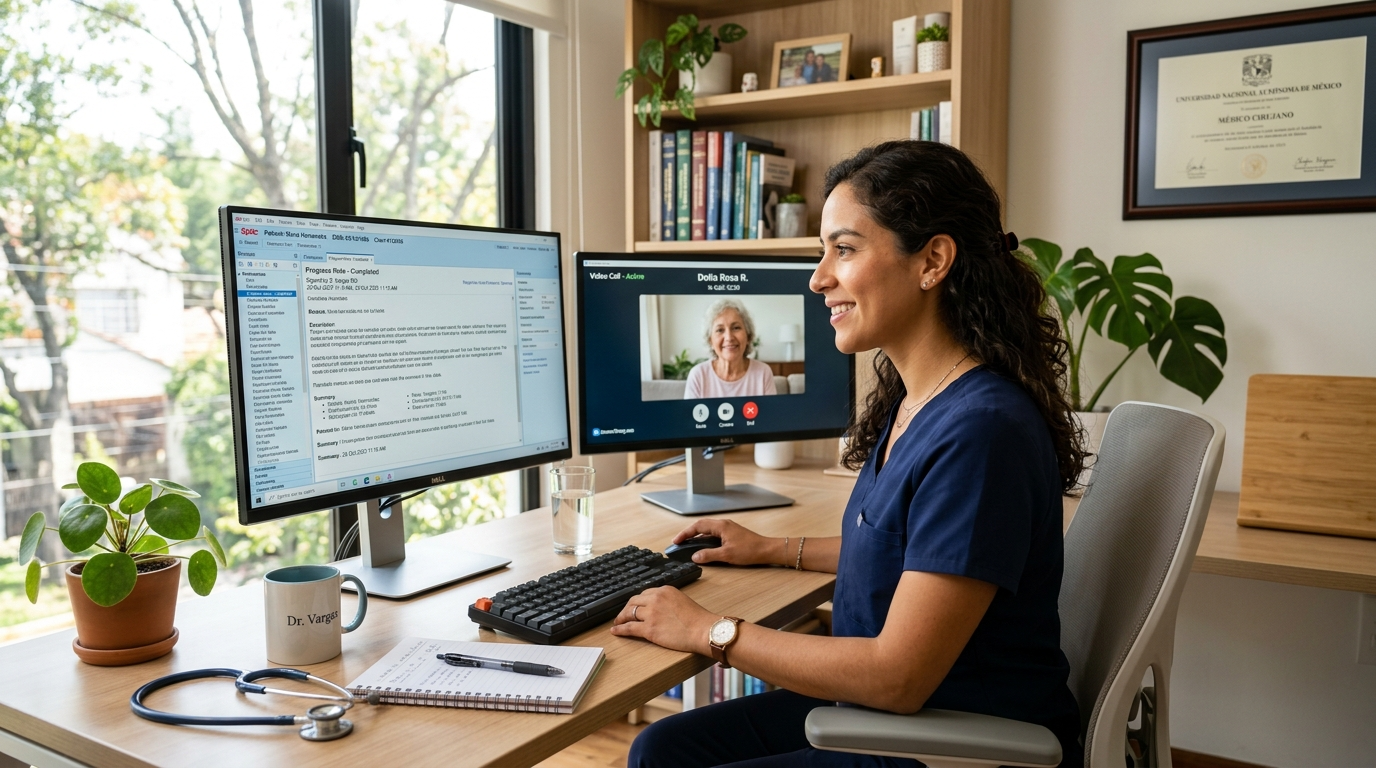
What Tasks Does a Virtual Medical Scribe Handle Day-to-Day?
The core job is real-time documentation — but a well-trained nearshore scribe covers substantially more ground than just typing notes. Understanding the full scope helps practices calculate the true return on the $2,500 monthly investment.
- Live SOAP / DAP note completion during or immediately after each encounter
- HPI, ROS, and physical exam documentation pulled from physician verbal dictation and patient responses
- Problem list and medication reconciliation updates flagged for physician sign-off
- Referral and order entry in the EHR, pending physician approval
- After-visit summary preparation so front desk can hand it directly to the patient
- Specialty-specific templating — scribes trained for orthopedics use different templates than those trained for psychiatry or internal medicine
- Chart prep before the day starts — pulling relevant labs, imaging results, and prior notes so the physician walks into each room already oriented
Practices in adjacent specialties — chiropractic, dental, and behavioral health — often start their virtual staffing journey with task-based assistants before layering in a dedicated scribe. If you operate a chiropractic practice, you can see how similar documentation and admin workflows play out in our post on virtual assistants for chiropractic offices. Dental practices have found analogous wins, detailed in our overview of dental office virtual assistant services.
A nearshore scribe does not just save documentation time — it changes the physician's cognitive experience of the workday. When a physician knows the note will be done before the next patient is roomed, they stop mentally "holding" the previous encounter while trying to be present in the next one. That reduction in cognitive load is difficult to quantify but universally reported as the biggest quality-of-life benefit.
Is a Nearshore Virtual Medical Scribe Right for Your Practice? 2026 Pros and Cons
Virtual scribing is not a perfect fit for every practice model. Below is an honest assessment of where the nearshore model excels and where you should think carefully before committing.
Pros
- Physicians reclaim 2–3 hours of daily charting time immediately
- Flat $2,500/month rate is 30–50% less than an in-person agency scribe with benefits
- No long-term contract — month-to-month with 30 days written notice to cancel
- Same-timezone presence means real-time clarification, not overnight turnaround
- EHR-specific AI copilot dramatically shortens the ramp-to-productivity window
- Free replacement if the scribe isn't a specialty or workflow fit
- Latin America-based teams are culturally aligned with US medical standards and communication norms
Cons
- Requires a stable, HIPAA-compliant audio/video connection — poor internet on either end degrades note quality
- Physicians who prefer to dictate asynchronously may need to adjust their workflow for live scribing
- Highly procedural specialties (surgery, interventional radiology) require specialized template builds before the scribe is productive
- Not a substitute for a physician reviewing and signing every note — final clinical judgment remains with the provider
The research on scribe ROI is consistent. A 2023 analysis in the Journal of General Internal Medicine (via PubMed/NCBI) found that physicians using scribes saw a 10–15% increase in patient throughput. At average primary care reimbursement rates, that throughput gain more than covers the scribe's monthly cost — often within the first week of full deployment. When you factor in the reduction in overtime, physician turnover risk, and EHR penalty avoidance from complete documentation, the financial case is not close.
"Scribes allow physicians to focus on what they went to medical school to do — care for patients, not type. The documentation burden we've placed on physicians through EHR mandates is a policy choice, and scribes are one of the most pragmatic reversals of that choice available today." — Robert Wachter, MD, Chair of Medicine at UCSF and author of The Digital Doctor (2023)
For practices already running lean on the administrative side, a scribe pairs best with a full virtual staffing strategy. Rose's broader medical practice virtual staffing intake walks you through which roles — scribe, billing coordinator, prior authorization specialist, or patient communications VA — to prioritize first based on your current bottleneck. And if you want to understand how the full suite of healthcare virtual roles is structured, the Rose staffing model overview explains the flat-rate, all-in approach that applies across every specialty we place in.
According to SHRM's Talent Acquisition Benchmarking data (2024), the average cost per hire in the US is $4,700 — before onboarding, training, or benefits. A nearshore scribe through Rose eliminates that cost entirely: recruiting, vetting, and placement are included in the $2,500 monthly flat rate. When a scribe leaves or isn't the right fit, the replacement cycle doesn't cost you another $4,700 and six weeks of open-chair productivity loss.