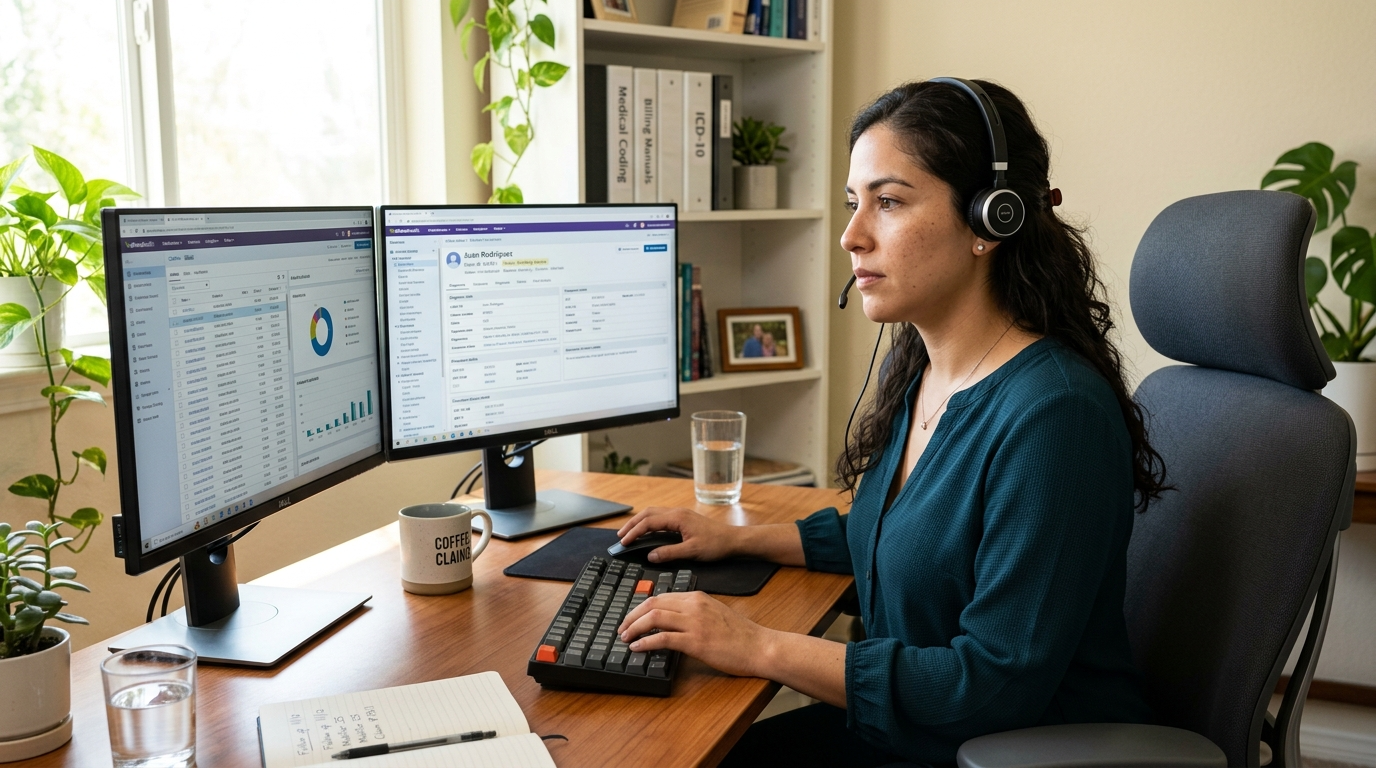
Nearshore medical billing outsourcing is quietly becoming the default staffing move for independent practices, multi-location groups, and revenue cycle management (RCM) firms that are done fighting the US billing labor shortage. Instead of posting on Indeed for a $28/hour biller who ghosts after two interviews, you hire a full-time, English-fluent specialist based in Latin America — someone in your timezone, trained on your software, and backed by a management layer you never have to build yourself. This guide breaks down exactly how that model works in 2026, what it costs, and how to tell a serious nearshore partner from a staffing arbitrage shop.
What Is Nearshore Medical Billing Outsourcing?
Nearshore medical billing outsourcing is the practice of placing full-time billing staff in geographically adjacent countries — primarily Latin America for US-based practices — rather than in distant offshore markets like the Philippines or India. The geographic proximity means team members operate in the same or overlapping time zones as your front desk, your providers, and your payers. That distinction matters more in medical billing than almost any other back-office function, because claim corrections, payer callbacks, and authorization follow-ups happen in real time during business hours.
What "nearshore" is not: it is not a call center model where dozens of agents rotate through your account. A properly structured nearshore engagement gives you a dedicated individual who learns your EHR, your payer mix, and your denial patterns — and shows up on Slack every morning at 8am your time.
The billing labor shortage is real and accelerating. The US Bureau of Labor Statistics projects medical records and health information specialist roles will grow 17% through 2032 — nearly five times the average for all occupations, according to the Bureau of Labor Statistics Occupational Outlook Handbook (2023). Supply is not keeping up. Practices that insist on hiring locally are competing over a shrinking pool at rising wages — while their clean claim rates quietly deteriorate.
How Nearshore Billing Differs From Offshore in 2026
The offshore model — largely centered on the Philippines and India — has been the default for budget-conscious practices for the past decade. But in 2026, the tradeoffs have become harder to ignore. The core issue is not accent or quality: it is time. A Manila-based biller works a 12-to-13-hour shift offset from US Eastern time. When a payer calls back about a claim at 2pm EST, no one answers. When your front desk flags a credentialing discrepancy at 10am, the correction sits until the next business day. Delays compound into denials, and denials compound into write-offs.

Nearshore billers in Colombia, Mexico, or Costa Rica work 9-to-5 EST or CST, take payer calls live, and communicate with your team without a 24-hour lag. If you've ever managed a virtual assistant handling insurance verifications in a distant timezone, you know exactly what that lag costs in follow-up rounds and failed auths. According to Health Affairs (2022), administrative complexity — including billing delays and authorization bottlenecks — accounts for roughly 34% of total US healthcare spending, a figure that same-timezone staffing directly helps practices chip away at.
Nearshore vs. Offshore vs. In-House Medical Billing: 2026 Comparison
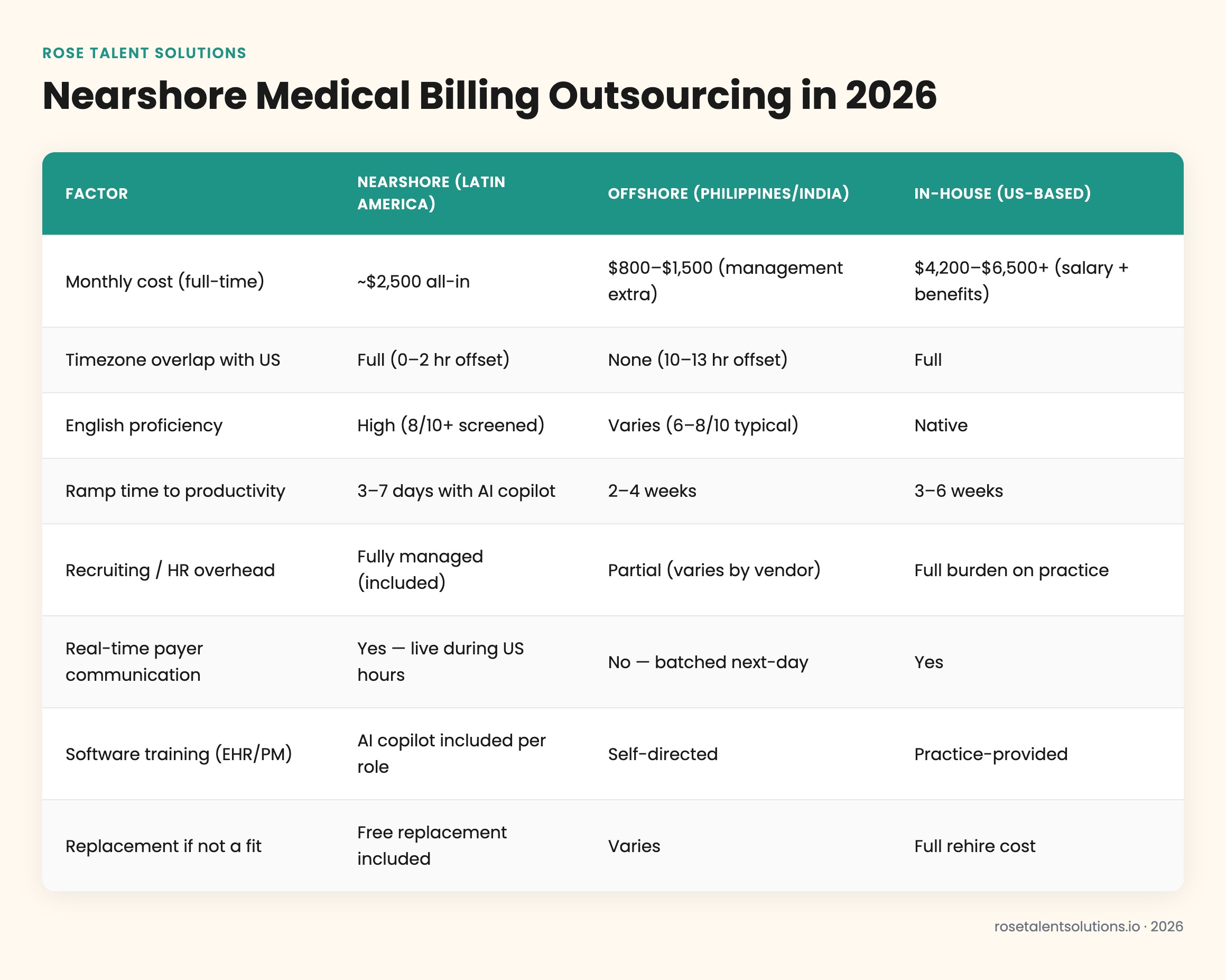
The table below compares the three dominant models practices are using in 2026. Use it as a decision framework, not a definitive ranking — your payer mix, claim volume, and practice size all affect which model fits best.
| Factor | Nearshore (Latin America) | Offshore (Philippines/India) | In-House (US-based) |
|---|---|---|---|
| Monthly cost (full-time) | ~$2,500 all-in | $800–$1,500 (management extra) | $4,200–$6,500+ (salary + benefits) |
| Timezone overlap with US | Full (0–2 hr offset) | None (10–13 hr offset) | Full |
| English proficiency | High (8/10+ screened) | Varies (6–8/10 typical) | Native |
| Ramp time to productivity | 3–7 days with AI copilot | 2–4 weeks | 3–6 weeks |
| Recruiting / HR overhead | Fully managed (included) | Partial (varies by vendor) | Full burden on practice |
| Real-time payer communication | Yes — live during US hours | No — batched next-day | Yes |
| Software training (EHR/PM) | AI copilot included per role | Self-directed | Practice-provided |
| Replacement if not a fit | Free replacement included | Varies | Full rehire cost |
"The administrative burden on physicians has reached a breaking point — practices that don't systematically offload billing complexity will continue to see margin erosion regardless of patient volume." — Robert Tennant, Director of Health Information Technology Policy at MGMA (2023)
How the AI Copilot Model Changes Medical Billing Productivity in 2026
The biggest shift in nearshore medical billing since 2024 is not wages or geography — it is AI augmentation. Every Rose Talent Solutions team member ships with a role-specific AI copilot trained on the software your practice already uses. If your team runs on DrChrono, that biller's copilot is pre-configured for DrChrono workflows. If you're on AdvancedMD or Kareo, same principle.
This matters because the traditional ramp problem in medical billing — the 4-to-6-week period where a new hire is learning your system before they're net-positive — compresses dramatically. A biller who arrives knowing exactly how to work a denial queue in your specific PM system is productive in days, not weeks. For a deeper look at how this plays out in one specific EHR, see our post on using a DrChrono virtual assistant for medical billing — the workflow breakdowns there apply directly to nearshore billing roles.

The hidden cost of a slow-ramp biller isn't the salary during training — it's the clean claim rate degradation that happens while they're still learning your payer rules. AI-augmented nearshore billers start working denial queues on day one, which protects your 90-day AR from the moment they onboard.
According to MGMA's 2023 Billing and Collections Benchmarking Report, high-performing medical practices maintain a clean claim rate above 95%. Practices with frequent staff turnover — a near-constant in US billing departments — consistently fall below 90%, triggering denial backlogs that take months to clear. A stable, AI-assisted nearshore biller is a structural hedge against that cycle.
The AI advantage also extends to adjacent healthcare support functions. If your practice needs more than billing — think prior auth, front desk coordination, or referral management — the same model scales. Our guides on virtual assistants for chiropractic offices and dental office virtual assistant services show how specialty-specific AI training adapts across practice types.
What Does Nearshore Medical Billing Outsourcing Cost in 2026?
Rose Talent Solutions prices nearshore billing staff at $2,500/month, flat. That rate is all-in: recruiting, multi-stage vetting, payroll, HR compliance, ongoing management, and the AI copilot setup. There are no add-on fees for replacement hires if someone isn't a fit — that's covered. The engagement runs month-to-month with no long-term contract; if you need to pause, you provide 30 days written notice.
Compare that to the fully-loaded cost of a US-based medical biller. According to the Bureau of Labor Statistics Occupational Employment Statistics (2023), the median annual wage for medical records specialists is $47,180 — roughly $3,932/month in salary alone, before employer payroll taxes, benefits, PTO, and recruiting costs. The SHRM Employee Benefits Survey (2023) estimates total employee benefits add 30–40% to base salary. The fully-loaded cost of a mid-level US biller easily clears $5,500–$6,500/month when you account for all of that.
The $2,500 flat also compares favorably against percentage-of-collections RCM billing services, which typically charge 4–8% of net collections. For a practice collecting $80,000/month, that's $3,200–$6,400/month — for shared, non-dedicated staff. With a nearshore model, you own the output: one person, fully dedicated, on your processes, in your systems, available on your Slack. The HHS Office for Civil Rights guidance on business associates (2023) confirms that international contractors qualify as business associates under HIPAA when a BAA is properly executed — removing the compliance concern that sometimes causes practices to default to higher-cost domestic options unnecessarily.
How Rose Talent Solutions Places a Nearshore Medical Biller in 2026
Discovery call and role scoping
Rose's team maps your EHR, payer mix, claim volume, and denial patterns to build an exact candidate profile — not a generic "medical biller" spec.
Multi-stage candidate vetting
Every candidate completes English proficiency screens (8/10+ required), live billing simulations, and background verification before you see a single profile.
AI copilot configuration
Before day one, Rose configures a role-specific AI copilot trained on your practice management software — DrChrono, AdvancedMD, Kareo, or other platforms — so the biller arrives tool-ready.
Placement and onboarding
Your biller starts within days of match approval, working your hours, attending your standups, and operating inside your workflows from day one.
Ongoing management and replacement guarantee
Rose handles HR, payroll, and performance management. If the team member isn't a fit, Rose replaces them at no additional cost — no rehire fees, no downtime billing.
If your practice also needs front-desk support or patient communication alongside billing, Rose's full healthcare staffing model covers that too — see the getting started page for a breakdown of role combinations that work well together.
Is Nearshore Medical Billing Right for Your Practice in 2026?
Nearshore medical billing outsourcing works best for practices that have consistent monthly claim volume (typically 200+ claims/month), use a mainstream EHR or PM system, and have at least one internal point of contact who can do a brief daily check-in. It is not the right fit for practices that require billers to be physically on-site for compliance reasons, though that requirement is rare and increasingly outdated as HIPAA-compliant remote work infrastructure has matured.
Nearshore billing works well when…
- You have steady claim volume and a defined payer mix
- Your EHR is cloud-based and supports remote access
- You're spending $4,000+/mo on a US biller or 5%+ of collections on an RCM service
- You've had turnover in your billing seat in the last 18 months
- You want a dedicated person, not a shared service team
Reconsider if…
- Your practice requires on-site billing staff by payer contract (uncommon but verify)
- You have fewer than 100 claims/month — a part-time model may fit better
- Your EHR is a legacy on-premise system with no remote access capability
- You don't have a single internal contact who can field daily communication
For practices that are on the fence, the risk is structurally low. The month-to-month engagement and the free replacement guarantee mean you're not locked into a bad hire or a long contract. The biggest risk most practice managers report after the fact isn't that nearshore didn't work — it's that they waited 18 months too long to try it while paying for a local biller who was actively burning their AR. To explore what the right role configuration looks like for your practice size, the Rose intake process takes less than 10 minutes and gives you a scoped recommendation without a sales pitch.
According to a McKinsey Global Institute report on the economic potential of generative AI (2023), healthcare administrative roles — including billing and coding — are among the most augmentable by AI tools, with 40–60% of current task time addressable through AI assistance. That's not a threat to billing jobs; it's a multiplier. A nearshore biller with an AI copilot handles the volume of 1.5 traditional billers, which is why the $2,500/month math works even for smaller practices. Gallup's research on remote workforce engagement found that fully remote workers report 4% higher engagement scores than on-site peers, according to Gallup's State of the Global Workplace report (2022) — a dynamic that translates directly into lower turnover and more consistent billing performance when nearshore staff are well-managed.