
What Are Nearshore Amazon FBA VA Services?
Nearshore Amazon FBA VA services place full-time virtual assistants — based in Latin America — inside your existing FBA operation. Unlike offshore staffing from the Philippines or India, nearshore VAs work within one to two time zones of US business hours, which means real-time Slack messages, live Amazon Seller Central updates, and zero overnight lag on supplier communications. If you've ever woken up to a suppressed listing that sat broken for eight hours while your offshore VA slept, you already understand the core problem nearshore solves.
A nearshore VA is a remote team member who shares your time zone, speaks fluent English (Rose's published floor is 8/10+ on proficiency screens), and operates as a dedicated full-time resource — not a task-by-task freelancer you find on a marketplace. They handle the operational layer of your FBA business: listing optimization, PPC monitoring, inventory reorder alerts, case management, and supplier coordination. Because they're embedded in your workflow during your hours, they function more like an in-house hire than a contractor.
According to SHRM's workforce research (2023), 68% of US small businesses that outsource report improved operational efficiency within the first 90 days. For Amazon sellers managing hundreds of SKUs, that efficiency gain is the difference between scaling to a second category and staying stuck firefighting the first one.

How Nearshore Beats Offshore for Amazon FBA in 2026
The offshore VA model was built for tasks that don't require real-time judgment — data entry, bulk image resizing, basic order tracking. Amazon FBA is not that business. Listing suppressions appear without warning. PPC bids shift hourly. A competitor hijacks your Buy Box at 11am on a Tuesday. If your VA is asleep, you're absorbing the loss alone. Nearshore solves the synchrony problem structurally, not by asking your VA to work odd hours.
Latin America has become a genuine talent hub for ecommerce operations roles. According to the US Bureau of Labor Statistics (2024), demand for operations and logistics coordinators in North America is projected to grow 8% through 2032 — and nearshore staffing absorbs a meaningful share of that demand by routing experienced talent across the border digitally rather than physically. Sellers who previously paid $55,000–$70,000 per year for a US-based ecommerce coordinator are accessing the same functional skill set at $2,500/month through Rose.
If your FBA operation also needs dedicated buyer communication coverage, the Amazon customer service VA role is a natural complement to a core FBA operations hire — and nearshore placement makes both roles functionally equivalent to having those people in your office.
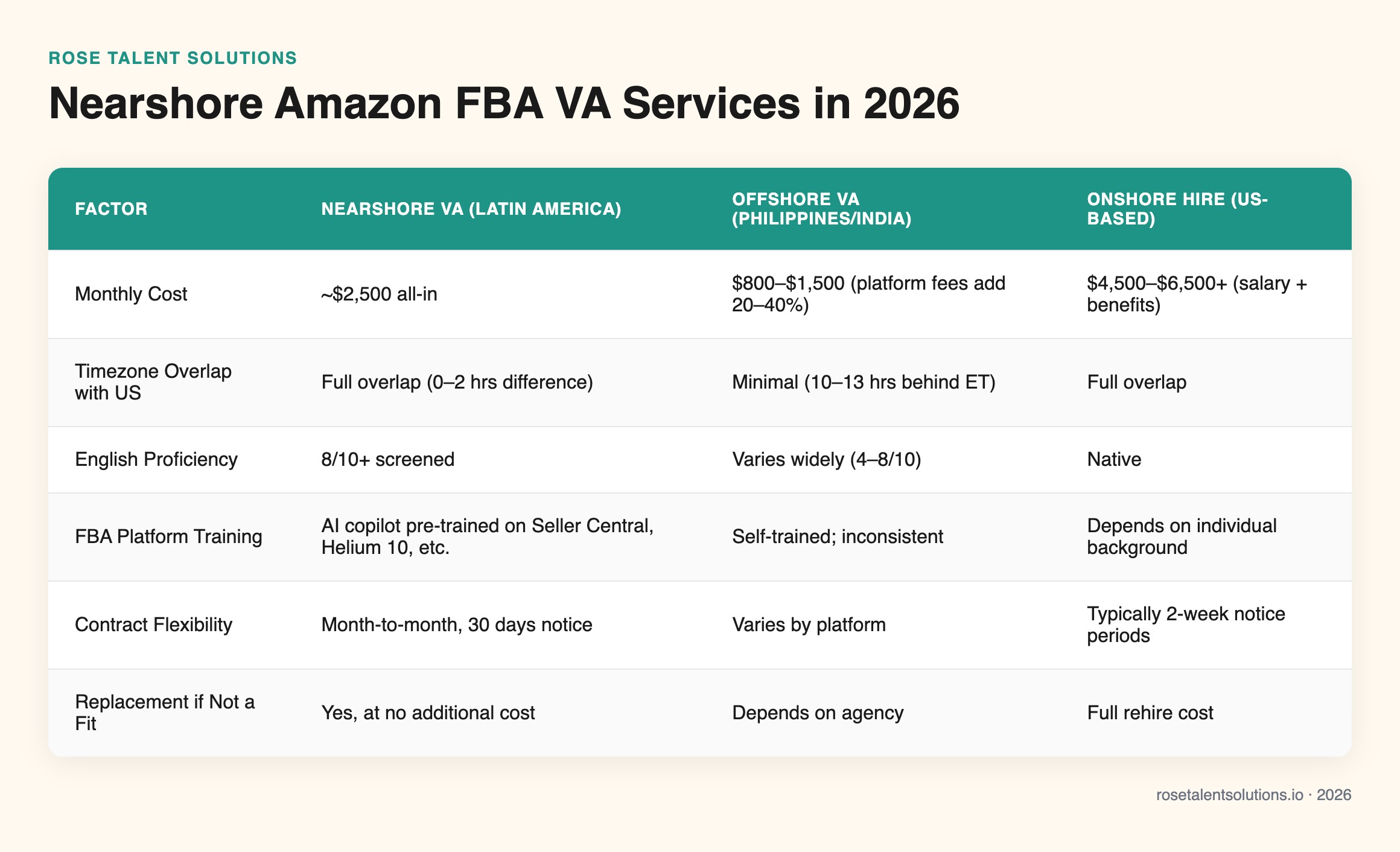
| Factor | Nearshore VA (Latin America) | Offshore VA (Philippines/India) | Onshore Hire (US-Based) |
|---|---|---|---|
| Monthly Cost | ~$2,500 all-in | $800–$1,500 (platform fees add 20–40%) | $4,500–$6,500+ (salary + benefits) |
| Timezone Overlap with US | Full overlap (0–2 hrs difference) | Minimal (10–13 hrs behind ET) | Full overlap |
| English Proficiency | 8/10+ screened | Varies widely (4–8/10) | Native |
| FBA Platform Training | AI copilot pre-trained on Seller Central, Helium 10, etc. | Self-trained; inconsistent | Depends on individual background |
| Contract Flexibility | Month-to-month, 30 days notice | Varies by platform | Typically 2-week notice periods |
| Replacement if Not a Fit | Yes, at no additional cost | Depends on agency | Full rehire cost |
What Tasks Does a 2026 Nearshore FBA VA Actually Own?
The scope of what a skilled nearshore FBA VA can own in 2026 is meaningfully wider than it was three years ago, largely because of AI copilots. Rose embeds every team member with a role-specific AI tool trained on the software your business actually uses — Helium 10, Jungle Scout, Amazon Seller Central, InventoryLab, and similar platforms. That means your VA isn't spending the first 60 days learning where buttons are. They're executing from day one.
Core ownership areas for an FBA VA in 2026 include:
- Listing health monitoring — daily audits of suppressed, stranded, or policy-flagged ASINs, with same-day case submission to Seller Support
- PPC campaign maintenance — bid adjustments, search term harvesting, negative keyword additions based on ACoS thresholds you define
- Inventory forecasting and reorder coordination — pulling sell-through data, flagging low-stock SKUs, and emailing suppliers within your replenishment windows
- Supplier and freight communication — coordinating shipment plans in Seller Central, reconciling received vs. expected units, filing discrepancy cases
- Review and feedback monitoring — flagging negative reviews, submitting removal requests for policy violations, escalating patterns to you weekly
- Competitive intelligence — tracking Buy Box win rate, monitoring competitor pricing shifts, and flagging hijacker activity
Sellers who need deeper catalog research support often pair the core FBA VA role with a dedicated Amazon product research VA — someone who runs Helium 10 Cerebro and Black Box deep dives while the FBA operations VA holds down the live account. That division of labor prevents both roles from getting diluted.
"Virtual assistants who are trained on specific seller tools before day one reduce the typical onboarding ramp from six weeks to under two. That's not a marginal gain — it's a structural advantage." — Nathan Hirsch, Founder of FreeeUp and EcomBalance (2024)
The hidden cost of an untrained FBA VA isn't the hourly rate — it's the four to six weeks of seller time spent teaching platform basics that a pre-trained, AI-copilot-equipped nearshore VA already knows on arrival. At $2,500/month flat, you're not just buying hours. You're buying a shorter runway to productive output.
How Rose's Nearshore Placement Process Works in 2026
Most sellers who've been burned by freelance marketplace hires have the same story: they posted a job, interviewed five candidates, picked the one who seemed best, and spent three months figuring out it wasn't working. Rose's model is built to eliminate that cycle. The placement is managed end-to-end — recruiting, vetting, skills-testing, payroll, ongoing HR — so your job is to describe what you need and show up to an intro call with a pre-vetted candidate.
Discovery Call
Rose's team scopes your FBA operation — category, SKU count, current tools, and the specific tasks you need owned. This takes 30 minutes and produces a candidate brief.
Candidate Matching
Rose sources from its Latin America talent network, runs English proficiency screens (8/10+ floor), and skills-tests candidates on your actual software stack before you see anyone.
Intro & Selection
You meet the shortlisted candidate(s), ask your own questions, and confirm the match. Most sellers finalize in one round of intros.
AI Copilot Activation
Before day one, Rose activates the role-specific AI copilot trained on your platforms — Seller Central, Helium 10, InventoryLab — so your VA ships with context, not just credentials.
Ongoing Management
Rose handles payroll, compliance, performance check-ins, and replacement if needed — at no additional cost. You manage the work; Rose manages the employment.
The flat $2,500/month rate covers all of it — there are no recruiting fees, no markup on hours, no HR add-ons. And if the placement isn't the right fit, Rose replaces them at no additional cost. You're not locked in by a long-term contract; terms are month-to-month with 30 days written notice.
Sellers who need Seller Central administrative depth — account health management, brand registry tasks, case escalation — can explore Rose's dedicated Seller Central VA role, which focuses specifically on the platform layer rather than broader FBA operations.

Is a Nearshore FBA VA the Right Fit in 2026? Pros and Cons
Nearshore staffing isn't the default right answer for every Amazon seller. It works best for sellers doing $500K+ in annual revenue who have a defined set of repeatable tasks they want to remove from their own plate. If you're pre-revenue or still figuring out your first product, a full-time hire adds structure before you need it. But if you're managing 50+ SKUs, running PPC, and coordinating inbound shipments — and those tasks are eating your week — a nearshore VA is the most cost-efficient structural fix available in 2026.
According to McKinsey's operations research (2023), companies that delegate repeatable operational tasks to dedicated remote specialists free up an average of 12–15 hours per week of founder or manager time. For an Amazon seller, that's the hours that go back into sourcing, brand building, and category expansion.
Pros of Nearshore FBA VA Staffing
- Full US-hours overlap — real-time response to listing issues, PPC swings, and supplier delays
- Flat $2,500/month covers recruiting, payroll, HR, and AI copilot — no hidden fees
- English fluency screened to 8/10+ — no communication friction on supplier calls or Seller Support cases
- Month-to-month terms — no long-term contract locking you into a mismatch
- Free replacement if the team member isn't a fit — zero rehire cost to you
- Latin America timezone means your VA can escalate cases during Amazon's US business hours
Cons / Considerations
- Not ideal for pre-revenue sellers who haven't yet defined repeatable tasks
- Requires a short onboarding investment (SOPs, tool access, 1:1 time in week one)
- Full-time 40hr/week structure is overkill if you only need 10 hours of support
- Sellers with highly complex technical catalog issues (e.g., custom variation structures) may need to train beyond what the AI copilot covers
Sellers managing high-volume SKU counts often find that inventory coordination is the first task that breaks under scale. Rose's guide to inventory management VAs for ecommerce covers how dedicated inventory roles prevent stockouts and overstock fees at the operational level — a natural next read if FBA inventory is your current bottleneck.
For a broader look at how Rose structures ecommerce staffing across roles and platforms, the AI advantage page walks through how role-specific AI copilots are deployed for each team member — and why that matters for ramp speed. And if you're ready to scope a placement now, the fastest path is the intake form at /start.
According to Statista's Amazon market data (2024), Amazon's third-party seller services revenue exceeded $140 billion in 2023 — which means the competitive pressure on individual FBA sellers to operate efficiently has never been higher. Sellers who still handle Seller Central operations manually are competing against operators who automated or delegated those layers two years ago. In 2026, a nearshore FBA VA isn't a luxury — it's table stakes for any seller serious about scaling.
According to Gallup's workplace research (2023), employees who feel their role is clearly defined and well-supported are 17% more productive than those in ambiguous positions. For VAs, that translates directly: a nearshore team member with clear SOPs, an AI copilot pre-loaded with your tool stack, and a dedicated HR layer from Rose performs at a materially higher level than a marketplace freelancer managing their own structure, tools, and support.