
Nearshore accountants are quietly becoming one of the smartest hires US and Canadian businesses make in 2026. Instead of paying $65,000–$85,000 a year for a US-based staff accountant — or gambling on a Philippines or India hire who works while you sleep — you get a full-time, Latin America-based accounting professional who logs in at 9 a.m. your time, speaks fluent English, and already knows the software stack your business runs on. The cost difference is dramatic. The quality gap, compared to offshore alternatives, is even more dramatic.
This guide breaks down exactly what a nearshore accountant is, what they can handle, how the pricing works, and how to evaluate whether this model is right for your business. No fluff — just the specifics you need to make a confident decision.
What Is a Nearshore Accountant?
A nearshore accountant is a trained accounting or bookkeeping professional employed in a geographically close country — in the US and Canada context, that almost always means Latin America. Countries like Mexico, Colombia, Argentina, and Costa Rica produce tens of thousands of finance graduates annually who are fluent in English, trained on US GAAP, and available during North American business hours. That time zone alignment is the defining trait that separates nearshore from traditional offshore outsourcing.
The term is worth defining precisely because it gets conflated with offshore outsourcing. Offshore typically means a 6–12 hour time zone gap — think India or the Philippines — where asynchronous communication is the norm. Nearshore means 0–3 hours of difference from US Eastern time, which means your accountant is on a video call with you at 10 a.m., responds to your Slack message before lunch, and closes the books on your schedule, not theirs. If you want a fuller breakdown of how these models compare structurally, this complete comparison of nearshore vs. offshore vs. onshore virtual staff covers the tradeoffs in depth.

How Much Does a Nearshore Accountant Cost in 2026?
Cost is where this model gets attention fast. A staff accountant in the United States earned a median annual salary of $78,000 in 2023, according to the U.S. Bureau of Labor Statistics (2023) — and that figure doesn't include payroll taxes, benefits, office space, or recruiting fees. When you add those in, the fully-loaded annual cost of a US accountant regularly clears $100,000.
The cost pressure from domestic hiring is real and worsening. According to SHRM's 2023 Employee Benefits Survey, the average cost-per-hire in the United States reached $4,700 — before a single dollar of salary is paid. For businesses already stretched thin on back-office budgets, that recruiting overhead alone makes the nearshore model worth a hard look.
A nearshore accountant through Rose Talent Solutions is $2,500 per month flat. That's $30,000 per year, all-in. Recruiting, vetting, payroll, HR administration, and ongoing management are included in that number. There's no long-term contract — you stay month-to-month and cancel with 30 days' written notice. If the team member isn't the right fit, Rose replaces them at no additional cost.
For context on how Latin America compensation compares to US and offshore rates, this breakdown of Latin America virtual assistant salaries gives transparent numbers behind what Rose pays team members and why the model is sustainable — not a race-to-the-bottom on wages.
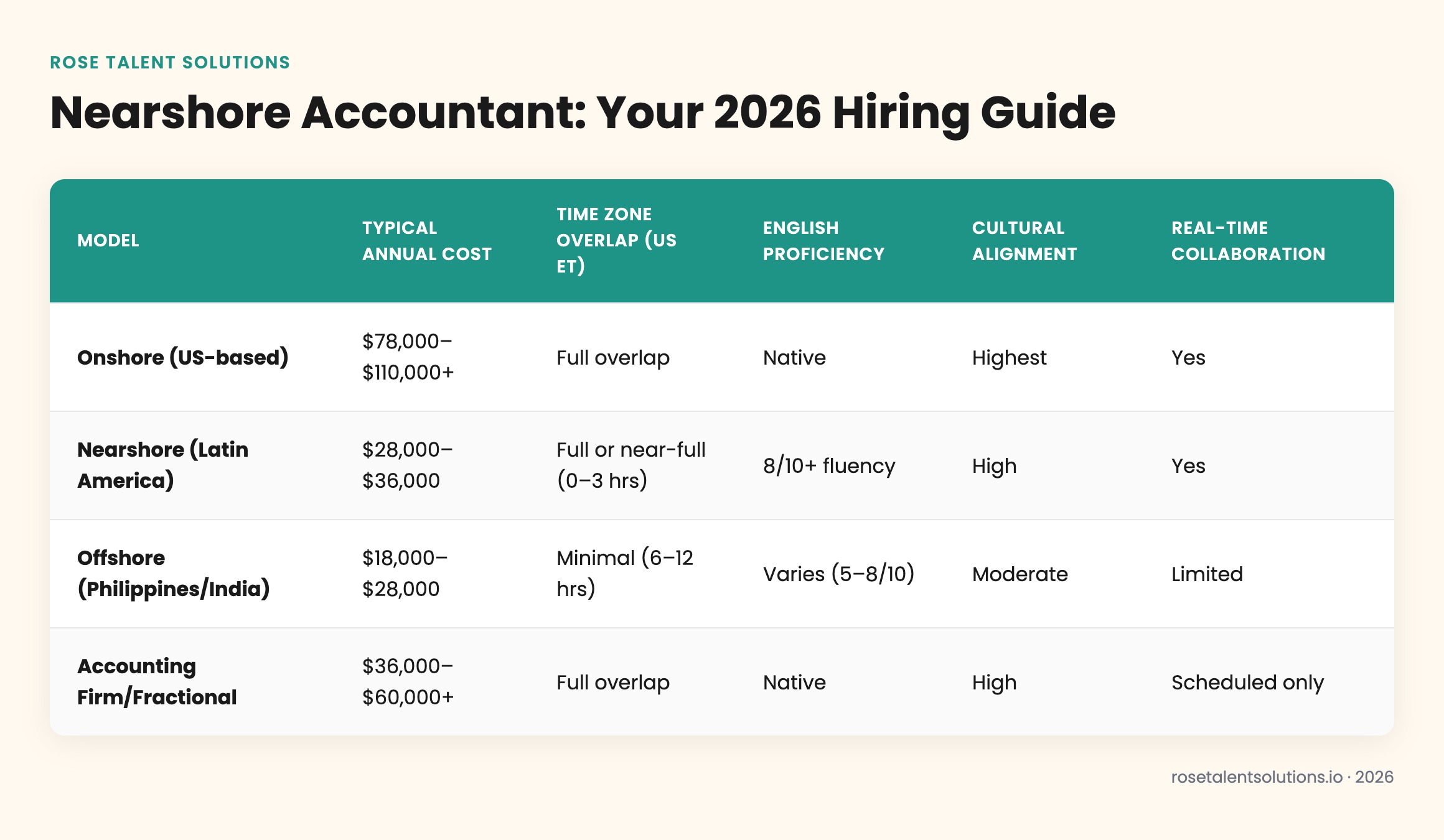
| Model | Typical Annual Cost | Time Zone Overlap (US ET) | English Proficiency | Cultural Alignment | Real-Time Collaboration |
|---|---|---|---|---|---|
| Onshore (US-based) | $78,000–$110,000+ | Full overlap | Native | Highest | Yes |
| Nearshore (Latin America) | $28,000–$36,000 | Full or near-full (0–3 hrs) | 8/10+ fluency | High | Yes |
| Offshore (Philippines/India) | $18,000–$28,000 | Minimal (6–12 hrs) | Varies (5–8/10) | Moderate | Limited |
| Accounting Firm/Fractional | $36,000–$60,000+ | Full overlap | Native | High | Scheduled only |
What Tasks Can a Nearshore Accountant Handle in 2026?
The scope is broader than most business owners expect. A well-vetted nearshore accountant isn't a data-entry clerk — they're a trained finance professional who can own significant portions of your back office. The exact scope depends on the candidate's background and your software stack, but here's what these hires routinely manage:
- Accounts payable and accounts receivable management
- Bank and credit card reconciliation
- Month-end and year-end close processes
- Payroll processing and reporting
- QuickBooks, Xero, or FreshBooks maintenance
- Financial statement preparation (P&L, balance sheet, cash flow)
- Invoice generation and collections follow-up
- Expense categorization and reporting
- Coordination with your CPA for tax prep
- Budget tracking and variance analysis
The accounting talent pipeline feeding this demand is substantial and growing. According to the UN Women Gender Snapshot 2023, Latin America has among the highest female tertiary education enrollment rates in the developing world — a workforce demographic that disproportionately enters accounting and finance roles and drives the region's deep professional talent bench. Separately, ECLAC's Social Panorama of Latin America 2022 documents significant expansion in university-educated professionals across Colombia, Mexico, and Argentina — the three countries that produce the largest share of Rose's accounting candidates.
One differentiator Rose builds in: every team member is paired with a role-specific AI copilot trained on the exact software they'll use — QuickBooks, Xero, Buildium, AppFolio, and others. That means your accountant isn't learning your tools on your dime. They arrive already oriented to your stack. Learn more about how this works on Rose's AI advantage page.
"Accounting talent in Latin America has matured significantly over the past decade. Universities in Colombia, Mexico, and Argentina now produce graduates who are not only technically strong but increasingly fluent in US GAAP and international reporting standards." — Diego Solano, Partner at BDO Colombia, speaking at the 2023 ICAC Latin America Finance Summit (2023)
The hidden cost of offshore accounting isn't the hourly rate — it's the communication lag. When your bookkeeper is 10 hours ahead and batches responses overnight, a simple vendor dispute that should take 20 minutes stretches into a 3-day back-and-forth. Nearshore eliminates that friction entirely.
How Rose's Nearshore Accountant Placement Process Works in 2026
Understanding the process helps you set realistic expectations. Rose isn't a job board — it's a managed staffing model. You're not screening 40 resumes. You tell Rose what you need and they surface a matched candidate, typically within a week. Here's how the placement sequence runs:
Intake Call
Rose's team learns your accounting stack, volume, industry, and specific skill requirements. This shapes the candidate profile — not a generic accounting hire, but one matched to your actual workflows.
Vetting & Matching
Candidates go through English proficiency screening (8/10+ required), skills assessment, and background verification. Rose presents only those who clear every bar.
Interview & Selection
You interview the shortlisted candidate. You make the call. Rose facilitates, but the decision is yours.
Onboarding & AI Copilot Setup
Your team member's role-specific AI copilot is configured for your software stack before day one. Rose handles HR and payroll from the first day forward.
Ongoing Management
Rose stays in the background handling HR, compliance, and performance support. If the fit isn't right, you get a free replacement — no restart fees, no delays.
If you want to see the full service model before committing, Rose's bookkeeping and accounting staffing page outlines exactly what's included at the $2,500/month flat rate.

Is a Nearshore Accountant Right for Your Business in 2026? Pros and Cons
The nearshore model works extremely well for a specific type of business — and it's worth being honest about where it fits and where it doesn't. The accounting talent shortage in the US is not improving in the short term. According to the AICPA (2023), the number of accounting graduates sitting for the CPA exam has declined for five consecutive years. Meanwhile, McKinsey's State of Organizations 2023 report found that talent scarcity in specialized back-office functions — including finance and accounting — is ranked among the top five operational risks cited by mid-market executives globally. Nearshore staffing is increasingly how smart operators bridge that gap without overpaying or underdelivering on quality.
That said, there are tradeoffs worth naming clearly. Here's an honest breakdown:
Pros of Nearshore Accounting
- Full time zone overlap with US/Canada — real-time communication, no batch delays
- 60–70% cost reduction versus a US staff accountant hire
- Fluent English (8/10+ proficiency floor at Rose)
- Familiar with US business culture and professional norms
- Dedicated full-time hire — not a shared resource like a bookkeeping service
- Software-trained from day one via AI copilot
- No long-term contract — month-to-month with 30-day exit
Cons / Things to Consider
- Not a licensed CPA — cannot sign off on audits or file taxes as the preparer of record
- Requires clear onboarding and documentation from your side for first 2–4 weeks
- Best suited for businesses with consistent, recurring accounting workflows — not one-off projects
- Slight (0–3 hour) time zone difference may require minor schedule coordination for West Coast businesses
The bottom line: if you're a US or Canadian business with recurring accounting needs — payroll, reconciliation, AP/AR, reporting — and you're currently paying a US employee or a bookkeeping firm more than $30,000 a year for that work, a nearshore accountant almost certainly makes financial sense. If you need a licensed CPA signatory, you pair them with your existing CPA — your nearshore accountant does the prep work that currently costs your CPA's billing rate.
Businesses exploring the broader category of nearshore virtual staffing — beyond just accounting — can start with this overview of what a nearshore virtual assistant actually does and how the model applies across functions from operations to customer service. And if you're evaluating agencies specifically, this guide to choosing a nearshore staffing agency walks through the vetting criteria that separate quality providers from resume-mills.
How to Get Started Hiring a Nearshore Accountant in 2026
The process is faster than most business owners expect. Rose typically has a matched candidate ready for your interview within one week of intake. The flat $2,500/month rate covers everything — there are no add-on fees for recruiting, payroll processing, or HR management. If the placement isn't the right fit, Rose replaces the team member at no additional cost. No long-term contract means you're not locked in if your needs change.
Remote and distributed work models have permanently shifted what "staffing" looks like for finance teams. Gallup's Future of Hybrid Work report (2022) found that 60% of remote-capable employees prefer a fully remote or hybrid arrangement — a structural preference that has expanded the global talent pool available to US businesses far beyond domestic borders. Nearshore accounting is the highest-trust expression of that shift: same hours, same responsiveness, a fraction of the cost.
If you're ready to explore a placement, start here to book your intake call with Rose's team. The conversation takes 20 minutes and gives you a clear picture of who you'd be hiring and what they'd own from week one.