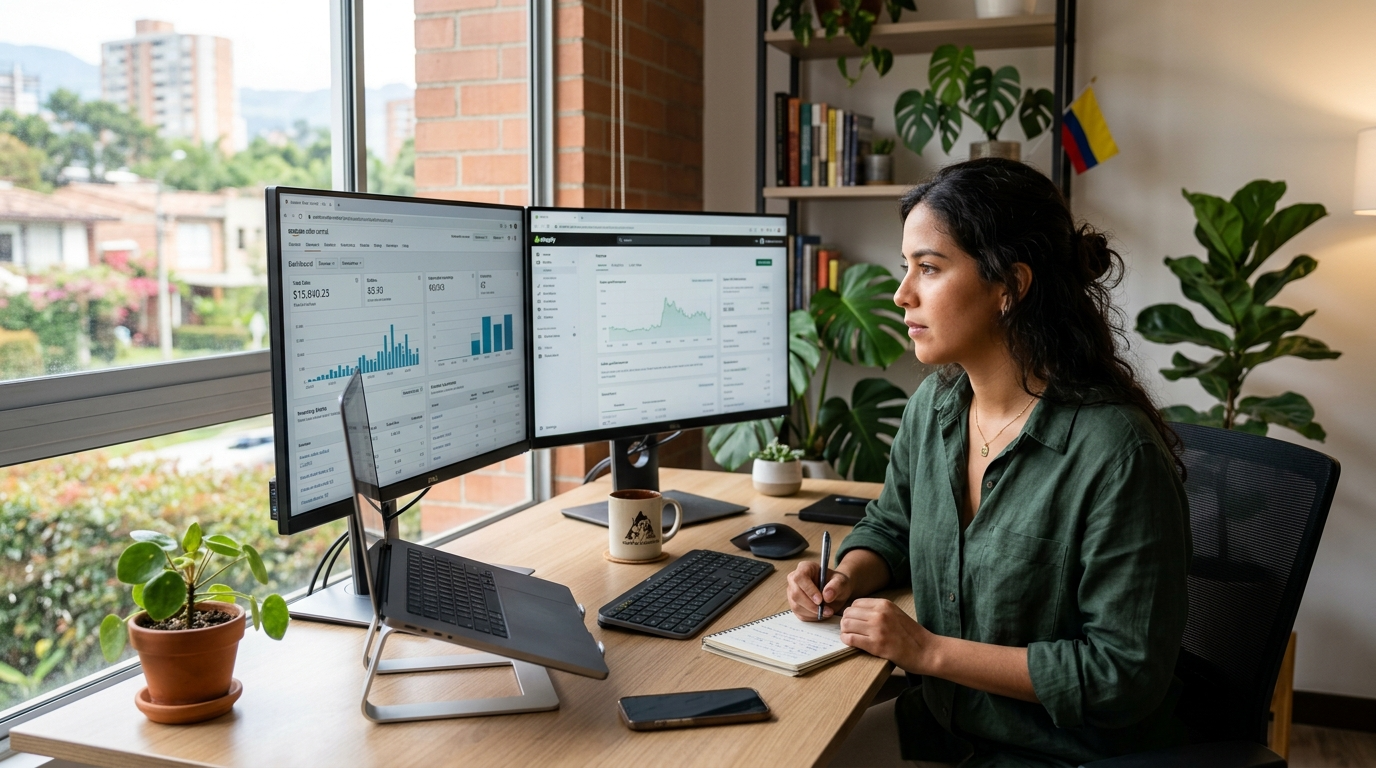
Nearshore virtual assistants have quietly become the engine behind some of the fastest-growing multichannel ecommerce brands in North America. If you are selling on two or more platforms — Amazon, Shopify, Walmart Marketplace, TikTok Shop, eBay — you already know the operational load multiplies with every channel you add. Listings need to stay synced. Inventory levels need to be watched in real time. Customer tickets pile up across five inboxes simultaneously. Hiring a full-time in-house coordinator for each platform is not financially rational. A single, well-trained multichannel ecommerce virtual assistant handles all of it — and the best ones come from Latin America, working your time zone, for a fraction of what a US-based hire costs.
This guide breaks down exactly what a multichannel ecommerce VA does, how to hire one in 2026, what to pay, and which tasks you can offload on day one. By the end, you will know whether a nearshore VA is the right move for your operation — and what to look for when you hire.
What Does a Multichannel Ecommerce Virtual Assistant Actually Do in 2026?
A multichannel ecommerce virtual assistant is a remote operations specialist trained to manage the day-to-day workflow across multiple selling platforms from a single role. Rather than hiring one person for Amazon, another for Shopify, and a third for Walmart, a multichannel VA handles the cross-platform coordination that most sellers underestimate until it breaks something. The role spans listing management, order processing, customer communications, inventory syncing, and platform-specific compliance — all under one headcount cost.
The practical scope of the role includes: writing and optimizing product listings with SEO-friendly copy, updating inventory quantities before stockouts happen, managing returns and refund workflows, monitoring sponsored ad performance dashboards, and flagging policy violations before they trigger account suspensions. At Rose Talent Solutions, every VA ships with a role-specific AI copilot trained on the exact platforms your business runs — so they are not learning Seller Central from a YouTube tutorial on your dime.

Merchants selling on three or more channels generate 143% more revenue on average than single-channel sellers, according to Shopify's Future of Commerce (2024) — but that revenue only materializes if operations can keep up. Most small and mid-size ecommerce teams cannot, which is why a dedicated VA for this role is less a luxury and more a structural necessity by the time you cross $500K in annual revenue.
How Nearshore VAs Outperform Offshore for Multichannel Ecommerce in 2026
The offshore VA model — sourced from regions with a 6-to-12-hour time difference from the US — was built for asynchronous tasks: data entry, graphic design, back-office processing that does not require real-time availability. Multichannel ecommerce is not that. A customer who orders on Walmart Marketplace at 11am Eastern and gets an automated wrong-item notification expects a human response before they file a dispute. An inventory sync failure that happens at 2pm your time needs to be caught and corrected before it compounds into a stockout on three platforms. Time zone alignment is not a comfort feature — it is an operational requirement.
Nearshore VAs based in Latin America — Colombia, Mexico, Costa Rica, Argentina — operate on Eastern, Central, or Pacific time naturally. They are online when your 3PL warehouse opens. They are online when your Shopify support queue spikes after a flash sale. They communicate in fluent English with an 8/10+ proficiency baseline, which means your customers and your internal team interact with them without friction. If you have explored hiring a VA specifically for Amazon customer service, you already know how much the time zone issue matters when a negative review clock is ticking.
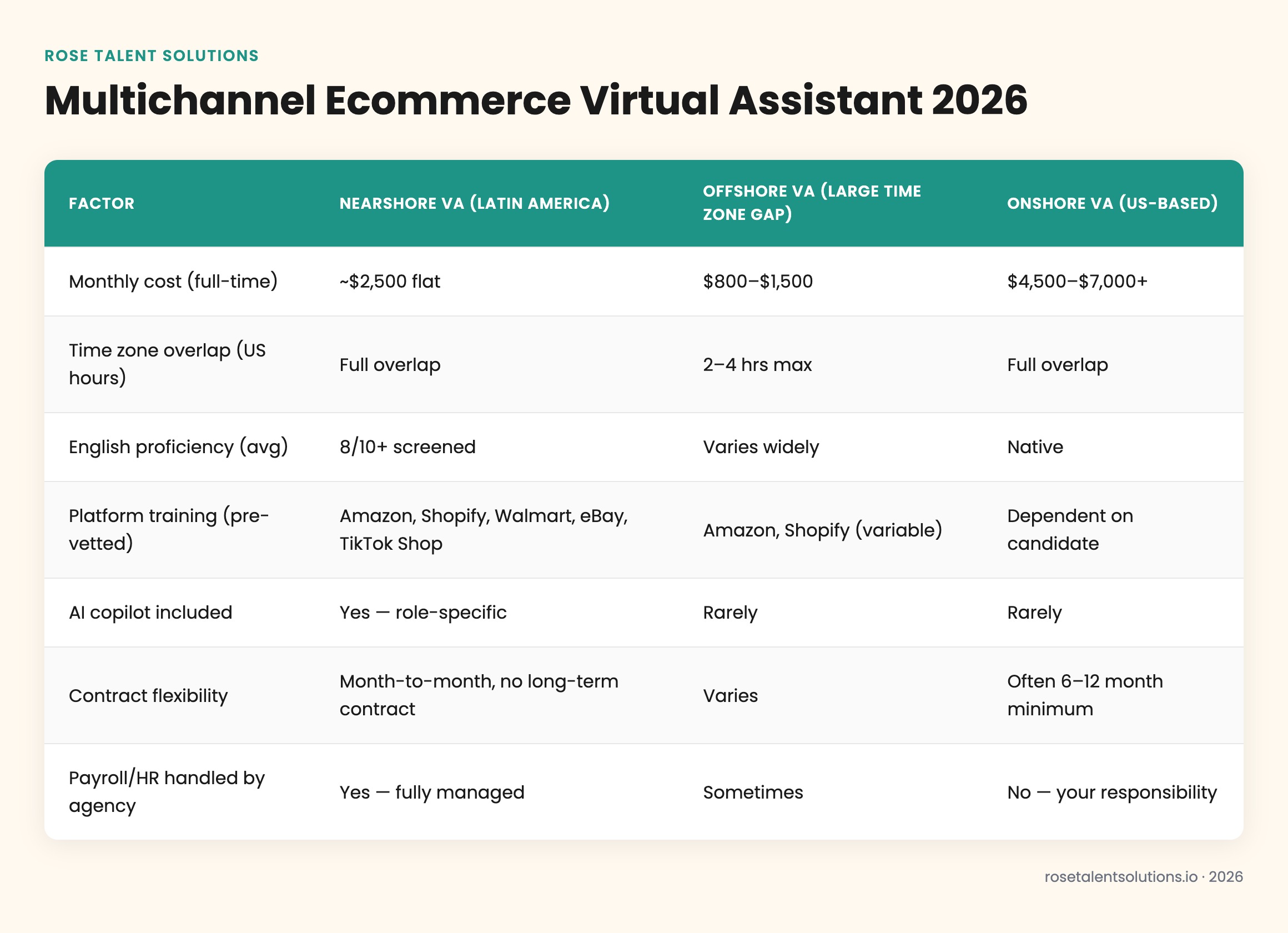
| Factor | Nearshore VA (Latin America) | Offshore VA (Large Time Zone Gap) | Onshore VA (US-based) |
|---|---|---|---|
| Monthly cost (full-time) | ~$2,500 flat | $800–$1,500 | $4,500–$7,000+ |
| Time zone overlap (US hours) | Full overlap | 2–4 hrs max | Full overlap |
| English proficiency (avg) | 8/10+ screened | Varies widely | Native |
| Platform training (pre-vetted) | Amazon, Shopify, Walmart, eBay, TikTok Shop | Amazon, Shopify (variable) | Dependent on candidate |
| AI copilot included | Yes — role-specific | Rarely | Rarely |
| Contract flexibility | Month-to-month, no long-term contract | Varies | Often 6–12 month minimum |
| Payroll/HR handled by agency | Yes — fully managed | Sometimes | No — your responsibility |
Which Platforms Can a Multichannel Ecommerce VA Manage for You?
The short answer is: any platform that has a web-based seller dashboard. The practical answer depends on what your VA has been specifically trained on before their first day with you. Rose vets for hands-on experience across the major platforms US sellers actually use in 2026. Here is what a well-rounded multichannel VA should be ready to handle on day one:
- Amazon Seller Central — listing optimization, FBA shipment creation, case management, review monitoring, PPC dashboard checks. For a deeper look at what this role involves, see our guide on what an Amazon Seller Central virtual assistant actually manages.
- Shopify — order processing, app integrations, discount code management, abandoned cart follow-up, theme content updates.
- Walmart Marketplace — item setup, pricing rules, returns processing, fulfillment exception handling.
- eBay — listing creation, Best Offer responses, feedback management, promoted listing adjustments.
- TikTok Shop — product catalog uploads, creator affiliate program coordination, order dispute handling.
- Etsy — listing renewal, star seller metrics monitoring, shop announcement updates.
Beyond the storefronts themselves, a multichannel VA typically works inside inventory management tools like SkuVault, Linnworks, or Skubana to keep stock levels synced across channels. This is one of the highest-leverage tasks they can own — a single VA monitoring reorder points across five channels prevents the kind of oversell that tanks your seller metrics on Amazon and Walmart simultaneously. If inventory coordination is your primary pain point, our breakdown of what an inventory management virtual assistant for ecommerce handles day-to-day goes deeper on that workflow.

US ecommerce revenue topped $1.19 trillion in 2023, according to US Census Bureau Retail E-Commerce Sales data (2024) — and the brands capturing that growth are overwhelmingly multichannel. The operational infrastructure to support multichannel selling does not scale with one overworked founder.
Remote work adoption has permanently expanded the talent pool available to ecommerce operators. According to Pew Research Center (2023), the normalization of distributed work arrangements has made it far easier for US businesses to build operational teams across time zones — provided those team members share meaningful overlap with the home office schedule. That last point is exactly where Latin America-based nearshore VAs have a structural advantage over talent pools located 8–12 hours away.
The hidden cost of managing multichannel ecommerce yourself is not just your time — it is the listing errors, stockouts, and unanswered customer tickets that erode your seller ratings across every platform simultaneously. A single nearshore VA monitoring all channels in real time during your business hours costs less per month than one Amazon suspension appeal with a consultant.
How to Hire a Multichannel Ecommerce VA in 2026: The Rose Process
Most ecommerce operators who have tried freelance platforms like Upwork or Fiverr for VA hiring report the same experience: high initial effort to vet candidates, inconsistent quality, and significant ramp time before anyone is productive. The alternative is a managed placement model — where the recruiting, skills testing, platform-specific vetting, and ongoing HR are handled for you. Rose Talent Solutions places full-time nearshore ecommerce VAs based in Latin America at a flat $2,500/month with no long-term contract and a free replacement if the match is not right. The process from first call to first day looks like this:
Intake Call (Day 1)
You walk through your current channel mix, the specific tasks you need covered, the tools your team uses, and any non-negotiables (time zone windows, communication style, platform certifications). This takes 30 minutes.
Candidate Matching (Days 2–5)
Rose matches you with pre-vetted candidates from Latin America who have documented hands-on experience with your specific platforms. Every candidate has passed English proficiency screening at 8/10 or above and completed platform skills assessments.
Your Interview (Days 5–6)
You interview your top match. Most clients meet one to two candidates and move forward with their first choice — the vetting is done before the call, so you are choosing fit, not screening from scratch.
AI Copilot Onboarding (Day 7)
Your VA's role-specific AI copilot — trained on your platforms (Amazon, Shopify, Walmart, etc.) — is activated before their first day. This cuts productive ramp time from weeks to days.
Ongoing Management
Rose handles payroll, HR, performance check-ins, and compliance. If at any point the VA is not the right fit, Rose replaces them at no additional cost — no fee, no re-signup, no delay.
If your ecommerce operation also needs support with financial reporting, reconciliation, or COGS tracking — common at the $1M+ revenue stage — Rose's nearshore bookkeeping and accounting VAs work alongside your ecommerce coordinator so your numbers stay clean without a separate hire. And if you want to explore the full range of roles Rose places, the getting started page walks through the intake process in detail.
"Remote work has fundamentally changed what's possible for small business hiring. The constraint used to be geography — the best people for a role had to live near you. That constraint is gone." — Matt Mullenweg, CEO at Automattic (2023 Distributed Work Summit)
What Does a Multichannel Ecommerce VA Cost in 2026? Nearshore vs. DIY vs. Agency
Pricing for VA talent in 2026 varies significantly by model. Freelance platforms give you the lowest sticker price but the highest hidden costs: time spent vetting, re-hiring after churn, gaps in coverage, and no backup if your VA disappears two weeks before peak season. Staffing agencies charge a markup but handle everything — recruiting, payroll, compliance, replacement. Here is an honest breakdown:
Managed Nearshore VA (Rose Model)
- Flat $2,500/month — no recruiting fee, no markup spikes
- Fully managed payroll and HR — zero compliance burden on you
- Free replacement if not a fit — risk stays with the agency
- AI copilot included — faster ramp, fewer errors
- Month-to-month, no long-term contract — cancel with 30 days written notice
DIY Freelance Platform
- $800–$1,500/month sticker price but 20–40 hours of your time to vet
- No backup if VA quits — you restart the search solo
- No platform skills verification — you discover gaps after hire
- Payroll and tax compliance is your problem
- No AI tooling included — you build it or they work without it
The average cost to recruit and onboard a single employee in the US is $4,700, according to SHRM's cost-per-hire benchmarks (2024) — and that does not include the productivity loss during the ramp period. For an ecommerce VA role that turns over every 12–18 months on a freelance platform, those recruiting cycles add up fast. A managed placement model eliminates that recurring cost entirely.
The median annual salary for a full-time US-based ecommerce operations coordinator exceeds $58,000, according to the US Bureau of Labor Statistics (2024) — before benefits, payroll taxes, or equipment. At $2,500/month, a nearshore VA from Latin America runs $30,000/year all-in. The math does not require a spreadsheet.
According to McKinsey Global Institute's Future of Work report (2023), businesses that leverage global talent pools for operational roles reduce labor costs by 20–40% without meaningful quality trade-offs — provided they hire for time zone fit, language proficiency, and role-specific skills rather than cost alone. That is exactly the sourcing model Rose is built around: Latin America-based talent, US hours, screened for the specific platforms your ecommerce business runs on.
For ecommerce brands specifically looking to expand into Amazon's catalog deeper — whether that means product research or building a more defensible private label — the skill sets required shift. Our guide on what an Amazon product research virtual assistant does and how to hire one covers that specialized role in full.