
What Is a Mobile App Developer Recruiter — and Why 2026 Changed the Game
Nearshore recruiting for mobile app developers has moved from niche experiment to mainstream strategy in the past 18 months. A mobile app developer recruiter is a specialist who sources, screens, and places engineers — iOS, Android, React Native, Flutter, or cross-platform — into product teams that need to ship faster than internal HR can move. They differ from general tech recruiters because they speak the language: they know the difference between a senior SwiftUI engineer and a UIKit generalist, and they won't waste your time sending the wrong stack.
What makes 2026 different is the talent supply picture. The global mobile developer shortage has tightened. According to the U.S. Bureau of Labor Statistics (2024), software developer employment is projected to grow 25% through 2032 — nearly four times the average for all occupations. That growth sounds good until you realize demand is compressing the available pool at the top of the market, and US-based recruiters are competing for the same 50 resumes on LinkedIn.
The smarter move in 2026 is to pair a mobile app developer recruiter who specializes in nearshore Latin American talent with a staffing model that gets your engineer placed in days, not months. That's the core thesis of this guide. We'll cover how recruiting works, what it costs, how to evaluate a recruiter, and why the nearshore model consistently beats both onshore and offshore alternatives for most product teams.
How Mobile App Developer Recruiting Works in 2026
The recruiting funnel for mobile developers has five distinct stages, and where most companies stall is stages two and three — technical screening and culture fit assessment. A generalist recruiter can post jobs and collect resumes. A specialist mobile app developer recruiter adds value by pre-screening for framework depth, portfolio quality, and code review habits before a single resume hits your inbox.
Understanding what you're buying when you engage a recruiter matters. There are three common engagement models: contingency (you pay only on placement, typically 15–25% of first-year salary), retained search (upfront fee plus success fee, used for senior/executive roles), and staff augmentation or staffing agency models (a flat monthly rate for a fully managed team member). For most small-to-midsize product teams, the staffing model has become the default because it removes the one-time fee spike and gives you a managed, replaceable resource with HR and payroll handled. For a deeper breakdown of how these models compare structurally, the nearshore staffing agency overview on the Rose blog walks through the operational differences in plain terms.

According to Statista's global smartphone user data (2024), the number of smartphone users worldwide is projected to exceed 7.1 billion by 2028 — a figure that explains why mobile development capacity is now a strategic constraint, not a nice-to-have. Every product team that delays a mobile hire is leaving market share on the table while their developer search drags on.
Onshore vs. Offshore vs. Nearshore: The 2026 Recruiting Comparison
Before you engage any mobile app developer recruiter, you need clarity on which talent geography you're targeting. Each model carries real trade-offs that affect developer quality, collaboration, cost, and your ability to iterate quickly. This table gives you the honest picture.
| Factor | Onshore (US/Canada) | Offshore (India/Philippines) | Nearshore (Latin America) |
|---|---|---|---|
| Avg. monthly cost (mid-level dev) | $10,000–$15,000+ | $1,500–$2,500 | $2,500–$5,000 |
| Timezone overlap with US East | Full overlap | 0–4 hours | Full or near-full overlap |
| English proficiency (avg.) | Native | Variable (5–7/10) | High (8/10+ screened) |
| Time-to-fill (specialist recruiter) | 45–90 days | 14–30 days | 7–21 days |
| Cultural alignment with US teams | Very high | Moderate | High |
| Contract flexibility | Low (FTE norms) | Variable | High (month-to-month options) |
| Replacement guarantee available? | Rarely | Sometimes | Yes (at no additional cost) |
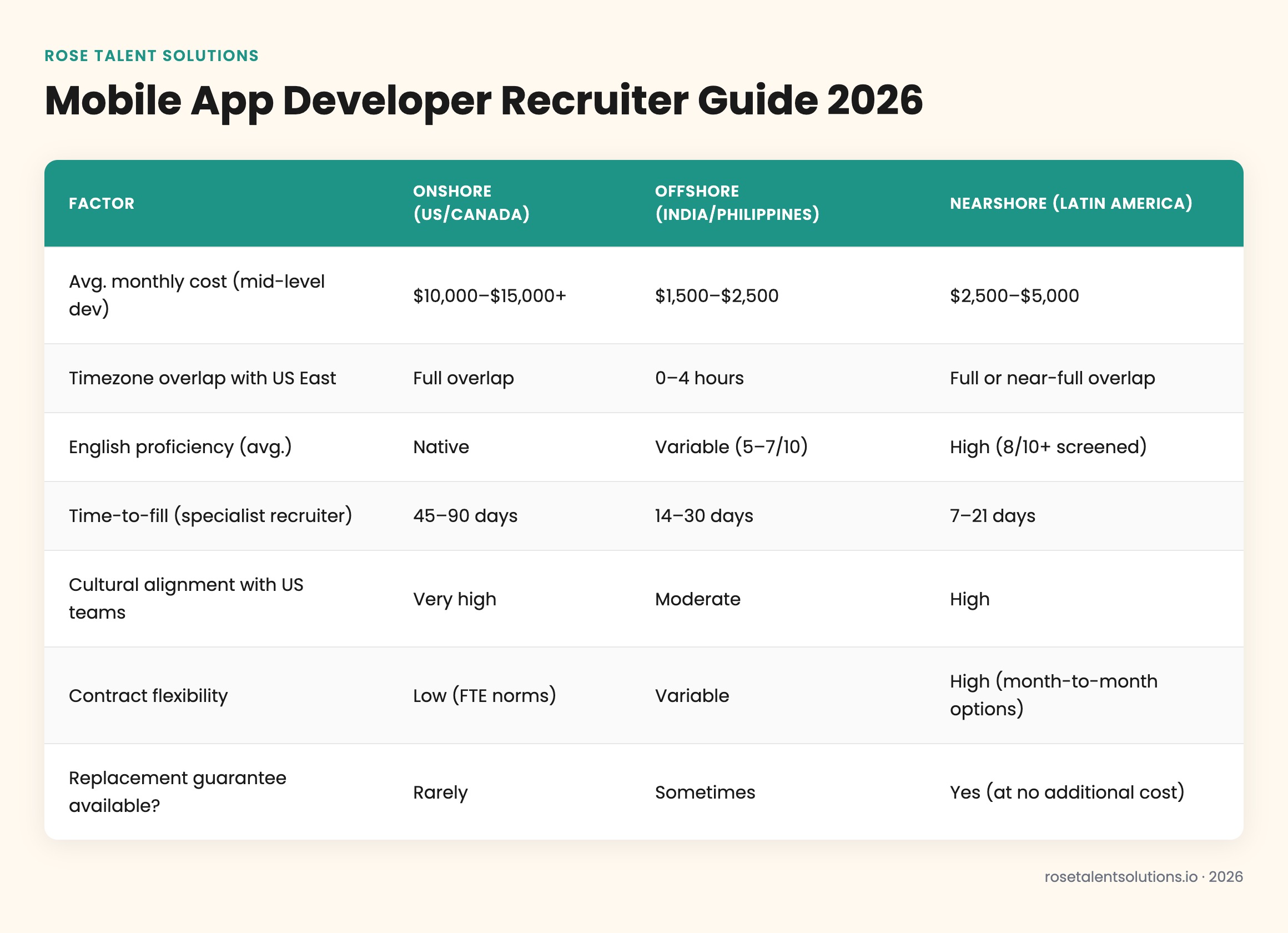
The nearshore model wins on the combination of timezone overlap, English proficiency, and cost — not on any single factor alone. If you're running daily standups at 10am EST, a developer in Bogotá or Buenos Aires is right there with you. A developer in Bangalore is already at 8pm, and the collaboration tax compounds over every sprint. For a fuller breakdown of how these three models stack up across more dimensions, see this nearshore vs. offshore vs. onshore comparison that examines the trade-offs in detail.
"The timezone issue with offshore development isn't just an inconvenience — it's a compounding tax on every decision. By the time you get an answer to a blocker, your sprint is half a day behind." — Matt Watson, Founder & CEO at Full Scale (2023)
How to Evaluate a Mobile App Developer Recruiter Before You Sign
Not all mobile app developer recruiters are equal. The market is flooded with generalist staffing firms that added "mobile development" to their service page after 2022. Here's how to separate specialists from resume-pushers in under 30 minutes.
First, ask the recruiter to define the role back to you. A specialist should be able to distinguish your required stack, name the core libraries relevant to your product category (e.g., ARKit for AR features, Stripe SDK for payments), and flag realistic salary or rate bands without Googling them live. If they can't, they're sourcing from job boards the same way you would.
The hidden cost of a mismatched developer hire isn't the recruiter fee — it's the 3–6 months of delayed product milestones before you admit the fit is wrong and restart the search. A recruiter who offers a free replacement guarantee removes that risk entirely.
Second, ask about their screening process. The gold standard is: resume review → async technical assessment → live coding interview → communication/collaboration screen → reference check. Any recruiter skipping the live coding or communication screen is cutting corners on the steps that predict on-the-job performance, not resume quality. According to SHRM's workforce research (2023), the average cost of a bad hire is equivalent to 50–60% of that employee's annual salary — a figure that makes a thorough screening process look cheap by comparison.
Third, check their replacement policy. The strongest recruiters stand behind their placements. At Rose Talent Solutions, if a team member isn't the right fit, we replace them at no additional cost — no long-term contract required to access that protection. That's a concrete risk reversal, not a marketing promise. You can review the full AI-advantage approach Rose uses to match and onboard technical talent to see how the vetting layer works in practice.
What Does a Mobile App Developer Recruiter Cost in 2026?
Cost structure varies dramatically by engagement model, and understanding the math prevents sticker shock on both ends. Here's what the 2026 market looks like across the three main models.
Contingency recruitment for a mid-level mobile developer in the US typically runs 18–22% of first-year base salary. If the developer earns $130,000, you're writing a $23,400–$28,600 check on placement day — with no guarantee they'll still be there in six months. This model made sense when developer salaries were lower and job tenure was longer. In 2026, it's increasingly hard to justify.
Retained search for senior mobile engineers (principal, lead, staff-level) typically runs $20,000–$50,000 all-in, paid in installments. Appropriate for founding engineer or CTO-track searches. Most product teams don't need retained search for standard development roles.
Staffing/augmentation flat rate is where the nearshore model shines. At $2,500/month, you get a full-time (40 hrs/week) nearshore mobile developer or developer-adjacent role — recruiting, vetting, payroll, HR, and ongoing management all included. Compare that to the $23,000+ contingency fee for a single onshore placement, and the math becomes obvious within the first quarter. For context on what Latin American developer and technical talent earns in this model, see the breakdown of average salary ranges for Latin American virtual and technical staff.
According to McKinsey Digital's technology trends research (2024), companies that adopt flexible staffing models for technical roles reduce total talent acquisition cost by 30–40% over a 24-month horizon compared to traditional FTE hiring cycles. The key driver isn't the hourly rate — it's eliminating the repeated recruiting fees each time a developer churns.
The talent cost gap between regions is also widening. According to the International Labour Organization's global wage data (2023), median technology wages in Latin America remain 55–65% below US equivalents at comparable skill levels — a structural gap that nearshore staffing models translate directly into client savings without compromising on output quality. This is not about cheap labor — it's about accessing a skilled, English-fluent, timezone-aligned workforce at a rate that makes full-time dedicated placement economically rational for teams that couldn't justify a $130K US hire.
Nearshore Recruiting: Pros
- Full US timezone overlap — real-time standups, no async lag
- 8/10+ English proficiency screened before placement
- Flat $2,500/month — no placement fee spikes
- Replacement guarantee at no additional cost
- Month-to-month — no long-term contract lock-in
- AI copilot included, trained on your tech stack
Nearshore Recruiting: Considerations
- Smaller senior talent pool vs. onshore US market
- Regulatory differences require agency to manage compliance
- Not ideal for roles requiring US security clearance
How Rose Talent Solutions Handles Mobile App Developer Recruiting in 2026
Rose Talent Solutions is a nearshore staffing agency placing Latin American technical and operational talent with US, Canadian, and UK businesses. For mobile app developer recruiting specifically, the process is built around speed and fit — not volume.
Role Discovery
We map your stack, sprint cadence, and team culture in a 30-minute kickoff. This is where we separate "Flutter developer" from "Flutter developer who's shipped a fintech app to the App Store."
Sourcing & Technical Screen
Our recruiters pull from a pre-vetted Latin American developer network and run async technical assessments plus a live coding screen — before you see a single resume.
English & Communication Screen
Every candidate clears an 8/10+ English proficiency bar and a communication-style assessment. You shouldn't have to guess whether your developer can run a standup or write a clear PR description.
Client Interview
You interview the shortlisted candidate — typically 1–2 people, not a parade of 10 — and make the call. Most placements complete within 7 days of kickoff.
Managed Onboarding
We handle payroll, HR compliance, and onboarding. Your developer shows up on day one with their role-specific AI copilot trained on your tools and ready to contribute from the first sprint.
The Rose model is also built for teams that are still figuring out scope. Month-to-month terms mean you're not locked in while your product roadmap evolves. If the developer isn't the right fit after onboarding, we replace them at no additional cost. You can explore what a nearshore technical team member looks like in practice on the nearshore virtual assistant overview page, or jump directly to the get started page if you already know what you need.
According to Gallup's State of the Global Workplace (2023), only 23% of employees worldwide are engaged at work — but that number rises significantly when workers report having the right tools and clear role expectations from day one. The AI copilot Rose includes with every placement is designed specifically to close that gap: every developer arrives with a tool environment already configured for your stack, reducing the typical 2–4 week ramp-up to under a week.
If your product touches property management, accounting, or back-office operations alongside mobile development, Rose also places technical staff in those verticals — see the property management staffing page and the bookkeeping and accounting staffing page for role-specific details.
The bottom line for 2026: the best mobile app developer recruiter is one who combines specialist technical screening, real timezone alignment, and a risk reversal that protects you if the placement is wrong. Nearshore Latin American talent, placed through a flat-rate staffing model, is the configuration that checks all three boxes for most product teams operating at the $5M–$50M ARR stage.