
Nearshore medical virtual assistants have quietly become one of the most cost-effective staffing moves a healthcare-adjacent business can make in 2026 — but only if you understand what you're actually comparing. Most cost guides online bury the real numbers under vague hourly ranges and forget to mention the extras: recruiting fees, HR overhead, software licensing, and the productivity drag that comes with an 8-hour timezone gap. This post strips all of that away and gives you a clean, honest cost comparison across every major model so you can make a decision based on actual math, not marketing copy.
What Is a Medical Virtual Assistant (and Why the Agency Model Matters)?
A medical virtual assistant is a remote staff member who handles clinical-adjacent or administrative tasks for healthcare practices, medspas, billing companies, or health-tech operators. Common duties include patient scheduling, insurance verification, prior authorization follow-up, medical billing support, EHR data entry, and after-hours triage routing. The role requires HIPAA awareness, strong English communication, and familiarity with practice management platforms like Kareo, AdvancedMD, or DrChrono.
The agency model matters because who manages the VA after placement determines 80% of your actual cost. A cheap hourly rate from a freelance marketplace sounds appealing until you factor in the hours you spend recruiting, onboarding, managing payroll compliance, and replacing no-shows. A full-service agency wraps all of that into one number. That's the comparison this post is built around.
According to SHRM's Human Capital Benchmarking Report (2023), the average cost-per-hire across industries sits above $4,000 — and healthcare administrative roles skew higher due to credentialing requirements and specialized screening. That's money most small and mid-sized practices spend before the new hire takes a single call. A managed agency model eliminates that entire spend from your budget line.
How 2026 Medical VA Agency Pricing Actually Breaks Down
There are four staffing models you'll realistically encounter when shopping for a medical VA in 2026. Each has a different cost structure, risk profile, and operational overhead for your team. Here's how they stack up honestly.
U.S. in-house medical administrative salaries averaged between $55,000 and $72,000 annually in 2024, according to the U.S. Bureau of Labor Statistics (2024) — and that figure does not include benefits, payroll taxes, PTO, or the cost of replacing turnover, which runs at 20–30% of annual salary according to industry norms. When you annualize a nearshore agency at $2,500/month, you land at $30,000/year, fully managed. The math is not close.
If you want a deeper dive into how Latin American VA pricing compares across different engagement types, the full Latin America virtual assistant cost breakdown on the Rose blog walks through hourly vs. flat-rate models with real numbers.

The 2026 Medical VA Agency Cost Comparison Table
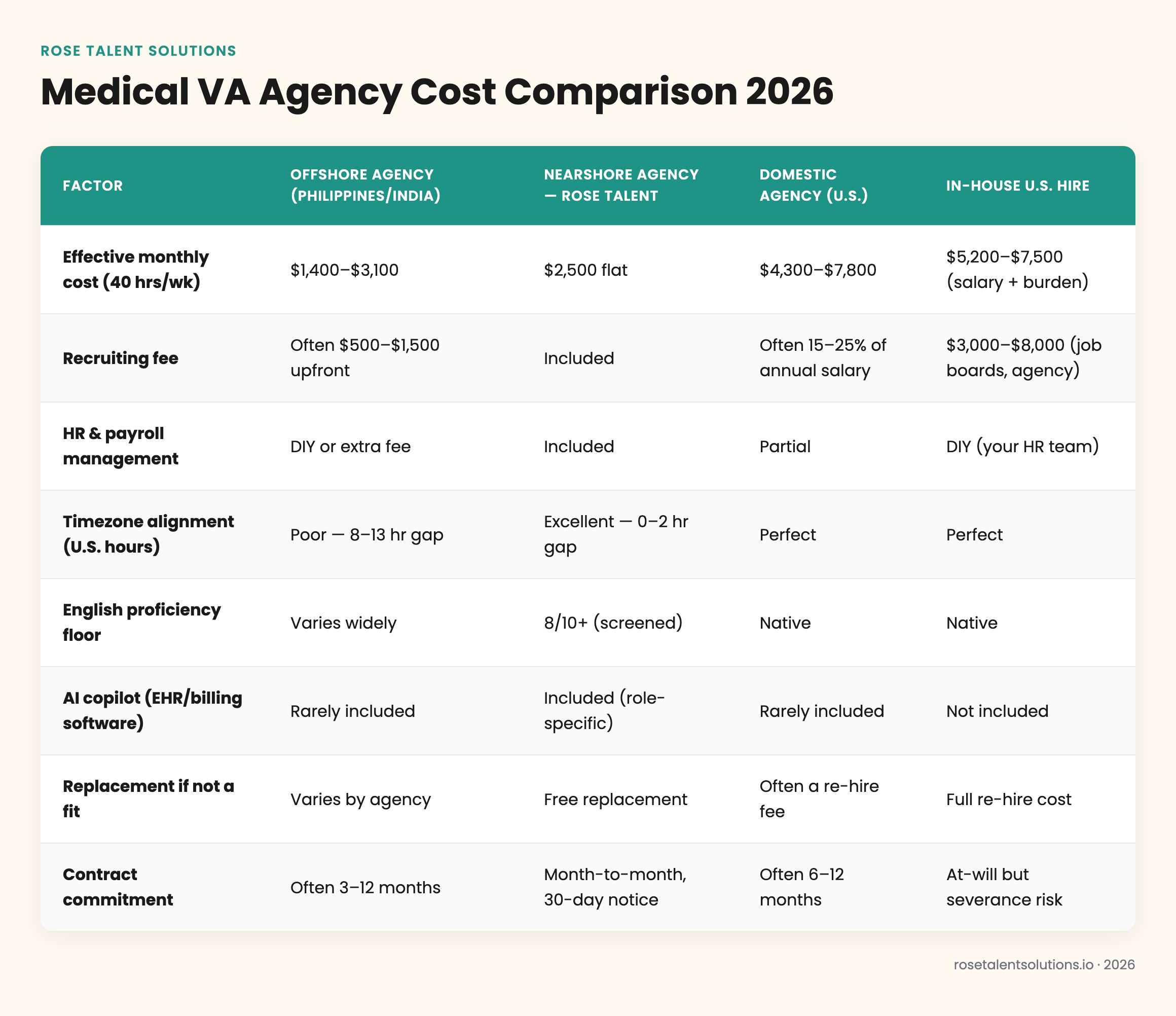
The table below compares four staffing models across eight factors that actually affect your total cost of ownership. Use this as your decision framework, not just the headline hourly rate.
| Factor | Offshore Agency (Philippines/India) | Nearshore Agency — Rose Talent | Domestic Agency (U.S.) | In-House U.S. Hire |
|---|---|---|---|---|
| Effective monthly cost (40 hrs/wk) | $1,400–$3,100 | $2,500 flat | $4,300–$7,800 | $5,200–$7,500 (salary + burden) |
| Recruiting fee | Often $500–$1,500 upfront | Included | Often 15–25% of annual salary | $3,000–$8,000 (job boards, agency) |
| HR & payroll management | DIY or extra fee | Included | Partial | DIY (your HR team) |
| Timezone alignment (U.S. hours) | Poor — 8–13 hr gap | Excellent — 0–2 hr gap | Perfect | Perfect |
| English proficiency floor | Varies widely | 8/10+ (screened) | Native | Native |
| AI copilot (EHR/billing software) | Rarely included | Included (role-specific) | Rarely included | Not included |
| Replacement if not a fit | Varies by agency | Free replacement | Often a re-hire fee | Full re-hire cost |
| Contract commitment | Often 3–12 months | Month-to-month, 30-day notice | Often 6–12 months | At-will but severance risk |
How Timezone Gaps Drive Hidden Costs in Offshore Medical VA Arrangements
The offshore hourly rate looks attractive until you map it against a real patient workflow. A prior authorization that requires three back-and-forth calls with an insurance rep — calls that happen between 9am and 4pm Eastern — cannot be efficiently handled by a VA who is asleep during those hours. Batching those calls to the next day extends claim timelines, delays patient care, and creates billing lag that compounds across dozens of active cases.
Offshore VA arrangements with 8–13 hour timezone gaps effectively convert full-time medical admin support into next-day support. For patient scheduling, prior auth, and insurance calls — where real-time response directly affects revenue — that lag has a measurable dollar cost that never appears on the agency invoice.
Nearshore VAs based in Latin America work your U.S. business hours in real time — no overnight batching, no delayed callbacks, no scheduling coordination overhead. For a detailed breakdown of how that plays out operationally, the nearshore vs. offshore vs. onshore comparison on the Rose blog goes deep on timezone, communication, and total cost differences across all three models.
According to McKinsey & Company (2023), poor-fit hires cost organizations 30–150% of that employee's annual salary when you account for lost productivity, management time, and re-hiring. For a medical VA earning $18/hr offshore, a single bad placement and re-hire cycle can erase 6–8 months of the apparent cost savings.

"Practices that move administrative burden off their clinical staff — especially scheduling and prior auth — see measurable reductions in physician burnout and claim denial rates within the first quarter." — Renee Dahring, Nurse Practitioner Business Coach and Healthcare Operations Consultant (2023)
Physician burnout and administrative overload are directly linked. The American Medical Association's 2023 Physician Burnout Survey found that 62% of physicians reported burnout — with administrative burden cited as the leading driver. Offloading that burden to a well-trained, timezone-aligned medical VA is one of the most direct levers a practice has.
What Does a Nearshore Medical VA Agency Include in 2026?
Not all agencies bundle the same services into their monthly rate. When you're doing a cost comparison, you need to know what "managed" actually means line by line. Here's what a full-service nearshore engagement with Rose Talent Solutions includes at $2,500/month.
Sourcing & Vetting
Rose recruits candidates from Latin America with verified healthcare administrative experience, English proficiency screened at 8/10 or higher, and background checks completed before you see a single profile.
Role-Specific AI Copilot Setup
Every team member ships with an AI copilot trained on the specific software your practice uses — Kareo, AdvancedMD, DrChrono, or similar. This cuts ramp time significantly compared to a cold hire. Learn more about how this works on the Rose AI Advantage page.
Payroll, HR & Compliance
Rose handles all payroll processing, local labor compliance in the VA's home country, and HR management. You have no employer-of-record liability and no payroll admin overhead.
Ongoing Performance Management
Your VA has a dedicated manager on the Rose side. If performance slips, Rose addresses it. If the placement is not a fit, Rose replaces the team member at no additional cost — that's the sole risk reversal, and it's a real one.
Month-to-Month Terms
No long-term contract. Cancel with 30 days written notice. The model is designed to earn your business every month, not lock you in.
For practices exploring what a fully managed nearshore staffing engagement looks like in practice, the Latin America staffing agency guide on the Rose blog covers the operational structure in detail — including how compliance and payroll work across different Latin American countries.
Nearshore vs. Offshore Medical VA: Pros and Cons in 2026
If you're still weighing nearshore against offshore purely on price, this grid is for you. The monthly difference between a cheap offshore placement and a managed nearshore engagement often narrows to under $500 when you account for management overhead — and flips entirely when you factor in one bad-fit replacement cycle.
Nearshore Medical VA (Latin America)
- Real-time U.S. business hour coverage — no overnight batching
- 8/10+ English floor — clearer patient communication
- All-in flat rate — no surprise fees for recruiting or HR
- AI copilot included — faster ramp on EHR and billing software
- Free replacement if placement isn't a fit
- Month-to-month — no long-term contract required
Offshore Medical VA (Philippines/India)
- 8–13 hour timezone gap — real-time patient calls are impractical
- English proficiency varies widely without a verified floor
- Recruiting and HR fees often added separately
- No standardized AI tool integration
- Replacement terms vary — often include re-placement fees
- Many agencies require 3–12 month commitments
The nearshore virtual assistant cost guide breaks down exactly how the all-in monthly math compares when you stop looking at headline rates and start accounting for every dollar the arrangement actually costs your business. It's one of the most referenced posts in this cluster for a reason.
According to Gallup (2023), U.S. businesses lose $1 trillion annually to voluntary employee turnover — a figure that makes the month-to-month, fully managed model structurally attractive compared to any arrangement where you carry the full replacement risk. Turnover in medical admin roles runs especially high, with the Medical Group Management Association reporting front-desk and billing staff turnover above 20% annually in many practices.
If you're ready to see how a nearshore medical VA fits your specific practice workflow, the Rose intake process takes under five minutes and gets you a matched candidate profile within days — not weeks.