
Nearshore medical records virtual assistants are quietly becoming the default hire for US healthcare practices that need reliable, HIPAA-trained support without the overhead of a full-time in-office employee. If your front desk is buried under release-of-information (ROI) requests, chart audits, and EHR data backlogs, a dedicated nearshore VA — based in Latin America, working your exact business hours — can clear that queue at a fraction of the cost of a local hire. This guide covers exactly what these VAs do, how HIPAA compliance works in a remote-staff model, and what to look for before you sign anything.
What Is a Medical Records Virtual Assistant?
A medical records virtual assistant is a trained remote staff member who manages the administrative side of patient health information. Core tasks include processing medical record requests, coordinating release-of-information workflows, auditing charts for completeness, entering clinical documentation into EHR platforms, and communicating with patients, attorneys, and insurers about record status. They work inside your existing software — Epic, Athenahealth, DrChrono, eClinicalWorks — and follow your internal SOPs rather than a generic agency script.
The role sits at the intersection of administrative precision and regulatory compliance. Because these VAs handle Protected Health Information (PHI), every compliant engagement requires a signed Business Associate Agreement (BAA) between your practice and the staffing agency before the VA touches a single record. That BAA legally binds the agency — and the VA — to HIPAA's Security and Privacy Rules under 45 CFR Parts 160 and 164.
The administrative burden on US medical practices is not shrinking. According to the American Medical Association's 2023 Prior Authorization Survey, physicians and their staff spend an average of 14 hours per week on prior authorizations, record requests, and related paperwork — time pulled directly from clinical care. Delegating the records function to a trained, HIPAA-aware virtual assistant recovers those hours without adding headcount to your payroll.
How HIPAA Compliance Works With a Remote VA in 2026
Remote work does not weaken HIPAA compliance — poor vetting does. A properly onboarded medical records VA operates under the same regulatory framework as an in-office HIM tech. Here is what a compliant engagement looks like in practice:
BAA Execution
The staffing agency signs a Business Associate Agreement with your practice before any PHI is accessed. This is non-negotiable under the HIPAA Omnibus Rule and shifts liability correctly between parties.
HIPAA Security Training
The VA completes documented HIPAA Privacy and Security training covering minimum necessary standards, breach notification, and proper PHI handling. Training records are retained and available for audit.
Secure Access Provisioning
The VA accesses your EHR and any shared drives through role-based permissions you control. VPN, multi-factor authentication, and encrypted communication channels (no personal email for PHI) are standard requirements.
Workstation Security Attestation
The VA's workstation must meet minimum standards: full-disk encryption, current OS patches, screen lock, and no unauthorized third-party software. Your practice can require a signed attestation before go-live.
Ongoing Audit Trail
All EHR activity is logged under the VA's individual credentials — never a shared login. Your compliance officer can pull access logs at any time to verify minimum necessary access.
The HHS Office for Civil Rights is clear that covered entities remain responsible for their business associates' compliance. That means your staffing agency's vetting process is part of your risk posture — not separate from it. Ask any agency you evaluate for their BAA template, training documentation, and workstation security policy before you engage.

What Tasks Can a Medical Records VA Handle in 2026?
A well-trained medical records VA covers far more ground than simple chart filing. Below are the task categories practices most commonly delegate:
- Release of Information (ROI): Processing patient, attorney, and insurer record requests, verifying valid authorizations, redacting non-responsive PHI, and coordinating delivery via fax, secure portal, or encrypted email.
- EHR Data Entry and Chart Completion: Entering visit notes, lab results, referral documentation, and diagnostic reports into your EHR. Flagging incomplete charts for clinician signature.
- Medical Record Audits: Reviewing charts for documentation gaps, missing consents, or coding support deficiencies. Producing audit reports for your HIM or compliance team.
- Patient Record Request Coordination: Communicating with patients about their right of access under 45 CFR §164.524, tracking 30-day response deadlines, and escalating exceptions.
- Third-Party Payer Record Submissions: Pulling and formatting records for pre-authorization support, appeals, and audit defense. VAs trained on insurance verification workflows can bridge the records and billing functions seamlessly.
- Referral Documentation Management: Tracking inbound and outbound referral records, confirming receipt, and updating EHR referral logs.
- Scanning and Indexing: Managing paper-to-digital conversion workflows, naming files to your practice's indexing convention, and QA-checking scanned documents for legibility.
If your practice uses DrChrono specifically, a VA trained on that platform can handle medical billing and records functions inside a single workflow — a combination covered in depth in our guide on DrChrono virtual assistants for medical billing.
"The single biggest HIPAA risk in a remote HIM engagement isn't the VA's location — it's whether the staffing agency has documented, auditable training records and a clean BAA chain of custody. If they can't produce those in 24 hours, walk away." — David Holtzman, VP of Compliance Strategies at CynergisTek (2023)
Nearshore vs. Offshore vs. Onshore: Which Model Wins for Medical Records in 2026?
Not all virtual assistant models carry the same risk profile for HIPAA-sensitive work. The table below compares the three main sourcing models on the dimensions that matter most for a medical records function.
| Factor | Onshore (US-Based) | Nearshore (Latin America) | Offshore (Philippines / India) |
|---|---|---|---|
| Typical monthly cost | $4,500–$7,000+ | $2,500 (Rose flat rate) | $800–$1,800 |
| Timezone alignment (US Eastern) | Exact match | 1–2 hour offset, same business hours | 10–14 hour gap; overnight batching common |
| English fluency | Native | Fluent (Rose screens 8/10+ floor) | Variable; accents can create friction on patient calls |
| BAA / HIPAA infrastructure | Standard; agencies familiar | Available; reputable nearshore agencies execute BAAs as SOP | Inconsistent; some agencies unfamiliar with US BAA requirements |
| EHR software training | Varies by candidate | Role-specific AI copilot included (Rose) | Generic training; software depth varies widely |
| Real-time patient communication | Yes | Yes — live during your office hours | Limited; async responses typical |
| Contract flexibility | Often 12-month minimums | Month-to-month, 30-day notice (Rose) | Variable; some lock-in |
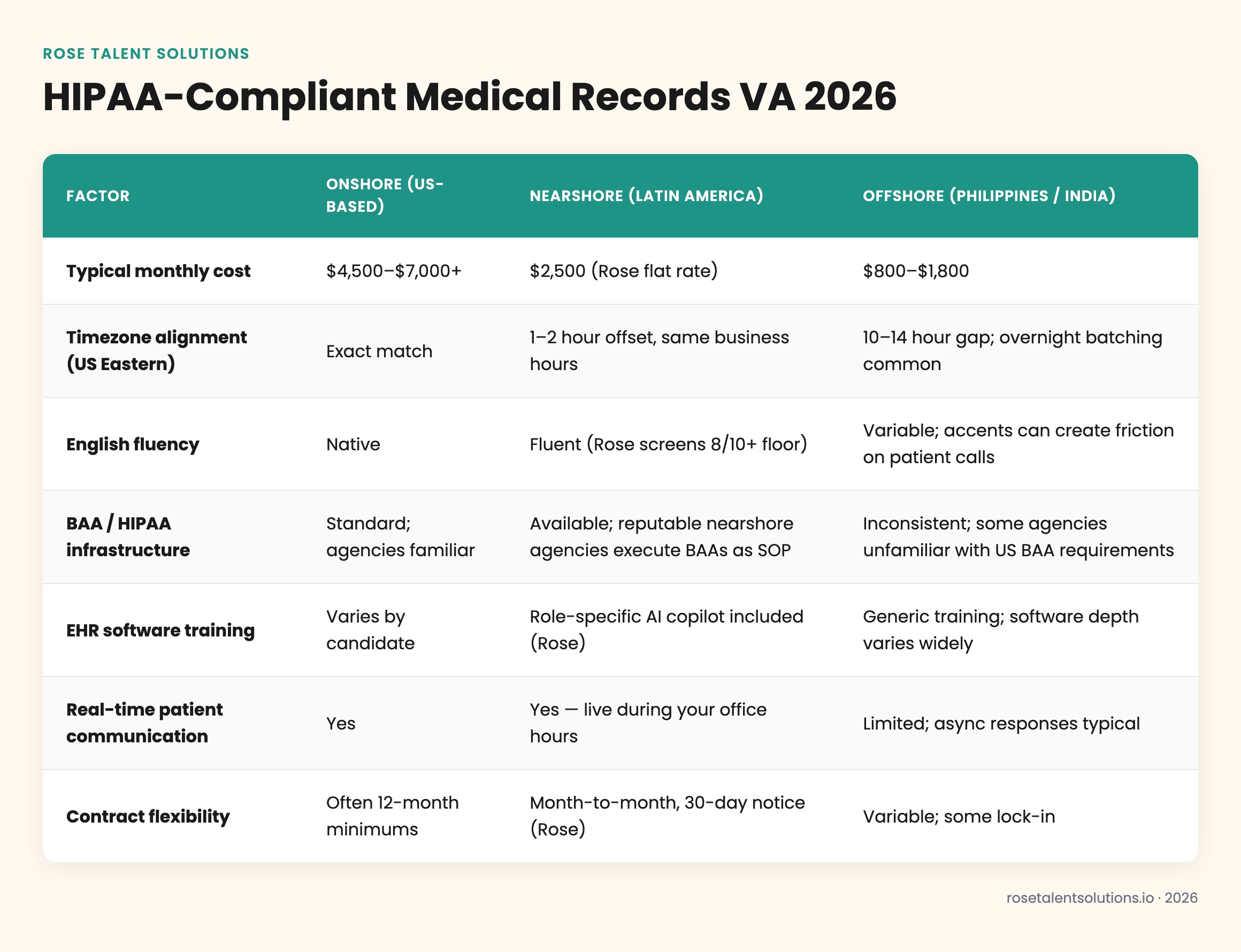
The offshore cost advantage evaporates when you account for the timezone gap, the supervision overhead required for async teams, and the real risk of BAA ambiguity with agencies that primarily serve non-US markets. Nearshore is the only model that gives you near-onshore timezone coverage at a cost structure that actually pencils out.
This dynamic holds across healthcare verticals. Whether you run a chiropractic clinic (where ROI requests and insurance submissions follow the same HIPAA rules), a dental group, or a multi-specialty practice, the compliance infrastructure requirements are identical — only the EHR changes. Our post on virtual assistants for chiropractic offices covers how this model applies to smaller, high-volume practices with lean admin teams.
How the AI Copilot Makes a Medical Records VA Faster From Day One
Every Rose Talent Solutions team member ships with a role-specific AI copilot trained on the software your practice actually uses. For a medical records VA, that means the AI is pre-loaded with workflows for your EHR — whether that is Athenahealth, Epic, eClinicalWorks, or DrChrono — plus standard ROI authorization templates, HIPAA-compliant communication scripts, and audit checklist frameworks.

According to McKinsey's healthcare AI research (2024), administrative functions in healthcare — including HIM and records management — represent one of the highest-yield areas for AI-assisted productivity, with documented time savings of 20–40% on documentation-intensive tasks. When a VA already knows how to use AI tools tuned to your specific workflows, that productivity gain starts on day three, not month three.
The AI copilot isn't a chatbot slapped on top of a generic hire. It's a workflow accelerator built around your specific EHR, your ROI authorization templates, and your practice's internal SOPs — which means your VA arrives already knowing how your records function is supposed to run, not learning it at your expense.
Learn more about how this works end-to-end on Rose's AI advantage page, including how copilots are customized per role before the first day of placement.
What Does It Cost — and What's the Risk If It Doesn't Work Out?
Rose Talent Solutions prices medical records virtual assistants at a flat $2,500 per month. That covers a full-time, 40-hour-per-week dedicated team member. Recruiting, vetting, HIPAA training verification, payroll, HR, and ongoing performance management are all included in that number. There are no setup fees, no per-task billing, and no long-term contract — the engagement runs month-to-month with 30 days written notice to cancel.
Compare that to the fully-loaded cost of an in-office HIM technician. According to the Bureau of Labor Statistics Occupational Outlook Handbook (2024), the median annual wage for medical records specialists in the US is $47,180 — roughly $3,930 per month in base salary alone, before employer payroll taxes, benefits, PTO, and workspace costs push the true cost to $55,000–$65,000 per year or more.
The risk side is covered by a single, clear guarantee: if your VA isn't the right fit, Rose replaces them at no additional cost. That is the sole risk reversal, and it is the right one — it aligns the agency's incentive with your outcome rather than offering a hollow performance guarantee nobody can enforce.
For practices already running other administrative functions through virtual staff — bookkeeping, accounts receivable, insurance verification — the Rose bookkeeping and accounting team and the getting started process are built to accommodate multi-role engagements without complex coordination overhead.
How to Evaluate Whether Your Practice Is Ready for a Records VA in 2026
A medical records VA is not the right first hire for every practice. The model works best when your ROI volume, chart backlog, or EHR data entry load has reached a point where your clinical staff is absorbing administrative overflow. Here are the signals that typically indicate readiness:
Strong Fit Indicators
- You receive 20+ ROI requests per month and turnaround is consistently running past 15 business days
- Your front desk or billing staff are handling chart requests in addition to their primary roles
- You have an EHR with role-based access controls that can be provisioned for a remote user
- Your compliance officer (or you) can execute a BAA and document VA training before go-live
- You want real-time support during business hours, not batched overnight processing
Not-Ready Signals
- Your practice has no documented ROI or records SOP — the VA will have nothing to follow
- Your EHR is on a local server with no secure remote access capability
- Your compliance posture hasn't been reviewed recently and BAA chain-of-custody is unclear
- Volume is low enough that a part-time solution would be more appropriate than 40 hours/week
Dental practices face a nearly identical readiness checklist — the HIPAA framework is the same, the EHR platforms differ. If you run a dental group and are evaluating this model for the first time, our guide on dental office virtual assistant services is a useful companion read before you talk to a staffing partner.
According to SHRM's research on the true cost of hiring (2022), the average cost-per-hire in the US healthcare administrative sector exceeds $4,700 — before the new employee's first paycheck clears. That upfront cost alone justifies a serious look at the virtual staffing model for roles like medical records that don't require physical presence in the building. Explore the full range of healthcare roles Rose supports at the Rose Talent Solutions staffing overview.