
Nearshore medical credentialing virtual assistants are quietly becoming one of the highest-leverage hires a US medical practice can make in 2026. While your clinical team focuses on patient care, a dedicated credentialing VA tracks payer deadlines, submits enrollment packets, monitors CAQH profiles, and chases down the approval letters that unlock your revenue. Credentialing backlogs are not a paperwork inconvenience — they are a cash-flow crisis. The average provider loses $10,000–$30,000 in billable revenue for every month they cannot bill a new payer, according to MGMA (2023). Hiring a nearshore VA trained specifically on credentialing workflows is the fastest way to close that gap without adding a full-time W-2 employee to your overhead.
What Is a Medical Credentialing Virtual Assistant?
A medical credentialing virtual assistant is a remote specialist who manages the end-to-end process of verifying provider qualifications and enrolling them with insurance payers. This includes primary source verification, CAQH ProView maintenance, payer-specific enrollment applications, re-credentialing cycles, and hospital privileging paperwork. The role sits at the intersection of healthcare administration and revenue cycle management — and it demands someone who is detail-obsessed, deadline-driven, and fluent in the language of insurance payer portals.
A nearshore credentialing VA specifically means your specialist is based in Latin America — not the Philippines or India — and works your exact US business hours. They are available on Slack, phone, or Teams in real time, attend your morning huddles, and respond to payer callbacks the same day. That timezone alignment is not a minor detail; it is the single biggest operational difference between a nearshore hire and a generic offshore one.

How Credentialing Delays Cost Practices Real Money in 2026
Credentialing is not a one-time event. Every new provider you hire, every new payer contract you sign, and every two-year re-credentialing cycle creates a fresh wave of applications, follow-ups, and status checks. Most practice managers are already stretched across scheduling, billing, and compliance — credentialing gets batched, delayed, or forgotten until a claim denial forces the issue.
The downstream damage is significant. Denied claims due to enrollment lapses cost the average US medical practice tens of thousands of dollars annually, according to the American Medical Association (2024). Administrative burden on physicians has reached a breaking point: physicians spend nearly 2 hours on administrative tasks for every 1 hour of direct patient care, according to Health Affairs (2016) — a ratio that has only worsened in subsequent years. A credentialing VA who monitors every open application daily compresses that 92-day average timeline dramatically. If your practice handles its own medical billing, you may also want to explore how a dedicated medical billing virtual assistant can pair with a credentialing VA to create a fully staffed revenue cycle function at a fraction of the cost of two in-office hires.
How Nearshore VAs Outperform Offshore for Medical Credentialing in 2026
The case for nearshore over offshore is not about talent quality in isolation — it is about operational fit. Credentialing is a communication-intensive role. Payers call back with questions. Hospitals have credentialing coordinators who only answer calls between 9am and 4pm Eastern. Missing one callback from BCBS or Aetna can add three weeks to an enrollment timeline. A VA working from the Philippines at a 12-hour offset simply cannot field those calls live.
"The biggest mistake practices make is treating credentialing like a form-filling exercise. It's a relationship and follow-up discipline. Whoever owns it needs to be available when the payer picks up the phone." — Kem Tolliver, Founder at Credentialing Resource Center (2023)
Rose's nearshore team members are based in Colombia, Mexico, Costa Rica, and other Latin American countries. They match US Eastern, Central, and Pacific time zones without any shift premium. Every credentialing VA placed through Rose also ships with a role-specific AI copilot trained on the payer portals and workflows relevant to their assignment — CAQH, PECOS, payer-specific enrollment platforms, and your practice management software.
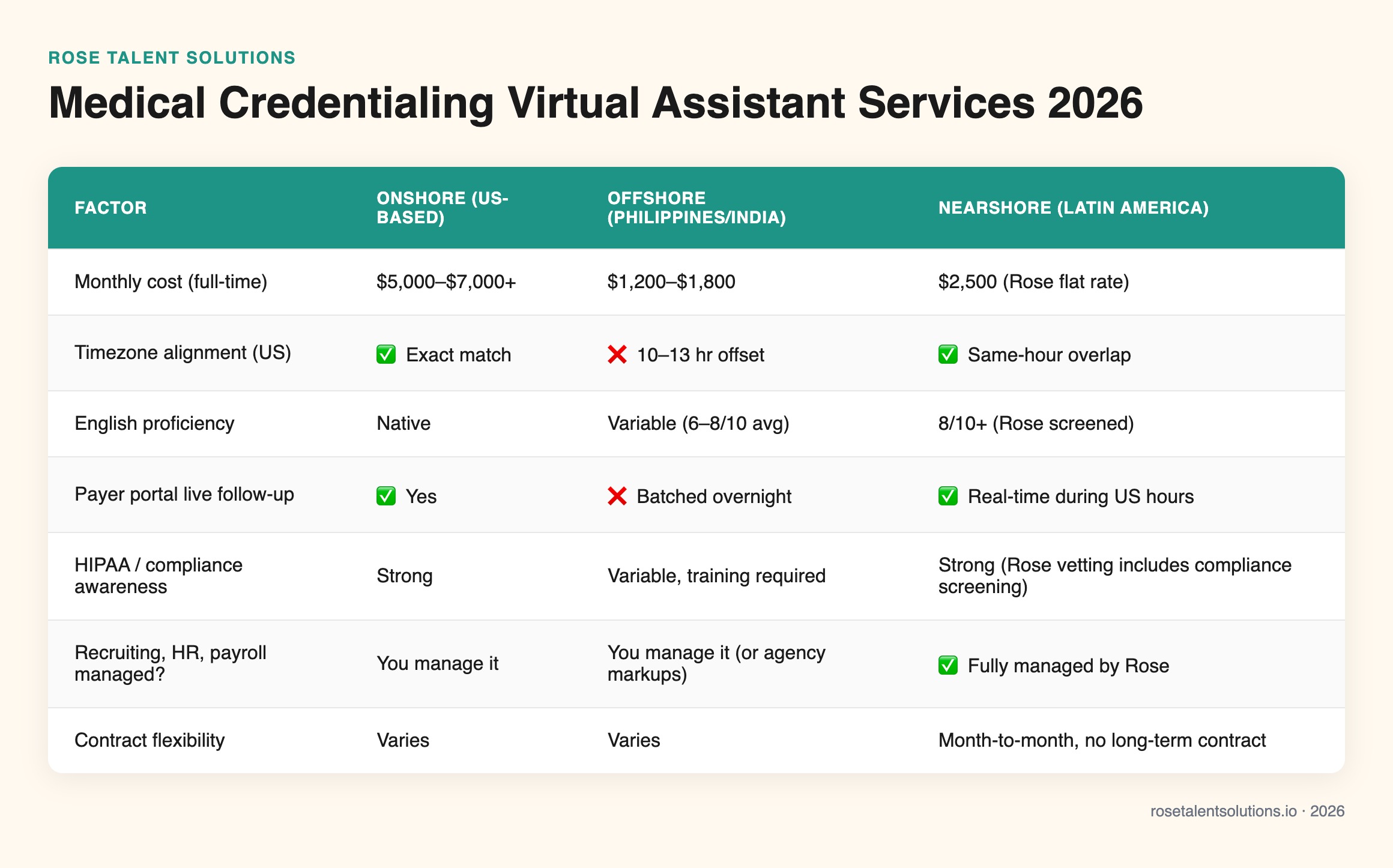
| Factor | Onshore (US-based) | Offshore (Philippines/India) | Nearshore (Latin America) |
|---|---|---|---|
| Monthly cost (full-time) | $5,000–$7,000+ | $1,200–$1,800 | $2,500 (Rose flat rate) |
| Timezone alignment (US) | ✅ Exact match | ❌ 10–13 hr offset | ✅ Same-hour overlap |
| English proficiency | Native | Variable (6–8/10 avg) | 8/10+ (Rose screened) |
| Payer portal live follow-up | ✅ Yes | ❌ Batched overnight | ✅ Real-time during US hours |
| HIPAA / compliance awareness | Strong | Variable, training required | Strong (Rose vetting includes compliance screening) |
| Recruiting, HR, payroll managed? | You manage it | You manage it (or agency markups) | ✅ Fully managed by Rose |
| Contract flexibility | Varies | Varies | Month-to-month, no long-term contract |
What Tasks Does a Credentialing VA Handle Day-to-Day?
The scope of a medical credentialing VA is broader than most practice owners initially expect. This is not just a CAQH-update role. A fully utilized credentialing VA can take ownership of an entire provider's enrollment lifecycle, freeing your office manager or billing supervisor from a task that consumes 8–15 hours per provider per month, according to HFMA (2024). The Society for Human Resource Management (SHRM) consistently finds that administrative specialists who own a single function end-to-end outperform generalists splitting their time — credentialing is precisely that kind of role.
- Initial payer enrollment applications (Medicare, Medicaid, commercial payers)
- CAQH ProView profile creation, updates, and quarterly attestations
- Hospital and facility privileging applications
- DEA, state license, and malpractice insurance expiration tracking
- Payer follow-up calls and portal status monitoring
- Re-credentialing every 2–3 years per payer
- Council for Affordable Quality Healthcare (CAQH) data integrity audits
- Credentialing database maintenance (e.g., Verity Stream, Cactus, or your EHR's credentialing module)
Practices that run multi-specialty groups or add providers frequently find the most ROI here. If your practice also handles dental or chiropractic providers, the workflows are parallel — Rose places dental office virtual assistants and chiropractic office VAs who manage credentialing alongside scheduling and front-desk tasks within the same flat monthly rate.
The hidden cost of a credentialing gap is not just the delayed claim — it is the provider sitting in your schedule generating encounters that cannot be billed for weeks. One unmanaged re-credentialing lapse on a $400/hour specialist can erase $25,000+ in a single month before anyone notices.

How Rose Places a Medical Credentialing VA in 2026: The Process
Rose Talent Solutions is not a job board. The $2,500/month flat rate includes recruiting, vetting, payroll, HR, and ongoing management — you never post a job or manage a contractor relationship. The average placement timeline from intake call to first day is seven business days.
Intake & Role Scoping
Rose walks you through your payer mix, software stack (CAQH, Verity Stream, EHR), and current credentialing backlog to spec the exact VA profile needed.
Recruiting & Vetting
Rose screens candidates on English proficiency (8/10+ floor), medical credentialing knowledge, HIPAA awareness, and software familiarity before any name reaches your desk.
AI Copilot Setup
Your VA receives a role-specific AI copilot pre-trained on your payer portals and workflows, so they are productive from day one — not week four.
Placement & Onboarding
Your VA starts on your schedule, attends your team's morning sync, and integrates directly into your communication tools — Slack, Teams, email, or all three.
Ongoing Management
Rose handles HR, payroll, and performance oversight. If the team member is not a fit for any reason, Rose replaces them at no additional cost.
The month-to-month terms mean you are never locked in. There is no long-term contract — just 30 days written notice if you ever need to pause. For practices that need the full revenue cycle covered, the insurance verification VA role is a natural complement to credentialing — together they handle both the front end (eligibility checks before appointments) and the back end (enrollment status with payers) of your billing infrastructure.
Is a Nearshore Credentialing VA Right for Your Practice in 2026?
A nearshore credentialing VA delivers the strongest ROI for practices that are growing — adding providers, expanding into new payer networks, or acquiring another group. If you have one provider fully credentialed and no near-term plans to add more, the role may be part-time at first. But the moment you hire a second provider, the enrollment queue justifies a full-time coordinator immediately.
According to the U.S. Bureau of Labor Statistics (2024), the median wage for a US-based medical records and health information specialist — a comparable in-office role — is over $47,000 annually, not including benefits, payroll taxes, or PTO. At $2,500/month, a nearshore credentialing VA costs under $30,000 per year, all-in, with no employer tax burden, no benefits overhead, and no recruiting fee. The math holds up even at one provider.
Why Nearshore Credentialing VAs Work
- Real-time payer follow-up during US business hours
- Flat $2,500/month — no benefits, taxes, or recruiting fees
- AI copilot cuts ramp time on portal-heavy workflows
- Month-to-month — no long-term contract risk
- Free replacement if the VA is not a fit
- Scales instantly when you add providers
When It Might Not Be the Right Fit Yet
- Solo provider, fully credentialed, no payer changes planned
- Practice has a dedicated in-office credentialing staff member with bandwidth
- EHR or credentialing platform has severe access-control restrictions for remote logins
If you are ready to stop losing revenue to enrollment backlogs, the fastest next step is a 20-minute scoping call with Rose. Visit Rose's intake page to get matched with a credentialing VA in as few as seven business days. For practices with broader administrative needs, Rose's full-service staffing model shows how the same nearshore framework scales across departments — and the bookkeeping and accounting VA pairing is especially popular with multi-location groups managing provider compensation and practice financials side by side.
The credentialing function will never be glamorous — but it is the gate that controls whether your providers can bill. Leaving it to whoever has a free hour in the office is a decision that costs most growing practices tens of thousands of dollars a year. A dedicated, trained, nearshore credentialing VA is the fix that pays for itself in the first month a new provider goes live on time.