
Nearshore medical coding outsourcing is quietly becoming the staffing strategy that revenue cycle managers at small-to-mid-size US practices wish they had adopted years earlier. While offshore vendors in India and the Philippines have dominated the conversation for two decades, a growing number of clinics, group practices, and specialty billing companies are shifting to Latin America-based coders who work the same hours your front desk does, speak English at a professional level, and arrive already trained on the software platforms your team uses daily. This guide breaks down exactly how medical coding outsourcing services work in 2026, what they should cost, and what separates a high-performing nearshore coder from a cheap offshore one.
What Are Medical Coding Outsourcing Services?
Medical coding outsourcing services involve contracting an external provider — either a staffing agency or a billing company — to assign standardized codes (ICD-10-CM, CPT, HCPCS Level II) to patient encounters, procedures, and diagnoses on behalf of a healthcare practice or hospital. These codes feed directly into claims submitted to Medicare, Medicaid, and commercial payers. When coding is accurate, claims clear faster. When it's not, you get denials, audits, and delayed cash flow.
The outsourcing model shifts coding labor off your payroll. Instead of hiring, training, and managing a full-time in-house coder — with benefits, PTO, and turnover risk — you pay a flat fee or hourly rate to an external team or dedicated specialist. The quality of that external talent is what determines whether outsourcing actually saves you money or just moves the problem somewhere else.
Medical coding is distinct from medical billing, though the two are tightly connected. Coding assigns the codes; billing uses those codes to construct and submit the claim. Many practices outsource both functions together — if you want to understand how billing and coding overlap from a virtual staffing perspective, the breakdown in our guide on the best medical billing virtual assistant services for 2026 covers the full revenue cycle workflow in detail.
Claim denial rates are a direct measure of coding quality. According to the American Medical Association (2023), physicians reported that 35% of their practices wait three or more business days for prior authorizations — and coding errors are among the leading contributors to administrative delays across the revenue cycle. Every percentage point reduction in your denial rate compounds directly into faster collections and less staff time on rework.
How Nearshore Coders Outperform Offshore in 2026
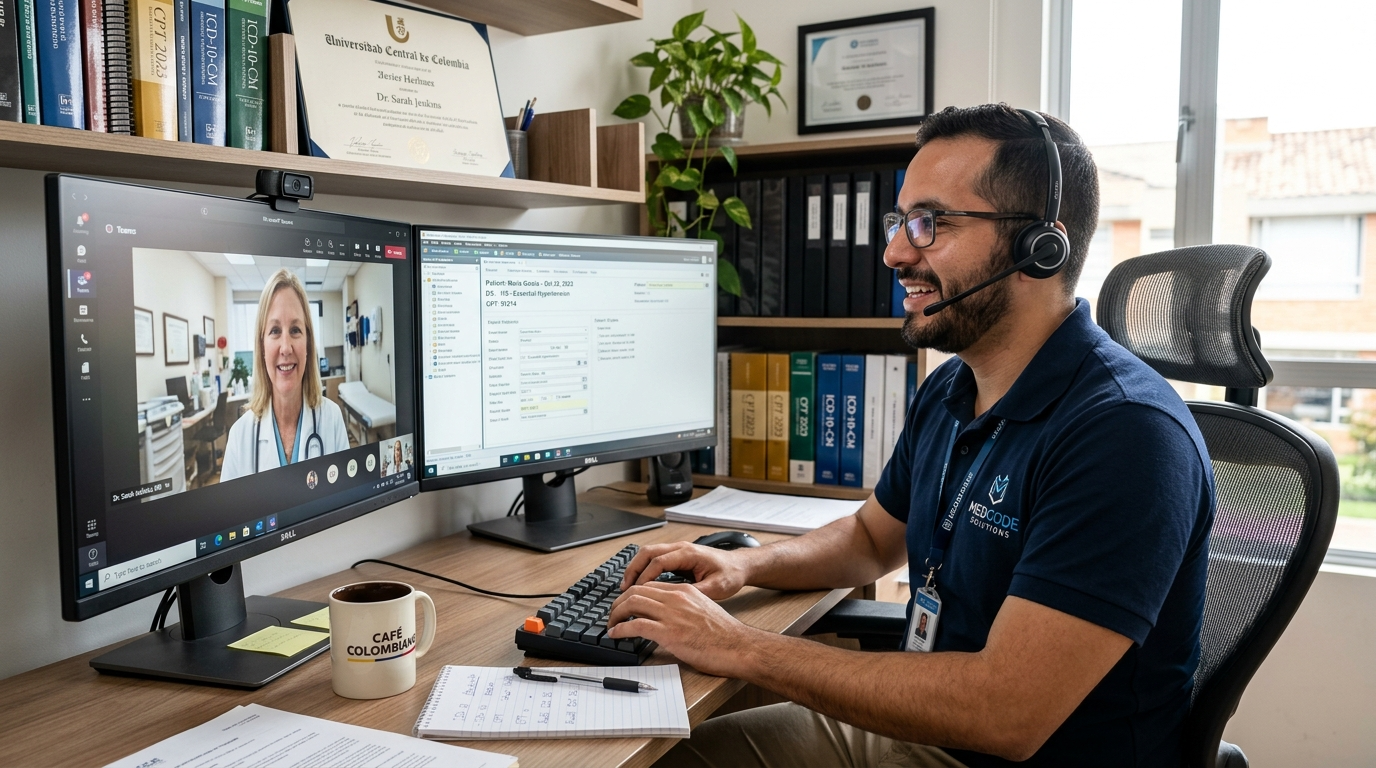
The offshore model — routing coding work to India or the Philippines — works on paper until you actually need to talk to someone. A 10-hour or 12-hour timezone gap means that a question about a complex surgical encounter goes unanswered until the next morning. Queries stack. Denials pile. Your billing manager spends the first hour of every day triaging overnight errors instead of working new claims.
Nearshore coders based in Latin America — Colombia, Mexico, Costa Rica, Argentina — operate on EST, CST, or MST. They are available on Slack, Teams, or phone during your billing department's working hours. That alone changes the entire rhythm of your revenue cycle. According to SHRM's workforce research (2023), real-time collaboration between remote specialists and in-house teams reduces error-correction cycles by meaningful margins when timezone overlap exceeds six hours — nearshore Latin America delivers full overlap.
English proficiency is the second factor that separates nearshore from offshore at scale. Rose Talent Solutions screens every candidate to a published minimum of 8/10 on English proficiency assessments before they are ever placed. That matters when your coder needs to call a payer's provider line, interpret a physician's dictation note, or flag a documentation gap in a chart note with enough precision that the provider actually understands the correction needed. Offshore coders rated at 6/10 English proficiency consistently generate avoidable rework — the kind that costs your billing team two hours for every hour of "savings" the cheap rate appeared to provide.
Healthcare administrative costs remain stubbornly high across the US system. According to Health Affairs (2019), administrative costs account for roughly 34.2% of total US healthcare expenditures — a figure that has barely shifted since, underscoring why revenue cycle efficiency, including coding accuracy, remains one of the highest-leverage levers available to a practice manager.
"The revenue cycle is only as strong as the communication that holds it together. When your coder can't reach your biller and your biller can't reach your coder in real time, you are not running a revenue cycle — you are running a delayed correspondence chain." — Terri Lundberg, Revenue Cycle Director at MGMA (Medical Group Management Association), 2023 Annual Conference
Practices that support multiple specialties — say, a multi-provider orthopedic group that also handles physical therapy and pain management — benefit especially from nearshore coders who can quickly pivot between CPT code families during the same shift. The same principle applies to dental and chiropractic practices: if your team handles chiropractic billing and front-office coordination, having a nearshore specialist who works your hours is a force multiplier across every revenue-generating touchpoint in the office.
Nearshore vs. Offshore vs. Onshore: 2026 Cost and Quality Comparison
The table below compares the three primary sourcing models for medical coding outsourcing services across the dimensions that actually drive ROI for a US practice: cost, timezone fit, denial-rate risk, and communication quality.
| Criteria | Onshore (US-Based) | Nearshore (Latin America) | Offshore (India / Philippines) |
|---|---|---|---|
| Monthly Cost (FT Coder) | $5,000–$7,500+ | ~$2,500 flat (all-in) | $800–$1,800 |
| Timezone Overlap (EST) | Full (same zone) | Full (0–2 hr difference) | Poor (8–12 hr gap) |
| English Proficiency | Native | 8/10+ screened | Varies (4–7/10 common) |
| Denial Rate Risk | Low | Low–Medium | Medium–High |
| Real-Time Availability | Yes | Yes | No (batched overnight) |
| HIPAA Training Feasibility | Standard | High (US-aligned training) | Variable (oversight gaps) |
| Ramp Time | 2–4 weeks | 1–2 weeks (with AI copilot) | 3–6 weeks |
| Replacement Guarantee | Rarely offered | Yes (Rose: free replacement) | Rarely offered |
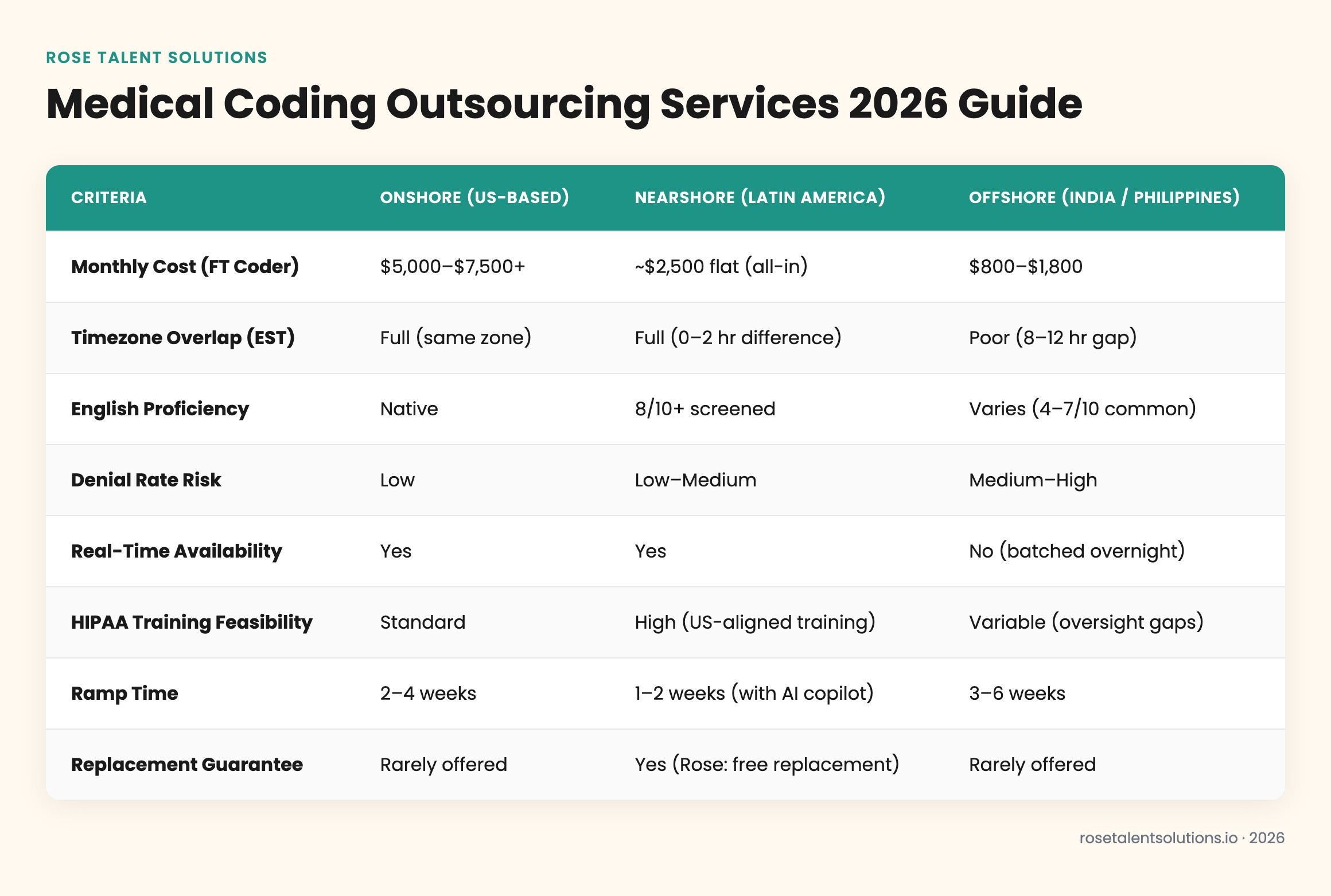
The price spread between nearshore and onshore is significant — a US-based certified coder (CPC credential) commands $28–$38/hour fully loaded, which puts a full-time position at $58,000–$79,000 per year before benefits. At $2,500/month flat, nearshore outsourcing through Rose delivers comparable output for roughly 40–50 cents on the dollar, with recruiting, HR, and management already built into that rate. No long-term contract locks you in — just month-to-month terms with 30 days written notice if your needs change.
What Tasks Do Outsourced Medical Coders Actually Handle in 2026?

A well-placed nearshore medical coding specialist handles a wider scope than most practice managers expect. The core function is assigning ICD-10-CM diagnosis codes and CPT procedure codes from provider documentation — but in practice, that work bleeds into adjacent revenue cycle functions that are just as critical to your cash flow.
According to the Bureau of Labor Statistics (2024), medical records and coding specialists increasingly perform cross-functional work including charge entry, claim scrubbing, and denial triage — functions that were once siloed into separate roles. A trained nearshore coder can own this expanded scope from day one, especially when they arrive with an AI copilot pre-trained on your specific EHR and practice management software.
Here is the standard task scope for a full-time outsourced medical coding specialist placed through Rose:
- ICD-10-CM and CPT code assignment from physician documentation
- HCPCS Level II coding for DME, injectables, and outpatient services
- Charge capture and charge entry into your PM/EHR system
- Claim scrubbing and pre-submission error flagging
- Denial management — identifying root cause and resubmitting corrected claims
- Prior authorization support and payer-specific documentation queries
- Coordination with your billing team on modifier use and payer policy changes
For practices that also need front-office support — eligibility checks, patient scheduling, or insurance verification — a nearshore VA can bridge both functions. Our dedicated post on insurance verification virtual assistants explains how that workflow integrates with the coding side, reducing the handoff friction that leads to claim delays.
The hidden cost of offshore coding isn't the hourly rate — it's the 10–12 hour timezone gap that turns every documentation question into a next-day delay, compounding across hundreds of claims per week. A single avoidable denial cycle at a mid-size practice can cost $150–$600 in staff rework time per claim. Multiply that by 20 denials per month and the "cheap" offshore option erases its own savings inside 90 days.
How the Rose Nearshore Coding Placement Process Works in 2026
Rose Talent Solutions is not a job board. Every placement is actively sourced, vetted, and managed — which is why the flat $2,500/month rate includes recruiting, HR, payroll, and ongoing management. Here is exactly how a medical coding placement works from inquiry to first chart reviewed.
Scoping Call
Rose's team learns your specialty mix, EHR platform, payer panel, and current denial rate. This determines the exact skill profile — certified coder vs. experienced uncredentialed, single specialty vs. multi-specialty, coding-only vs. coding + billing hybrid.
Candidate Matching
Rose sources from its Latin America network, screening for English proficiency (8/10+ minimum), coding accuracy assessments, and software familiarity with your specific EHR (AdvancedMD, DrChrono, Kareo, Athenahealth, etc.). Only shortlisted candidates are presented to you.
AI Copilot Deployment
Every placed coder ships with a role-specific AI copilot trained on your software stack and payer-specific rules. This compresses ramp time from weeks to days and supports ongoing accuracy on complex encounters. Learn more on the Rose AI Advantage page.
Onboarding and Go-Live
Your coder joins your team's daily standup (or async workflow), completes HIPAA acknowledgment, and begins live chart coding — typically within 7 days of your initial inquiry.
Ongoing Management
Rose handles HR, payroll, and performance oversight. If your coder isn't meeting accuracy benchmarks or isn't the right fit, Rose replaces them at no additional cost — no renegotiation, no extra placement fees.
For practices exploring broader virtual staffing across their clinical and administrative functions — from coding to bookkeeping and financial reporting — Rose can staff multiple roles under the same model. And if you're ready to move forward, the fastest path is the Rose intake form, which takes under three minutes to complete.
Pros and Cons of Outsourcing Medical Coding in 2026
Outsourcing is not the right move for every practice at every stage. Here is an honest breakdown of what you gain and what you need to manage when you shift coding out of house.
Pros
- 40–60% lower labor cost vs. US in-house coder
- No recruiting, benefits, or turnover overhead
- Faster ramp with AI copilot pre-trained on your EHR
- Real-time availability during your practice hours (nearshore)
- Free replacement if placement isn't a fit
- Scales up or down without long-term contract commitments
- Coders available for multi-specialty and complex encounter types
Cons
- Requires clear documentation protocols — vague physician notes slow any coder down
- Initial EHR access setup and HIPAA BAA execution takes time
- Quality depends heavily on the vendor's vetting process
- Not ideal if your practice has fewer than 50 encounters per week (part-time may fit better)
- Requires a point-of-contact on your team for real-time communication
The practices that get the most from outsourced coding are the ones that treat the external coder as a genuine team member — not a ticket queue. Give them access to your daily huddle, a direct line to your supervising physician for documentation questions, and clear KPIs (first-pass acceptance rate, denial rate by payer, days in A/R). According to MGMA's 2023 DataDive report, high-performing practices that outsource coding maintain first-pass claim rates above 95% — a benchmark achievable with nearshore talent when the communication infrastructure is in place.
Remote work adoption in healthcare administration has also accelerated the talent pool available to practices that are willing to hire outside their zip code. According to Gallup's 2023 State of the Global Workplace report, remote-capable workers who operate in fully distributed environments report higher engagement scores than those in hybrid-forced roles — a dynamic that translates directly into lower turnover risk for nearshore coding placements compared to local in-house hires who are perpetually vulnerable to competing offers from larger health systems.
Practices in adjacent verticals — dental groups, for example — follow the same integration model. Our guide on dental office virtual assistant services outlines how multi-function nearshore VAs handle coding-adjacent tasks like CDT code entry and insurance claim submission in that specific specialty context.
The broader takeaway: medical coding outsourcing services work best when the sourcing model is nearshore (not offshore), the vendor vets for both technical coding skill and English communication, and your practice treats the remote specialist as an embedded team member rather than an external vendor. That combination — combined with an AI-augmented workflow — is what separates a 3% denial rate from a 15% one. Visit the Rose intake page to get matched with a nearshore coding specialist and see the difference within the first billing cycle.