
Nearshore medical coding outsourcing is quietly becoming the default for independent practices, multi-specialty groups, and healthcare management companies across the US — and for good reason. The in-house model is breaking. A credentialed medical coder in the United States commands a median salary of $47,180 per year, according to the U.S. Bureau of Labor Statistics (2024) — before you add payroll taxes, benefits, PTO, and the cost of re-hiring when they leave. Outsourcing eliminates that overhead entirely while keeping your denial rate in check.
This guide explains exactly how medical coding outsourcing works in 2026, what it costs, how to avoid the common failure modes, and why the nearshore model — coders based in Latin America, working your time zone — outperforms both onshore and offshore alternatives on almost every metric that matters for a US practice.
What Is Medical Coding Outsourcing — and Who Actually Needs It in 2026?
Medical coding outsourcing is the practice of contracting an external team — whether a company or a dedicated virtual staff member — to translate clinical documentation into standardized codes (ICD-10-CM, CPT, HCPCS Level II) that determine how much your practice gets reimbursed. The outsourced coder reviews physician notes, operative reports, and encounter records, then assigns the correct codes before claims are submitted to payers.
The model is not new, but who uses it has changed dramatically. Solo physicians and small group practices once assumed outsourcing was for hospital systems. In 2026, the economics have flipped. The practices most likely to benefit are those billing 200 or more encounters per month without a full-time coding department — exactly the sweet spot where one excellent virtual coder can absorb all the volume at a fraction of the cost of a W-2 employee.
If your practice is also dealing with insurance verification bottlenecks upstream, a dedicated insurance verification virtual assistant handling eligibility checks before appointments can pair powerfully with an outsourced coding function — reducing denials at both ends of the revenue cycle.

How the 2026 Nearshore Model Outperforms Offshore Coding Services
The dominant alternative to nearshore outsourcing is offshore — coders based in India or the Philippines, typically sold through large billing clearinghouses or RCM companies. On paper, offshore looks cheaper. In practice, the hidden costs eliminate that advantage fast.
The core problem is the timezone gap. An offshore coder operating on Indian Standard Time is 9.5 to 12.5 hours ahead of US Eastern. That means questions that arise during your billing cycle — payer-specific code edits, physician queries about documentation — don't get answered until the following morning at the earliest. Each 24-hour delay is a 24-hour delay in claim submission, which compounds into slower cash flow and more aging AR.
Nearshore coders based in Latin America work the same business hours you do. When your front desk flags a questionable E&M level at 10am Tuesday, your coder can respond by 10:15am Tuesday. That real-time loop is worth far more than the marginal cost difference between nearshore and offshore.
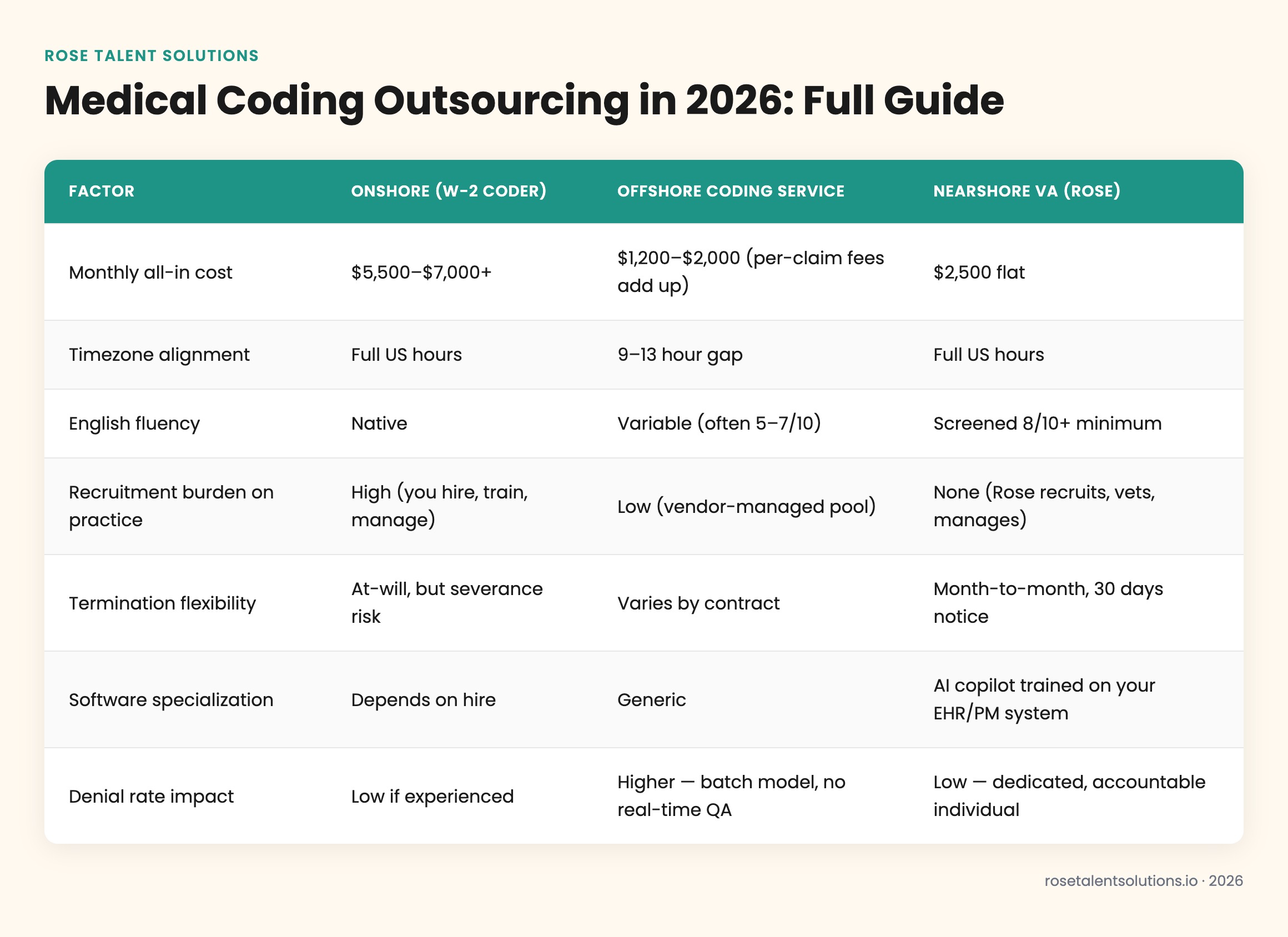
| Factor | Onshore (W-2 Coder) | Offshore Coding Service | Nearshore VA (Rose) |
|---|---|---|---|
| Monthly all-in cost | $5,500–$7,000+ | $1,200–$2,000 (per-claim fees add up) | $2,500 flat |
| Timezone alignment | Full US hours | 9–13 hour gap | Full US hours |
| English fluency | Native | Variable (often 5–7/10) | Screened 8/10+ minimum |
| Recruitment burden on practice | High (you hire, train, manage) | Low (vendor-managed pool) | None (Rose recruits, vets, manages) |
| Termination flexibility | At-will, but severance risk | Varies by contract | Month-to-month, 30 days notice |
| Software specialization | Depends on hire | Generic | AI copilot trained on your EHR/PM system |
| Denial rate impact | Low if experienced | Higher — batch model, no real-time QA | Low — dedicated, accountable individual |
What Does Medical Coding Outsourcing Actually Cost in 2026?
Pricing in the medical coding outsourcing market breaks into three models: per-claim fees (typically $0.50–$2.50 per claim depending on specialty complexity), percentage-of-collections (usually 4–9%), and flat-rate dedicated staffing. Each model has a different risk profile for your practice.
Per-claim and percentage-of-collections models align the vendor's incentive to your volume — but they also mean your cost is unpredictable month to month, and it scales upward exactly when your revenue is growing, which is the wrong direction. A flat-rate dedicated model like the one Rose Talent Solutions offers — $2,500/month, all-in — converts your coding function into a fixed operational cost you can budget around. Recruiting, vetting, payroll, HR, and ongoing management are included. No hidden per-encounter charges.
To put the math plainly: a full-time in-house coder earning the BLS median costs your practice roughly $5,900/month after you add employer FICA, health insurance, and PTO accrual. Nearshore outsourcing at $2,500/month is a 57% reduction in fully-loaded labor cost for the same 40-hour weekly coverage. Even at a 95% collection rate, that delta more than pays for itself in a single quarter.
"Revenue cycle labor is the fastest-growing cost center in ambulatory care — and the most addressable one. Practices that restructure coding and billing around remote, time-zone-aligned staff are consistently outperforming their peers on days in AR." — Anders Gilberg, Senior Vice President of Government Affairs at the Medical Group Management Association (MGMA) (2024)
According to MGMA's 2024 DataDive Cost and Revenue report, practices in the top quartile for operational efficiency spend 14.3% less on administrative labor per physician FTE than their bottom-quartile peers — and coding workflow is cited as a primary differentiator. That gap is the financial case for outsourcing in a single data point.
The real risk of cheap offshore coding is not the hourly rate — it's the denial rate. A coder who can't ask your physician a clarifying question until tomorrow morning will default to the safer, lower-specificity code. That conservative coding behavior costs US practices an estimated $935 per physician per month in uncaptured reimbursement, according to industry RCM benchmarks.
How Rose's AI-Augmented Coders Work Inside Your EHR in 2026
Every medical coding virtual assistant placed through Rose Talent Solutions ships with a role-specific AI copilot trained on the software your practice actually uses — whether that's DrChrono, Kareo, AdvancedMD, Athenahealth, or eClinicalWorks. The AI layer doesn't replace the coder's judgment; it accelerates their throughput and catches common error patterns before claims go out the door.
The practical effect: a nearshore coder working with an AI copilot can process 20–30% more encounters per shift without compromising accuracy. For a mid-volume primary care practice pushing 400 encounters monthly, that headroom matters — it's the difference between one coder handling full volume versus needing to split the function across two part-time contractors.

This AI advantage extends naturally to adjacent revenue cycle functions. If your practice also struggles with the prior authorization bottleneck — which the AMA reports consumes an average of 13 hours per physician per week — a dedicated prior authorization virtual assistant can run parallel to your coding function, ensuring authorizations are secured before claims are submitted. Similarly, practices managing high appointment volumes often find that adding a patient scheduling virtual assistant upstream reduces the volume of incomplete encounter documentation that flows to the coding queue.
For specialty practices — particularly chiropractic, physical therapy, and pain management — where code specificity is especially high-stakes, see how operators are already using virtual assistants built for chiropractic office workflows to manage both coding and front-desk functions under one nearshore model. Learn more about how Rose structures the AI copilot advantage for every role.
According to Healthcare IT News (2024), over 68% of US health system revenue cycle leaders now use some form of remote or virtual coding staff — up from 41% in 2020. The shift is structural, not cyclical.
How to Start Outsourcing Medical Coding in 2026 — Step by Step
Transitioning your coding function to a nearshore virtual model is straightforward when the staffing partner handles the operational complexity. Here is the typical sequence when you work with Rose Talent Solutions:
Discovery call and role scoping
Rose's team maps your specialty mix, average monthly encounter volume, current EHR/PM system, and any payer-specific coding rules that require coder familiarity — typically a 30-minute conversation.
Candidate matching and vetting
Rose recruits from a pre-screened Latin American talent pool, running English proficiency screens (8/10+ minimum), credential verification (CPC or CCS preferred), and specialty-specific coding assessments before you see a single profile.
AI copilot calibration
Before your coder's first shift, Rose configures their role-specific AI copilot to your EHR, payer mix, and specialty — so they arrive trained on your software, not learning it on your clock.
Onboarding and shadowing
Your new coder typically spends days one through three in a structured shadowing period — reviewing existing claims, meeting your billing staff, and mapping your documentation workflow before taking on live volume.
Ongoing management and QA
Rose handles HR, payroll, and performance oversight. If the placement isn't the right fit, Rose replaces the team member at no additional cost — the risk sits with Rose, not your practice.
Month-to-month terms with 30 days written notice means you're never locked in. If your volume drops seasonally or you add an in-house coder, you can scale back without penalty. Explore how to get started with Rose or review the broader bookkeeping and back-office services that practices often pair with their coding function.
Nearshore vs. Offshore Medical Coding: The Real Trade-Offs in 2026
Before you commit to any outsourcing model, it helps to be honest about the trade-offs. Nearshore is not perfect for every situation — but for most US independent and group practices, it wins on the factors that drive revenue cycle performance.
Nearshore Strengths
- Real-time US-hours availability — questions answered same shift
- Strong English fluency enables direct physician communication
- Dedicated individual accountable to your practice, not a coding pool
- AI copilot trained on your specific EHR reduces ramp time
- Predictable flat monthly cost — no per-claim billing surprises
- Free replacement if the coder isn't the right fit
Nearshore Limitations
- Slightly higher base cost than the cheapest offshore per-claim services
- One dedicated coder means backup planning needed for PTO weeks
- Best fit for 200+ monthly encounters — very low-volume practices may over-invest
According to a SHRM Healthcare Workforce Report (2024), administrative turnover in medical offices averages 28.4% annually — meaning the average practice is re-hiring and re-training their coding function roughly every 3.5 years. Every turnover cycle costs an estimated $8,000–$12,000 in lost productivity, recruiting fees, and training time. A nearshore model with a managed replacement guarantee short-circuits that cycle entirely.
The AAPC's 2024 Medical Coding Salary Survey also notes that CPC-credentialed coders in specialties like orthopedics, cardiology, and oncology command premium salaries well above the BLS median — often $60,000–$75,000/year before benefits. For these specialties, the cost compression from nearshore outsourcing is even more pronounced.